
Executive Overview
The agreement places Airtable’s enterprise value at $1.285 billion. Factoring in Airtable’s substantial net cash reserves, the total equity value of the transaction sits at roughly $2.25 billion. Subject to customary regulatory approvals, the deal is expected to formally close by the end of the year.
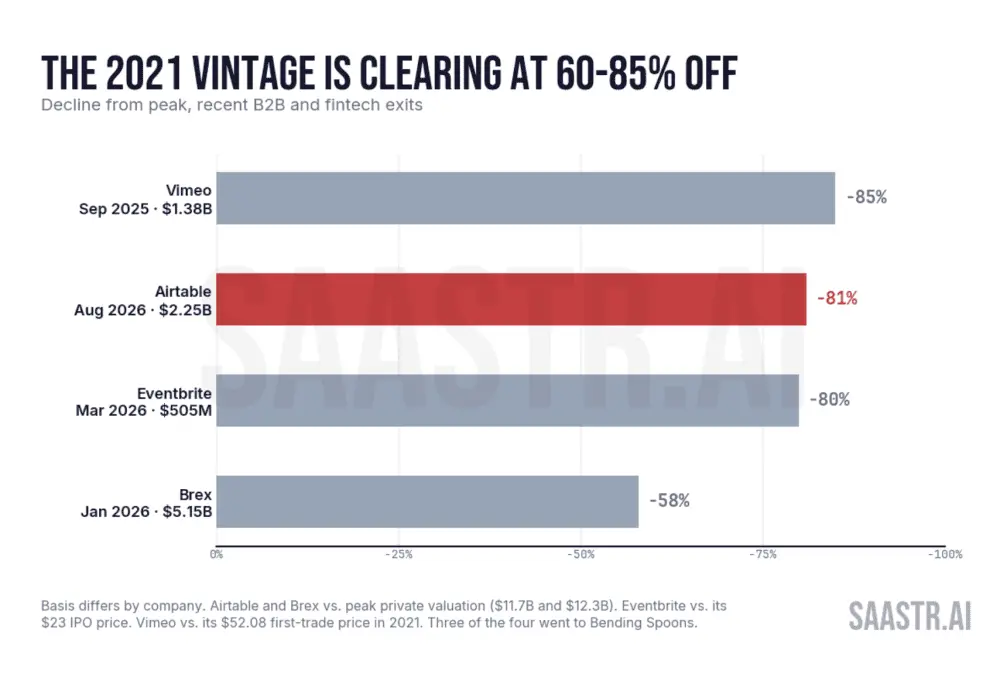
For an organization long heralded as the "Lego of software"—a pioneer that melded the relational database with a flexible spreadsheet interface—the valuation marks a staggering descent from its December 2021 peak. At that time, during the zenith of the pandemic-era tech boom, Airtable raised a colossal $735 million Series F round at an astronomical $11.7 billion post-money valuation.
Today, the asset is trading hands at 2.7x its projected June 2026 Annual Recurring Revenue (ARR) of roughly $480 million. Despite boasting elite financial metrics—including over 20% year-over-year growth, pristine 90% gross margins, robust cash-flow positivity since late 2024, and a client roster featuring 80% of the Fortune 100—Airtable’s exit serves as a sobering market-wide bellwether. It reveals a harsh new paradigm for mature enterprise software companies: without accelerating compound growth or an active IPO window, even a category-defining, cash-generative software giant will find itself priced as a mature utility asset rather than a hyper-growth compounder.
Detailed Chronology: From Garage Origins to the $11.7B Peak and Subsequent Corrections
The Rise of the "Lego of Software" (2012–2021)
Founded in 2012 by Howie Liu, Andrew Ofstad, and Emmett Nicholas, Airtable set out to solve a ubiquitous enterprise problem: democratizing database creation for non-technical users. By fusing the power of a relational database with the intuitive visual simplicity of a spreadsheet, the company cultivated a bottoms-up adoption model. Departmental teams routinely onboarded themselves, eventually expanding into massive enterprise-wide deployments.
Over the next decade, Airtable achieved category-defining status, crossing hundreds of millions in ARR and capturing the attention of top-tier crossover investors. The apex of this journey arrived in December 2021, when the company secured a $735 million financing round at a headline valuation of $11.7 billion ($187.28 per share), with ARR hovering around $156 million. It was a 75x forward multiple that priced in endless, uninterrupted expansion.
The Macroeconomic Whiplash and the AI Pivot (2022–2025)
Almost immediately after the 2021 financing, the macroeconomic cycle turned violently. Zero-interest-rate policy (ZIRP) gave way to aggressive monetary tightening, and private software valuations suffered severe compressions.
Airtable was not immune. As growth decelerated from hyper-scale levels, the company was forced to recalibrate its operations, executing two rounds of layoffs totaling 491 employees to staunch cash burn. By 2023, the tech ecosystem was awash with "Airtable is dead" memes.
Yet, unlike many of its venture-backed peers that unraveled completely, Airtable’s leadership executed a masterclass in operational discipline:
- Capital Preservation: The company retained roughly half of the cash it had raised during the boom years on its balance sheet.
- Margin Optimization: By late 2024, aggressive cost-cutting successfully transitioned the company to sustainable cash-flow positivity, throwing off upwards of $100 million annually.
- The Hard AI Pivot: Rather than simply issuing cosmetic AI press releases, CEO Howie Liu spearheaded a profound, foundational re-architecture of the product. Liu personally returned to writing code to integrate autonomous workflows and machine-learning capabilities deeply into the core platform.
While the AI overhaul successfully stabilized the business and restored its long-term defensibility, it did not fully re-accelerate the top line back to historical highs. Growth stabilized at a respectable, albeit unspectacular, 20% year-over-year.
The Tipping Point (2026)
By mid-2026, Airtable found itself at a strategic crossroads. Despite holding roughly $700 million in cash and zero debt, the path back to an $11.7 billion valuation was mathematically closed.
The public markets and secondary desks had been relentlessly repricing the asset for three years. A 66% valuation haircut in early 2026 turned out to be merely the halfway point; secondary market marks continued to slide, culminating in an ultimate clearing price that forced institutional investors and founders alike to confront market reality over private paper marks.

Supporting Context & Metrics
Financial Breakdown of the Acquisition
To understand why a company with half a billion in revenue and elite margins sold at a 2.7x multiple, one must examine the hard numbers:
- Enterprise Value (EV): $1.285 billion
- Equity Value: ~$2.25 billion (inclusive of net cash)
- Projected ARR (June 2026): ~$480 million
- YoY Growth Rate: >20%
- Gross Margins: ~90%
- Cash Generation: >$100 million annually (cash-flow positive since late 2024)
- Customer Base: >500,000 organizations, including 80% of the Fortune 100
The Pref Stack Mechanics: Who Makes What?
The transaction’s payout structure illuminates why a company that once commanded an $11.7 billion valuation ultimately accepted a $2.25 billion exit. Over seven rounds of financing, Airtable raised approximately $1.4 billion in total capital.
Layering in standard liquidation preferences (assuming a 1x non-participating preferred stack):
- The Preferred Holders: Approximately $1.29 billion comes off the top of the proceeds for preferred equity holders, who own roughly 25% of the shares. This structure protected crossover investors from taking catastrophic, total write-downs on their 2021 investments.
- The Common Holders: Roughly $900 million to $1 billion remains for all common stock, spread across the remaining 75% of shares. This translates to an effective payout of $18 to $25 per share—a far cry from the $187.28 price tag of the Series F round.
- The Founders: CEO Howie Liu’s equity stake—estimated by Forbes at roughly 10% during the 2018 Series C, subsequently diluted through subsequent rounds and pool refreshes—likely lands between 6% and 8%. At ~$20 per share, Liu’s return is estimated between $90 million and $130 million, with co-founders Andrew Ofstad and Emmett Nicholas realizing roughly half that amount each. While life-changing for a 14-year entrepreneurial endeavor, it represents a fraction of what the Series F paper valuation once suggested.
- The Employees: Option holders whose strikes were pegged near the $11.7 billion peak find themselves underwater, receiving $0. Employees who successfully offloaded shares on the secondary market over the prior year fared significantly better than those who held out for an IPO.
The Hyperagent Carve-Out
A critical nuance uncovered in SEC pre-signing reorganization filings is the execution of a pre-deal carve-out. Assets and liabilities pertaining to "Hyperagent"—Airtable’s cutting-edge platform for building and running autonomous AI workers across enterprise tools, launched in early 2026—were spun out into a separate, independent entity called Hyperagent Inc.
Because Bending Spoons cited the same ~$480 million ARR figure post-carve-out, Hyperagent was contributing virtually negligible revenue at the time of acquisition. Consequently, the 2.7x multiple remains mathematically intact. While the ultimate value of Hyperagent Inc. to existing shareholders remains to be seen, the structuring ensures that the high-upside autonomous agent bet survived the sale and can pursue independent growth unencumbered by Bending Spoons’ traditional cost-optimization playbook.
Official Statements & Strategic Intentions of the Buyer
Enter Bending Spoons
Headquartered in Milan, Bending Spoons has cemented its reputation as one of Europe’s most aggressive serial tech consolidators. Fresh off its July 1, 2026 Nasdaq IPO—which valued the company at roughly $18.4 billion and saw shares surge nearly 40% on day one—Bending Spoons views Airtable as its premier enterprise software acquisition as a public entity.
The firm’s playbook is well-documented across a sprawling portfolio that includes Evernote, WeTransfer, Meetup, StreamYard, Issuu, Brightcove, Vimeo, AOL, and Eventbrite. The strategy is clinical and consistent:
- Target: Acquire strong, legacy brand names characterized by stalled growth.
- Execution: Overhaul the underlying technology stack, execute deep operational and headcount rationalization, implement aggressive pricing structures, and hold for long-term cash generation.
Bending Spoons CEO Luca Ferrari has frequently touted the company’s heavy operational reliance on artificial intelligence, noting that roughly 90% of the firm’s code is now AI-generated, which has driven staggering efficiency gains—pushing revenue per employee from $1.12 million in 2023 to $2.57 million in 2025.
However, this aggressive growth-by-acquisition model carries substantial financial leverage. As of March 31, 2026, Bending Spoons carried approximately $4.4 billion in debt against roughly $1.06 billion in shareholders’ equity, resulting in a first-quarter interest expense of $93.2 million against full-year 2025 GAAP net income of essentially zero on $1.31 billion of revenue. The compounding model is undeniably powerful; so is the debt burden servicing it.
Future Outlook: Implications for the Broader SaaS Ecosystem
The acquisition of Airtable is more than a single corporate transaction; it serves as a watershed moment carrying profound lessons for the entire technology sector:
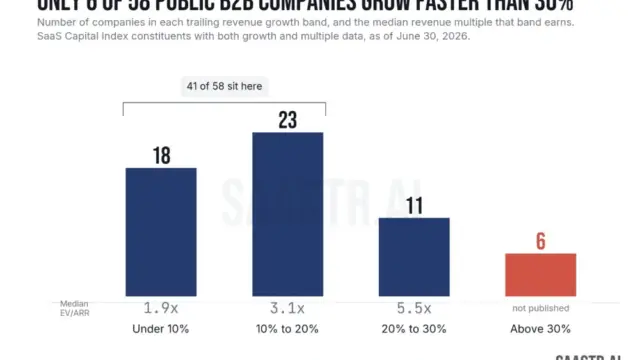
- 2.7x ARR is the New Reality for Slowing SaaS: Mature software businesses growing under 25% with no viable IPO window can expect to be priced as cash-flow assets rather than high-multiple compounders, regardless of elite gross margins or Fortune 100 penetration.
- Growth Rate Trumps All: Tripling revenue over five years could not save Airtable from a severe valuation contraction. At exit, valuation is inextricably bound to the current growth velocity, not historical scale.
- The Preference Stack is Sovereign: Liquidation preferences dictate the ultimate survival of venture-backed tech. While preferential structures can penalize common stock and late-stage employee options during down-round exits, they are often the sole mechanism preventing total capital wipeout for crossover investors, thereby enabling deals to close.
- AI as Defense, Not Salvation: Transitioning an enterprise product into an AI-native platform is a mandatory baseline defense to stay competitive in modern software markets; it is no longer an automatic catalyst for a valuation re-rating.
- The Private Equity Bid Ceiling: The fact that mega-buyout funds (such as Thoma Bravo, Vista Equity, and Silver Lake) passed on bidding higher for an asset sitting dead-center in the private equity sweet spot signals a conservative, highly disciplined valuation ceiling across the entire institutional buyout market.
For Airtable’s 935 employees and its massive enterprise user base, the immediate future will likely mirror the standard Bending Spoons operating procedure: upcoming headcount rationalization, price adjustments, a more restrictive free tier, and meter-based AI consumption limits.
Ultimately, eleven years of venture-backed development culminating in $1.4 billion of total capital raised resulting in a $2.25 billion exit yields a modest 1.6x gross return on invested capital—a mid-single-digit IRR that lags far behind risk-free yields for capital deployed post-2020. As the 2021 vintage of enterprise tech continues to mature, Airtable’s journey stands as the defining case study of what happens when a generational software icon collides with a permanently transformed market reality.