

Executive Overview
While this shift has unlocked unprecedented levels of workplace flexibility, operational efficiency, and cross-channel collaboration, it has simultaneously introduced an unprecedented regulatory challenge. Voice compliance—long considered a straightforward matter of recording desk phones and archiving tapes—is now entering a period of rapid, turbulent evolution. Legacy recording and surveillance infrastructure, built for a bygone era of static hardware and siloed channels, are struggling to keep pace with fragmented communication flows, complex regulatory mandates, and the borderless nature of modern work.
Financial regulators globally, including the US Securities and Exchange Commission (SEC), the Financial Conduct Authority (FCA) in the UK, and the European Securities and Markets Authority (ESMA), continue to enforce stringent requirements regarding the capture, retention, and surveillance of all communications related to business transactions. The stakes for non-compliance are exceptionally high, with multi-million-dollar fines and reputational damage looming over firms that fail to secure their communication channels.
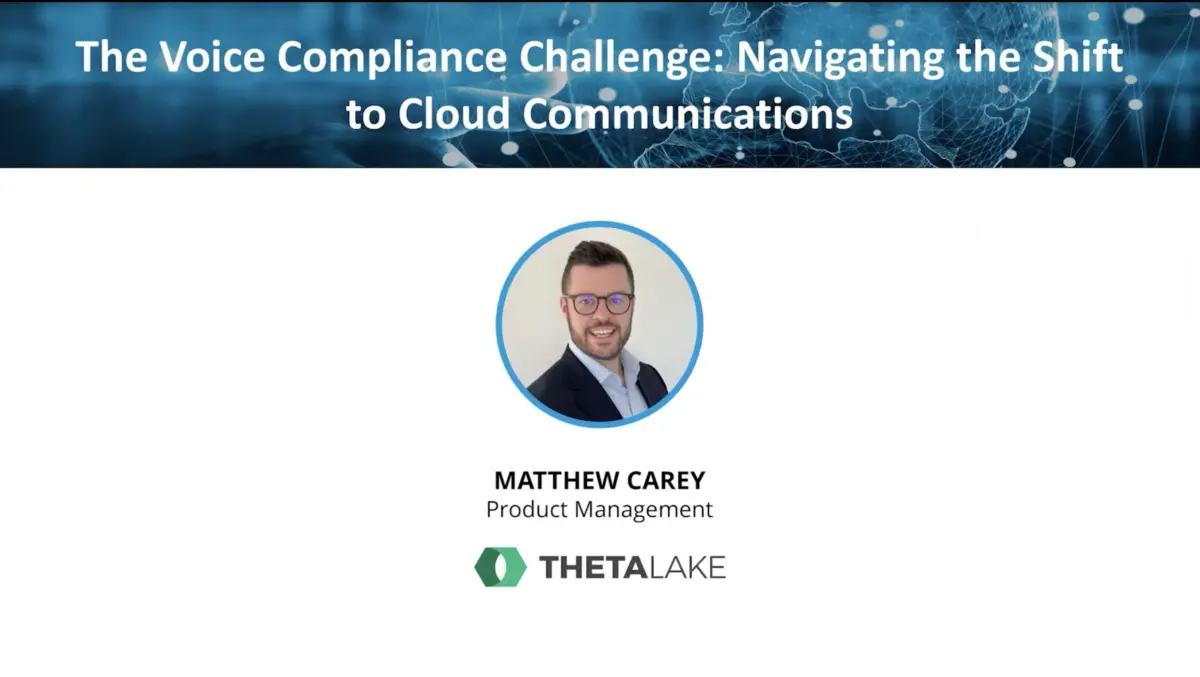
How can financial institutions modernize their voice compliance strategies without inadvertently creating new operational, security, or regulatory risks? To unpack this complex industry challenge, industry leaders are turning to specialized RegTech innovators. Recently, insights from Matthew Carey, Director of Product Management at Theta Lake, shed light on the current state of voice compliance in financial services and offered a strategic roadmap for managing the inevitable migration to cloud communications.
Detailed Chronology: The Evolution of Voice Compliance
To understand the urgency of today’s voice compliance crisis, it is essential to trace how communication technologies and regulatory expectations have co-evolved over the past several decades.
The Era of Fixed Telephony and Analog Recording (Pre-2000s)
For decades, voice compliance was a relatively contained discipline. Financial institutions operated on dedicated private branch exchange (PBX) systems. Telephones were hardwired to physical desks, and calls were routed through centralized, on-premise hardware switches. Surveillance was similarly localized: compliance teams installed physical voice-logging recorders—initially reel-to-reel tapes, later transitioning to digital hard-drive arrays—that captured audio streams directly from the trading floor turret systems.
Regulatory expectations during this era were straightforward. Rules primarily targeted traditional voice interactions on fixed lines. If a broker placed a trade over the phone, the audio file was stored in a secure, immutable archive, ready to be retrieved upon request by internal auditors or regulatory examiners.
The Rise of Mobile and Fragmented Channels (2000s–2010s)
The turn of the millennium marked the beginning of communication fragmentation. The proliferation of mobile phones, BlackBerries, and direct-dial SMS messaging introduced new channels that employees frequently used for business discussions. However, these mobile channels rarely integrated cleanly with legacy recording systems.
Regulators quickly recognized this blind spot. Scandals involving market manipulation, insider trading, and benchmark rate-fixing (such as the LIBOR scandal) exposed critical gaps in surveillance. In response, regulatory bodies enacted sweeping mandates—most notably the Markets in Financial Instruments Directive II (MiFID II) in Europe and tightened Dodd-Frank rules in the United States. These frameworks significantly expanded the scope of communications that required monitoring, forcing financial institutions to implement mobile call recording solutions and extend their compliance perimeters beyond the physical office.
The Cloud Revolution and Unified Communications (2015–Present)
The most disruptive shift in communication history arrived with the mass adoption of cloud-based unified communications (UC) and collaboration platforms such as Microsoft Teams, Zoom, Webex, and Slack. These platforms converged voice, video, chat, screen sharing, and file collaboration into single, highly dynamic interfaces.
Driven further by the global shift toward remote and hybrid work models, financial institutions rapidly migrated their infrastructure to the cloud to maintain business continuity. While this technological leap empowered employees to collaborate seamlessly across geographies, it broke traditional compliance models. Voice was no longer just an audio stream traveling down a dedicated telephone line; it was now a packetized data stream embedded within multifaceted digital collaboration sessions.
Legacy recording tools, designed to capture isolated audio channels, could not effectively parse, record, or analyze rich, multi-modal cloud sessions. Compliance officers were suddenly confronted with a labyrinth of missed audio feeds, unrecorded chat sidebars accompanying voice calls, and ephemeral messaging features that threatened to evade regulatory oversight entirely.
Supporting Context & Metrics: The Scale of the Modern Compliance Burden
The friction between modern cloud communications and legacy compliance infrastructure has created a high-risk environment for financial institutions. Analyzing the current data and market trends reveals why voice compliance has become a board-level priority.
The Proliferation of Communication Channels
According to recent industry compliance surveys, the average financial services employee now utilizes between four and seven distinct communication channels for business interactions. These include traditional desk phones, mobile voice calls, SMS, WhatsApp, WeChat, enterprise chat platforms, and video conferencing software. Each of these channels generates unique data formats, metadata structures, and recording requirements.
Furthermore, the lines between formal and informal communication have blurred. A conversation that begins on a Microsoft Teams video call may transition into a private chat sidebar, followed by a voice call via a mobile messaging app. If a compliance surveillance program captures only the primary video call while missing the accompanying chat logs and follow-up voice notes, the firm is left with a fragmented audit trail—a severe vulnerability during regulatory investigations.
The Financial and Reputational Cost of Non-Compliance
Regulatory enforcement actions targeting communication recordkeeping failures have accelerated dramatically. Over the past several years, global regulators—particularly the SEC and the Commodity Futures Trading Commission (CFTC) in the United States—have levied billions of dollars in fines against major financial institutions for failing to monitor "off-channel communications" (the unauthorized use of unapproved messaging apps and unrecorded channels for business matters).
While many of these initial enforcement actions focused on text and messaging apps, regulators are increasingly turning their attention to voice compliance in cloud environments. As automated surveillance tools become more sophisticated, regulatory bodies expect financial firms to demonstrate absolute mastery over all communication mediums, including cloud telephony and UC voice streams.
The Technological Gap: Legacy vs. Modern RegTech
Traditional recording systems suffer from several critical shortcomings in the modern cloud era:
- Siloed Architecture: Legacy systems are typically built to ingest audio from specific telephony vendors, making them incompatible with multi-vendor cloud ecosystems.
- Lack of Contextual Metadata: Older recorders often capture raw audio without capturing the rich contextual metadata generated by cloud platforms (e.g., participant lists, screen-sharing activities, chat logs, and timestamps).
- Inability to Scale: On-premise storage and processing hardware struggle to handle the massive volumes of high-definition audio and video data generated by global workforces.
To bridge this gap, financial institutions are increasingly adopting next-generation RegTech solutions designed specifically for cloud-native, multi-channel environments.
Official Statements and Industry Insights: Perspectives from Theta Lake
To gain deeper clarity on how financial institutions can navigate this transitional landscape, industry analysts frequently look to technology providers on the front lines of compliance innovation. Matthew Carey, Director of Product Management at Theta Lake, recently shared critical insights regarding the modern voice compliance challenge and the strategies firms must employ to manage the shift to cloud communications.
The Complexity of Unified Communications
During discussions surrounding the voice compliance landscape, Carey emphasized that the fundamental challenge facing financial services firms is the sheer velocity and complexity of modern communications. Traditional voice compliance was built on a premise of simplicity: one channel, one recording mechanism, one storage repository.
Today, that paradigm is obsolete. Cloud-based unified communications platforms are designed to be fluid, flexible, and feature-rich. Features such as in-meeting chat, participant muting, breakout rooms, and dynamic call transfers create complex operational hurdles for compliance teams. According to Carey, attempting to force legacy, single-channel recording tools onto multi-modal cloud environments is a recipe for compliance failure. Firms must recognize that voice is now part of a broader, interconnected data ecosystem.
Managing the Shift to Cloud Communications
Transitioning legacy voice infrastructure to secure cloud environments requires a deliberate, strategic approach. Carey highlighted several key considerations for firms managing this migration:
- Adopting Native Integrations and APIs: Modern voice compliance cannot rely on hardware taps or kludgy workarounds. Financial institutions must leverage platforms that integrate natively with leading cloud communications providers via robust APIs. This ensures that audio streams, video feeds, and associated metadata are captured securely at the source without degrading user experience or call quality.
- Comprehensive Risk Management: Modernizing compliance strategies is not merely about checking regulatory boxes; it is about mitigating enterprise risk. Firms must implement comprehensive surveillance that goes beyond audio recording to include automated risk detection—such as natural language processing (NLP) and artificial intelligence (AI) capable of scanning voice transcripts and chat logs for signs of market abuse, insider trading, compliance breaches, or policy violations.
- Future-Proofing Compliance Architecture: As new communication channels and features emerge (such as generative AI assistants embedded within collaboration tools), compliance frameworks must be agile enough to adapt. Firms should invest in scalable, cloud-native RegTech solutions that can continuously update their capabilities to meet evolving regulatory expectations.
Future Outlook: The Next Frontier of Voice Compliance
As the financial services industry looks toward the remainder of the decade, the trajectory of voice compliance is clear: manual oversight and legacy silos will be entirely replaced by intelligent, automated, and holistic surveillance ecosystems.
The Integration of Artificial Intelligence and Machine Learning
Artificial intelligence is poised to revolutionize voice compliance. While transcription technology has existed for years, advancements in generative AI and large language models (LLMs) are enabling compliance teams to analyze voice data with unprecedented depth and nuance.
Next-generation RegTech solutions will not simply record and transcribe audio; they will actively comprehend context, tone, and sentiment. For example, AI-driven surveillance tools will be capable of detecting stress, hesitation, or coded language in a broker’s voice during a high-stakes trade negotiation, automatically flagging potential compliance risks for human review long before an audit occurs.
Harmonizing Global Regulatory Standards
As financial markets become increasingly borderless, the pressure for international regulatory harmonization around communications compliance will intensify. Firms operating across multiple jurisdictions must navigate overlapping—and sometimes contradictory—regulatory frameworks regarding data privacy (such as GDPR), cross-border data transfers, and mandatory record retention periods.
Cloud-native compliance platforms will play a vital role in helping multinational institutions harmonize these requirements, offering granular data governance controls that ensure compliance with local privacy laws while maintaining comprehensive global audit trails.
Conclusion
The transition from legacy telephony to cloud-based communications represents one of the most significant operational shifts in the history of financial services. While the challenges of voice compliance in this new era are formidable, they are not insurmountable. By moving away from brittle, legacy recording tools and embracing modern, cloud-native RegTech solutions, financial institutions can successfully bridge the gap between innovation and regulation.
As experts like Matthew Carey of Theta Lake demonstrate, the key to modernizing voice compliance lies in adaptability, comprehensive multi-channel coverage, and the intelligent use of automation. Firms that proactively modernize their compliance strategies today will not only avoid costly regulatory penalties; they will establish a competitive advantage built on trust, transparency, and operational resilience in an increasingly digital financial world.