
It is a query that dominates boardroom debates, watercooler whispers, and legislative hearings alike. Yet, according to leading industry experts, economists, and workforce data scientists, it is fundamentally the wrong question—or, at best, an incomplete one.
Artificial intelligence is not a monolithic force destined to either universally spare or entirely eradicate human labor. Instead, it is a complex nexus of simultaneous pressures. Its ultimate impact on any given profession depends entirely on which specific dynamic is acting upon it.
Certain tasks are systematically automated away, while others are vastly amplified. Entire categories of employment are materializing out of industries that barely existed a few years ago, while foundational shifts quietly alter who gets hired, how skills are accumulated, and how corporate career ladders are structured.
To accurately forecast where the labor market is heading, we must deconstruct these competing forces. By examining the five distinct ways AI is transforming work—backed by empirical data from institutions such as the World Economic Forum, Goldman Sachs, Stanford University, and the Federal Reserve—we can move past generalized panic and toward an informed, strategic understanding of the future of work.
Executive Overview
The global labor market is navigating its most volatile transformation since the advent of personal computing—and potentially its most consequential. As generative AI and machine learning models transition from experimental novelties to core enterprise infrastructure, the nature of human capital is being rewritten in real time.
Data from the World Economic Forum’s Future of Jobs Report 2025 indicates that while millions of traditional roles face displacement, an even greater number of new positions will be created, resulting in a net gain of employment opportunities globally. However, this macro-level net positive masks profound micro-level disruptions. Entry-level workers, routine information processors, and specialized knowledge workers are experiencing divergent realities.
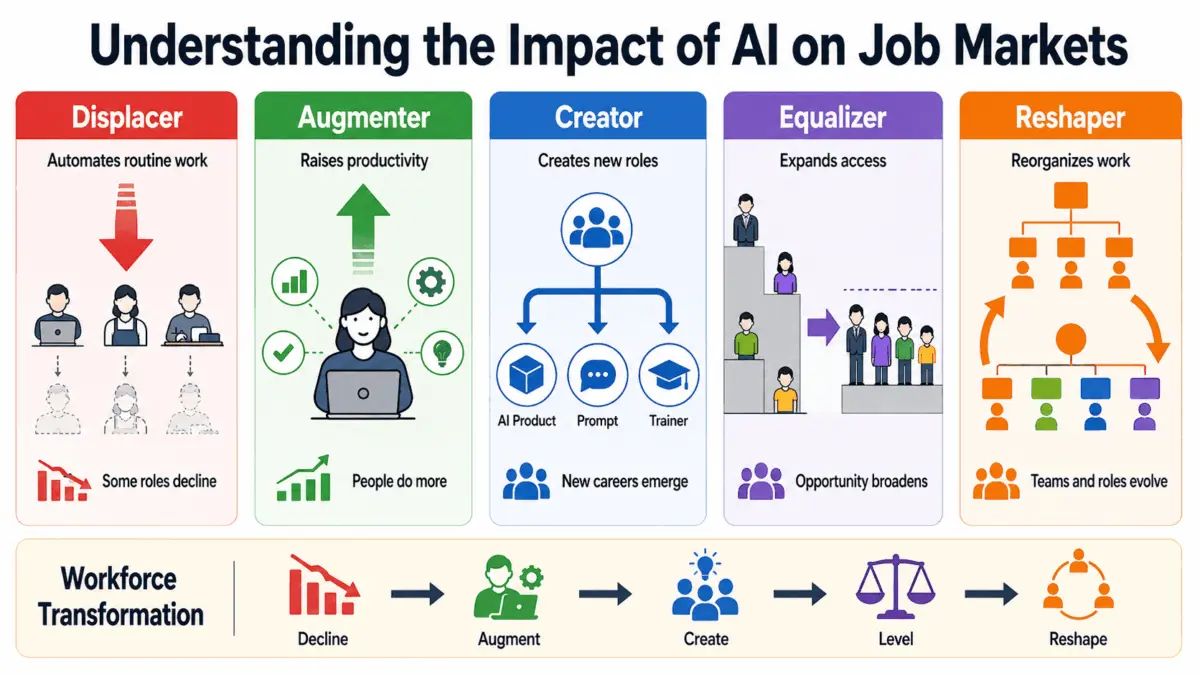
To comprehend this shift, analysts break down the impact of AI into five distinct operational forces:
- The Displacer: Automating routine, predictable tasks.
- The Augmenter: Amplifying the capacity of knowledge workers.
- The Creator: Spawning entirely new occupations and industries.
- The Equalizer: Compressing skill gaps between novices and veterans.
- The Reshaper: Redrawing or dismantling traditional career ladders.
Understanding these forces is no longer an academic exercise; it is an urgent economic imperative for professionals, corporate leaders, and policymakers alike.
Detailed Chronology of the AI Labor Disruption
The integration of artificial intelligence into the modern workforce did not happen overnight; it represents the culmination of decades of algorithmic development, compute scaling, and data accumulation.
Phase One: The Era of Narrow Automation (Pre-2022)
For much of the 2010s, AI in the workplace was defined by "narrow" applications. Machine learning algorithms were deployed primarily in structured environments for specific functions: algorithmic trading in finance, predictive maintenance in manufacturing, and early-stage pattern recognition in healthcare. During this era, displacement was largely confined to blue-collar manufacturing roles and highly structured back-office data entry positions. Knowledge workers largely viewed themselves as insulated from technological disruption.
Phase Two: The Generative Leap (2022–2024)
The public release of advanced generative pre-trained transformers in late 2022 fundamentally altered the landscape. For the first time, AI demonstrated proficiency in unstructured tasks involving natural language, creative drafting, and basic code generation. This democratized access to cognitive automation, exposing knowledge workers—copywriters, software developers, legal researchers, and financial analysts—to the same displacement pressures previously felt primarily by administrative and manual labor.
Phase Three: Agentic Integration and Structural Realignment (2025–Present)
Today, the conversation has moved beyond simple chatbots toward agentic workflows—systems capable of executing complex, multi-step business processes autonomously. As organizations integrate these tools into enterprise resource planning (ERP) systems and customer relationship management (CRM) platforms, the labor market is experiencing systemic realignment. Entry-level hiring has begun to contract in heavily exposed sectors, while demand for AI governance, infrastructure development, and workflow orchestration has skyrocketed.
Supporting Context & Metrics: The Five Forces of AI Transformation
To see where the labor market is heading, it is vital to examine the data driving each of the five operational forces of AI transformation.
1. The Displacer: Automating Routine Tasks
This is the effect that generates the most anxiety, and for valid reasons. AI excels at pattern recognition, high-volume data processing, and the execution of structured, repeatable tasks without cognitive fatigue.
According to the World Economic Forum’s Future of Jobs Report 2025, an estimated 92 million roles will be displaced by 2030 as technological, demographic, and economic pressures reshape the global market. Furthermore, a survey of more than 1,000 global employers conducted for the report revealed that 41 percent plan to actively reduce their workforce as AI automates specific operational tasks.
Who feels this displacement first? Roles anchored in routine information processing: data entry clerks, administrative assistants, accounting clerks, and first-line customer support agents. Crucially, entire jobs rarely vanish overnight. Instead, organizations deconstruct roles into individual tasks, delegate the predictable components to software, and leave human workers to grapple with the unpredictable edge cases and nuanced judgment calls.
2. The Augmenter: Amplifying Knowledge Work
While displacement captures headlines, augmentation represents the reality for millions of professionals. For these workers, AI acts less like a replacement and more like an exceptionally capable co-pilot. By absorbing tedious, repetitive chores—such as summarizing voluminous documents, drafting boilerplate code, or generating initial marketing copy—AI frees humans to focus on high-level strategy and creative direction.
Groundbreaking research from Goldman Sachs estimates that 300 million full-time jobs worldwide are exposed to some degree of AI automation, with roughly two-thirds of occupations facing at least partial exposure. Crucially, the firm projects that the vast majority of this exposure will manifest as a productivity boost rather than outright job annihilation, potentially lifting global GDP by around 7 percent over a ten-year period.
Professions experiencing this shift include software developers, financial analysts, graphic designers, and middle managers. The daily workflow shifts from production from scratch to direction, curation, and editing.
3. The Creator: Generating New Occupations
History demonstrates that major technological revolutions destroy specific jobs while simultaneously inventing entirely new categories of work that were previously unimaginable. The commercial internet birthed roles such as web developer and search engine optimization specialist; AI is currently driving a parallel, highly accelerated creation cycle.
The Future of Jobs Report 2025 projects the creation of 170 million new roles by 2030, resulting in a robust net gain of 78 million jobs even after accounting for displacement. High-growth titles include big data specialists, machine learning engineers, and information security analysts.
Moreover, the massive compute demands required to train and run AI models are sparking a physical infrastructure buildout, driving unprecedented hiring surges for electricians, HVAC technicians, and specialized construction crews tasked with building state-of-the-art data centers.
4. The Equalizer: Compressing the Skill Gap
For decades, technological innovations typically rewarded already highly skilled workers, widening wage disparities. Generative AI, however, appears to exhibit an inverse dynamic within specific operational environments.
Economists Erik Brynjolfsson, Danielle Li, and Lindsey Raymond conducted a landmark study tracking more than 5,000 customer support agents at a major enterprise software firm. Providing agents with access to an AI assistant boosted average productivity by 14 percent, but the gains were distributed unevenly:
- Novice and lower-skilled agents saw productivity spikes of roughly 34 percent.
- Highly experienced, veteran agents experienced little to no measurable change.
The tool functioned by codifying the tacit knowledge of top-performing agents and instantly transmitting those best practices to newer hires. Agents two months into their tenure suddenly began performing at a level comparable to peers with six months of experience. This compression of the skill gap fundamentally challenges traditional metrics of hiring criteria, onboarding timelines, and tenure-based pay scales.
5. The Reshaper: Redrawing the Career Ladder
While the equalizer effect helps novices accelerate their initial onboarding, it introduces a troubling paradox for the broader labor market: If AI absorbs entry-level responsibilities, where do tomorrow’s senior experts come from?
A 2026 Stanford University research initiative titled "Canaries in the Coal Mine" analyzed millions of payroll records to assess AI’s impact on early-career professionals. The study discovered that individuals aged 22 to 25 in occupations heavily exposed to AI—such as junior software development and entry-level customer service—experienced a 13 percent relative decline in employment following the widespread adoption of generative models, while older, tenured workers in the exact same roles remained steady.
This trend compounds broader youth labor market softness. Data from the Federal Reserve Bank of New York highlighted that underemployment among recent college graduates hovered at 42.5 percent. When companies lean too aggressively on AI to eliminate junior-level tasks, they risk starving their organizations of the foundational experience required to cultivate future industry leaders.
Comparative Matrix: The Five Forces of AI in the Workplace
| Force | Primary Operational Effect | Roles Most Vulnerable / Affected | Recommended Professional Adaptation |
|---|---|---|---|
| The Displacer | Automates predictable, routine operational tasks | Data entry clerks, administrative staff, basic support desks | Pivot toward complex, strategic, human-centric responsibilities |
| The Augmenter | Collaborates on and accelerates knowledge work | Software developers, writers, financial analysts, managers | Master the art of prompting, editing, and directing AI outputs |
| The Creator | Spawns entirely new industries and technical roles | Tech specialists, physical infrastructure trades, compliance consultants | Maintain continuous technical adaptability and lifelong learning |
| The Equalizer | Narrows performance gaps between novices and experts | Customer support, content writers, routine analysts | Adopt productivity tools early to climb initial learning curves faster |
| The Reshaper | Compresses or thins the entry-level career rung | Early-career graduates in highly exposed cognitive fields | Intentionally cultivate deep human judgment and unautomatable skills |
Official Statements and Industry Insights
As governments and global institutions grapple with these sweeping economic transformations, thought leaders have emphasized the need for proactive adaptation rather than passive resignation.
Vinod Chugani, an esteemed AI and data science educator specializing in agentic workflows and machine learning applications, emphasizes the necessity of direct engagement with emerging technologies:
"The market is undergoing its largest structural shift since the invention of personal computing—and potentially an even deeper one. The most counterproductive move a professional can make is to ask in the abstract whether AI will take their job. Instead, individuals must audit their specific daily responsibilities, identify which of the five forces is acting upon them most aggressively, and strategically redirect their professional energy toward high-value human capabilities."
Economic policymakers echo this sentiment. While international labor organizations urge caution regarding corporate over-automation and the erosion of entry-level career pathways, corporate leaders are increasingly realizing that technological adoption must be paired with comprehensive internal reskilling programs. Organizations that fail to train their workforces to collaborate effectively with AI risk falling behind competitors who leverage the technology to multiply human ingenuity.
Future Outlook: Navigating the Algorithmic Threshold
Looking toward the horizon of 2030 and beyond, the trajectory of the global labor market will be determined by how institutions, educators, and individual workers navigate the tensions between displacement, augmentation, and career reshaping.
The convergence of agentic AI, physical infrastructure demands, and evolving regulatory frameworks means that static job descriptions are effectively obsolete. Professionals who anchor their value solely to the execution of routine, rules-based tasks face an increasingly precarious employment landscape. Conversely, those who cultivate emotional intelligence, complex problem-solving, strategic systems thinking, and mastery over AI orchestration tools will find themselves uniquely empowered.
Ultimately, mapping one’s professional role against the five forces of AI transformation provides a clear diagnostic framework. By identifying immediate pressure points—whether facing the threat of displacement, the leverage of augmentation, or the structural hurdles of career reshaping—workers can transition from passive observers of technological change to active architects of their own professional futures.