

Executive Overview
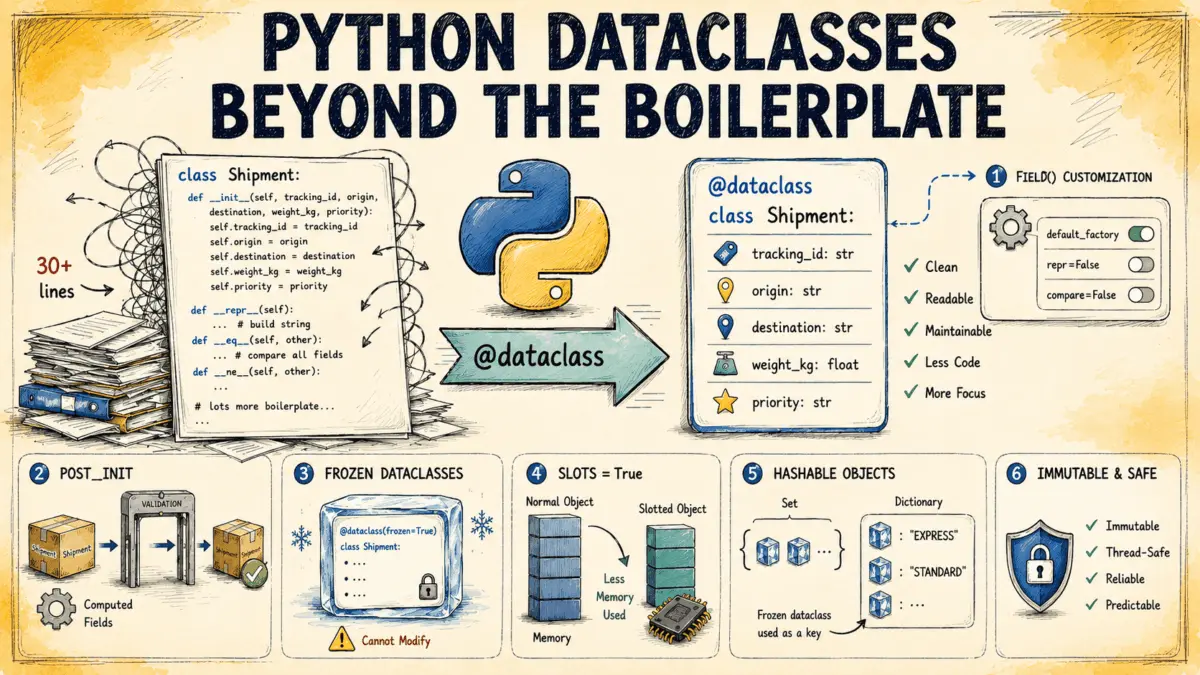
The introduction of Python dataclasses via PEP 557 revolutionized how developers approach object-oriented programming for data models. However, a significant portion of the developer community still treats @dataclass as little more than a cosmetic shorthand to eliminate constructor definitions. While reducing syntactic noise is an undeniable victory, it scratches only the surface of what dataclasses can achieve.
Beneath the deceptively simple decorator syntax lies a robust ecosystem of advanced controls, including fine-grained field management, post-initialization validation, immutable state enforcement, and memory optimization via memory slots. By leveraging these powerful paradigms, engineers can transition from simple data structures to resilient, production-ready, and domain-driven architectures. This comprehensive guide explores how to harness Python dataclasses beyond the basics, equipping you with the patterns necessary for enterprise-scale workloads.
Detailed Chronology: From Manual Dunder Methods to Advanced @dataclass Engineering
To fully appreciate the architectural efficiency of modern Python dataclasses, it is instructive to examine how data modeling has evolved. Historically, structuring a domain entity—such as a logistics shipment tracker—demanded tedious, repetitive implementations of foundational object behaviors.
The Baseline: The Legacy Approach
Consider a traditional Python class designed to track freight shipments. Without dataclasses, an engineer must explicitly write out the mechanics of instantiation, string representation, and equality comparison:
class Shipment:
    def __init__(self, tracking_id, origin, destination, weight_kg, priority):
        self.tracking_id = tracking_id
        self.origin = origin
        self.destination = destination
        self.weight_kg = weight_kg
        self.priority = priority

    def __repr__(self):
        return (
            f"Shipment(tracking_id=self.tracking_id!r, origin=self.origin!r, "
            f"destination=self.destination!r, weight_kg=self.weight_kg!r, "
            f"priority=self.priority!r)"
        )

    def __eq__(self, other):
        if not isinstance(other, Shipment):
            return NotImplemented
        return (
            self.tracking_id == other.tracking_id
            and self.origin == other.origin
            and self.destination == other.destination
            and self.weight_kg == other.weight_kg
            and self.priority == other.priority
        )
This legacy implementation spans over thirty lines of code, yet contains precisely zero domain-specific logic. Every single line exists solely to satisfy the structural overhead required by the Python runtime for object construction, comparison, and debugging inspection. As data models grow in complexity—adding optional fields, nested structures, or validation rules—this approach scales linearly with technical debt.
The Modern Paradigm: The @dataclass Transformation
With the advent of Python’s built-in dataclass module, the identical behavioral outcome is reduced to a declarative blueprint:
from dataclasses import dataclass

@dataclass
class Shipment:
    tracking_id: str
    origin: str
    destination: str
    weight_kg: float
    priority: str
When the interpreter parses this class definition, the @dataclass decorator inspects the type annotations. It automatically synthesizes the __init__, __repr__, and __eq__ methods behind the scenes. It is crucial to note that these type annotations are purely declarative hints for the decorator and generation engine; Python does not enforce strict runtime type-checking by default. Nonetheless, they provide a clean schema that defines which fields belong to the class and in what structural order.
Supporting Context & Metrics: Advanced Configuration & Optimization
Moving past basic syntax reveals the true power of dataclasses: fine-grained control over object behavior, memory utilization, and structural integrity.
Controlling Fields with field()
When default annotation syntax proves too restrictive, the field() function acts as an architectural escape hatch. It allows developers to configure individual attributes with surgical precision.
1. Preventing Shared Mutable State via Default Factories
A classic pitfall in Python programming is the assignment of mutable objects—such as lists or dictionaries—as default values in function signatures or class attributes. If defined directly, every instance of the class shares a reference to the exact same mutable object, leading to erratic, hard-to-debug side effects. Dataclasses eliminate this vulnerability by requiring mutable defaults to be initialized through a default_factory:
from dataclasses import dataclass, field
from datetime import datetime

@dataclass
class Shipment:
    tracking_id: str
    origin: str
    destination: str
    weight_kg: float
    priority: str = "standard"
    route_stops: list[str] = field(default_factory=list)
    created_at: datetime = field(default_factory=datetime.utcnow)
The default_factory accepts any zero-argument callable. Consequently, every newly instantiated Shipment receives an isolated, independent list and timestamp, completely isolating object states.
2. Encapsulating Internal Metadata: Excluding Fields from repr and eq
In complex enterprise systems, data classes frequently carry operational metadata—such as internal audit logs, database connection states, or security flags—that should remain hidden from debugging outputs and excluded from equality checks. This is managed via repr=False and compare=False:
@dataclass
class Shipment:
    tracking_id: str
    origin: str
    destination: str
    weight_kg: float
    priority: str = "standard"
    route_stops: list[str] = field(default_factory=list)
    created_at: datetime = field(default_factory=datetime.utcnow)
    _internal_notes: str = field(default="", repr=False, compare=False)
Under this configuration, two shipments with identical core logistics data will evaluate as equal, even if their internal administrative notes differ. Furthermore, _internal_notes is omitted from generated string representations, keeping log streams focused strictly on relevant business data.
Enforcing Integrity: __post_init__() for Validation and Computed Fields
While automatic initialization is efficient, real-world applications demand rigorous data validation and calculated attributes. Python dataclasses support this natively through the __post_init__() method, which the generated __init__ calls immediately after assigning all fields.
Input Validation
To ensure that invalid states can never propagate through an application, input validation should occur at the moment of object construction:
VALID_PRIORITIES = "economy", "standard", "express", "critical"

@dataclass
class Shipment:
    tracking_id: str
    origin: str
    destination: str
    weight_kg: float
    priority: str = "standard"
    route_stops: list[str] = field(default_factory=list)

    def __post_init__(self):
        if self.weight_kg <= 0:
            raise ValueError(f"weight_kg must be positive, got self.weight_kg")
        if self.priority not in VALID_PRIORITIES:
            raise ValueError(f"priority must be one of VALID_PRIORITIES, got self.priority!r")
If an engineer attempts to initialize an object with erroneous data—such as a negative weight—construction halts instantly, raising a ValueError before any corrupt state enters the system workflow.
Computing Derived Attributes
__post_init__() is equally valuable for computing attributes derived from other primary fields. By leveraging field(init=False), we can instruct the constructor to ignore these calculated fields during instantiation while ensuring they are always calculated safely:
FREIGHT_RATE_PER_KG =
    "economy": 1.20,
    "standard": 1.85,
    "express": 3.40,
    "critical": 6.00


@dataclass
class Shipment:
    tracking_id: str
    origin: str
    destination: str
    weight_kg: float
    priority: str = "standard"
    route_stops: list[str] = field(default_factory=list)
    freight_cost: float = field(init=False)

    def __post_init__(self):
        if self.weight_kg <= 0:
            raise ValueError(f"weight_kg must be positive, got self.weight_kg")
        if self.priority not in FREIGHT_RATE_PER_KG:
            raise ValueError(f"Invalid priority: self.priority!r")

        self.freight_cost = round(
            self.weight_kg * FREIGHT_RATE_PER_KG[self.priority], 2
        )
Official Statements & Architectural Best Practices
As applications scale to process millions of transactions, architectural choices regarding memory consumption and mutability become paramount. Python dataclasses offer native mechanisms to address these enterprise concerns.
Immutability and Hashability (frozen=True)
For objects representing discrete domain values—such as geographic coordinates, financial transactions, or immutable routing segments—mutability introduces architectural vulnerability. Passing frozen=True to the decorator converts the class into an immutable structure:
@dataclass(frozen=True)
class RouteSegment:
    from_hub: str
    to_hub: str
    distance_km: float
    carrier: str
Once initialized, any attempt to modify an attribute attribute raises a FrozenInstanceError. Crucially, frozen dataclasses are automatically hashable by default. This enables them to serve directly as keys in dictionaries or elements within sets:
transit_costs =
    RouteSegment("Hamburg", "Rotterdam", 120.5, "DHL Freight"): 340.00,
    RouteSegment("Rotterdam", "Antwerp", 80.0, "DB Schenker"): 210.00,
Memory Footprint Reduction (slots=True)
In standard Python classes, every instance stores its attributes inside an internal instance dictionary (__dict__). This dictionary carries a distinct memory overhead, which multiplies rapidly when processing large datasets or high-throughput ETL (Extract, Transform, Load) pipelines.
Introduced in Python 3.10, the slots=True parameter instructs the interpreter to use memory-efficient C-structure slots instead of a dynamic dictionary:
import sys

@dataclass
class ShipmentNormal:
    tracking_id: str
    origin: str
    destination: str
    weight_kg: float
    priority: str

@dataclass(slots=True)
class ShipmentSlotted:
    tracking_id: str
    origin: str
    destination: str
    weight_kg: float
    priority: str

normal = ShipmentNormal("SHP-0001", "Frankfurt", "Lyon", 55.0, "standard")
slotted = ShipmentSlotted("SHP-0001", "Frankfurt", "Lyon", 55.0, "standard")

print(f"Normal instance dictionary overhead: sys.getsizeof(normal.__dict__) bytes")
print(f"Slotted instance total size: sys.getsizeof(slotted) bytes")
Empirical benchmarking consistently demonstrates dramatic savings: standard instances often exhibit significant dictionary overhead, whereas slotted instances reduce base object footprints down to lean memory allocations (frequently dropping from hundreds of bytes to roughly 72 bytes per instance). Across millions of records, this optimization prevents excessive memory consumption and reduces garbage collection pressure.
Future Outlook: Ecosystem Integration and Advanced Horizons
As Python continues to solidify its dominance in data engineering, machine learning, and enterprise web services, the ecosystem surrounding dataclasses is expanding rapidly. Modern workflows frequently require validation and serialization capabilities that extend beyond the standard library.
Expanding the Toolchain
When integrating dataclasses with external APIs or databases, developers often adopt specialized community packages:
dacite: Simplifies the construction of complex, nested dataclass hierarchies directly from raw JSON dictionaries.marshmallow-dataclass: Automatically generates robust validation schemas from dataclass definitions, bridging the gap between runtime validation and object serialization.PydanticDataclasses: Integrates advanced runtime validation and coercion rules with native dataclass syntax, providing an exceptional option for high-assurance API gateways.
Summary: The Production-Ready Blueprint
By combining slot optimization, immutability where appropriate, field-level controls, and rigorous post-init validation, Python dataclasses transform from simple syntactic sugar into a cornerstone of enterprise software design.
Below is the complete, production-ready implementation synthesizing these advanced techniques:
from dataclasses import dataclass, field
from datetime import datetime

FREIGHT_RATE_PER_KG =
    "economy": 1.20,
    "standard": 1.85,
    "express": 3.40,
    "critical": 6.00


@dataclass(slots=True)
class Shipment:
    tracking_id: str
    origin: str
    destination: str
    weight_kg: float
    priority: str = "standard"
    route_stops: list[str] = field(default_factory=list)
    created_at: datetime = field(default_factory=datetime.utcnow)
    freight_cost: float = field(init=False)
    _audit_tag: str = field(default="", repr=False, compare=False)

    def __post_init__(self):
        if self.weight_kg <= 0:
            raise ValueError(f"weight_kg must be positive, got self.weight_kg")

        if self.priority not in FREIGHT_RATE_PER_KG:
            raise ValueError(f"Invalid priority: self.priority!r")

        self.freight_cost = round(
            self.weight_kg * FREIGHT_RATE_PER_KG[self.priority],
            2
        )
Through this unified approach, developers achieve clean, expressive code that validates input upon construction, maintains synchronized derived values, maximizes memory efficiency, and eliminates the burden of manual boilerplate maintenance.