
Executive Overview
To combat these systemic challenges, Amazon Web Services (AWS) has introduced a transformative architectural paradigm: the Specification-Driven Composition Pattern. Formally detailed in a recent AWS architecture guidance release, this innovative approach decouples workflow intent from processing logic. By shifting from procedural, script-bound data pipelines to declarative, metadata-driven assemblies, engineering teams can dramatically reduce code duplication, enhance pipeline traceability, and streamline governance across complex enterprise environments.
At its core, specification-driven composition relies on structured, human-readable documents—typically written in JSON or YAML—to describe what a data workflow should achieve, leaving the how to a dynamic compilation and execution engine. Built upon a serverless stack utilizing AWS Lambda, AWS Step Functions, Amazon S3, and Amazon OpenSearch Service, this design pattern offers a scalable blueprint for organizations grappling with sprawling data variants, stringent regulatory frameworks, and the constant overhead of pipeline maintenance.
While the pattern introduces a degree of abstraction that may prove overly complex for simple, isolated workflows, it establishes a new industry benchmark for large-scale data engineering. As compliance mandates tighten and enterprise data estates expand exponentially, transitioning from imperative pipeline scripting to declarative composition may well become the defining architectural shift of the decade.
Detailed Chronology: The Evolution of Modern Data Pipelines
To fully grasp the significance of AWS’s specification-driven composition pattern, it is essential to trace the evolutionary trajectory of data pipeline architecture over the past two decades. Understanding the friction points that necessitated this architectural pivot highlights why legacy approaches are increasingly unsustainable.
The Era of Monolithic Scripts and Hardcoded ETL (Early to Mid-2010s)
In the early days of cloud-native data warehousing and big data processing, data pipelines were predominantly constructed as monolithic scripts. Organizations relied heavily on languages like Python, Java, or SQL queries bound together by cron jobs or early workflow orchestrators. In these environments, a single script frequently handled ingestion, cleansing, transformation, validation, and loading.
While this approach was straightforward to set up for small projects, it quickly deteriorated as data volumes and source varieties expanded. Adding a new dataset or modifying an existing transformation field meant cracking open the codebase, altering the logic, running local validations, and pushing an entire deployment pipeline update. Because orchestration, transformation, and governance logic were hopelessly intertwined, debugging pipeline failures often required wading through hundreds of lines of procedural code to trace a single data lineage path.
The Rise of DAG-Based Orchestrators (Late 2010s to Early 2020s)
The advent of Directed Acyclic Graph (DAG) orchestrators—such as Apache Airflow, Prefect, and Dagster—represented a major leap forward. These tools allowed data engineers to define pipelines as code, decomposing monolithic scripts into modular tasks connected by explicit dependencies.
However, while DAGs solved the orchestration visibility problem, they did not fully resolve the underlying code duplication crisis. Organizations rapidly discovered that as business units requested custom workflow variants (e.g., applying regional data masking or specific regulatory transformations), engineers resorted to copying existing DAG definitions and modifying them slightly. This anti-pattern led to a proliferation of nearly identical pipeline codebases. When a core transformation bug was discovered, engineers had to patch dozens of separate pipelines manually, introducing human error and severe compliance vulnerabilities, particularly in regulated sectors like finance and healthcare.
The Shift Toward Declarative and Metadata-Driven Architectures (Present Day)
Recognizing that writing code to generate code was reaching a point of diminishing returns, enterprise architects began advocating for declarative patterns. Instead of programming how a pipeline should execute step-by-step, teams began exploring specifications that declare what data transformations are required.
The specification-driven composition pattern represents the maturation of this philosophy. By codifying data flow intent into clean, version-controlled specification files and pairing them with a dynamic capability registry, AWS has provided a standardized framework for building extensible, self-assembling data workflows. This evolution mirrors the transition in infrastructure engineering from manual server provisioning to Infrastructure as Code (IaC), and ultimately to declarative cloud-native definitions like Kubernetes manifests.
Architectural Deep Dive: Anatomy of the Three-Layer Pattern
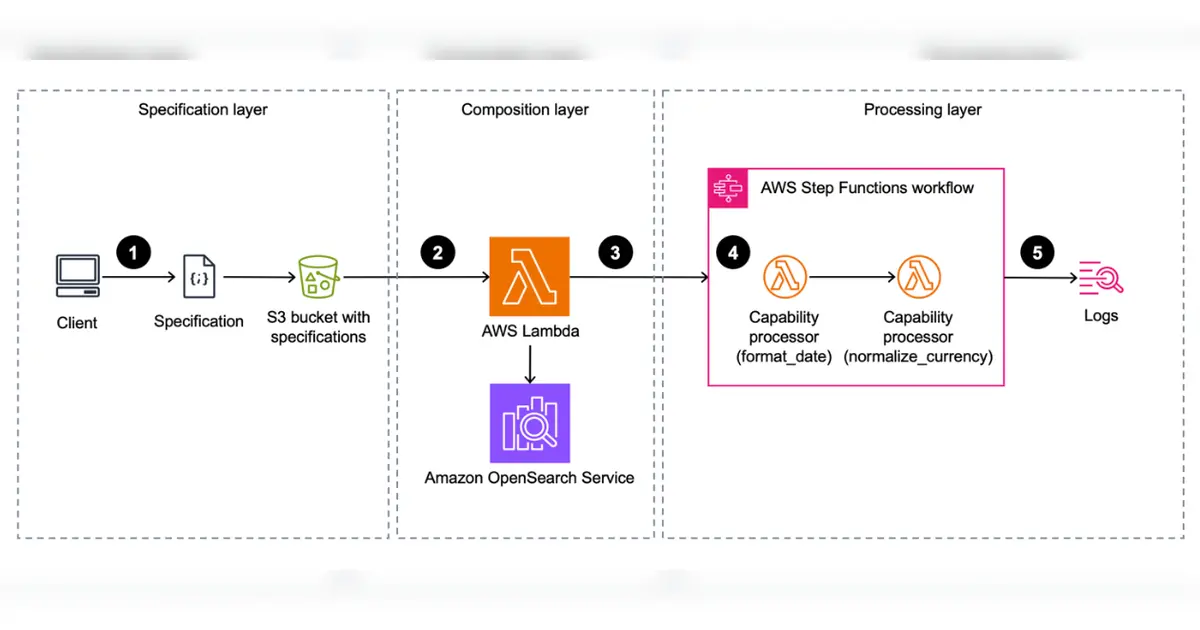
The AWS specification-driven composition pattern is structurally partitioned into three distinct, decoupled layers: the Intent Layer, the Composition Layer, and the Processing Layer. This clear separation of concerns ensures that business logic, orchestration mechanics, and execution tasks remain strictly isolated.
+-------------------------------------------------------+
|                     INTENT LAYER                      |
|       (Declarative Specs: JSON/YAML in Amazon S3)     |
+-------------------------------------------------------+
                           |
                           v
+-------------------------------------------------------+
|                   COMPOSITION LAYER                   |
|     (Validator & Assembler via AWS Lambda &           |
|                Amazon OpenSearch Service)             |
+-------------------------------------------------------+
                           |
                           v
+-------------------------------------------------------+
|                    PROCESSING LAYER                   |
|   (Execution via AWS Step Functions & Lambda,         |
|             Logged to Amazon CloudWatch)              |
+-------------------------------------------------------+
1. The Intent Layer: Declarative Specifications
At the top of the architecture sits the intent layer. Here, data workflows are defined not through imperative code, but through structured specification documents, typically authored in JSON or YAML. These specifications capture the pure business requirements of the pipeline without any coupling to underlying compute engines or execution runtimes.
A standard specification document explicitly defines:
- Source and Target Datasets: Where the raw data originates (e.g., raw ingestion buckets) and where the processed output should be delivered.
- Field Mappings: Declarative instructions on how input schema fields map to target schema fields.
- Transformations: High-level references to business rules, data cleansing operations, and enrichment processes.
- Data Classification & Governance Rules: Tags indicating the sensitivity level of specific fields (e.g., PII, PHI) and required compliance treatments.
By externalizing these definitions into files stored in Amazon S3, organizations treat pipeline intent as a first-class citizen. As Rajat Shrivastav noted in his industry commentary on LinkedIn:
"By codifying the intent into a declarative specification, you ensure that traceability isn’t an afterthought; it’s the core of the pipeline."
2. The Composition Layer: Validation and Dynamic Assembly
When a new or updated specification is uploaded to Amazon S3, an S3 event notification triggers the composition layer, implemented serverlessly via AWS Lambda.
The composer performs several critical duties:
- Schema Validation: It validates the incoming specification against predefined JSON schemas to ensure syntax and structural correctness before any data processing begins.
- Capability Discovery: The composer queries an Amazon OpenSearch Service registry. This registry maintains comprehensive metadata for all reusable transformation functions available across the enterprise, including their unique identifiers, supported input/output formats, permission profiles, and version histories.
- Intent Resolution: Instead of forcing authors to know exact function ARNs or implementation scripts, specifications can reference reusable transformations by intent (e.g.,
"transform": "normalize-phone-numbers"). The composer resolves these intent declarations against the OpenSearch capability registry. - Dynamic Workflow Generation: Once validated and resolved, the composer dynamically generates a runnable workflow structure and initializes an AWS Step Functions state machine tailored precisely to that specification’s requirements.
3. The Processing Layer: Execution and Telemetry
The final tier is the processing layer, where the heavy lifting of data transformation occurs. Guided by the state machine constructed by the composition layer, AWS Step Functions orchestrates a series of modular, serverless AWS Lambda functions.
Each Lambda function acts as an independent capability processor, executing a single, well-defined transformation step. Because these processors are stateless and modular, they can be tested, versioned, and scaled independently. Furthermore, throughout execution, the processing layer emits comprehensive traces, metrics, and logs to Amazon CloudWatch, ensuring absolute observability and auditability from ingestion to final sink.
Supporting Context, Governance, and Advanced Capabilities
Beyond basic ETL efficiency, the specification-driven composition pattern addresses some of the most persistent hurdles in enterprise data management: discoverability, data governance, and regulatory compliance.
The Capability Registry as an Enterprise Marketplace
In traditional data architectures, discovering existing transformation logic is notoriously difficult. Engineers often reinvent the wheel, writing duplicate data-cleansing scripts simply because they do not know a colleague built a similar function six months ago.
By centralizing transformation metadata within Amazon OpenSearch Service, the AWS pattern establishes an internal "marketplace" of capabilities. Engineers and data stewards can search the registry using descriptive tags, semantic schemas, and capability metadata. This promotes code reuse on an enterprise scale, drastically cutting down development time and reducing the maintenance burden of disparate script repositories.
Versioning and Reproducibility
In highly regulated industries—such as banking, insurance, and healthcare—auditors frequently demand the ability to reproduce historical data transformations exactly as they occurred on a specific date.
The specification-driven pattern excels in this arena. Because specifications are version-controlled documents stored in S3, and because capability references in the registry are strictly versioned, an organization can look back at any historical pipeline run, inspect the exact specification file that drove it, and verify the precise capability versions that executed the logic. This eliminates ambiguity and simplifies compliance audits.
Built-In Data Classification and Masking
Data governance is frequently bolted onto pipelines as an afterthought, leading to security gaps and compliance violations. The AWS pattern integrates governance directly into the specification phase.
/filters:no_upscale()/news/2026/08/aws-spec-driven-data-workflow/en/resources/1Screenshot%202026-08-16%20at%209.41.42 PM-1786944921986.png)
Within the specification document, data authors can explicitly classify fields—tagging sensitive columns such as Social Security Numbers, credit card details, or medical records. Simultaneously, registered capabilities declare how their processing affects data sensitivity (e.g., whether a function sanitizes, masks, or preserves a classified field).
During the validation phase, the composition layer cross-references these declarations to ensure that sensitive fields are never inadvertently exposed to unauthorized downstream consumers, automatically generating necessary data masking artifacts as part of the compiled workflow.
Official Statements and Industry Perspective
The release of AWS’s architectural guidance has sparked active discussions across the cloud engineering community regarding the future of declarative data management.
While AWS positions the specification-driven composition pattern as an optimal solution for complex, multi-source enterprise integrations, regulated financial reporting, and large-scale reusable ETL architectures, the cloud giant also offers a pragmatic note of caution. AWS explicitly acknowledges that this pattern introduces unnecessary architectural complexity for simple data transformations or organizations managing only a handful of pipelines.
For startups or small engineering teams with straightforward batch jobs, traditional script-based orchestration or lightweight DAGs remain more than sufficient. However, as organizations cross the threshold where workflow variation, team scaling, and governance overhead begin to choke productivity, specification-driven composition transitions from an advanced architectural option to an absolute necessity.
Industry experts have echoed these sentiments, emphasizing that the decoupling of intent from execution is a natural maturation step for cloud-native engineering. As data estates grow increasingly decentralized—with multiple business units contributing data variants daily—relying on procedural code deployments is no longer tenable. Declarative specifications provide the guardrails, visibility, and agility required to govern enterprise data at scale.
Future Outlook: The Road Ahead for Declarative Data Engineering
As we look toward the future of data systems and cloud architecture, the principles underlying AWS’s specification-driven composition pattern point toward a broader industry transformation.
1. Standardization of Specification Schemas
Just as OpenAPI (formerly Swagger) revolutionized how REST APIs are documented, tested, and consumed, we are likely to see the emergence of standardized, open-source specification schemas for data workflows. Organizations will benefit from universally recognized YAML/JSON schemas that define data intent, allowing interoperability across multi-cloud and hybrid data processing engines (such as Spark, Flink, and serverless compute primitives).
2. Generative AI Integration
The synergy between Large Language Models (LLMs) and specification-driven architectures is profound. Today, writing a YAML specification still requires technical familiarity with data schemas and registered capabilities. In the near future, natural language interfaces will allow business analysts to state their data intent in plain English—e.g., "Ingest the Q3 sales ledger, mask customer PII, and join it with regional shipping logs"—and have an LLM automatically generate, validate, and submit the compliant specification to the composition layer.
3. Shift-Left Compliance and Automated Auditing
As regulatory bodies worldwide tighten data privacy laws (such as GDPR, CCPA, and emerging AI regulations), real-time auditability will become mandatory. Specification-driven composition bakes compliance into the initiation phase of every pipeline. Future iterations of these architectures will likely feature automated policy engines (utilizing tools like OPA – Open Policy Agent) integrated directly into the composition layer, blocking non-compliant pipeline specifications before they can even be compiled into execution states.
Conclusion
AWS’s introduction of the specification-driven composition pattern marks a significant milestone in the evolution of cloud data engineering. By decisively separating workflow intent from processing logic and uniting serverless orchestration with dynamic capability registries, AWS has provided a blueprint for conquering pipeline sprawl and governance debt.
While not every organization requires the robust abstraction of a three-layer compositional architecture today, those navigating complex, multi-source, and heavily regulated data environments ignore these principles at their peril. As enterprises continue to scale their data and AI initiatives, moving from procedural pipeline scripting to declarative, metadata-driven composition will be the defining differentiator between chaotic maintenance and resilient, future-proof data operations.