
Executive Overview
In July 2020, Meritech’s IPO breakdown labeled BigCommerce “a very distant #2”—and at the time, that was framed as the bull case. While nearly every other competitor in the category was merely a division of a larger tech titan (such as Magento inside Adobe, Commerce Cloud inside Salesforce, or WooCommerce inside Automattic), BigCommerce stood alone.
Then came the fork in the road. Roughly a month before its initial public offering, Intuit floated a lucrative $1.5 billion acquisition offer for the company. BigCommerce opted to turn it down, choosing the public markets instead. Priced at $24 per share, the stock closed its first trading day at a staggering $72.27, earning the title of the biggest IPO pop of 2020 and securing a market capitalization of roughly $4.8 billion.
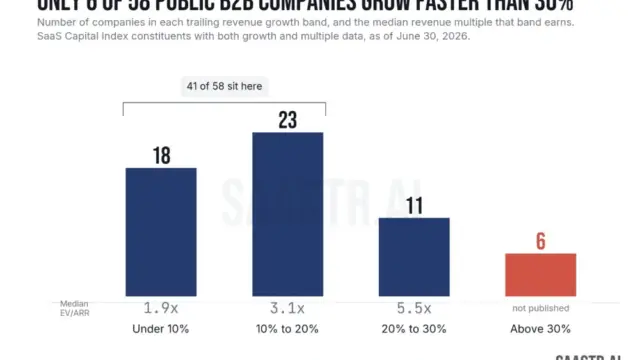
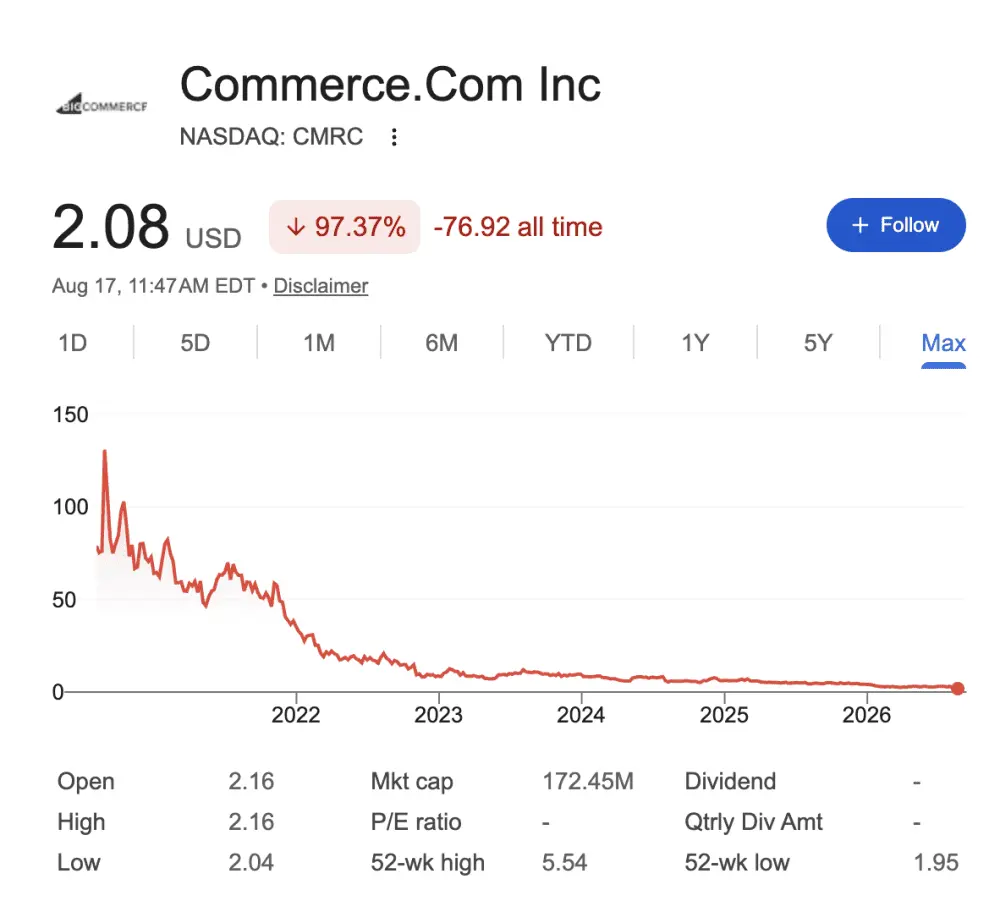
Today, that same company—rebranded as Commerce.com and trading under the ticker CMRC—commands a market capitalization of roughly $200 million, valuing it at less than 1x its Annual Recurring Revenue (ARR). It is currently fielding a hostile takeover bid from a much smaller rival, and its leadership recently guided full-year 2026 revenue to a midpoint below what the company generated in 2025.
While everyone in the tech ecosystem knew Shopify was winning back in 2020, looking back provides something far more valuable: a clinical view of the shape of structural decay, and a sobering lesson on what truly compounds in the unforgiving world of B2B software.
Detailed Chronology: From IPO Darling to Hostile Takeover Target
The 2020 High-Water Mark
In the summer of 2020, the macroeconomic environment supercharged digital commerce. BigCommerce capitalised on this tailwind with a blockbuster public debut. The prevailing sentiment among analysts was that the expanding pie of global digital commerce was vast enough to accommodate at least two major independent software winners. BigCommerce management leaned heavily into this narrative, investing in enterprise features, open architecture, and custom integrations designed to woo complex B2B merchants who found Shopify’s out-of-the-box templates too rigid.
The Gradual Drift (2021–2024)
What followed was not a catastrophic corporate collapse, a massive data breach, or a failed platform migration. There was no single "black swan" disaster quarter that rattled Wall Street. Instead, a much more insidious force took over: quiet, relentless deceleration.
For the first two years post-IPO, the revenue gap between Shopify and BigCommerce hovered relatively flat at around a factor of 20x. But as the quarters ticked by, the divergence widened. The widening gulf was not caused by a sudden absolute drop in BigCommerce’s revenues, but by a steady compression of its growth engine. BigCommerce’s year-over-year growth rate slid from 27% down to 11%, then to 7%, and finally trickled down to a meager 3%. Meanwhile, Shopify—operating at a scale twenty times larger—maintained a relentless clip of 26% to 30% growth.
The Pivot, the Rebrand, and the Cost Cutters
Recognizing the tightening noose, leadership executed the traditional playbook for a stalling SaaS asset. A new chief executive was brought in. The company dropped its legacy identity, aggressively rebranding from BigCommerce to Commerce.com to signal a broader strategic pivot. Simultaneously, management implemented workforce realignments explicitly driven by AI and automation, driving rigorous cost discipline.
These maneuvers bore fruit on the bottom line. The company posted two consecutive quarters of positive GAAP net income, with Q2 non-GAAP operating income reaching $8.1 million—well ahead of initial internal guidance of $4 million to $5 million.
The 2026 Reality Check
Despite real margin expansion and undeniable cost discipline, the market rendered a harsh verdict. Alongside the Q2 earnings print, management slashed full-year revenue guidance by $18 million at the midpoint. Barclays and UBS slashed their price targets into the $3.00 to $3.50 range. Adding insult to injury, Rezolve AI—a company a fraction of Commerce.com’s size—launched a hostile acquisition bid, with its CEO openly labeling the target’s growth trajectory "embarrassing" during television appearances. Profitability, it turned out, could not mask a fundamentally broken growth engine.
Supporting Context & Metrics
1. Growth Rates Dictate Everything
In B2B software, growth rate at scale is the single most predictive metric of long-term health. While Commerce.com’s growth flatlined into single digits, Shopify moved aggressively in the opposite direction, accelerating at scale. Shopify’s 2025 revenue growth of 30% was four percentage points higher than its 2024 performance, and Q2 2026 came in even stronger at 34%.

To put that scale into perspective, Shopify was adding roughly $900 million of incremental quarterly revenue—equivalent to roughly 2.7 times Commerce.com’s entire annual revenue—every single three-month cycle. Six years of compounding divergence cemented an insurmountable lead.
2. Software vs. The Transaction: The Business Model Chasm
What fundamentally broke underneath the hood was the monetization model. Shopify evolved from selling software to monetizing the transaction itself.
An examination of recent financials highlights this structural chasm. For Commerce.com, traditional subscription solutions accounted for $63.1 million out of a total $84.5 million quarterly revenue—roughly 75%. They were fundamentally selling software licenses and tiered subscriptions.
In contrast, Shopify anchored its model to Gross Merchandise Volume (GMV). As merchants process more volume through Shopify, the platform captures a meaningful cut via payments, shipping, financial services, and app ecosystems. Shopify gets paid more as its merchants scale; BigCommerce historically got paid the exact same flat subscription fee whether a merchant processed $1 million or $50 million. Six years of compounding on that single architectural choice resulted in a 40x revenue gap and a nearly 1,000x market capitalization gap.
Recognizing this belatedly, Commerce.com’s CFO highlighted payments and cross-sell attachments as the primary strategic focus. The rollout of BigCommerce Payments powered by PayPal yielded initial transaction volumes running over 30% ahead of internal plans—a vital correction, though arriving roughly half a dozen years after Shopify made transaction monetization the absolute center of its universe.
3. The Fallacy of the Defensible Niche
The standard advisory playbook for a distant runner-up dictates carving out a defensible segment and dominating it. BigCommerce followed this script to the letter. They leaned into enterprise and B2B markets, constructed a more open, modular API architecture, and repeatedly won technical feature comparisons. Notably, the company swept 24 out of 24 medals in the Paradigm B2B Combines for four consecutive years.
However, the financial scorecard exposed the flaw in this strategy. While average revenue per account (ARPA) rose, the total account count dwindled. This dynamic represents price capture on a shrinking base—a strategy that works temporarily before hitting a hard ceiling. Winning analyst accolades in a specific enterprise niche while the market leader captures that exact same segment at four times the velocity is not a defensible moat; it is simply losing market share more slowly with superior marketing collateral.
Official Statements and Industry Reactions
The shifting fortunes of the company have sparked intense debate across the enterprise software and venture capital communities. During recent earnings calls, executive leadership has heavily emphasized operational resilience and margin discipline.
"Our rigorous cost discipline, accelerated deployment of AI-driven automation, and disciplined execution have enabled consecutive quarters of positive GAAP net income and superior operating income expansion," management noted in communications defending the turnaround strategy.
Yet, external analysts and opportunistic suitors have viewed these metrics through a more critical lens. Investment banks including Barclays and UBS have adjusted their outlooks downward, anchoring price targets to a depressed multiple reflecting terminal growth concerns. The hostile bid launched by Rezolve AI amplified the narrative that legacy SaaS mechanics without underlying top-line expansion are increasingly vulnerable to opportunistic consolidation. Industry commentators have repeatedly pointed to the episode as a cautionary tale: cost-cutting and margin optimization can buy a management team time, but they can never serve as a permanent substitute for organic top-line growth.
Future Outlook: Lessons for B2B Challengers
The trajectory of BigCommerce—now Commerce.com—serves as an invaluable case study for founders, operators, and institutional investors navigating competitive markets where a dominant gorilla looms large. Most B2B companies are not, and will never be, the undisputed number one player in their category. That reality is entirely acceptable, provided executives recognize that "second place" is not a structural moat.
Five critical takeaways emerge from the wreckage of this market dynamic:
- Monetize the Core Economic Driver: If your customers are building businesses that transact, you must align your revenue model with their success (GMV, usage, or volume). Charging flat SaaS subscription fees while your clients scale transactionally leaves vast amounts of value on the table.
- Growth Rate is King: Margin expansion, cost-cutting, and operational efficiencies are defensive buffers. They buy time, but they do not manufacture a compounding growth engine.
- Analyst Trophies Do Not Equal Moats: Winning feature-by-feature comparisons and industry scorecards means little if the category leader is out-executing you at scale and capturing the broader ecosystem’s mindshare.
- The Danger of the Middle Ground: Being too enterprise-rigid for small businesses while lacking the balance sheet and ecosystem breadth of an Adobe or Salesforce leaves a company stranded in a perilous no-man’s-land.
- Business Model Innovation Supersedes Product Features: Shopify and BigCommerce looked at the exact same market opportunity at the same time with comparable product features. Both correctly predicted the explosion of ecommerce. However, the market proved large enough for two companies, but fundamentally not large enough for two competing business models.