
Executive Overview
Look closer, however, and the narrative disintegrates into a cautionary tale of skewed metrics and market anomalies.
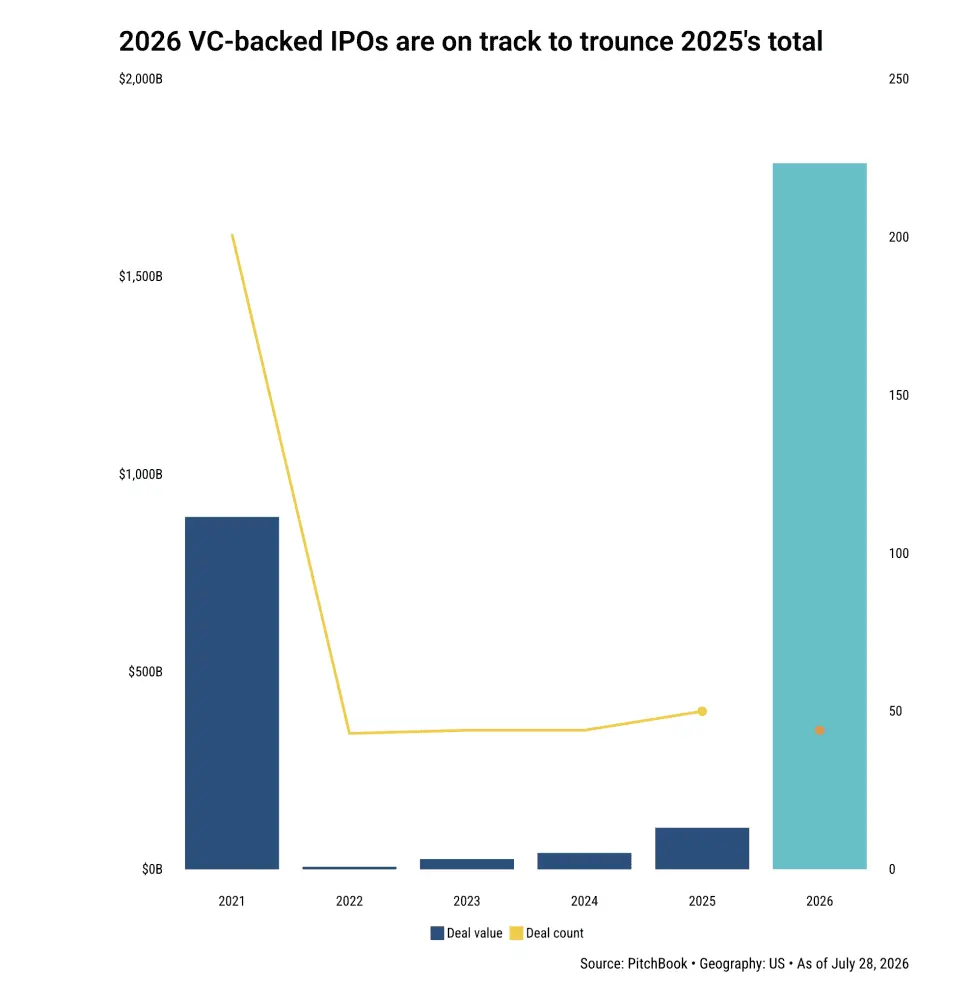
Strip away a single outlier—SpaceX’s historic June debut at a staggering $1.77 trillion valuation—and the illusion of a broad-based IPO boom vanishes. The remaining 43 VC-backed IPOs of 2026 combined account for a modest $17 billion in value. Far from a market-wide recovery, the current landscape represents a continuation of the stagnant conditions of 2023 and 2024, albeit stamped with a trillion-dollar asterisk.
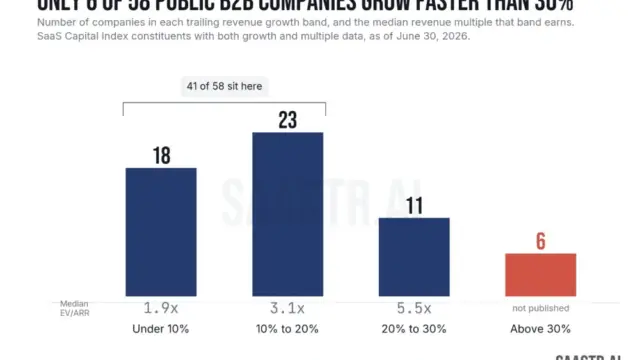
Even more startling is the near-total evaporation of traditional B2B software companies from the public docket. Not a single venture-backed enterprise SaaS or application software unicorn submitted filing paperwork in 2026. As public markets rigorously reprice technology stocks based on whether artificial intelligence renders them obsolete or indispensable, a profound structural sorting is underway. The IPO window is not broken; rather, it has been forcefully redesigned, shutting its doors to seat-priced application software while remaining selectively open to consumption-driven infrastructure, hard-tech, and life sciences.
Detailed Chronology: How a Trillion-Dollar Debut Masked a Flat Market
The trajectory of the 2026 market became crystal clear on June 12, when SpaceX completed the largest initial public offering in corporate history. Opening at $135 a share, the aerospace and AI-adjacent giant commanded a post-money valuation of roughly $1.77 trillion. By issuing 555.56 million shares and leveraging underwriter overallotments, the company raised a record-shattering $85.7 billion.
When factored into aggregate industry tracking, SpaceX single-handedly inflated year-to-date VC-backed IPO volume to $1.786 trillion. But this methodology obscures a vital distinction: PitchBook’s metrics measure post-money valuation at listing, not direct capital proceeds. No pool of public investors handed $1.8 trillion in raw cash to founders and limited partners this year. The actual cash raised by the rest of the cohort is a rounding error against that towering figure.
When evaluating the cadence of the market by sheer volume of offerings, the metrics initially suggest normalization. Through late July, 44 VC-backed companies had gone public, pacing toward roughly 75 offerings by year’s end—a meaningful uptick from the 50 listings recorded across all of 2025. Yet, historical volume was never the true bottleneck of the post-2021 tech downturn. The underlying structural flaw of the market has always been the reluctance of premier, high-growth category leaders to test the public waters.
That reluctance remains deeply entrenched among enterprise software leaders. Databricks, boasting an immense $5.4 billion in annual revenue growing at a blistering 65% clip and carrying a private valuation of $134 billion, embodied the exact profile historically destined for a triumphant public debut. Yet, in June, CEO Ali Ghodsi delivered a blunt reality check on Bloomberg television: "We will be a public company. I just think this is a terrible year to go public."
When an enterprise powerhouse of that scale concludes the market conditions are hostile, the message to the broader B2B ecosystem is unequivocal.
Supporting Context & Metrics: The Anatomy of the Post-IPO Slump
For the select few companies that did brave the public markets in 2026, the immediate aftermath has proved sobering. Far from soaring out of the gate, many of the most heavily hyped listings faced severe downward pressure within weeks of trading.

Market pundits have pointed to external macroeconomic pressures—such as geopolitical conflicts in the Middle East and rising trade tensions over advanced semiconductor supply chains—to explain the volatility. However, a deeper examination reveals a common thread among the underperforming class:
- Enormous Capital Expenditures: Companies are burning through historic sums of cash to build and maintain infrastructure.
- Extended Runways to Profitability: The timeline required to convert massive capital outlays into stable, predictable free cash flow has stretched considerably.
- Pure Narrative Dependency: Many valuations have relied entirely on the uncritical assumption that the broader AI total addressable market will compound exponentially ad infinitum.
SpaceX itself serves as a prime example of this capital intensity. The company reported spending $10.1 billion on capital expenditures in the three months ending March, more than double the $4.1 billion spent during the same period the previous year, with the vast majority directed toward artificial intelligence scaling. Following a fiscal year that saw net losses approach $5 billion, institutional research firms like CFRA initiated coverage with a sell rating, explicitly citing high capital intensity and stretched valuation expectations. Public market investors, true to form, are shifting their focus away from grandiose narratives and beginning to ruthlessly discount future cash flows.
This dynamic has exposed a persistent chasm between private market valuations and public market realities. For four years, venture capitalists maintained that the IPO window was locked tight. In truth, the window was open; what was locked was the willingness of public shareholders to honor inflated 2021 private-round pricing. The 2026 class tested this hypothesis by bringing some of the world’s most heavily hyped private enterprises to market at or near their private marks, only to watch public buyers markdown those assets by 30% or more within weeks. The valuation gap has not closed; it has simply been validated at a much larger scale.
Official Statements and Industry Perspectives
The structural shifts dividing winners and losers in 2026 are best understood through the commentary of industry leaders navigating the transition. The dividing line across the technology sector is no longer determined by simple quality or top-line growth metrics; it is defined by whether foundational artificial intelligence advancements make a platform more indispensable or entirely redundant.
Public markets are systematically repricing B2B technology through this lens, giving rise to a distinct sorting mechanism:
- Infrastructure & Consumption Winners: Companies providing underlying infrastructure that experiences heavier consumption as AI models scale are thriving. Cloudflare CEO Matthew Prince told investors that AI is effectively re-platforming the internet, representing the single greatest tailwind in the company’s history. Similarly, data warehousing giant Snowflake secured a landmark $6.4 billion cloud and chip agreement with Amazon, subsequently raising its forward guidance. Datadog crossed $1 billion in quarterly revenue for the first time, with sequential growth accelerating from 25% to 29% and finally 32%, fueled by the surging complexity of monitoring multi-model AI environments.
- Application Software Vulnerabilities: Conversely, seat-priced application software companies face existential dread. When foundation model developers like Anthropic routinely ship native design and productivity tools that replicate standalone software features, public markets begin pricing in the risk that an LLM will functionally replace an entire SaaS suite.
This divergence explains why May 2026 saw software stocks register their best month since 2001, effectively dampening chatter of a generalized "SaaSpocalypse," even as specific application software stalwarts floundered. Giants like Salesforce and Adobe—both exceptionally profitable, cash-generative businesses—experienced severe valuation compression because their traditional pricing models are perceived as vulnerable to AI-driven disintermediation. The market is not merely compressing multiples; it is ruthlessly separating infrastructure enablers from application-layer tenants.
Future Outlook: Where Liquidity Flows Next
Despite the chilling effect on enterprise software, pockets of the 2026 IPO landscape have exhibited remarkable resilience and vitality, offering a blueprint for where future liquidity may emerge.
Biotechnology has emerged as a standout performer. A major Bloomberg biotech IPO index surged 55% through late July, comfortably outperforming the broader AI-heavy IPO cohort. When an asset’s investment thesis hinges on binary clinical trials and regulatory approvals rather than speculative compute narratives, public investors have proven highly willing to deploy capital. Furthermore, the broader Renaissance IPO Index—tracking the largest and most liquid U.S. IPOs over a three-year window—posted a 12.7% gain for the year, outperforming the S&P 500’s 8.3% return over the same timeframe.
These indicators prove that the post-IPO landscape is not universally toxic; rather, it is deeply bifurcated. The punishment is heavily concentrated among capital-intensive AI infrastructure plays attempting to anchor themselves to unrealistic private-market valuations.
As the market looks toward the horizon, the path forward for technology listings depends on a reckoning between private valuations and public utility. For B2B SaaS, the pipeline will likely remain frozen until application-layer companies can convincingly demonstrate an AI-resilient moat that enhances, rather than competes with, foundational models. Until that structural realignment occurs, the public markets will continue to celebrate headline-grabbing liquidity events driven by historic anomalies, while quietly ignoring the empty hallways of enterprise software.