Executive Overview
Enterprises are rapidly deploying autonomous AI agents—systems capable of orchestrating complex multi-step workflows, invoking external Application Programming Interfaces (APIs), interacting with Model Context Protocol (MCP) servers, and modifying enterprise databases with minimal human intervention. Yet, traditional governance structures, which rely heavily on static PDF documents, periodic audits, and post-incident reviews, are wholly inadequate for the sub-second velocity of machine intelligence.
In response to this paradigm shift, Microsoft has unveiled a comprehensive, production-grade AI Governance Architecture. Moving far beyond traditional, passive policy frameworks, Microsoft’s architecture anchors itself in a transformative philosophy: moving from policy to proof.
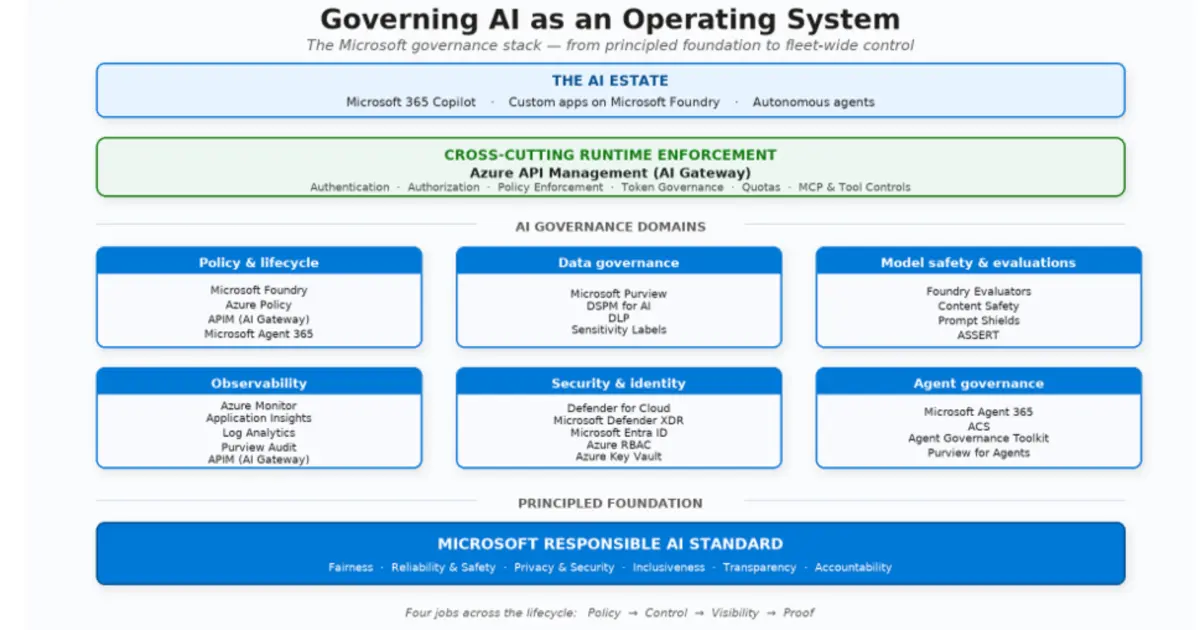
Designed to transition organizations from theoretical governance documentation to active runtime enforcement, continuous evaluation, deep observability, and verifiable audit evidence, the framework creates a closed-loop ecosystem. This architecture spans nine distinct governance domains and four foundational functions—Policy, Control, Visibility, and Proof—effectively bridging the gap between high-level regulatory mandates and the raw, unyielding telemetry of production environments.
By integrating native enterprise tools such as Microsoft Foundry, Microsoft Purview, Microsoft Entra ID, Microsoft Defender, and Azure API Management, the architecture provides a unified control plane. This control plane empowers organizations to scale their artificial intelligence initiatives securely, ensuring that human ambition and machine capability advance in tandem without sacrificing compliance, security, or ethical boundaries.
Detailed Chronology: The Evolution of Microsoft’s AI Governance Framework
To fully appreciate the architectural rigor of Microsoft’s latest announcement, it is essential to trace the chronological and strategic trajectory that led to its creation. For years, the enterprise software ecosystem treated AI governance as a compliance afterthought—a checklist to be reviewed annually by legal teams rather than an operational discipline embedded directly into system architecture.
The Shift from Static Policy to Dynamic Runtime
As generative AI adoption shifted from exploratory proof-of-concept projects to mission-critical production environments between 2023 and 2025, enterprises encountered a glaring operational void. While organizations established comprehensive AI ethics charters and acceptable use policies, their development and security teams lacked the tooling required to enforce these rules at runtime. A policy stating that "AI models must not disclose proprietary source code" meant little when a fast-moving developer pipeline exposed an API key or inadvertently leaked intellectual property to an external foundational model.
Recognizing this critical vulnerability, Microsoft began conceptualizing a runtime governance model that could intercept, inspect, and evaluate AI interactions on the fly. This conceptual evolution crystallized in early 2026, marked by the release of the open-source Agent Governance Toolkit in April 2026, which provided early access to runtime security capabilities for autonomous agents.
The Culmination: The "From Policy to Proof" Architecture
The release of the formal AI governance architecture document in mid-2026 served as a watershed moment. Rather than offering a loose collection of disparate security recommendations, Microsoft unified its product ecosystem—specifically leveraging Microsoft Foundry and the Foundry AI Gateway—into a cohesive, cyclical governance pipeline.
The architecture formally maps out how an organization moves from defining a risk classification in a policy document to capturing cryptographic or operational telemetry in an audit log. By treating governance as a continuous operational loop rather than a static gate, Microsoft has established a new benchmark for how hyperscalers must support enterprise compliance in the age of autonomous systems.
The Four-Function Operational Loop and Nine Governance Domains
At the heart of Microsoft’s architecture is a continuous operational loop underpinned by four core functions, which operationalize governance across nine critical domains.
┌────────────────────────────────────────────────────────┐
│                      POLICY                            │
│         Establishes requirements & risk classes        │
└───────────┬────────────────────────────────┬───────────┘
            │                                │
            ▼                                ▼
┌───────────────────────┐        ┌───────────────────────┐
│        CONTROL        │        │     EVALUATIONS       │
│  Enforces runtime &   │        │   Tests quality and   │
│    access rules       │        │    safety metrics     │
└───────────┬───────────┘        └───────────┬───────────┘
            │                                │
            └───────────────┬────────────────┘
                            │
                            ▼
                    ┌───────────────┐
                    │  OBSERVABILITY│
                    │ Captures live │
                    │    behavior   │
                    └───────┬───────┘
                            │
                            ▼
                    ┌───────────────┐
                    │     AUDIT     │
                    │   Converts    │
                    │ telemetry to  │
                    │    evidence   │
                    └───────────────┘
The Four Core Functions
- Policy: The foundational layer where organizations establish overarching regulatory requirements, risk classifications, and acceptable use boundaries.
- Control: The active enforcement mechanism that translates high-level policies into granular access controls, prompt shields, token limits, and runtime interception rules.
- Visibility (Observability): The continuous monitoring layer that captures live system behavior, tracking user prompts, model responses, token consumption, and tool execution paths.
- Proof (Audit & Evaluation): The verification engine that subjects AI outputs to pre-deployment and continuous post-deployment evaluations, converting operational telemetry into undeniable audit evidence for compliance officers and regulators.
The Nine Governance Domains
To ensure comprehensive coverage, the framework addresses nine interconnected domains that span the entire lifecycle of an enterprise AI deployment:
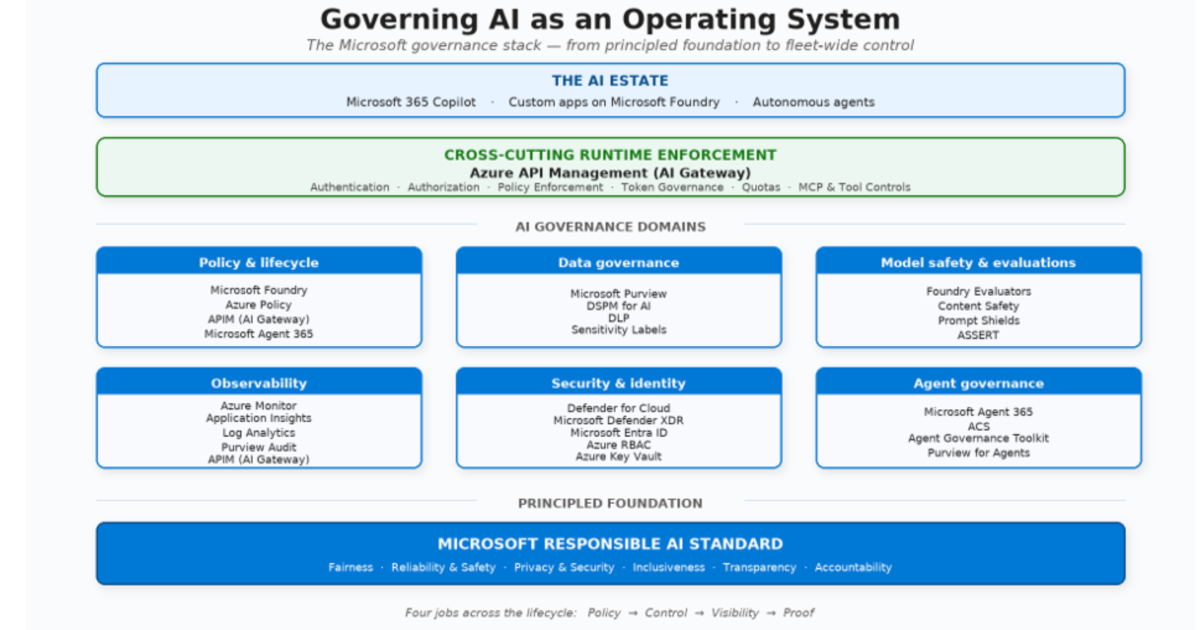
- Policy Domain: Defining organizational constraints and risk appetites.
- Data Governance: Ensuring secure ingestion, handling, and masking of enterprise data used in Retrieval-Augmented Generation (RAG) and fine-tuning pipelines.
- Model Governance: Managing model selection, versioning, deployment registries, and lifecycle retirement.
- Observability Domain: Capturing runtime telemetry and tracking drift, latency, and anomalous behavior.
- Evaluations Domain: Systematically testing applications against custom and built-in safety and quality benchmarks.
- Security Domain: Defending against prompt injection, data exfiltration, and adversarial jailbreaks.
- Identity & Access Management (IAM): Governing permissions for both human users and non-human autonomous agents.
- Audit & Compliance Domain: Aggregating proof logs to satisfy external regulatory frameworks (such as the EU AI Act or NIST AI RMF).
- Agent Governance: Specialized controls for autonomous multi-agent workflows, tool execution checkpoints, and human-in-the-loop overrides.
Technical Integration: Microsoft Foundry, Gateways, and MCP Tools
To transition this architectural vision into reality, Microsoft has anchored its governance model within its broader cloud ecosystem, utilizing Microsoft Foundry as the central orchestration engine.
The Foundry AI Gateway as a Runtime Boundary
A standout technical innovation within the architecture is the positioning of the Foundry AI Gateway. Rather than forcing developers to embed complex compliance checks directly into their application logic—which leads to fragmented security implementations and high maintenance overhead—the AI Gateway acts as an unyielding runtime boundary.
Operating seamlessly between client applications and foundational models, the gateway enforces:
- Centralized Authentication & Authorization: Ensuring that only verified users and authorized agents can query specific models.
- Token Limits & Quotas: Preventing runaway loops or denial-of-service attacks driven by erratic agent behavior.
- Policy Enforcement: Intercepting prompts and responses in real time to scan for toxic content, regulated data leakage, and prompt injection attempts.
Governing Model Context Protocol (MCP) Servers
As enterprises increasingly adopt the Model Context Protocol (MCP) to connect AI agents to external tools, databases, and enterprise systems, securing these integrations has become paramount.
Microsoft’s architecture addresses this challenge directly. By routing MCP tool interactions through the Foundry AI Gateway, organizations can apply centralized authentication, rate limiting, IP restrictions, and comprehensive audit logging without modifying the underlying MCP servers or agent code. This non-intrusive governance model allows engineering teams to innovate rapidly while security teams retain absolute operational visibility and control.
Continuous Evaluation Framework
Evaluation in Microsoft’s architecture is not a one-time gate passed before software release; it is an ongoing operational discipline. Using Microsoft Foundry, engineering teams can evaluate AI applications and autonomous agents against curated test datasets using both built-in evaluators (measuring metrics like groundedness, relevance, and safety) and custom business-specific evaluators.
Crucially, these evaluation engines run both pre-deployment (in CI/CD pipelines) and post-deployment (sampling production traffic), ensuring that model degradation, data drift, or emergent behavioral shifts are caught and remediated immediately.
Official Statements and Industry Insights
The release of Microsoft’s architecture has generated significant dialogue across the cloud architecture and enterprise compliance communities, highlighting a growing consensus that operational proof must replace passive documentation.
Weighing in on the foundational motivation behind the architecture, Manasa T. Ramalinga, Cloud Solution Architect at Microsoft, shared a powerful perspective in an accompanying LinkedIn post:
"Organizations cannot scale what you cannot control."
Ramalinga emphasized that as enterprises aggressively transition AI workloads from experimental sandboxes into production environments, they are fundamentally re-architecting their foundational digital infrastructure. Rather than treating governance as an afterthought or an administrative burden appended to a finished product, forward-thinking organizations are baking runtime safety directly into their core architectures.
Reinforcing this operational distinction, Anthony Bartolo, Principal Cloud Advocate at Microsoft, captured the essence of the framework in his own analysis:
/filters:no_upscale()/news/2026/08/microsoft-ai-governance/en/resources/1microsoftaigoverance-1786848893730.jpeg)
"Your AI policy is not governance until production can prove it."
Bartolo further illuminated the cyclical nature of the framework, breaking down the operational loop: "Policy defines the rules; runtime controls enforce them; observability captures behavior; evaluations test quality and safety; and audit converts telemetry into evidence."
Industry analysts have noted that this explicit focus on converting operational telemetry into verifiable audit evidence represents a major leap forward, particularly for enterprises operating in highly regulated sectors such as finance, healthcare, and government contracting.
Supporting Context & Metrics: Aligning with Global Frameworks
While Microsoft’s architecture is natively optimized for Azure and its proprietary enterprise tooling (Purview, Entra ID, Defender), its underlying design principles are intentionally aligned with broader, vendor-neutral industry standards.
Mapping to the NIST AI Risk Management Framework
The United States National Institute of Standards and Technology (NIST) AI Risk Management Framework (AI RMF), alongside its Generative AI Profile, provides the gold standard for managing artificial intelligence risks across the entire system lifecycle. The NIST framework organizes risk management into four core functions: Govern, Map, Measure, and Manage.
Microsoft’s nine-domain architecture maps these vendor-neutral governance concepts directly into concrete, actionable platform controls and automated telemetry streams:
- Govern translates into Microsoft’s Policy and Audit domains, supported by Microsoft Purview compliance tooling.
- Map corresponds to Model and Data Governance, identifying risks inherent in data pipelines and model selection.
- Measure aligns directly with Microsoft’s Observability and Evaluation domains, utilizing runtime metrics and automated testing suites.
- Manage is operationalized through the Control, Security, IAM, and Agent Governance domains, utilizing the Foundry AI Gateway and the Agent Governance Toolkit to enforce real-time risk mitigation.
The Rise of Agentic Governance
A critical driver behind Microsoft’s architecture is the explosive growth of autonomous agentic systems. Unlike traditional chatbots that respond reactively to a single prompt, modern AI agents operate with a high degree of autonomy. They invoke tools, make API calls, chain logic across multiple reasoning steps, and interact directly with enterprise software.
To prevent unintended consequences—such as an agent executing an unauthorized database wipe or misinterpreting a customer request—Microsoft’s architecture introduces the Agent Control Specification. This specification mandates rigorous checkpoints across agent inputs, model calls, tool execution phases, and final outputs. Crucially, the framework allows organizations to configure dynamic thresholds where high-impact or high-risk actions automatically trigger mandatory human-in-the-loop approval workflows before execution can proceed.
Future Outlook: The Road Ahead for Enterprise AI Governance
As we look toward the horizon of enterprise technology, Microsoft’s AI governance architecture signals a mature turning point in the adoption curve of artificial intelligence. The wild-west era of unbridled, ad-hoc AI deployment is rapidly drawing to a close, replaced by an era characterized by rigorous operational accountability, automated compliance, and runtime resilience.
What Lies Ahead for Enterprise Architecture?
- Automated Regulatory Reporting: As legislative bodies worldwide—most notably the European Union with the EU AI Act—enforce strict legal penalties for non-compliant AI systems, architectures that automatically convert runtime telemetry into audit-ready proof will transition from "nice-to-have" to business-critical. Expect to see organizations integrating Microsoft’s proof mechanisms directly into external regulatory filing workflows.
- Standardization of Agentic Protocols: As multi-agent systems become the default mode of enterprise software interaction, industry-wide standards for agent identity, non-human access control, and cross-platform safety checkpoints will continue to evolve. Microsoft’s open-source initiatives, such as the Agent Governance Toolkit, position the company to heavily influence these emerging technical standards.
- Deepening Convergence of Security and AI Operations (SecOps & AIOps): The traditional boundaries separating cybersecurity operations, data governance, and AI model evaluation will continue to dissolve. The unification of tools like Microsoft Defender, Entra ID, and Purview within the Foundry architecture points toward a future where protecting an AI model is indistinguishable from protecting the enterprise network itself.
Conclusion
Microsoft’s "From Policy to Proof" architecture marks a definitive evolution in how enterprises must approach the governance of machine intelligence. By moving past static documentation and establishing an active, closed-loop operational architecture encompassing policy, control, visibility, and proof, Microsoft has provided a blueprint for sustainable innovation.
For enterprise leaders, chief information security officers, and cloud architects, the message is unmistakable: unlocking the true economic and operational scale of artificial intelligence is fundamentally tethered to the rigor of your runtime controls. In the autonomous era, you cannot scale what you cannot control—and in production, your policies are only as valid as the proof you can demonstrate.