Azzam Bilal Chamdy is a reporter for Tech Ledgers covering Developer & Software Engineering. She/He is based in Indonesia.
7 August 2026 • 8 min read
In the high-stakes world of large-scale distributed systems, every second of downtime translates to frustrated users, lost revenue, and strained engineering teams. Traditionally, the moment a production alert fires, an on-call engineer is thrust into an exhausting, high-pressure reconnaissance mission. Long before they can even think about fixing a bug, they must piece together a narrative from a sprawling puzzle of disparate sources: tracking down service ownership, parsing dense deployment histories, querying logs and metrics dashboards, digging through wiki documentation, and manually correlating current failure symptoms against past operational anomalies.
To fundamentally transform this friction-heavy triage phase, grocery technology giant Instacart has introduced Blueberry, an advanced, multi-agent artificial intelligence system explicitly engineered to optimize incident response. Rather than leaving engineers to start their investigations from a blank slate, Blueberry acts as an autonomous force multiplier. The system leverages parallelized AI subagents, deep operational telemetry, and over a decade of historical incident knowledge to automatically investigate production issues, surface relevant context, and deliver grounded root-cause hypotheses directly inside Slack within minutes of an alert.
Instacart’s innovation represents a significant evolutionary step in Site Reliability Engineering (SRE) and production operations. By combining general-purpose language reasoning with a deeply customized, tool-aware architecture, Blueberry handles the heavy lifting of context collection. In April alone, the system executed approximately 25,000 diagnostic passes across more than 270 Slack channels, achieving an extraordinary workflow success rate of 99.9% while dispatching over 58,000 Model Context Protocol (MCP) tools across roughly 60 internal team profiles.
This article provides an in-depth investigative look into Blueberry’s architecture, its operational impact, the philosophy driving its design, and what its deployment signals for the future of agentic AI in mission-critical software engineering.
Detailed Chronology & Architectural Mechanics
The genesis of Blueberry was born out of a universal pain point in enterprise software operations: human cognitive overload during midnight pages. Instacart’s platform engineering leadership recognized that while modern observability tooling provides access to virtually unlimited data, the sheer volume of telemetry often creates a paralyzing "needle in a haystack" problem. Engineers spent an inordinate amount of time simply aggregating data before any hypothesis could even be formed.
The Anatomy of an Incident Pass
To solve this, Instacart built Blueberry as a durable, tool-aware harness designed to execute structured investigative workflows. The chronological life cycle of an incident response involving Blueberry unfolds through a tightly choreographed sequence:
The Trigger: A production alert is fired within Instacart’s ecosystem, instantly routing to the relevant team’s Slack channel.
Parallel Subagent Deployment: Upon receiving the alert, Blueberry does not rely on a monolithic LLM call. Instead, it dynamically instantiates approximately 10 specialized subagents that operate concurrently.
Context Harvesting via MCP: These subagents fan out across the enterprise infrastructure, querying a side-mounted Model Context Protocol (MCP) catalog. They pull in real-time logs, recent code deployments, service ownership topologies, and performance metrics.
Historical Grounding: Crucially, the system cross-references current failure signatures against a vast repository of historical data—specifically drawing from Instacart’s 14-year archive of past incidents.
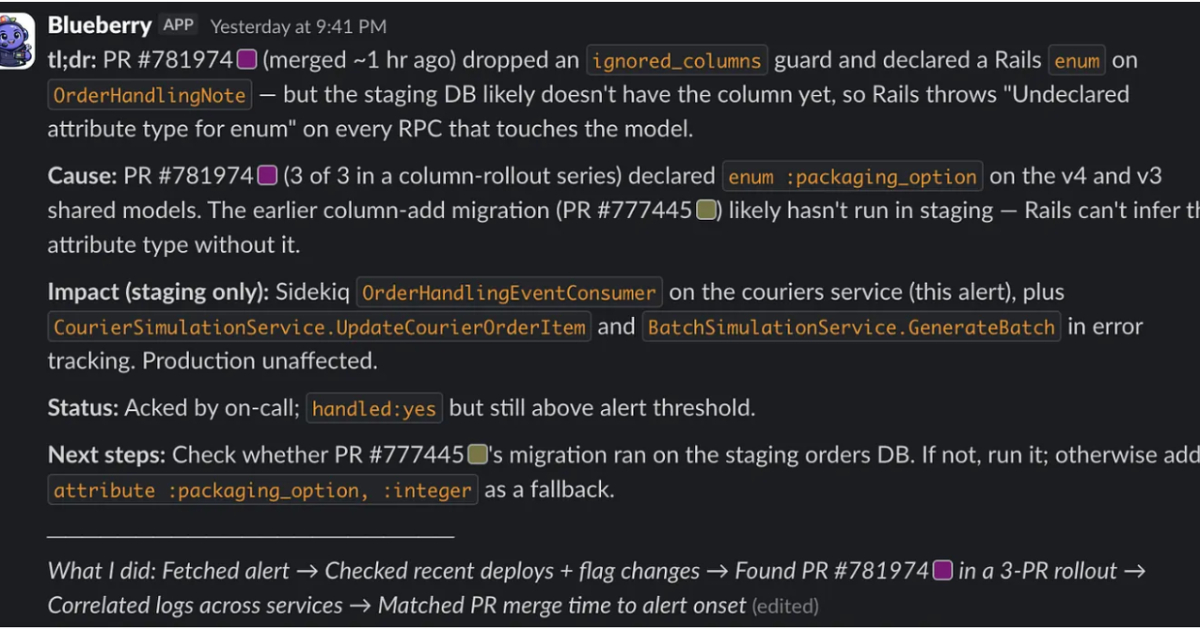
Hypothesis Generation & Delivery: Within roughly three minutes of the initial alert, Blueberry synthesizes its findings and deposits a structured, grounded root-cause hypothesis directly into the active Slack thread.
Bridging the Gap: Context vs. Control
A core architectural challenge in designing AI agents for production environments is mitigating the risks of hallucination and automated misconfiguration. Instacart intentionally drew a hard line regarding autonomy. Blueberry is strictly an advisory and investigative engine; it does not execute automated remediation or make direct production changes.
By keeping humans firmly in the loop for remediation decisions, Blueberry respects the unpredictable nuances of complex production systems while completely unburdening engineers from manual data gathering. The system maintains a persistent investigation state, allowing engineers to drill down into specific hypotheses, request further log parsing, or query alternative metrics without losing the contextual thread established by the AI.
Supporting Context & Metrics: Quantifying the Impact
To evaluate whether an internal AI tool is truly driving value, organizations must move beyond qualitative impressions and examine hard empirical data. Instacart’s engineering organization has published compelling metrics that validate Blueberry’s efficacy across scale, precision, and operational reliability.
The Power of Grounded History
In its early experimental iterations, Blueberry faced a hurdle common to general-purpose AI systems: while it could read logs and query tools, its diagnostic accuracy hovered in the mid-60% range due to a lack of institutional context. Every engineering organization has its own unique architecture, naming conventions, tribal knowledge, and failure modes that generic models cannot natively understand.
To bridge this gap, Instacart systematically grounded Blueberry using 14 years of historical incident data. By embedding this institutional memory into the system’s knowledge retrieval pipelines, diagnostic accuracy skyrocketed into the high 90% range. This dramatic leap underscores a vital lesson for enterprise AI adoption: raw model intelligence is insufficient without deep, domain-specific grounding.
Scale and Reliability Metrics
The deployment footprint of Blueberry across Instacart’s infrastructure is substantial, as reflected by operational data from its peak rollout periods:
Diagnostic Volume: Approximately 25,000 diagnostic passes executed in a single month (April).
Collaboration Reach: Active deployment across more than 270 specialized Slack channels, supporting roughly 60 unique team profiles.
Tool Utilization: Over 58,000 dispatches of Model Context Protocol (MCP) tools, demonstrating high-frequency interaction with underlying observability platforms.
Execution Reliability: A staggering 99.9% workflow success rate, ensuring that engineers can depend on the tool even under high-stress, chaotic operational conditions.
By integrating seamlessly into existing chat-based workflows, Blueberry respects the cultural habits of modern engineering teams. Engineers do not need to log into a separate portal or learn a proprietary interface; the AI meets them precisely where they are communicating.
Official Statements & Leadership Perspectives
The successful launch of Blueberry has generated significant discussion across Instacart’s technical leadership ranks, highlighting a shared vision for agentic AI as a transformative cultural and operational lever.
Anirban Kundu, Chief Technology Officer at Instacart, framed Blueberry as a pioneering milestone in the company’s broader exploration of agentic AI systems. In his public commentary, Kundu emphasized the speed and precision of the platform:
"When an alert is triggered, Blueberry launches approximately 10 subagents in parallel and generates a grounded root cause hypothesis directly in the Slack thread where engineers are working… typically providing this initial investigation output within about three minutes."
Echoing this sentiment, Siby Alappatt, Vice President of Engineering, pointed to the tangible relief the system brings to front-line responders:
"Blueberry has proven to be a force multiplier in harnessing AI to help transform on-call and help us quickly troubleshoot and mitigate complex issues in production."
Alan Wong, Director of Software Engineering, emphasized how Blueberry fundamentally alters the psychological and tactical starting point of an incident response:
"Instead of starting from an empty investigation path, engineers can begin with collected context such as logs, deployments, and related system information. Blueberry changes the starting point for on-call engineers by providing relevant information before deeper analysis begins."
These statements collectively reflect a mature engineering philosophy: AI should not replace the engineer’s judgment, but rather elevate it by automating administrative and exploratory drudgery.
Future Outlook: The Evolution of Agentic Operations
Instacart’s successful deployment of Blueberry offers a blueprint for the future of Site Reliability Engineering and enterprise software operations. As distributed systems continue to scale in complexity, manual triage is rapidly becoming an unsustainable bottleneck.
The Shift Toward Proactive Agentic Frameworks
While Blueberry currently operates reactively—spinning up in response to a production alert—the architectural foundations laid by Instacart hint at a broader trajectory. Future iterations of agentic operations platforms are likely to move further left, utilizing continuous background reasoning to detect anomalous drift before alerts even fire. By pairing persistent MCP tool catalogs with predictive modeling, systems may soon be able to recommend architectural optimizations or preemptively flag brittle dependencies.
Cultural and Architectural Takeaways for the Industry
For engineering leaders watching Instacart’s journey, Blueberry underscores several indispensable principles for building effective operational AI:
Context Trumps Raw Parameters: Domain-specific grounding—such as Instacart’s integration of 14 years of incident history—is far more valuable for operational accuracy than relying on generalized intelligence.
Workflow Cohesion: AI tools must integrate natively into existing communication fabrics (like Slack) rather than demanding context-switching into siloed dashboards.
Controlled Autonomy: Maintaining a clear boundary between investigation/recommendation and execution/remediation builds vital trust between engineering teams and autonomous systems.
As agentic AI matures from experimental prototypes into mission-critical infrastructure, Instacart’s Blueberry stands out as a pragmatic, highly scalable implementation that successfully lightens the cognitive load of keeping modern applications running.



/filters:no_upscale()/news/2026/08/instacart-blueberry-sre-ai/en/resources/1instacartslack-1785721385389.jpeg)