
Executive Overview
For decades, the promise of industrial robotics has been anchored in a singular, elusive goal: creating machines capable of seamlessly stepping into human workflows to perform repetitive, physically demanding tasks around the clock. While traditional robotic arms and Automated Guided Vehicles (AGVs) have long dominated structured factory floors, they have routinely stumbled when confronted with the chaotic, dynamic realities of modern logistics and fulfillment centers. Enter humanoid robotics—a rapidly maturing frontier promising general-purpose adaptability.
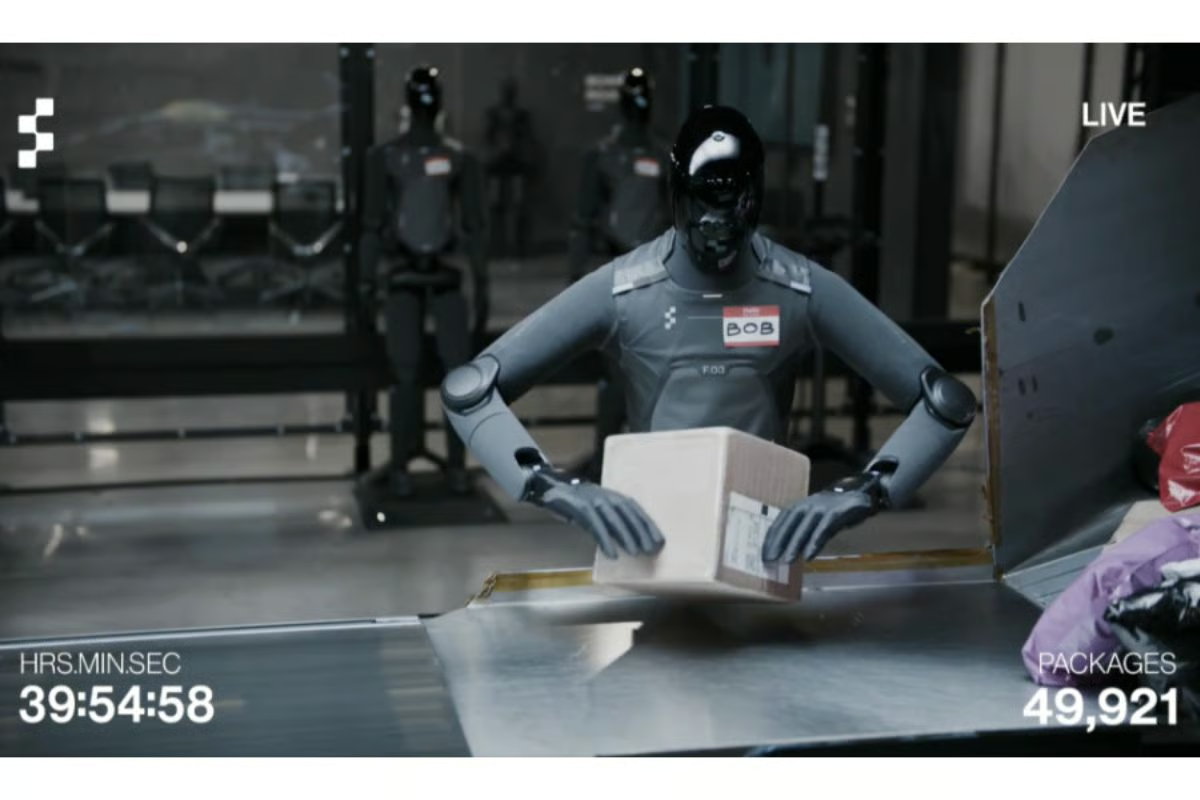
In a landmark demonstration that could fundamentally reshape the calculus of warehouse automation, robotics innovator Figure has pushed its humanoid robots far beyond initial design expectations. What was originally slated as a standard, eight-hour benchmark test exploded into an extraordinary feat of endurance. Powered by the company’s proprietary Helix 02 neural framework, a team of humanoid robots—affectionately named Bob, Frank, Gary, and eventually joined by Rose—successfully sorted packages autonomously for nearly 40 consecutive hours.
By the time the livestreamed endurance run concluded, the quad of humanoids had processed more than 50,000 packages without a single reported mechanical failure or human intervention. This milestone shifts the conversation within the logistics and manufacturing sectors. The debate is no longer about whether bipedal robots can maintain power or perform isolated tricks in controlled laboratory environments; it is rapidly becoming about whether these machines can sustain continuous industrial operations through grueling, multi-shift workloads.
Detailed Chronology: The 40-Hour Marathon
The path to Figure’s milestone reads like a progressive stress test designed to push both software and hardware to their absolute limits. The operation was streamed live, offering industry observers an unvarnished look at how autonomous humanoid systems handle sustained, real-world pressures.
The Initial 8-Hour Baseline
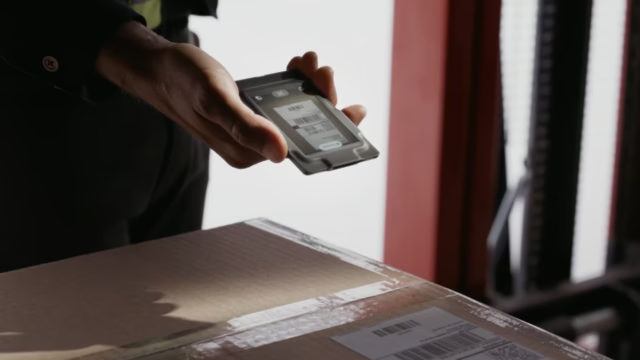
When Figure engineers initiated the warehouse simulation, the primary objective was modest by industrial standards: complete a standard eight-hour operational shift. The task itself was deceptively complex. The robots were tasked with scanning incoming packages, detecting barcodes, accurately picking up individual items, and placing them face-down onto conveyor belts with consistent precision.
Throughout this initial window, the robots—relying entirely on onboard computing and the Helix 02 software architecture—executed their pick-and-place routines with flawless execution. Witnessing zero downtime or operational failures during the first shift, the engineering team made a high-stakes decision: keep going.
Crossing the 24-Hour Threshold
As the robots ticked past their initial schedule, they entered territory rarely achieved by bipedal systems operating on continuous battery and compute loads. At the 24-hour mark, the robots had processed over 28,000 packages without stopping for maintenance, recharging resets, or manual troubleshooting.
Figure Founder and CEO Brett Adcock took to social media to broadcast the achievement. “Our original goal was an 8-hour run. After zero failures yesterday, we decided to keep going. We’re now over 24 hours of continuous autonomous operation without failure. This is a new frontier,” Adcock wrote on X (formerly Twitter).
Pushing Past 30 and Into 40 Hours
Not content with a single day of continuous operation, the system continued to churn through inventory. By hour 30, the continuous operational log showed zero downtime, with cumulative processing surpassing 38,000 packages.
The climax of the demonstration arrived when the cumulative run officially crossed the 40-hour mark, culminating in a staggering total of more than 50,000 packages sorted. Notably, midway through the marathon, a fourth robot named Rose was successfully integrated into the active workspace alongside Bob, Frank, and Gary, demonstrating the scalability and adaptability of the fleet within a shared environment.
Supporting Context & Metrics: Decoding the Helix 02 Architecture
To appreciate the gravity of Figure’s milestone, one must examine the technological leap represented by Helix 02. Introduced earlier this year, Helix 02 is a full-body autonomy system designed to bridge the gap between abstract artificial intelligence and physical kinetic execution.
Unified Neural Networks vs. Modular Control
Traditional industrial robotics typically rely on fragmented control systems: vision processing is handled by one module, path planning by another, and actuator control by a third. This modularity often introduces latency, points of failure, and a brittle inability to adapt when conditions deviate from strict parameters.
Helix 02 takes a fundamentally different approach. It connects the robot’s advanced sensor suite directly to its physical actuators through a unified neural network. This architecture integrates:
- Vision: High-definition spatial awareness for identifying package boundaries and barcodes.
- Touch: Tactile feedback loops ensuring optimal grip pressure without damaging goods.
- Proprioception: Internal awareness of body position, joint tension, and balance.
- Whole-Body Control: Dynamic equilibrium management that allows the robot to walk, shift weight, and manipulate objects as a cohesive, harmonious system.
Beyond Simple Pick-and-Place
The significance of the 40-hour run lies not just in the sheer volume of packages handled, but in the physical endurance required. Maintaining balance on two legs while repeatedly reaching, lifting, twisting, and placing items places immense strain on actuators, thermal management systems, and power supplies.
Previous demonstrations of Helix 02—such as a complex, four-minute autonomous dishwasher-loading task executed entirely via onboard sensors and zero teleoperation—proved the system’s dexterity. However, the warehouse endurance trial proves that this dexterity is robust enough to endure the thermal and mechanical fatigue of multi-day deployments.
Official Statements and Industry Reception
The commercial implications of Figure’s livestreamed marathon have reverberated across enterprise technology and logistics circles. Industry leaders are weighing the tension between impressive public demonstrations and the rigorous demands of enterprise procurement.
Leadership Perspective
Brett Adcock’s public commentary emphasized that the industry has officially entered uncharted waters. By demonstrating that autonomous humanoid systems can operate across multiple standard work shifts without human intervention, Figure is attempting to reframe the timeline for commercial humanoid deployment.
The ability to operate continuously without teleoperation—meaning no human was sitting behind a console remotely steering the robots out of trouble—underscores the maturity of Figure’s onboard perception and machine learning models.
The Skepticism of Enterprise Buyers
Despite the celebratory tone of the livestream, supply chain executives and enterprise IT buyers maintain a pragmatic, cautious stance. Industry analysts point out several critical factors that separate a controlled demonstration from a factory deployment:
- Independent Auditing: The 40-hour milestone was broadcast via Figure’s own channels. Prospective enterprise buyers typically demand independent verification, rigorous third-party testing, and standardized benchmarking before committing capital to emerging hardware categories.
- Edge Cases and Environmental Variability: Warehouse floors are notoriously unpredictable. Spills, misplaced inventory, equipment jams, and variable lighting present constant hurdles. While a curated livestream showcases optimal performance, real-world deployment requires robust handling of unforeseen anomalies.
- Total Cost of Ownership (TCO): Beyond uptime and sorting speed, logistics operators must evaluate maintenance costs, energy consumption, component lifecycle wear, and safety compliance metrics before replacing traditional automation with bipedal humanoids.
Future Outlook: What’s Next for Humanoid Robotics?
Figure’s 40-hour endurance test serves as a critical signpost for the trajectory of enterprise robotics. As companies race to solve labor shortages, rising fulfillment costs, and the physical constraints of traditional warehouses, the pressure on robotics developers to prove real-world viability has never been higher.
The Road to Commercialization
The transition from endurance demos to commercial fleets will hinge on Figure’s ability to replicate these results outside the lab. As the company refines its hardware and software iterations, potential buyers will be watching closely for pilot programs deployed directly into active, third-party distribution centers.
The competitive landscape—featuring heavyweights and agile competitors alike, including Tesla, Unitree, Agility Robotics, and UBTech—is locked in a high-stakes race for commercial dominance. Success will ultimately be measured not by how long a robot can run on a livestream, but by how seamlessly it integrates into enterprise IT infrastructure, adheres to industrial safety standards, and delivers a measurable return on investment for warehouse operators.
For now, Bob, Frank, Gary, and Rose have established a formidable benchmark. Whether the rest of the robotics industry can match—and exceed—this endurance milestone will define the next chapter of enterprise automation.