Executive Overview
Workers have interacted with digital assistants like Copilot by typing prompts or clicking icons within software suites such as Microsoft 365. However, as autonomous AI agents evolve from passive helper tools into active participants in daily workflows, the physical architecture of human-computer interaction is shifting.
At the Microsoft Build 2026 conference, the technology giant unveiled Project Solara, an ambitious chip-to-cloud platform designed explicitly for "agent-first experiences." Rather than pitching another software update, Microsoft introduced two physical concept hardware designs that aim to liberate AI agents from the confines of standard PCs.
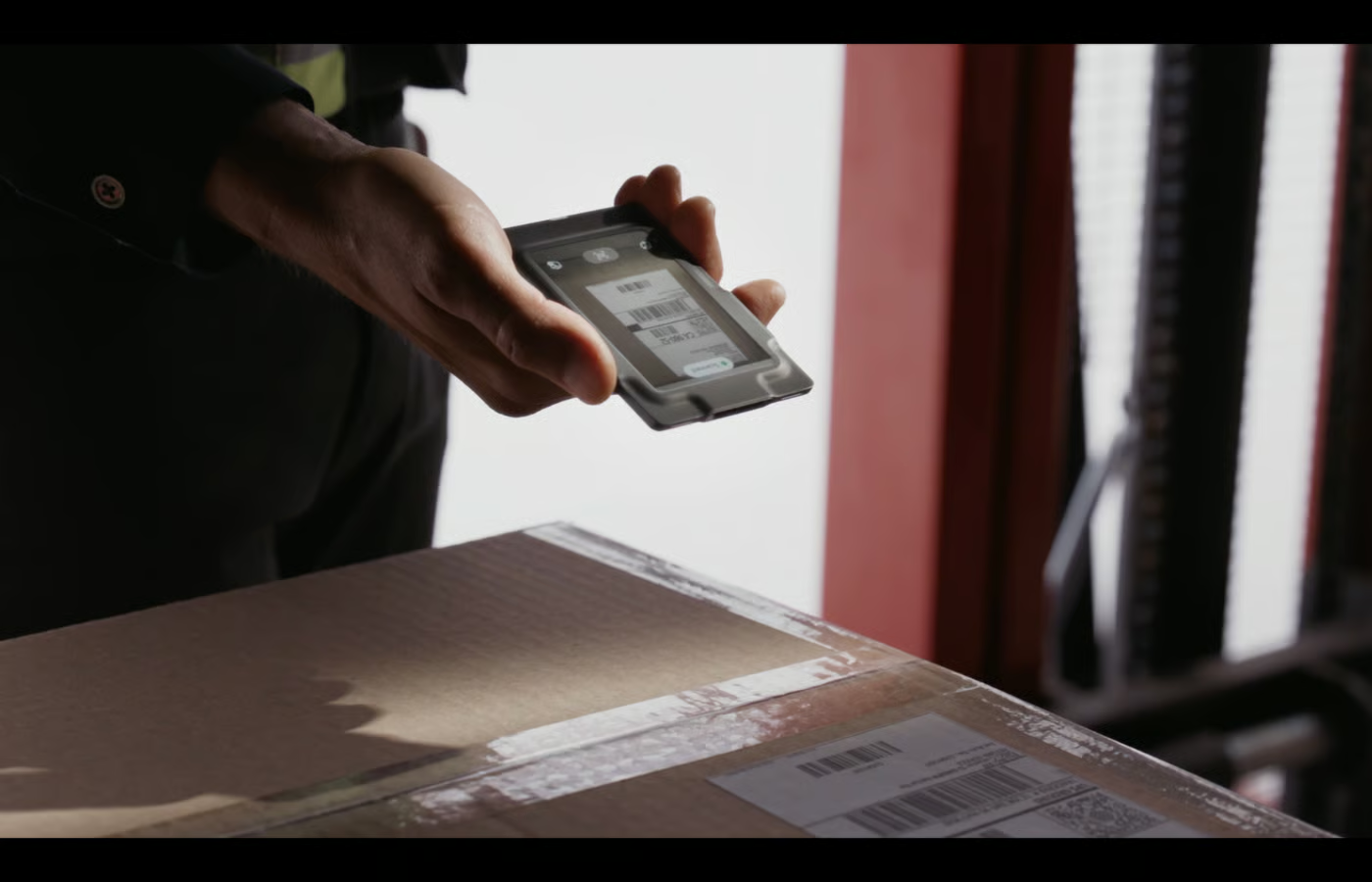
The first is a wearable AI badge roughly the size of an office access card, complete with a touch screen, high-definition camera, and fingerprint scanner. The second is an intelligent desk display engineered to surface Microsoft 365 data and respond instantly to voice inputs.
Rather than positioning these gadgets as consumer products ready for immediate retail shelves, Microsoft is releasing them as reference designs. Developed in close partnership with silicon heavyweights Qualcomm and MediaTek, Project Solara serves as an open blueprint for hardware manufacturers looking to engineer the next generation of enterprise AI devices.
Powered by the Microsoft Device Ecosystem Platform (MDEP)—an enterprise-grade operating system built on Android Open Source Project (AOSP)—these devices integrate seamlessly into existing corporate IT infrastructures using security mainstays like Microsoft Intune, Entra ID, and Windows Hello for Business.
While early enterprise pilots are already underway with major brands including AccuWeather, Best Buy, CVS Health, and Target, the initiative also resurrects critical discussions surrounding workplace surveillance, employee privacy, and the operational compliance of AI hardware equipped with active optical and audio sensors.
This deep-dive investigative report examines the architecture, strategic implications, security frameworks, and future outlook of Microsoft’s Project Solara.
Detailed Chronology: Unveiling Project Solara at Microsoft Build 2026
The journey toward Project Solara did not happen overnight; it represents the culmination of Microsoft’s aggressive pivot toward agentic artificial intelligence. For the past three years, the company has integrated generative AI across its enterprise ecosystem. Yet, executives increasingly recognized a fundamental friction point: forcing autonomous agents to wait inside desktop applications limits their utility in dynamic, physical environments.
The Build 2026 Reveal
During the keynote presentations at Microsoft Build 2026, Microsoft executives pulled back the curtain on the company’s vision for ambient, hardware-level enterprise intelligence.
Steven Bathiche, a key Microsoft executive spearheading modern hardware innovation, took the stage to demonstrate the two core pillars of Project Solara:
- The Wearable AI Badge: Designed to replace or accompany traditional corporate security credentials, this badge is roughly the dimensions of a standard office access card. It can be clipped securely to a lanyard or lapel. During the live demonstration, Bathiche activated the device securely via a built-in biometric fingerprint scanner. He then prompted the badge to capture live photographs of the auditorium audience and transmit them to an underlying cloud agent for analysis and contextual review.
- The Desktop Smart Display: This secondary device functions as a dedicated ambient terminal for office environments. Shaped like a compact, elegant smart display, it connects directly to Microsoft 365 services—such as Outlook, Excel, and Teams—allowing desk-bound workers to offload routine tasks, check calendar scheduling, and execute complex data queries via hands-free voice commands without needing to open a single traditional software application.
The "Chip-to-Cloud" Architectural Philosophy
Microsoft formally described Project Solara as a comprehensive "chip-to-cloud platform." This definition emphasizes that the initiative goes far beyond standard peripheral manufacturing.
By partnering with silicon innovators like Qualcomm and MediaTek, Microsoft has ensured that the underlying processing architecture is optimized locally on the device (Edge AI) while scaling securely into Azure cloud infrastructure for heavy agentic reasoning.
In a follow-up corporate blog post, Bathiche emphasized the functional necessity of the badge’s optical sensor suite:
"The camera lets agents better understand and take action on the environment around them."
By giving AI agents "eyes" and "ears" inside the physical workspace, Microsoft is shifting the paradigm from software that waits for user input to proactive systems that observe, interpret, and assist in real time.
Echoing this sentiment during post-keynote media sessions, Microsoft CEO Satya Nadella characterized the hardware as an entirely "new form factor" for enterprise computing, drawing parallels to the early days of mobile computing when smartphones fundamentally redefined human connectivity.
Supporting Context, Architecture, and Enterprise Metrics
To understand why Microsoft is shifting its hardware strategy toward wearable AI badges and desktop terminals, one must analyze the technical backbone and enterprise management frameworks powering Project Solara.
The Microsoft Device Ecosystem Platform (MDEP)
A major hurdle for corporate IT departments deploying novel hardware is security and device management. Introducing untried smart badges or peripheral displays into a corporate network can easily introduce vulnerabilities or administrative nightmares.
To mitigate these concerns, Microsoft built Project Solara upon the Microsoft Device Ecosystem Platform (MDEP).
MDEP is an enterprise-grade operating system foundation built upon the Android Open Source Project (AOSP), heavily customized and hardened for corporate environments. By leveraging MDEP, Project Solara devices inherit the gold standard of enterprise management tools:
- Microsoft Intune: Allows IT administrators to provision, monitor, update, and wipe Solara devices remotely.
- Microsoft Entra ID: Provides centralized identity and access management, ensuring that every interaction with an AI agent is tied securely to an authenticated corporate identity.
- Windows Hello for Business: Powers biometric authentication layers, such as the badge’s fingerprint scanner, ensuring that unauthorized individuals cannot access sensitive enterprise data even if the physical badge is lost or stolen.
Reference Designs vs. Commercial Hardware
It is vital to note that Microsoft does not plan to manufacture, market, or sell Project Solara devices directly to end consumers or corporate procurement departments. Instead, Microsoft is acting as an ecosystem architect.
By treating Solara as a reference design, Microsoft provides original equipment manufacturers (OEMs) with a validated blueprint containing hardware schematics, software integration layers, and security frameworks.
Industry analysts tracking the announcement noted that this strategy mirrors Microsoft’s historic approach with early tablet and mobile reference guidelines. By delegating physical manufacturing to hardware partners—backed by silicon optimization from Qualcomm and MediaTek—Microsoft minimizes its direct supply chain risk while maximizing the potential surface area for its enterprise software and AI agent ecosystem.
Early Enterprise Pilots
While commercial availability dates and unit pricing remain unannounced, Microsoft has already initiated restricted enterprise pilots with a select cohort of forward-thinking organizations.
Early testing partners include major industry players such as AccuWeather, Best Buy, CVS Health, and Target. These enterprise pilots are designed to stress-test how wearable and desktop AI form factors perform in high-stakes, fast-paced environments—ranging from retail storefront floors to logistical distribution hubs and meteorological operational centers.
Official Statements and Industry Reactions
The announcement of Project Solara immediately generated intense debate across the enterprise technology sector, drawing commentary from corporate leadership, hardware analysts, and privacy advocates alike.
Microsoft Leadership Perspectives
In his keynote remarks at Build 2026, Satya Nadella framed the hardware rollout as a natural evolution of enterprise digital transformation. Nadella noted that as software agents transition from reactive chatbots to proactive enterprise partners, they require physical anchors in the real world.
By bridging the gap between digital Microsoft 365 workflows and physical workspaces, Microsoft aims to keep enterprise users engaged within its ecosystem regardless of whether they are sitting at a traditional desk, walking a warehouse floor, or attending an in-person executive briefing.
Steven Bathiche further elaborated on the human-agent dynamic during his product demonstrations, stressing that wearable AI must feel effortless:
"Workers use agents throughout the day, but those agents shouldn’t be locked behind a desktop interface when the physical world demands immediate attention and context."
Independent Industry Analysis
External technology analysts have offered varied perspectives on the feasibility and appeal of office-centric AI badges.
- The Verge highlighted the strategic nature of the rollout, emphasizing that Microsoft’s decision to position Solara as an open reference design allows third-party hardware manufacturers to experiment rapidly without locking Microsoft into direct device manufacturing liability.
- Engadget focused on the critical silicon partnerships, noting that the close collaboration with Qualcomm and MediaTek ensures these devices will possess sufficient local neural processing unit (NPU) power to handle edge AI computations efficiently without constantly draining battery life or hammering cloud bandwidth.
- Tech-sector commentators have drawn direct comparisons to previous hardware bets by Microsoft, most notably the HoloLens mixed-reality headset. While HoloLens eventually ceased active production in 2024 following years of enterprise adoption challenges and scaling hurdles, observers note that Project Solara is significantly more lightweight, cost-effective, and directly aligned with the current hyper-focus on generative AI and agentic workflows.
Future Outlook: Privacy, Compliance, and the Road Ahead
Despite the undeniable technological ingenuity behind Project Solara, the path to widespread enterprise adoption is fraught with significant cultural, regulatory, and logistical challenges.
The Privacy and Surveillance Dilemma
The introduction of a wearable badge equipped with an active camera, microphone, and internet connectivity immediately triggers profound privacy and compliance alarm bells.
In modern corporate environments—where employee monitoring is already a sensitive topic—introducing a device capable of recording ambient conversations, transcribing private meetings, or capturing continuous visual data of colleagues and clients creates immense legal exposure.
Organizations must grapple with critical questions regarding data governance:
- Consent: How do workers and visitors consent to being filmed or recorded by an AI badge worn by an employee walking down a hallway?
- Data Retention: Where are the captured audio and visual logs stored, who has access to them, and how quickly are they purged?
- Regulatory Compliance: Under stringent privacy frameworks such as the European Union’s General Data Protection Regulation (GDPR) and emerging state-level biometric privacy laws in the United States, continuous passive recording in the workplace could trigger severe regulatory penalties unless robust opt-out and zero-retention defaults are rigorously enforced.
The Evolution of Workplace AI
Project Solara signals a definitive shift in how the technology industry envisions the future of work. We are moving rapidly past the era where artificial intelligence was viewed merely as a software feature residing inside a web browser.
Whether office workers ultimately embrace wearing digital access badges equipped with autonomous AI agents remains an open question that early pilot programs with companies like Best Buy and Target will help answer.
What is certain, however, is that Microsoft is aggressively laying the groundwork for ambient, omnipresent enterprise intelligence. As hardware manufacturers iterate on the Solara reference designs and regulatory frameworks adapt to the realities of wearable AI, the boundary between digital computing and the physical workplace will continue to blur, forever changing how we work, communicate, and collaborate.