Executive Overview
Yet, a sobering truth permeates the tech ecosystem: most companies are, at best, 40% of the way there.
While landmark success stories like Fin (formerly Intercom) capture headlines with massive exits—such as its monumental $3.6 billion acquisition agreement by Salesforce—thousands of other B2B companies are locked in a grueling struggle. They have successfully shipped AI features, deployed autonomous agents into production, and eased some customer pain points, but these measures have failed to move the needle on top-line growth. Revenue expansion remains stubbornly trapped between 10% and 30%.
This comprehensive report explores the structural hurdles stalling B2B growth, the harsh realities of the valuation multiples punishing stagnant companies, the blueprint behind true generational transformations, and why the next two years will separate the category-defining leaders from those who surrender the keys.
Detailed Chronology: The Evolution of the SaaS AI Shift
To understand where the software industry stands today, we must examine the timeline of how the modern enterprise software stack collided with generative artificial intelligence.
Phase 1: The Feature Drop (2023–2024)
When foundational large language models burst into the mainstream in late 2022 and early 2023, the initial industry reaction was swift and reactive. B2B software companies rushed to integrate basic AI text generation, summarization, and rudimentary chatbots into their existing applications. Boardrooms demanded "AI strategies," leading to a flurry of feature releases. During this period, companies marketed these additions heavily, believing that simply having "AI-enabled" on a feature list would justify premium pricing and reignite hyper-growth.
Phase 2: The Growth Stall and Reality Check (2025)
By 2025, the honeymoon phase of the AI feature boom officially ended. While customers appreciated smarter search tools and automated email drafters, overall enterprise growth rates failed to accelerate. Companies realized that adding features to legacy, seat-based SaaS architectures did not fundamentally alter the customer’s workflow or willingness to pay. Software buyers began pushing back against price hikes for tools that merely made individual employees faster, especially when those same efficiency gains often resulted in headcount reductions—thereby shrinking the software vendor’s own user seat count.
Phase 3: The Hard Rebuild and Structural Reckoning (2026 and Beyond)
By mid-2026, the market split into two distinct camps. On one side are the companies stuck in the median 10% to 30% growth band, facing compressed valuation multiples and mounting pressure from private equity and public markets. On the other side are the rare, aggressive operators willing to undergo radical organizational surgery. These enterprises are abandoning seat-based pricing, rewriting core data layers, eliminating human-in-the-loop bottlenecks entirely, and betting their long-term survival on autonomous AI agents.
The premier example of this hard rebuild is Intercom, which spent nearly four years fundamentally restructuring its business around an AI support agent before renaming the 15-year-old company "Fin" in May 2026, culminating in its historic $3.6 billion deal with Salesforce just weeks later.
Supporting Context & Metrics: The 10% to 30% Growth Trap
Public market data and private industry surveys paint an unflattering portrait of the average B2B software company today. The days of effortless 60%+ year-over-year growth at scale have effectively vanished.
Public and Private Market Benchmarks
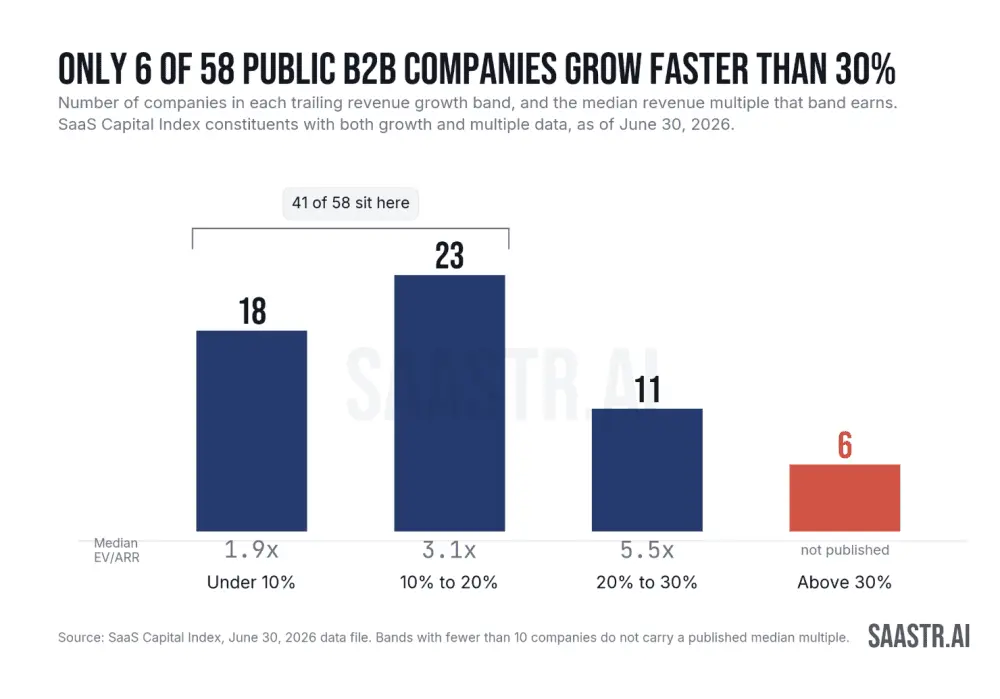
Data compiled from the SaaS Capital Index and PitchBook’s Q2 2026 reports reveal the grim reality of industry-wide growth distribution:
- Estimated Median Revenue Growth: PitchBook pegs median 2026 revenue growth at a modest 13.2% (up slightly from 12.2% in Q1).
- Sector Disparities: The highest-growing pockets belong to DevOps, ITOps, and developer/automation platforms, which hover around a median 21.9% growth rate. Conversely, traditional categories like CRM, sales, marketing, customer experience (CX), collaboration, and productivity sit near the bottom.
- Private Companies: SaaS Capital’s 2026 survey of private B2B companies shows bootstrapped firms growing at a median rate of 20%, while equity-backed counterparts achieve 25%.
The Brutal Cost of Slipping Growth Bands
For B2B executive teams, failing to find a second growth gear carries severe financial penalties. The market valuation multiples tied to growth rates on the SaaS Capital Index illustrate how ruthlessly public and private markets punish deceleration:

- 20% to 30% Growers: Commanded a median multiple of 5.5x.
- 10% to 20% Growers: Slips dramatically to 3.1x.
- Under 10% Growers: Plummets to a dismal 1.9x.
When a company slides from 22% growth down to 18%, it effectively loses half of its enterprise value. This financial Sword of Damocles explains why the pressure on CEOs goes far beyond simply shipping AI code—it is an existential race to escape a valuation penalty that can wipe out years of hard work.
Why "We Shipped AI Features" Fails to Move the Needle
Despite near-universal adoption of AI features across B2B companies generating over $20M in ARR, top-line growth has remained largely unresponsive. Industry experts point to four primary structural reasons for this stagnation:
1. The Pricing Unit Remains Flawed
For decades, the dominant business model for B2B software has been per-seat pricing. However, if artificial intelligence successfully makes each human worker twice as productive, enterprises need half as many seats. If a software vendor continues charging per seat, it has inadvertently built a business model designed to shrink its own billing base. The categories growing the slowest today are precisely the ones most dependent on seat-based monetization. Companies that have successfully broken through this barrier have radically reinvented what they charge for—shifting toward outcome-based, consumption-based, or agent-task pricing.
2. The Agent is Bolted Onto Legacy Workflows
There is a profound operational difference between building an AI assistant and reimagining a workflow. Simply adding a chat sidebar to an existing software screen forces human workers to open, monitor, and manually manage the tool—retaining old friction points. A true AI-first rebuild involves removing the screen entirely, allowing autonomous agents to execute complex, multi-step business processes end-to-end without human intervention. Most companies remain trapped in the former approach because designing for autonomy breaks traditional organizational charts and product roadmaps.
3. The Data Layer is Unprepared for Autonomy
When companies attempt to deploy autonomous agents into production, they routinely hit a massive operational wall: dirty, unstructured, and unmaintained enterprise data. Stale customer records, duplicate entities, and legacy database fields that haven’t been audited in years render advanced AI models ineffective. While foundational models are generally capable, the local corporate context is often a disaster. Most organizations do not discover these deep data deficiencies until an autonomous agent makes a catastrophic error in a live production environment.
4. Go-to-Market (GTM) Motions Target Legacy Buyers
Enterprise software sales teams have spent decades selling productivity tools to middle-management budget holders who buy software based on user seat counts. Selling fully autonomous AI outcomes requires an entirely different sales motion, a new executive champion (often shifting from department heads to the C-suite), and a completely restructured value proposition. Most companies fail to scale their AI initiatives because their sales engines are still optimized for the SaaS playbook of the 2010s.
Official Statements and Industry Perspectives
The path to an AI-first enterprise is littered with difficult choices, leading many exhausted founders to contemplate stepping down or accepting early private equity buyouts.
Market observers and venture investors note a noticeable wave of founder fatigue across the B2B landscape. Executives who successfully navigated the zero-interest-rate policy era, the post-pandemic market correction, and the initial inflation shocks now face a multi-year structural rebuild that requires tearing down the very products they spent a decade building.
When private equity firms step in with offers at 3.0x revenue multiples, the temptation to leave the keys on the table is immense. However, industry veterans caution that incoming operators rarely possess the institutional memory, passion, or foundational vision required to complete a complex technological pivot. Without the original founder’s relentless drive, half-finished AI initiatives are frequently downsized or canceled entirely to protect gross margins in the short term—destroying long-term category dominance in the process.
Future Outlook: The Next Decade Belongs to the Resilient
The stretch from 2024 through 2026 will undoubtedly be recorded as the most grueling chapter in modern B2B software history. Founders have navigated over two years of intense public scrutiny, skeptical boards questioning why growth numbers hover in the high teens, and constant media coverage of lean startups scaling to massive valuations with minimal headcounts.
For the CEOs currently sitting at the 40% completion mark of their structural rebuild, this milestone is not a failure—it is the realistic baseline for an enterprise undergoing major surgery. Companies that achieved 100% transformation typically had to make radical moves, such as completely rebranding their corporate identity around their autonomous AI products.
Key Takeaways for the Road Ahead:
- Embrace the Hard Rebuild: Superficial AI integrations are dead. Long-term survival requires dismantling legacy workflows, overhauling data infrastructures, and shifting away from seat-based pricing.
- Redefine GTM Strategies: Sales motions must evolve from selling software seats to provisioning autonomous digital labor and guaranteed business outcomes.
- Stay the Course: The founders who endure this multi-year crucible and refuse to hand over the keys prematurely will ultimately capture and dominate their respective software categories for the next decade.
The future does not belong to those who started fresh without history; it belongs to the battle-tested operators who navigated the 40% mark in 2026 and refused to quit.