
Today, that conversational baseline has fundamentally shifted. In boardrooms, innovation labs, and enterprise IT centers across the globe, the rhetoric is no longer about potential; it is about accountability, resilience, and operational survival.
As organizations grapple with the harsh realities of deployment, the central inquiries facing modern enterprises have evolved into a complex gauntlet: How do we scale past the pilot phase? How do we govern systems that operate faster than human comprehension? What should we automate, and what must remain strictly human? Is our foundational data infrastructure actually ready for agentic workflows? And ultimately, when an autonomous AI system makes a consequential decision on its own, where does the liability lie?
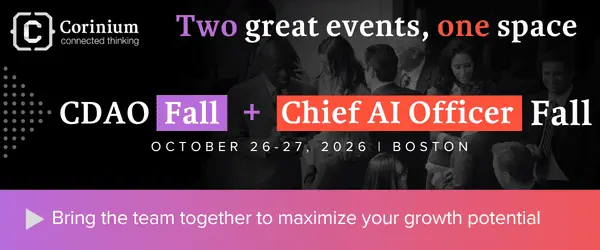
These high-stakes inquiries form the heartbeat of CDAO Fall and CAIO Fall, two premier, co-located leadership events convening on October 26–27, 2026, at the Renaissance Boston Seaport District. Bringing together a veritable who’s who of data, analytics, and artificial intelligence executives from organizations such as Honeywell Aerospace Technologies, the United States Air Force, NYC Health + Hospitals, Johnson & Johnson, Capital One, Comcast, Mass General Brigham Healthcare, Prudential Financial, Travelers, Walmart, Citi, New York Life, The Cigna Group, TE Connectivity, and MetLife, the summit is poised to tackle the enterprise technology landscape’s most pressing intersections of strategy and execution.
Executive Overview: The Transition from Hype to Hard Reality
The overarching narrative of the 2026 enterprise tech cycle is the death of the "pilot graveyard." Countless enterprises poured billions of dollars into generative AI experiments over the last three years, discovering along the way that building a functional prototype in a sandbox environment is vastly different from operationalizing a resilient, secure, and value-generating AI system at scale.
Enterprise leaders are discovering that technical capability does not automatically equate to business value. Issues surrounding spiraling inference costs, architectural debt, shifting regulatory frameworks, and cultural resistance have exposed deep vulnerabilities in how companies approach AI adoption.
To bridge the gap between slide-deck aspirations and P&L reality, CDAO Fall and CAIO Fall have curated a rigorous agenda designed to address these friction points head-on. The upcoming Boston gathering promises to unpack the unglamorous truths of enterprise AI—focusing heavily on data hygiene, autonomous agentic workflows, dynamic regulatory compliance, and the structural transformation of the C-suite itself.
Detailed Chronology: Key Themes Shaping the Agenda
1. Moving Beyond the Pilot Graveyard: Turning Ambition into Operational Reality
The journey from an isolated proof-of-concept to an enterprise-wide production system is fraught with peril. Many organizations find their initiatives stranded indefinitely in the "pilot graveyard," unable to scale due to rigid legacy architectures, unclear business use cases, or a lack of clear ROI metrics.
During the conference, Ash Dhupar, Chief AI & Data Officer at Honeywell Aerospace Technologies, will take center stage to dissect what separates organizations that successfully embed AI into their core operations from those that remain trapped in endless experimentation loops.
Complementing this session, the program features high-impact panel discussions including:
- "From Strategy Deck to Business Reality: What It Actually Takes to Scale Data and AI Across an Enterprise"
- "AI: What’s Next? Hype Cycle to Hard Reality"
These tracks will emphasize the critical importance of ruthless prioritization, strict cost discipline, and—perhaps most importantly—knowing which AI initiatives to terminate before they drain capital and engineering bandwidth.
2. The Unglamorous Foundation: Why Data Architecture Still Dictates AI Destiny
While generative and agentic AI command the headlines, they have done nothing to alter the foundational rule of computing: garbage in, garbage out. In fact, autonomous systems amplify underlying data flaws at machine speed.
A recurring motif throughout the Boston sessions is that advanced AI cannot rescue broken data pipelines. In the session titled "Dirty Data, Broken Promises: The Unglamorous Work That Makes AI Actually Function," data leaders from Johnson & Johnson, Dakota, Omnicom Media, and Sensata will pull back the curtain on the grueling, unglamorous data engineering, governance, and infrastructure investments required to make AI systems viable rather than hazardous.
Further pushing the architectural envelope, Manajit Barman, Chief Data Officer at the United States Air Force, will deliver a keynote titled "The Architecture Decision That Will Define Your Next Five Years," addressing how large, mission-critical institutions must future-proof their data pipelines against rapid technological obsolescence.
Concurrently, sessions like "From Data Movement to Data Momentum: Rethinking Integration in an AI-First World" will explore how organizations can transition from batch-processing data to continuously supplying AI engines with fresh, contextual, and clean data streams.
3. The Agentic Leap: Governance in an Era of Autonomous Action
Perhaps the most profound shift on the technological horizon is the transition from AI that merely advises to AI that actively executes. Agentic AI systems are designed to perceive their environment, reason through complex workflows, and independently initiate actions across enterprise software stacks.
This autonomy shatters traditional governance paradigms.
The session "The Agentic Leap: From AI That Advises to AI That Acts"—featuring senior practitioners from The Hartford, Walmart Global Tech, and MassMutual—will explore the intricacies of autonomous agent frameworks, real-time observability, automated intervention protocols, and the ethical threshold of granting software systems decision-making authority traditionally reserved for humans.
This naturally leads to a radical reimagining of corporate oversight. In "Human in the Loop Is Not a Strategy: Rethinking Oversight for Systems That Move Faster Than People Do," industry leaders will debate whether traditional "human-in-the-loop" checkpoints are mathematically or operationally viable when algorithms execute thousands of micro-decisions per second. Simply having a human sporadically review logs is no longer a legitimate strategy for risk mitigation.
4. Navigating the Regulatory Labyrinth Without Stifling Innovation
As global regulatory bodies ramp up compliance frameworks—ranging from the European Union’s Artificial Intelligence Act to emerging federal and state guidelines in the United States—enterprises face a delicate balancing act. Over-regulation kills agility; under-regulation invites catastrophic legal, financial, and reputational risk.
At CDAO Fall, Colleen Tartow of Capital One and Chandrakanth Thadkapally of Walmart will lead a vital discussion titled "Regulation Is Coming Whether You’re Ready or Not: Building AI Governance That Doesn’t Break the Business."
Rather than treating governance as a static legal checklist, the conversation will center on designing dynamic operating models that embed compliance directly into the software development lifecycle. Additional panels will dissect the corporate trust deficit, the execution of responsible AI frameworks, and how data leaders can transform governance from an enterprise bottleneck into an operational enabler of trusted speed.
5. The Evolution of the C-Suite: The CDAO and CAIO Power Partnership
One of the most fascinating organizational trends highlighted by the co-located summits is the institutional convergence of data leadership and artificial intelligence leadership.
While organizations initially split these functions into isolated silos—treating data engineering as a back-office utility and artificial intelligence as an experimental frontier—the realities of modern tech stacks have forced these roles together. Today, data strategy and AI strategy are inextricably linked.
The symbiotic relationship between these executive roles will be deeply explored in sessions such as:
- "Two Titles, One Mission: What CDAOs and CAIOs Are Finally Figuring Out About Each Other," featuring Adem Albayrak (Chief Data and AI Officer, Alzheon), Sanjay Sidhwani (Chief Data & Analytics Officer, Valley Bank), and Jillian Landi (Chief AI Officer, Needham Bank).
- "The New Power Couple: How the CDAO and CAIO Have to Work Together or Watch Everything Fall Apart."
These discussions move beyond organizational charts to pinpoint the exact operational friction points where CDAOs and CAIOs must lock arms to prevent institutional failure, secure budgets, and drive unified digital transformation.
Supporting Context & Metrics: The Macro Landscape of Enterprise AI
To fully understand the urgency driving leaders to Boston this October, one must examine the broader economic and operational currents sweeping through the global enterprise:
- The ROI Pressure Cooker: According to recent enterprise technology surveys, upwards of 60% of generative AI pilots fail to transition into full-scale production, primarily due to unclear definitions of return on investment and intractable data silos.
- The Talent Bottleneck: Organizations continue to report a severe deficit in cross-functional talent—professionals who understand both deep data architecture and advanced machine learning deployment models.
- Security and Compliance Realities: With shadow AI usage remaining prevalent among corporate workforces, data governance has shifted from a compliance afterthought to a top-three board-level priority.
- Infrastructure Evolution: Enterprise spending has pivoted away from raw compute acquisition toward advanced data integration fabrics, semantic layers, and automated governance platforms designed to support multi-agent ecosystems.
These macro-level pressures ensure that events like CDAO Fall and CAIO Fall function less as traditional networking conferences and more as emergency operational councils for the Fortune 500.
Official Statements and Industry Perspective
The thematic focus of the upcoming summit reflects a mature, sobering industry realization. Enterprise technology analysts note that the era of speculative spending has given way to an era of disciplined execution.
"We are past the honeymoon phase of enterprise AI," notes event advisory material. "Organizations can no longer hide behind impressive demos or vague strategic visions. The mandate for data and AI leaders today is clear: build a resilient data foundation, govern intelligent agents before they govern you, and align executive leadership to turn technological potential into measurable bottom-line value."
By gathering practitioners from highly regulated and complex sectors—spanning healthcare giants like Mass General Brigham, financial institutions like Prudential and Citi, and industrial stalwarts like Honeywell and the United States Air Force—the summit guarantees a cross-pollination of battle-tested strategies that transcend individual industries.
Future Outlook: What Lies Beyond 2026
As we look toward the remainder of the decade, the decisions made by enterprise leaders at gatherings like CDAO Fall and CAIO Fall will cast a long shadow over the global economy.
The successful enterprise of the late 2020s will not necessarily be the one with the most powerful algorithms, but rather the one with the cleanest data pipelines, the most transparent governance models, and the most cohesive C-suite leadership. Autonomous agentic systems will weave themselves into the fabric of daily commerce, supply chain management, patient care, and national defense.
Whether those systems act as engines of immense productivity or catalysts for systemic vulnerability depends entirely on the architectural, ethical, and operational frameworks being engineered today.
Join the Conversation in Boston
CDAO Fall + CAIO Fall will take place from October 26–27, 2026, at the Renaissance Boston Seaport District.
In an effort to ensure high-caliber peer-to-peer discourse, the organizers have announced a strict attendance policy. Qualified senior data, analytics, and AI executives and practitioners from end-user organizations are invited to apply for a complimentary VIP pass to attend the event.
Please note: The complimentary VIP registration program is exclusively reserved for eligible enterprise end-users. Solution providers, commercial vendors, third-party consultants, and service providers are strictly excluded from the complimentary pass program.
If your professional mandate involves navigating the treacherous waters between AI hype and enterprise reality, securing your place at this summit is not merely an option—it is an operational imperative.