
Executive Overview
That fundamental link has snapped.
Driven by four consecutive years of aggressive price inflation, the systemic reallocation of IT budgets toward artificial intelligence inference costs, and the decoupling of output from headcount via autonomous agents, the traditional seat model is entering a slow death spiral. According to recent insights from ZoomInfo CEO Henry Schuck and industry analysis, software buyers no longer know where B2B pricing is heading—and neither do the experts.
Yet, standing still is no longer an option. As enterprises face an average SaaS spend of $55.7 million annually despite flat application counts, Chief Information Officers (CIOs) are weaponizing contract renewals to cut legacy software costs and fund token-based AI infrastructure. In response, three alternative pricing models have emerged: Consumption, Outcome, and Resolution. While new market entrants are building their entire businesses around these value metrics, legacy enterprise incumbents face a brutal transition challenge: moving away from seats requires restructuring compensation plans, financial forecasting, revenue recognition policies, and customer success motions all at once.
Detailed Chronology: The Evolution of the B2B SaaS Pricing Crisis
The cracks in the traditional B2B software pricing edifice did not appear overnight. They are the result of a multi-year compounding trend accelerated by the generative AI boom.
- 2020–2023 (The Headroom Era): B2B software vendors heavily leaned on per-seat pricing models to carry the entire revenue burden. Software costs per employee steadily marched upward from roughly $7,900 in 2023 to $8,700 in 2024.
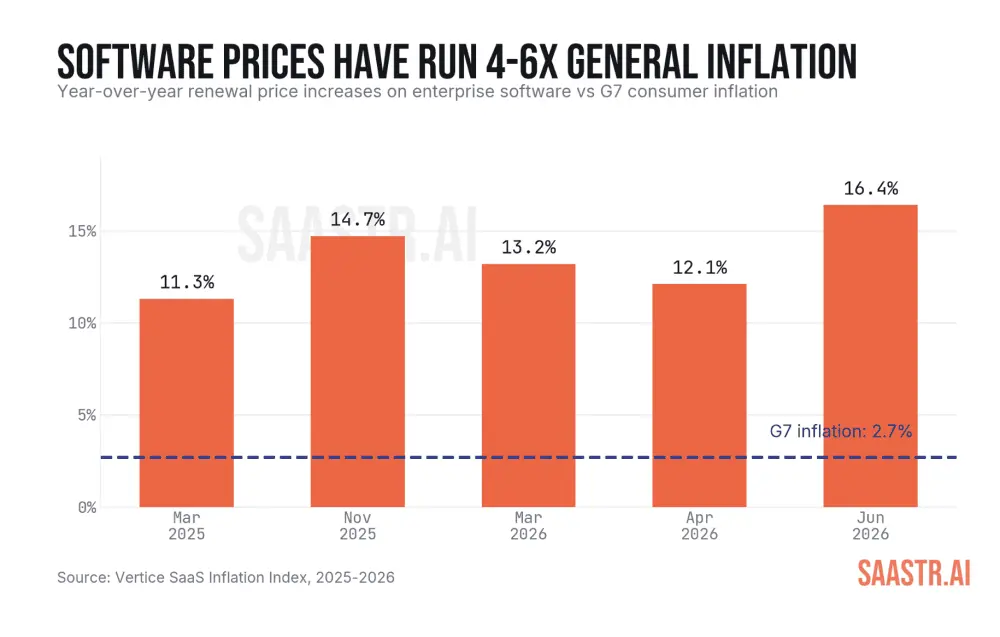
- 2024–2025 (The Inflationary Peak): According to the Vertice SaaS Inflation Index, SaaS inflation continuously ran between 12% and 16.4% through 2026—vastly outpacing general G7 inflation of roughly 2.7%. The index peaked at 14.7% in Q4 2025, strategically timed to corporate renewal seasons, before hitting 16.4% in June 2026. Enterprise software costs per employee surged to roughly $9,100 by the end of 2025.
- March 2026 (The CIO Budget Reallocation): Redpoint’s survey of 141 CIOs provided clear empirical evidence that enterprise tech budgets were no longer expanding neutrally. Instead, roughly two-thirds of AI inference costs began being funded through the direct cannibalization of existing IT budgets rather than fresh capital injections.
- Mid-2026 (The Threshold of Structural Transformation): Zylo’s SaaS Management Index revealed that average enterprise SaaS spend reached $55.7 million annually (an 8% year-over-year increase) while total application portfolios remained entirely flat at 305 apps. Simultaneously, high-profile market maneuvers—such as Salesforce’s agreement to acquire outcome-priced support leader Fin for approximately $3.6 billion, and Palantir’s historic 93% year-over-year revenue growth—cemented the transition toward outcome- and resolution-based metrics.
Supporting Context & Metrics: Why Seats Are Failing
To understand why the seat model is failing, one must look at the macro-economic and operational realities currently suffocating IT procurement teams.
1. Headroom Exhaustion and Enterprise Pushback
Enterprise software buyers have absorbed a 12%+ annual price increase for four consecutive years. Zylo’s data indicates that 79% of IT leaders experienced a price increase at renewal over a 12-month window, 78% absorbed unexpected charges tied to AI features or consumption tiers, and 61% were forced to cut planned IT projects entirely just to absorb these compounding hikes.
When a fifth consecutive price hike lands on a CIO’s desk, the dynamic shifts from negotiation to outright resistance. Enterprise buyers are no longer accepting baseline fee increases; they are actively demanding steep budget cuts at renewal.
2. The Token Bill vs. Legacy Software Trade-Off
The rise of generative AI has introduced a formidable new line item to the corporate ledger: the token bill. Goldman Sachs’ CIO research indicates that roughly two-thirds of AI inference costs are funded via internal budget reallocation, with 42% of CIOs expecting AI to command more than 10% of their total tech budgets within three years. Creative Strategies data corroborates this, showing that only about 28 cents of every incremental AI dollar represents net-new IT budget, leaving the remaining 72 cents to be scavenged from existing software stacks.

Publicly, major enterprises are walking the talk. Consulting giants like Publicis Sapient have announced intentions to cut traditional SaaS licenses—including Adobe licenses—by roughly half, redirecting those funds toward autonomous AI tools. For any vendor relying strictly on per-seat monetization, their software licenses have effectively become the primary funding source for their customers’ AI migration.
3. The Decoupling of Output from Headcount
Historically, headcount was a reliable proxy for business output: more employees meant more work, which justified more software seats.
Autonomous agents and AI tooling have permanently broken this equation. When a customer support department handles triple the customer volume using the exact same 40 human agents, a seat-based pricing model bills the vendor for zero additional revenue despite delivering triple the operational output. Conversely, if AI agents absorb Level 1 support tasks and headcount drops from 40 to 25, the software vendor accidentally penalizes its own top line for making the customer more efficient.
As a result, market growth in software categories priced strictly per seat (such as CRM, sales, marketing, CX, and collaboration) has slowed to single digits, even as the broader software market expands at over 15%. The market has not contracted; the billing unit has simply broken down.
The Three Emerging Pricing Models
With the traditional seat model buckling under pressure, three distinct alternatives have emerged. They vary significantly in execution complexity and customer alignment:
Model 1: Consumption (Credits, Tokens, Records)
- The Mechanism: Customers pay directly for what they use—whether measured in API calls, tokens, records, or runs (a path pioneered by infrastructure giants like Snowflake, Databricks, MongoDB, Twilio, and Stripe).
- The Pitfall: Bill shock. Unconstrained consumption models frequently lead to massive cost overruns, particularly with generative AI workloads ("token-maxxing"). Finance departments tasked with fixed annual budgets struggle to forecast variable usage costs.
- The Solution: Vendors adopting consumption pricing must build native financial guardrails into their platforms—providing real-time usage meters, hard spending caps, predictive threshold alerts, and autonomous agent-driven budget allocations (e.g., instructing an agent to spend up to $1,000 monthly on high-value workflows).
Model 2: Outcome (Palantir and Sierra)
- The Mechanism: Customers pay exclusively when a defined, enterprise-grade business result is achieved.
- The Enterprise Standard: Palantir exemplifies this model at scale. Rather than relying on rigid per-outcome rate cards, Palantir anchors every enterprise deal to a verified, measured dollar impact and expands off that proven financial return. This strategy fueled a staggering 93% year-over-year revenue increase to $1.935 billion in Q2 2026, alongside a US commercial revenue spike of 149%.
- The Pure Play: Companies like Sierra have built explosive growth ($200M ARR by mid-2026 on a $15.8B valuation) by negotiating direct rates per resolved customer case or complex multi-week business goals (such as processed mortgages or insurance claims), positioning software as a direct financial partner rather than an operational overhead cost.
Model 3: Resolution (Support, Data, and APIs)
- The Mechanism: A simplified subset of outcome pricing, resolution pricing charges a flat, countable fee for a binary outcome—did the support ticket resolve, or didn’t it? Did the API return a verified data record, or a null value?
- Market Adoption: Customer service platforms have rapidly embraced this shift. Fin charges $0.99 per billable outcome, Sierra commands roughly $1.50 per resolution, and HubSpot prices resolutions at $0.50.
- The Data API Paradox: Legacy data vendors continue to charge clients for API calls even when data returns come back empty or useless. New market entrants are disrupting this dynamic by shifting strictly to "pay-for-found-records" pricing, forcing incumbents to eventually abandon outdated pay-for-attempt paradigms.
Official Statements and Industry Insights
The debate surrounding the future of B2B pricing has drawn commentary from top enterprise software leaders:
- Henry Schuck, CEO of ZoomInfo: Following extensive consultations with high-priced consultants and hundreds of enterprise customers, Schuck summarized the current macroeconomic sentiment bluntly: "Nobody knows [where pricing is going]. Not the experts, not the customers, and the answer keeps changing week to week." However, Schuck warns that remaining passive in the face of structural change is a "slow death spiral."
- Jason Lemkin, SaaS investor and founder of Saastr: Highlighting Palantir’s historic performance, Lemkin noted: "Almost everyone’s growth rate decays at scale. Not Palantir. It just pulled off a quarter (and a year) like we’ve never seen: revenue grew 93% year-over-year to $1.935 billion… the twelfth consecutive quarter of accelerating growth." Lemkin emphasizes that Palantir’s success stems from a delivery and pricing model deeply integrated with forward-deployed engineering and verified business impact.
Future Outlook: How Incumbents Must Adapt
The core advantage held by new market entrants—such as Sierra or Fin—is that they carry no legacy baggage. They never had to migrate an installed base away from seats, dismantle commission structures tied to headcount, or rewrite multi-year enterprise contracts. Their billing systems were engineered from day one to meter the precise unit of value they deliver.
For legacy enterprise software incumbents, abandoning per-seat pricing requires dismantling four load-bearing operational pillars simultaneously:
- Sales Compensation Plans: Rewriting sales quotas and commission structures away from simple license counts.
- Financial Forecasting: Transitioning from predictable, locked-in annual contract values (ACV) to variable consumption and resolution revenue streams.
- Revenue Recognition Policies: Adapting accounting practices to handle fluctuating usage and outcome-linked billing milestones.
- Customer Success Motions: Shifting CS teams from driving user login adoption to actively protecting and expanding verified business outcomes.
Strategic Recommendations for Incumbents
- Test in Micro-Segments: Do not attempt a wholesale, overnight overhaul of your pricing page. Isolate a single new product SKU or secondary market segment and pilot consumption or resolution pricing immediately.
- Absorb Implementation Risk: Adopt the "forward-deployed engineering" playbook. Deploy working workflows on customer data before contracts are signed to prove tangible value upfront.
- Deliver Cost Controls: If deploying consumption or token-based pricing, bake robust financial controls, predictive alerts, and hard caps directly into the product to eliminate customer fear of bill shock.
The per-seat pricing model is dying because it measures the corporate org chart rather than software value in an era of intelligent automation. Software vendors do not need to possess a crystal ball to predict the exact terminal state of B2B pricing; they simply need to identify their true unit of customer value and begin testing alternative models today—before aggressive competitors render their pricing pages obsolete.