Jia Lissa is a reporter for Tech Ledgers covering Artificial Intelligence & Big Data. She/He is based in Indonesia.
25 August 2026 • 9 min read
On a bustling public holiday on the outskirts of Shanghai, the future of consumer robotics is being test-driven not by engineers in sterile laboratories, but by children, parents, and curious onlookers. At the Intelligent Manufacturing & Robotics Global Co-Innovation Center, a sprawling R&D hub housing more than 100 companies, a weekend "robot carnival" has drawn massive crowds. Here, mini robotic dogs perform acrobatic stunts, bipedal humanoids execute martial arts routines, and families eagerly line up to purchase the latest in consumer-grade automation.
Executive Overview
While Western markets frequently debate the commercial viability, safety risks, and physical limitations of humanoid robotics, China is pursuing a radically different trajectory. By embedding artificial intelligence directly into physical systems—a paradigm known as "embodied AI"—China is actively weaving robotics into the fabric of daily life. This consumer-facing carnival is just a micro-cosm of a broader national strategy.
Backed by targeted government mandates, such as the latest five-year plan, and an unmatched manufacturing ecosystem, Chinese firms have captured nearly 90% of global shipments for two-armed, two-legged robots. By transitioning humanoids from industrial assembly lines and research facilities into public entertainment venues, shopping malls, and tourist destinations, China is orchestrating a masterclass in public relations. The goal is clear: normalize human-robot interaction, demystify advanced automation, and secure total global dominance in the next frontier of artificial intelligence.
Detailed Chronology: A Day Inside the Shanghai Robotics Hub
Morning: The Arrival of the Curious Public
The morning air at the Shanghai innovation center buzzes with anticipation as gates open for the public holiday. Families stream into the complex, greeted by an eclectic mix of industrial utility and whimsical engineering. Unlike traditional tech expos restricted to enterprise buyers and industry insiders, this carnival is intentionally designed for mass consumption.
Within minutes of entry, the soundscape is dominated by delighted gasps and cheers. Near the central courtyard, an 11-year-old boy shouts ecstatically: "Look, it is trying to do a handstand!" He is watching his newly purchased mini robotic dog—a souvenir bought just moments prior—attempt a precarious balancing stunt. He immediately drops to his knees to show off the toy to passing families, capturing the infectious enthusiasm that defines the day.
Midday: Interactive Demos and Simulated Combat
As the morning crowd thickens, the event shifts from passive observation to active engagement. The innovation center, normally a serious engine for R&D housing companies specializing in heavy-load transport and sewage inspection bots, transforms into a playground of applied robotics.
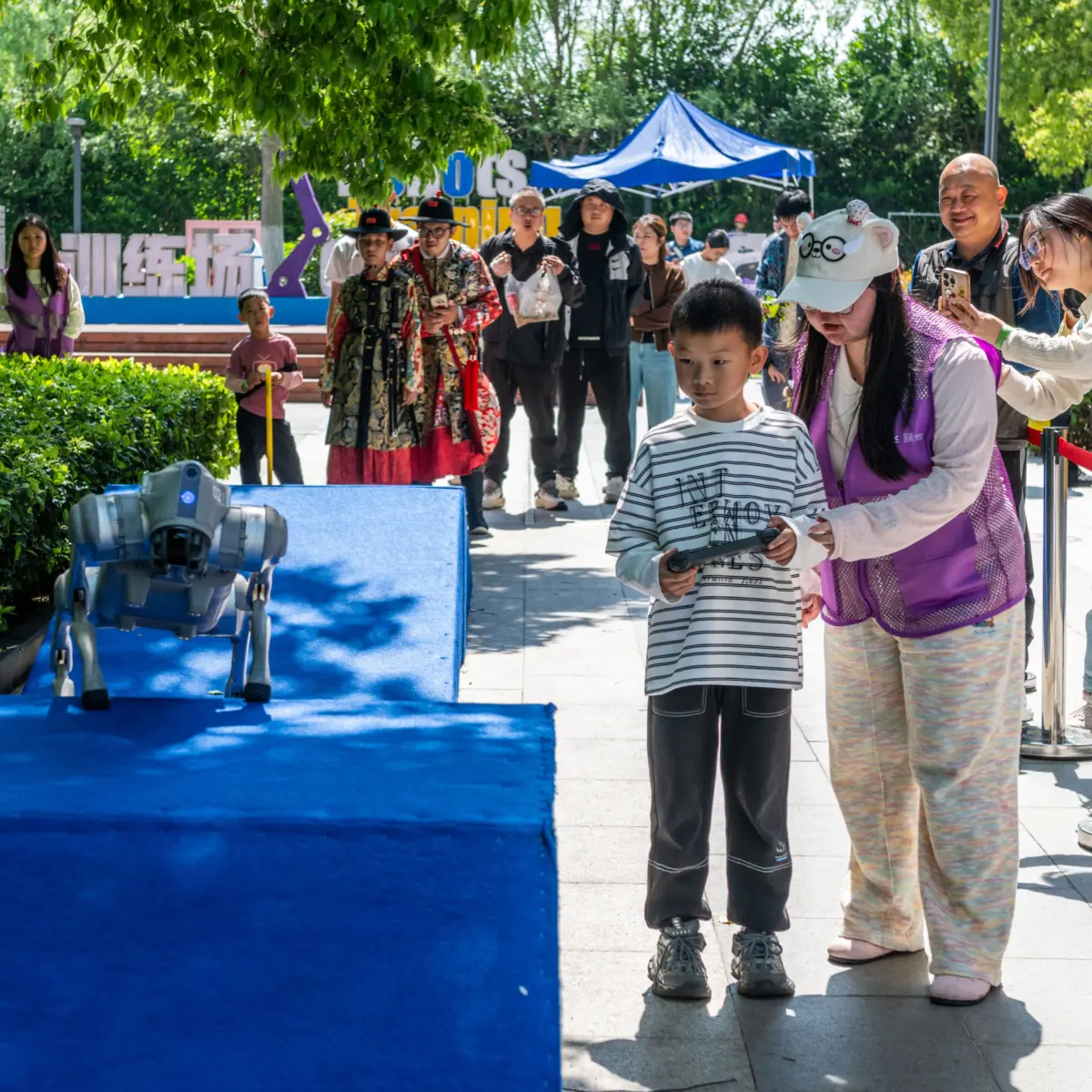
A few meters away from the retail booths, two patient staff members guide a group of children through the mechanics of quadrupedal locomotion, teaching them how to command a four-legged robot to climb a flight of stairs. The educational element is palpable, designed to inspire the next generation of engineers.
However, the day’s primary spectacle unfolds around a temporary ring erected in the center of the exhibition hall. A tense, high-stakes battle has broken out between two remote-controlled combat robots. Surrounded by a ring of cheering boys and girls, the machines maneuver aggressively, firing plastic water beads at one another in a flurry of tactical strikes and mechanical whirs. After several minutes of intense combat, a neutral staff member steps in to declare the duel a draw, drawing groans of playful disappointment from the young crowd.
As the afternoon progresses, the exhibition pivots to showcase the dual identity of modern robotics: industrial utility and mass entertainment.
At the booth of DexForce, a prominent player in the local robotics ecosystem, product manager Yang Duan explains the deeper philosophy driving the movement. "These machines can free people from physical work and mundane chores," Duan notes, gesturing toward a humanoid model expertly operating an automated coffee station. A few booths down, a pair of multi-jointed robotic arms works methodically, attempting to fold a messy basket of cotton T-shirts with surprising dexterity.
Yet, the true magnetism of the event lies in the entertainment tent. As applause rings out from the main stage, the crowds surge inward. On stage, a humanoid robot draped in a flashy, rhinestone-encrusted top performs the intricate, swaying movements of traditional Chinese "drunken boxing." Just seconds later, a companion humanoid launches into a flawless front flip, eliciting roars of approval from the packed auditorium.
Along the fringes of the stage, a squad of miniature robotic lions—complete with synchronized jaw movements and blinking LED eyes—lines up patiently, waiting for their cue to perform. The audience, utterly captivated, begins to chant in unison: "More, more, more!"
Supporting Context & Metrics: The Mechanics of China’s Robotics Boom
The vibrant scenes witnessed at the Shanghai carnival are the direct result of deliberate, state-backed industrial policy and staggering manufacturing output. Understanding China’s current dominance in robotics requires examining the convergence of macroeconomic strategy, supply chain mastery, and shifting technological paradigms.
The Rise of "Embodied AI"
For years, artificial intelligence was largely confined to software domains—large language models, computer vision algorithms, and data centers. However, the tech industry is rapidly pivoting toward "embodied AI," the concept of housing advanced neural networks within physical hardware bodies capable of navigating the real world.
China’s latest five-year plan explicitly targets embodied AI as a critical pillar of national technological self-reliance and economic modernization. Rather than treating robotics as a peripheral manufacturing sector, Beijing views it as the ultimate convergence point for advanced computing, precision engineering, and new productive forces.
Global Market Dominance in Numbers
The fruits of this strategic focus are already visible in global trade data. According to recent industry shipping reports, nearly 90% of the more than 13,000 two-armed, two-legged humanoid robots delivered globally last year were manufactured in China.
This manufacturing supremacy is underpinned by several structural advantages:
Supply Chain Proximity: Chinese robotics firms enjoy immediate access to localized supply chains for actuators, sensors, lightweight carbon-fiber frames, and high-capacity battery cells.
Cost Efficiency: While Western humanoid prototypes often carry prohibitive price tags running into the hundreds of thousands of dollars, Chinese manufacturers are aggressively driving down production costs through economies of scale.
Rapid Iteration Cycles: Prototyping and testing loops that take Western firms months can be executed in weeks within industrial clusters in Shenzhen, Hangzhou, and Shanghai.
Overcoming Global Skepticism
Despite these impressive metrics, the global robotics community remains deeply fractured over the viability of humanoid form factors. Critics in the West frequently point to persistent engineering roadblocks:
Balance and Stability: Maintaining dynamic equilibrium on two legs requires immense computational power and complex sensory feedback, leaving humanoids vulnerable to falls and mechanical failure.
Energy Consumption: High-torque actuators demand substantial power, resulting in notoriously short battery lives that limit operational utility.
The "Form Factor" Debate: Numerous roboticists argue that bipedal human forms are fundamentally inefficient for many industrial tasks, advocating instead for wheeled, tracked, or multi-pedal designs tailored to specific environments.
While international academic and corporate circles debate these hurdles, Chinese firms are adopting a pragmatic, market-first approach. By deploying humanoids directly into the public sphere—running half-marathons in Beijing, performing cultural dances in Shanghai shopping malls, and greeting tourists at heritage sites—they are collecting invaluable real-world operational data while simultaneously winning over public sentiment.
Official Statements and Industry Perspectives
The rapid escalation of humanoid deployments in China has sparked intense dialogue among product developers, researchers, and industry observers.
Yang Duan, Product Manager at DexForce:
"Look at what we are trying to achieve here. Humanoid robots are not just metal toys; they are designed to fundamentally alter human labor. These machines can free people from physical work and mundane chores, allowing society to focus on higher-level creativity and problem-solving. Events like this carnival give us direct feedback from the public, helping us bridge the gap between laboratory perfection and real-world acceptance."
Anonymous Robotics Researcher, Shanghai R&D Hub:
"There is a massive psychological barrier when it comes to living alongside bipedal machines. In the West, media narratives often lean toward dystopian job replacement or safety fears. By bringing these robots into public carnivals, shopping centers, and cultural performances, we are shifting the narrative. When a child watches a robot do a front flip or a martial arts routine, fear is replaced by wonder. That cultural acceptance is just as important as the hardware itself."
Industry analysts note that this aggressive public relations campaign serves a dual purpose. Not only does it build domestic consumer trust, but it also signals to international markets that Chinese robotics has moved past the experimental phase and is ready for commercial scaling.
Future Outlook: What Lies Ahead for Embodied AI?
As the Shanghai robot carnival winds down and families exit into the evening air, the broader implications of the event resonate far beyond the exhibition hall. The transition of humanoids from speculative science fiction into everyday Chinese civic life marks a watershed moment in technological history.
Near-Term Horizons (1–3 Years)
In the immediate future, expect to see an acceleration of public-facing robotics in China. Shopping malls, airports, theme parks, and museums will increasingly utilize bipedal and quadrupedal robots for customer service, wayfinding, and entertainment. This controlled exposure allows companies to stress-test their hardware in unstructured human environments without the catastrophic liability risks associated with early industrial automation deployments.
Medium-Term Challenges (3–5 Years)
The true test for Chinese robotics firms will lie in transitioning from performance and entertainment to genuine economic productivity. While performing drunken boxing or folding T-shirts makes for incredible viral marketing, deploying humanoids into unstructured, hazardous, or economically vital sectors—such as disaster relief, aged care, and complex manufacturing—requires solving deep reliability and edge-case navigation problems. Battery technology must also undergo a generational leap to support sustained, multi-hour physical labor.
The Global Geopolitical Landscape
As China solidifies its manufacturing chokehold on humanoid hardware, Western competitors face a stark choice. They can either attempt to out-manufacture a heavily subsidized and hyper-efficient Chinese supply chain or pivot toward higher-value software, proprietary neural network architectures, and specialized safety frameworks.
One thing remains undeniably clear: the era of embodied AI is no longer a distant abstraction. Whether witnessed in the high-tech laboratories of Shenzhen or through the delighted shouts of an 11-year-old boy holding a mini robotic dog in Shanghai, the future has arrived—and it has two legs, a metallic frame, and an insatiable appetite for the spotlight.