Executive Overview
Today, that tradition has evolved into a high-stakes race. Judged purely on their ability to untangle complex puzzles, modern AI models are improving at a breathtaking pace. In late 2024, empirical testing by scientists at Columbia University revealed that the leading frontier models could successfully solve a meager 18% of the notoriously tricky New York Times Connections puzzles. Just months later, by early 2025, optimized iterations of these architectures were breezing through the exact same challenges with near-perfect accuracy.
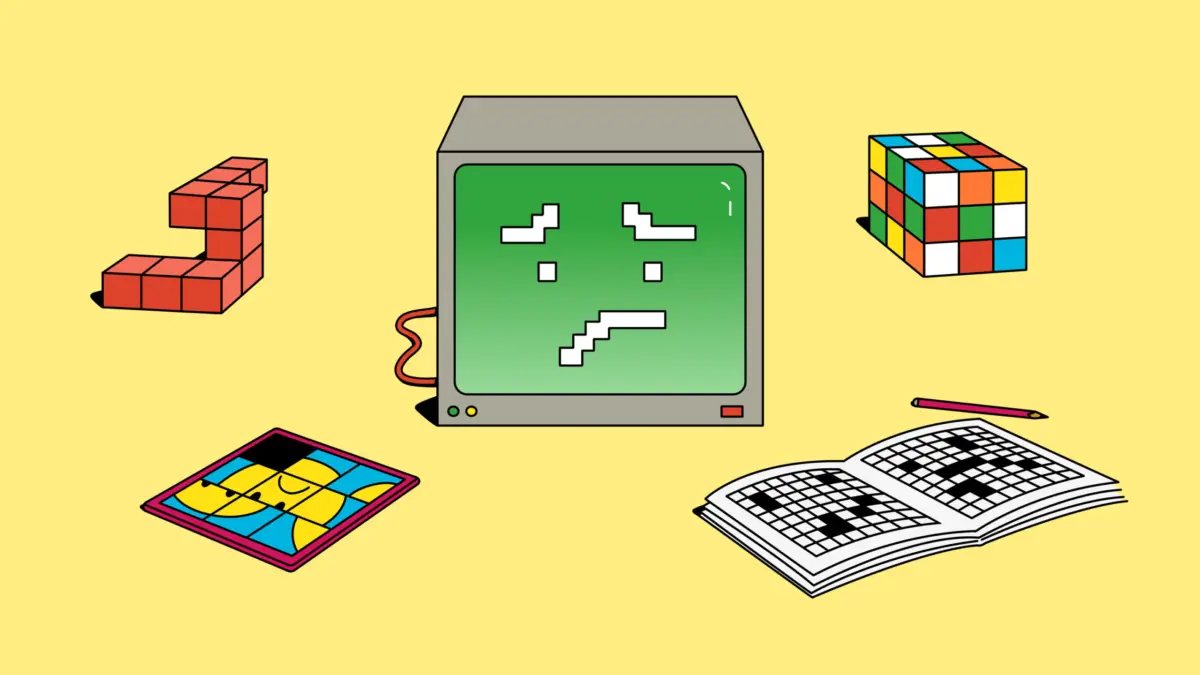
Yet, as computer scientists, cognitive psychologists, and researchers closely monitor these milestones, a deeper realization has taken hold: puzzles do much more than simply chart the inexorable march of raw computational power. They serve as a vital diagnostic window into the architectural strengths and fundamental weaknesses of modern artificial intelligence. By observing where state-of-the-art models succeed, where they stumble, and where human intuition easily outpaces silicon logic, we gain unprecedented clarity on how machine cognition diverges from human thought.
Despite boasting petabytes of training data and trillion-parameter matrices, contemporary AI systems remain notoriously brittle. Subtle alterations to classic riddles routinely trip them up, while visual and spatial puzzles expose glaring conceptual blind spots. This deep dive explores the current battleground of human versus machine cognition, examining why certain classes of puzzles continue to confound the world’s most advanced models, and testing whether human minds can still claim supremacy in the age of generative AI.
Detailed Chronology: The Evolution of AI Benchmarking
To understand how artificial intelligence arrived at its current puzzle-solving paradigm, it is essential to trace the historical checkpoints that transition machines from narrow task-executors to sprawling, multimodal systems.
The Foundational Era (1950s–1990s)
- 1950s: Arthur Samuel develops the checkers-playing program at IBM, popularizing the phrase "machine learning" and proving that heuristic search algorithms could surpass human proficiency in constrained, rule-based domains.
- 1997: IBM’s Deep Blue defeats reigning world chess champion Garry Kasparov, a watershed moment that demonstrated brute-force computation combined with specialized evaluation functions could conquer a classic intellectual pastime.
The Deep Learning Revolution (2010s–2023)
- 2016: DeepMind’s AlphaGo defeats Go world champion Lee Sedol, leveraging deep reinforcement learning and neural networks to master a game with an astronomical number of possible board configurations—a domain long thought to require human intuition.
- 2022–2023: The explosive rise of Large Language Models (LLMs) like GPT-4 shifts the benchmarking landscape. Rather than being hard-coded for a single game, models are evaluated on their ability to ingest natural language instructions and adapt to diverse, unconstrained text-based challenges.
The Frontier Puzzle Era (2024–2025)
- Late 2024: Columbia University researchers publish findings demonstrating that even premier LLMs achieve a dismal 18% success rate on the New York Times Connections puzzle, highlighting severe semantic clustering vulnerabilities. Concurrently, Google and University of Illinois researchers publish studies on Knights and Knaves benchmarks, revealing how training data memorization hinders logical deduction.
- Early 2025: Specialized vision-language models and reasoning frameworks dramatically improve, with models achieving near-perfect scores on semantic puzzles. However, new rigorous evaluations—such as SimpleBench, ZebraLogic, and spatial reasoning suites—expose persistent failure modes when complexity scales or visual manipulation is required.
Supporting Context & Metrics: Where Machines Triumph and Fumble
An exhaustive analysis of modern benchmarks reveals a nuanced portrait of artificial intelligence. While machines exhibit superhuman capabilities in information retrieval and pattern matching, their underlying mechanics create distinct vulnerabilities across four core cognitive domains.
1. Spatial Reasoning and Mental Rotation
Humans possess an innate capacity for mental manipulation—the ability to rotate three-dimensional objects in our minds’ eye to verify identity or fit. This skill is foundational for architects, mechanical engineers, and anyone who has ever assembled flat-pack furniture.
Despite the integration of visual inputs into modern multimodal LLMs, these systems fail abysmally at mental rotation tests. When presented with images of complex 3D structures viewed from varying angles, current models struggle to establish topological equivalence. For all the theoretical advancements in "world models" designed to help AI understand physical environments, LLMs still lack the continuous, intuitive spatial processing native to human neurobiology.
2. Memory, Memorization, and the Trap of Familiarity
Frontier LLMs possess staggering memories, having ingested colossal corpuses of human knowledge during their training phases. While this is an asset in trivia competitions and standardized testing, it frequently becomes a liability when facing logic puzzles.
When a novel puzzle closely resembles a classic problem encountered during training—such as the classic "Knights and Knaves" logic puzzles where specific characters are hard-coded to always lie or always tell the truth—models often bypass methodical deduction. Instead, they rely on pattern matching, hallucinating steps based on memorized solutions to structurally similar prompts. This phenomenon is vividly demonstrated in SimpleBench, a collection of deceptively simple problems designed to look like advanced academic prompts. While human solvers easily spot the verbal traps or alternative framings, elite models routinely trip over their own pre-trained biases.
3. Abstract and Visual Reasoning
Abstract visual problem-solving remains a formidable hurdle. The most prominent benchmark in this category is the Abstraction and Reasoning Corpus for Artificial General Intelligence (ARC-AGI). Created to test a system’s ability to learn new skills rather than memorize pre-existing data, ARC-AGI requires models to infer abstract rules from a series of grid-based visual examples.
Research indicates that models perform significantly better on ARC puzzles when the grids are converted into strings of text encoding cell colors, rather than processed as raw images. Furthermore, neuro-symbolic analysis suggests that even when models arrive at the correct answer, they often do so via byzantine, overfitted rules that fail to generalize. Humans, by contrast, apply parsimonious visual concepts, rapidly zeroing in on symmetrical, translational, or topological rules.
4. Scaling Limits and Complexity Cliffs
Recent studies from institutions like Apple, Stanford, the University of Washington, and the Allen Institute for AI have investigated what happens when classic multi-step puzzles—such as the Tower of Hanoi or intricate river-crossing scenarios—are scaled in complexity.
The empirical consensus is striking: LLMs can successfully navigate simple versions of these problems, reliably moving disks or ferrying agents across rivers. However, as the number of variables (such as disks or participants) scales to six or higher, the models hit a hard cognitive ceiling. Their step-by-step reasoning degrades exponentially. While critics debate whether this reflects a unique limitation of transformer architectures or simply mirrors the way human error increases with cognitive load, the operational bottleneck is undeniable.
Official Perspectives & Expert Insights
The dichotomy between human and machine cognition has driven a wedge through the artificial intelligence research community. Leading voices are increasingly pivoting away from raw scale toward hybrid architectures that bridge the gap between statistical prediction and symbolic reasoning.
Dr. Grace Huckins, an AI researcher and neural scientist, notes that the shift toward puzzle-based testing marks a maturation in how the tech industry evaluates safety and capability. "We are moving past the era where standardized exams designed for humans can accurately measure machine intelligence," Huckins explains. "Standard tests can be gamed through data contamination—where test questions accidentally end up in the training set. Puzzles, especially those requiring dynamic spatial or abstract manipulation, strip away the veneer of memorization and expose the raw mechanics of the underlying architecture."
Meanwhile, cognitive scientists emphasize that human intelligence is deeply embodied and grounded in physical reality. Dr. Thilo Hagendorff, a prominent researcher in AI behavioral biases, points out that humans and machines possess inverted vulnerability profiles: "While humans are prone to heuristic shortcuts, intuitive math errors, and narrative fallacies, our errors are often correctable through conscious deliberation. AI models, conversely, can execute billions of floating-point operations per second yet remain utterly blind to foundational physical constraints that an infant intuitively understands."
Industry developers are responding by integrating reinforcement learning-derived reasoning loops—such as those powering OpenAI’s o1 and o3 models or Anthropic’s Claude 3.5 Sonnet iterations—which force models to "think" in steps before outputting a response. Yet, as our testing demonstrates, even these advanced reasoning chains frequently fracture when confronted with novel visual layouts or cascading logical dependencies.
Future Outlook: The Road to Robust Reasoning
As artificial intelligence continues its aggressive climb toward artificial general intelligence (AGI), the role of puzzles in development will only intensify. The era of achieving breakthroughs purely by scaling up parameter counts and feeding models more internet text is encountering diminishing returns.
Future advancements will likely rely on neuro-symbolic AI—systems that fuse the pattern-matching flexibility of deep neural networks with the rigorous, rule-based precision of classical symbolic logic. By coupling LLMs with specialized spatial simulation engines and formal verification tools, developers hope to patch the glaring vulnerabilities exposed by tests like ARC-AGI, SimpleBench, and ZebraLogic.
Until that integration is perfected, the human mind retains a distinct, defiant advantage in domains requiring genuine adaptability, physical intuition, and parsimonious abstraction. Puzzles are no longer just a playful relic of computer science history; they are the litmus test that separates statistical mimicry from true, flexible understanding. Whether you are tackling mental rotation grids, untangling islanders who lie and tell the truth, or orchestrating a complex river crossing, every puzzle solved is a testament to the enduring, irreplaceable quirks of human cognition—at least for now.