
Executive Overview
Today, that paradigm is collapsing.
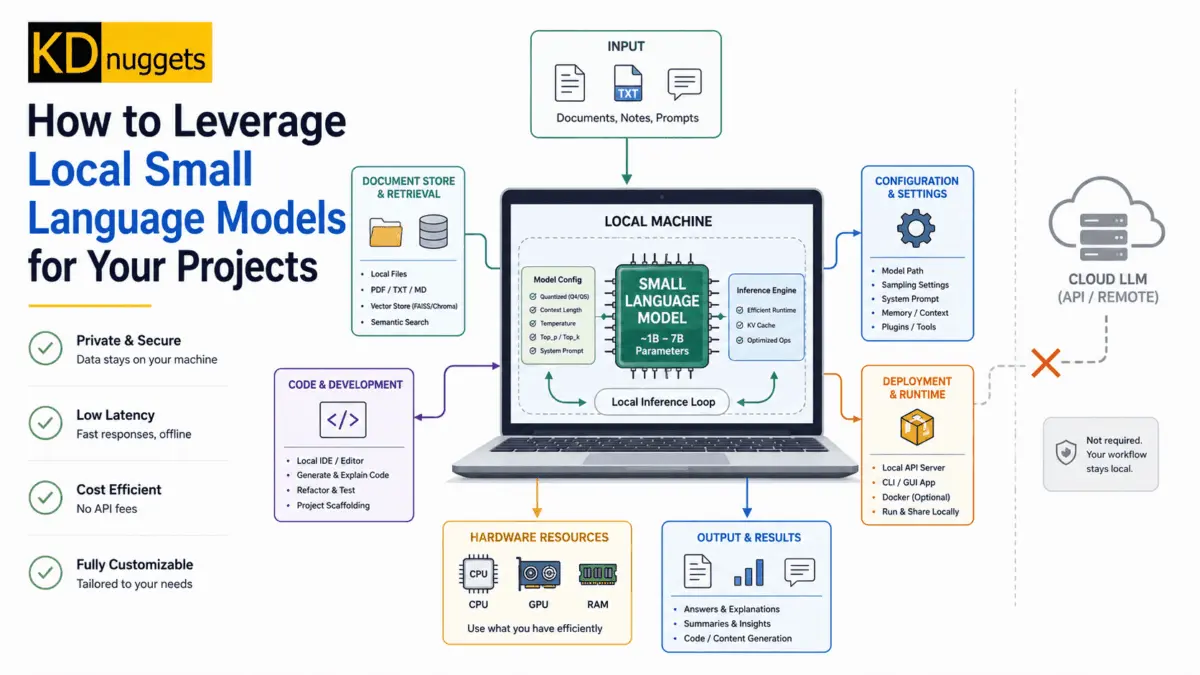
A quiet revolution is remaking the machine learning landscape, driven by the sudden, profound maturation of Small Language Models (SLMs). Typically ranging from 1 billion to 13 billion parameters, these compact neural networks pack a disproportionate computational punch. Small enough to run locally on a modern consumer-grade laptop or a modest single GPU, they possess the semantic dexterity to tackle complex, practical enterprise tasks. They deliver this capability with zero external API dependencies, rock-bottom inference costs, near-zero network latency, and uncompromising control over proprietary data.
Authored by AI and data science educator Vinod Chugani, the latest technical frameworks surrounding local SLMs point to a broader industry shift. Businesses and individual developers are no longer asking how to optimize their calls to massive, centralized foundation models. Instead, they are evaluating how to architect infrastructure entirely around local, self-hosted alternatives.
This deep dive explores the mechanics of local SLMs, examining how developers evaluate, configure, and scale these systems. We will trace the evolution of local tooling, analyze hardware configurations, and explore the architectural patterns—such as Retrieval-Augmented Generation (RAG) and multi-agent workflows—that are establishing local SLMs as the backbone of next-generation enterprise applications.
Detailed Chronology: From Cloud Monopolies to the Rise of Edge AI
To understand the current state of small language models, it is necessary to examine the trajectory of the generative AI boom.
Phase One: The Era of Centralized Scaling (2022–2023)
When foundational large language models (LLMs) captured the global imagination, raw parameter counts scaled exponentially. Models boasted upwards of 170 billion, 500 billion, or even over a trillion parameters. Operating these models required massive, specialized data centers outfitted with clusters of enterprise-grade H100 or A100 GPUs. Consequently, access was mediated through proprietary cloud APIs hosted by a handful of tech conglomerates.
For developers, this meant building software contingent on an external network pipe. Every prompt sent to the model traversed public or semi-private clouds, raising red flags for legal, medical, and financial institutions bound by strict data-residency laws. Furthermore, token-based pricing models created financial friction, making high-frequency, low-stakes automation economically unviable.
Phase Two: The Compression Breakthrough (Late 2023–2024)
As open-weight model initiatives gained momentum—spearheaded by releases like Meta’s Llama family, Mistral AI, and specialized fine-tunes—the research community shifted focus from sheer scale to architectural efficiency. Breakthroughs in model quantization (particularly the widespread adoption of GGUF formats) demonstrated that models could be compressed from 16-bit floating-point precision down to 4-bit or 8-bit integers with negligible degradation in reasoning capabilities.
Concurrently, inference engines like llama.cpp and accessibility layers like Ollama transformed what was once a complex, researcher-only pipeline into a one-line command-line experience. Suddenly, running a 7-billion parameter model locally on an Apple Silicon MacBook or an NVIDIA-powered desktop shifted from a technical novelty to a viable production strategy.
Phase Three: The Production and Agentic Era (2025–2026)
We have now entered an era where local SLMs are treated as production-grade infrastructure. Rather than viewing smaller models as weak stand-ins for massive cloud architectures, engineers recognize their specific advantages: hyper-specialized fine-tuning, deterministic output generation, total privacy, and absolute cost predictability. The narrative has pivoted from "How close can a small model get to GPT-4?" to "What specialized tasks can an ensemble of local SLMs execute faster, cheaper, and more privately than any monolithic cloud API?"
Supporting Context & Metrics: The Anatomy of Local SLM Deployment
Adopting local SLMs requires balancing hardware capabilities, architectural constraints, and performance metrics. To build an effective local AI stack, developers must navigate several core dimensions.
1. The Triad of Advantages: Privacy, Cost, and Latency
- Privacy and Data Sovereignty: Running models locally ensures that user prompts, internal source code, proprietary documents, and personally identifiable information (PII) never leave the local environment. For enterprises dealing with GDPR, HIPAA, or strict internal compliance, this eliminates the third-party vector inherent to cloud APIs.
- Cost Predictability: Cloud APIs scale linearly—and often unpredictably—with usage. Local deployment shifts expenditures to a fixed capital cost (the hardware). Once the machine is running, token generation is free, enabling unconstrained prototyping and high-throughput internal automation.
- Latency Elimination: Network round-trips introduce jitter and lag. By cutting out the internet transport layer, local inference delivers instantaneous time-to-first-token metrics, transforming conversational interfaces and real-time coding assistants.
2. The Hardware Equation and Parameter Scaling
Selecting an SLM requires aligning the model’s parameter footprint with available hardware resources (RAM/VRAM):
| Parameter Size | Hardware Requirement | Typical Use Case |
|---|---|---|
| 1B to 3B | Modern laptop / 8 GB RAM | Lightweight classification, fast text extraction, mobile/edge deployment. |
| 7B to 8B | Consumer GPU / 8 GB–16 GB VRAM | The "sweet spot" for general instruction following, coding, and RAG synthesis. |
| 13B | High-end GPU or Unified Memory (e.g., Mac Studio) | Complex reasoning, nuanced summarization, multi-step agentic planning. |
Through 4-bit quantization (Q4_K_M), a 7-billion parameter model compresses down to roughly 4.5 GB to 5 GB in file size, allowing it to run smoothly alongside a modern operating system on standard consumer hardware.
Official Insights & Architectural Integration
Deploying local models effectively extends far beyond pulling weights via Ollama. It requires integrating these models into robust software architectures. Vinod Chugani’s methodologies emphasize several key integration patterns.
Configuration via Modelfiles
Much like Dockerfiles containerize application environments, Ollama utilizes Modelfiles to dictate model behavior. Through these configuration files, developers can bake system prompts, temperature settings, stop sequences, and context window limits directly into the local deployment.
For instance, adjusting the temperature parameter allows developers to control output variance. For deterministic tasks like structured JSON extraction or automated code refactoring, lower temperatures (0.1 to 0.3) ensure consistency. Conversely, brainstorming or creative pipelines benefit from higher settings (0.7 to 1.0).
RAG and Document-Centric Pipelines
One of the most powerful implementations of local SLMs is within Retrieval-Augmented Generation (RAG) systems. Instead of feeding an entire enterprise document repository into a cloud API, a local vector database retrieves relevant context snippets from local files. A local 7B SLM then synthesizes an accurate, context-aware answer. Because the entire pipeline—vector search, retrieval, and generation—operates entirely offline, sensitive internal documentation remains secure.
Multi-Agent and Agentic Workflows
Rather than relying on a single, monolithic prompt-response cycle, modern AI architecture increasingly relies on agentic workflows. Small language models are uniquely suited for this paradigm. In a multi-agent system, discrete agents can be assigned hyper-specific roles: one SLM specialized in syntax checking, another in logical validation, and a third in formatting. Because each agent is small and specialized, the overall system remains modular, fast, and entirely self-contained.
Future Outlook: The Horizon of Edge Intelligence
The trajectory of small language models points toward an increasingly decentralized artificial intelligence ecosystem. As algorithmic innovations—such as more efficient attention mechanisms, advanced distillation techniques, and hardware-accelerated neural processing units (NPUs) built directly into consumer silicon—mature, the performance gap between massive cloud models and local SLMs will continue to narrow.
We are moving rapidly toward a future where ambient AI runs natively across laptops, mobile devices, Internet of Things (IoT) hardware, and local enterprise servers without ever querying a remote data center. For developers and organizations, mastering local SLM deployment today is no longer just an alternative optimization strategy—it is foundational preparation for the decentralized architecture of tomorrow.
Recommended Learning Resources
For professionals looking to deepen their expertise in local model deployment, hardware optimization, and advanced SLM architectures, the following foundational resources are recommended:
- Machine Learning Mastery: Introduction to Small Language Models: The Complete Guide
- KDnuggets: 5 Must-Read Resources for Mastering Small Language Models
- Ollama Tutorials: Running LLMs Locally Made Super Simple
- Advanced Architecture: Exploring the Role of Smaller Langauge Models in Augmenting RAG Systems
About the Author
Vinod Chugani is an AI and data science educator dedicated to bridging the gap between emerging artificial intelligence technologies and practical, production-ready implementation for working professionals. Focusing heavily on agentic AI, machine learning applications, and automated workflows, Vinod leverages his background in quantitative finance to deliver hands-on, highly analytical instructional content. His mentorship empowers data professionals to master modern AI stacks and execute immediate, high-impact strategies within their organizations.