Asep Darmawan is a reporter for Tech Ledgers covering SaaS & B2B Software. She/He is based in Indonesia.
24 August 2026 • 8 min read
For nearly a decade, the symbiotic relationship between home-services titan ServiceTitan and communication layer Podium seemed unbreakable. For nine years, Podium acted as the frontline marketing and messaging engine for thousands of contractors, pumping critical lead data, payment updates, and customer communications directly into ServiceTitan’s core system of record. Together, they formed a powerhouse tech stack for HVAC specialists, plumbers, and electricians nationwide.
Executive Overview
That digital marriage has now ended in a public, high-stakes divorce.
Last month, Podium Co-founder and CEO Eric Rea revealed that ServiceTitan abruptly gave roughly 1,000 shared customers just 30 days’ notice that their integration was being permanently terminated. The severing of ties hit home service operators squarely in the middle of peak HVAC season, forcing contractors to choose between their core operating software and their preferred customer engagement tools.
While public chatter on LinkedIn and X has framed this as a routine platform dispute or a marketplace disagreement, the reality is far more systemic. This breakup marks the official arrival of the Agent Era in enterprise software.
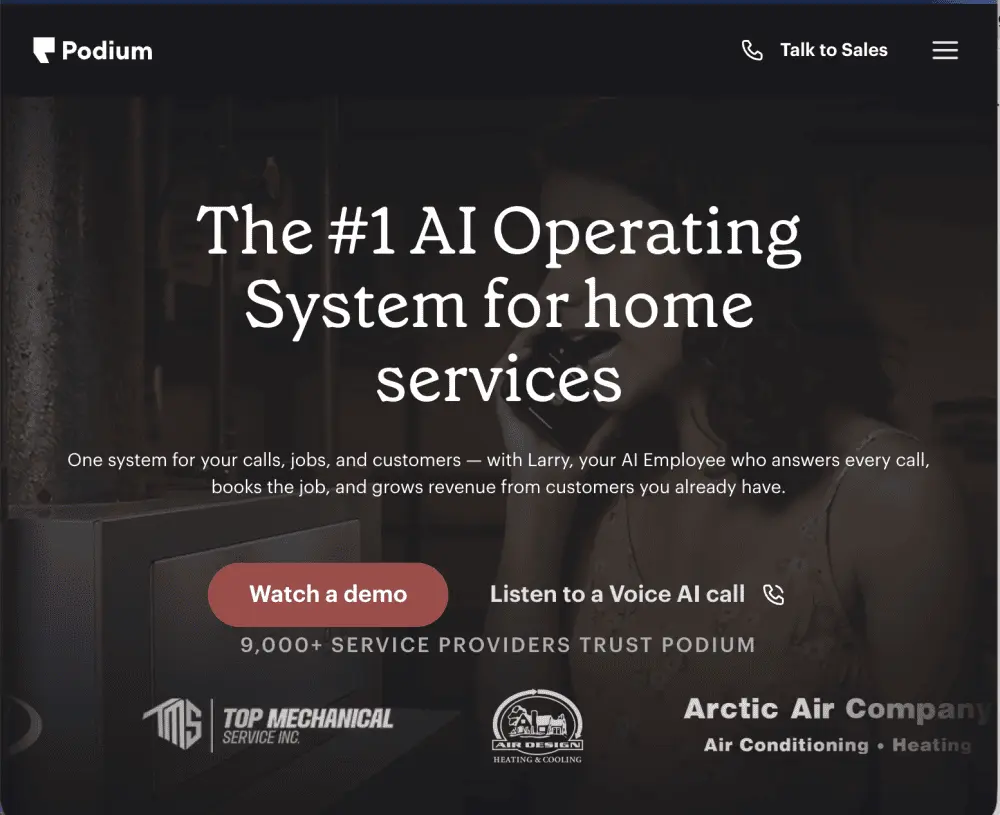
Advanced AI agents have evolved to a point where the "front layer" of customer interaction is sophisticated enough to absorb the backend operations. Podium’s rapid ascent into AI agents and field service management (FSM) software turned it from a complementary partner into a direct competitor. When software applications begin to mimic, replace, and outmaneuver the platforms they sit upon, the traditional definition of a "partner" immediately evaporates.
Detailed Chronology: How a 9-Year Alliance Collapsed
To understand how a stable, long-term commercial partnership unraveled in a matter of months, one must trace the shift from traditional API integrations to autonomous AI ecosystems.
The Anatomy of the Integration
For years, the technical bridge between ServiceTitan and Podium was deep and mutually beneficial. Contractors enabled four core data flows:
Contact Sync: Ensuring customer databases matched across platforms.
Lead Writeback: Automatically funneling web leads and text messages captured by Podium into ServiceTitan.
Payment Writeback: Pushing transactions collected via Podium back to the contractor’s financial record.
Conversation Writeback: Syncing comprehensive messaging histories directly to the customer profile.
For ServiceTitan, this meant contractors enjoyed a robust communication layer without ServiceTitan having to build it from scratch. For Podium, it secured instant distribution across roughly 7,500 contractors while granting access to rich job, appointment, and operational data.
Critically, Podium never locked itself into an exclusive deal with ServiceTitan. It built identical, parallel integrations with competing Field Service Management systems like Housecall Pro and ServiceFusion. Operating as a universal communication layer in front of any FSM is a lucrative business model—until your technology evolves to the point where you can replace the FSM entirely.
The Pivot to AI Agents and Rip-and-Replace
The turning point arrived when Podium’s agent business scaled from zero to $100 million in Annual Recurring Revenue (ARR) in under 24 months. Rebranding its ecosystem as an "AI Operating System," the company began rolling out an FSM competitor backed by a dedicated customer migration team.
A traditional marketplace app does not need a dedicated migration team capable of porting contacts and job history in 14 days. That is a classic "rip-and-replace" motion. Podium was no longer content simply forwarding leads to ServiceTitan; its new AI agents were stepping inside the workflow, handling customer service calls, auto-generating quotes, and booking jobs directly onto its own native boards.
The Rule Changes and the 30-Day Ultimatum
Recognizing the existential threat of autonomous agents siphoning away workflow ownership, ServiceTitan moved defensively. On June 24, the platform published strict new Marketplace certification requirements. Buried within the guidelines was a telling clause regarding competitive offerings:
"ServiceTitan welcomes partners whose products overlap with parts of its own, as long as they’re not using the partnership and ServiceTitan’s support to gradually displace additional parts of ServiceTitan."
With Podium’s roadmap steering squarely into FSM and autonomous agent territory, it failed to meet the updated certification terms under ServiceTitan’s post-AI framework. Seven weeks later, the 30-day termination notices landed in the inboxes of 1,000 shared customers.
Supporting Context & Metrics: The Battle for the Agent Layer
The clash between ServiceTitan and Podium is a microcosm of a much larger software war: the battle for supremacy between Systems of Record and AI Agents.
System of Record vs. Autonomous Operators
In legacy SaaS, the System of Record (the database holding schedules, dispatching logs, price books, and invoices) held absolute power. Because switching costs were historically high, software lock-in guaranteed long-term recurring revenue.
However, AI agents compress switching costs. When an AI agent can ingest data, map workflows, and manage customer interactions seamlessly, the underlying database threatens to become a commoditized backend.
ServiceTitan’s Position: As the established system of record for nearly 7,500 contractor companies, ServiceTitan commands deep operational trust. Its financial health remains exceptionally strong. In its quarter ending April 30, 2026, ServiceTitan reported:
Net Revenue Retention (NRR): Comfortably above 110%.
Operating Margins: Non-GAAP operating margins rose to 15.2% (up from 7.5% the previous year), while full-year fiscal 2027 guidance was raised to $1.13 billion.
Despite negative free cash flow of $9.6 million driven by heavy investments in its proprietary AI suite, ServiceTitan Max, the company is aggressively defending its turf. ServiceTitan Max features built-in demand-generation throttlers, voice agents that answer calls and book appointments, and automated field quoting tools—directly mirroring the core capabilities that Podium’s AI Operating System offers.
Podium’s Position: By scaling its agent-driven ecosystem to $100M ARR at breathtaking speed, Podium proved that contractors are hungry for autonomous labor. Eric Rea highlighted a DM from a multi-brand home services owner who remarked after seeing a Podium AI demo: "There is no competitor to ServiceTitan until the demo I saw from you guys today."
The realization that an agile layer built on top of an API can eventually swallow the system underneath has forced every major SaaS incumbent to rethink open API access. Four months prior to the dispute, ServiceTitan updated its API terms specifically to restrict autonomous agent behavior—mandating strict operational limits to prevent third-party applications from acting independently across workflows.
Official Statements and Industry Reactions
The sudden termination of the integration sent shockwaves through the home services contractor community, largely because the end users—the small business owners—were never consulted.
The Contractor Dilemma
Contractors choose ServiceTitan to run the operational backbone of their businesses, while independently selecting Podium to generate and nurture customer leads. The API pipeline binding the two was governed by behind-the-scenes legal and technical agreements between software vendors.
When the partnership dissolved, 1,000 businesses caught in the crossfire were given four weeks’ notice during the scorching summer HVAC peak. Overnight, customer records stopped syncing, job-triggered text messages ceased, automated review requests went dark, and conversation histories vanished from ServiceTitan dashboards while customer service representatives were actively on the phone.
While ServiceTitan was legally and contractually within its rights to protect its proprietary platform, the timing transformed a strategic commercial dispute into a deeply personal operational crisis. Business owners suddenly confronted the sobering reality that vital workflows housed within third-party integrations could be switched off without warning.
Industry Precedent
Not all communication partners suffered the same fate. Hatch, an AI customer communication platform serving over 1,000 shared ServiceTitan customers, successfully navigated the new compliance landscape and announced its formal certification in February 2026. This distinction underscores that the issue was not AI integration per se, but rather Podium’s explicit evolution into a direct competitor attempting to dislodge ServiceTitan’s core software stack.
Future Outlook: What the Agent Era Means for Enterprise SaaS
The ServiceTitan-Podium rupture is not an isolated incident; it serves as a bellwether for the entire software industry. As artificial intelligence blurs the lines between front-office engagement and back-office record-keeping, several defining trends are emerging:
The Erosion of Open Ecosystems: For over a decade, SaaS companies competed on who could build the most open, interconnected app marketplaces. The Agent Era is reversing this trend. As AI agents gain autonomous read-and-write capabilities, platforms will increasingly lock down their APIs to prevent third-party agents from cannibalizing core functionalities.
Compression of Switching Costs: Historically, migrating from one system of record to another took months and cost tens of thousands of dollars in lost productivity. With AI-driven migration teams capable of porting historical data and operational frameworks in under two weeks, customer lock-in is no longer guaranteed by database stickiness alone.
The Rise of "All-in-One" Agent Wars: Incumbents like ServiceTitan are spending heavily on internal AI R&D to ensure they own the agent layer, rather than ceding it to external upstarts. Conversely, communication layers and marketing platforms are rapidly expanding their feature sets to morph into full-fledged operating systems.
Key Takeaways for Business Leaders
For Platform Owners: Expect your integration partners to eye your core features. Protect your proprietary data layers and establish crystal-clear boundaries within your API terms before third-party agents outgrow their welcome.
For Point Solutions and AI Startups: Relying entirely on a major platform’s distribution channel carries existential risk. If your product roadmap naturally encroaches upon the system of record, prepare for an inevitable platform crackdown.
For End Users and Enterprises: Diversify your tech stack dependency. Ensure your operational data remains exportable and portable, safeguarding your business against sudden platform breakups in the fast-evolving landscape of enterprise AI.