
Executive Overview
Yet, perhaps the most damaging mistake a founder can make is getting the hire completely wrong and waiting too long to course-correct. In the fast-paced ecosystem of high-growth startups, a mismanaged executive hire doesn’t just waste money; it sets your trajectory back by a full year or more. Momentum is lost, team morale fractures, and competitors eat into your market share.
How, then, can founders cut through the noise, corporate polish, and impressive interview rhetoric to know quickly if they have hired a truly capable Vice President?
According to SaaS industry veteran and SaaStr founder Jason Lemkin, the evaluation process doesn’t have to be based on gut feeling or protracted trial periods. In a recent framework shared with the startup community, Lemkin distilled executive evaluation down to a rigorous, no-nonsense 4-Part Test.
This investigative report examines Lemkin’s framework, analyzing the operational psychology behind each criterion, exploring how startup economics intersect with executive performance, and providing founders with the hard truths needed to execute swift, decisive leadership changes before compounding damage takes root.
Detailed Chronology: The Critical First 60 Days of Executive Integration
The trajectory of an executive’s success is almost always baked into their first 60 days on the job. While corporations with deep financial cushions can afford protracted onboarding cycles and multi-quarter adjustment phases, startups operate in hyper-compressed timeframes. Every week an executive spends "getting oriented" without delivering tangible output is a week of lost runway and stalled growth.
To understand how executive performance unfolds—or unravels—we can map the typical lifecycle of a newly onboarded VP through a precise chronological lens.
Days 1 to 14: The Honeymoon and Diagnostic Phase
During the first two weeks, a newly minted VP is expected to drink from the firehose. They are auditing existing workflows, meeting key team members, examining historical data, and diagnosing systemic bottlenecks.
- The High-Performer: Uses this time to ask sharp, insightful questions, build psychological safety with their direct reports, and identify immediate "quick wins" that can demonstrate competence and momentum.
- The Underperformer: Spends this phase hiding behind jargon, scheduling endless introductory meetings with no clear agenda, and emphasizing the sheer difficulty of the startup’s current state.
Days 15 to 30: The Initial Pulse and Cultural Alignment
By the end of the first month, the reality of execution sets in. The team’s collective intuition begins to register whether the new leader is an asset or a liability.
- The High-Performer: Begins shifting operational weight off the founder’s shoulders. Early signs of metric stabilization or improvement appear, and the internal team’s confidence noticeably builds.
- The Underperformer: Offers excuses about why historical data is unreliable, why processes are broken beyond repair, or why the team they inherited is fundamentally uncooperative.
Days 31 to 60: The Execution Threshold
This is the crucible. By day 60, the executive must have transitioned from diagnosis to execution.
- The High-Performer: Has successfully closed or advanced critical talent searches, proving their recruiting engine works. A primary key performance indicator (KPI) is trending upward, and core operational responsibilities have officially transferred from the founder to the VP.
- The Underperformer: Fails to deliver any measurable movement in core metrics. They blame external market forces, resource constraints, or macro headwinds. Crucially, they have failed to recruit anyone noteworthy to the organization.
It is precisely at this 60-day mark that Lemkin’s 4-part test must be deployed with absolute objectivity.
Supporting Context & Metrics: The 4-Part Evaluation Framework
To remove subjectivity from executive management, founders must evaluate their new VP against four uncompromising criteria. If an executive fails any single pillar of this test, they are simply not good enough for an early-stage startup environment.
                  ┌────────────────────────────────────────┐
                  │        THE 4-PART VP TEST              │
                  └───────────────────┬────────────────────┘
                                      │
         ┌──────────────────┬─────────┴─────────┬──────────────────┐
         ▼                  ▼                   ▼                  ▼
┌─────────────────┐┌─────────────────┐┌─────────────────┐┌─────────────────┐
│ 1. Great Hires  ││ 2. KPI Growth   ││ 3. Load Relief  ││ 4. Team Belief  │
│  (First 60 Days)││  (Immediate)    ││  (Founders Free)││  (Confidence)   │
└─────────────────┘└─────────────────┘└─────────────────┘└─────────────────┘
Criterion #1: Did they hire someone great in the first 60 days?
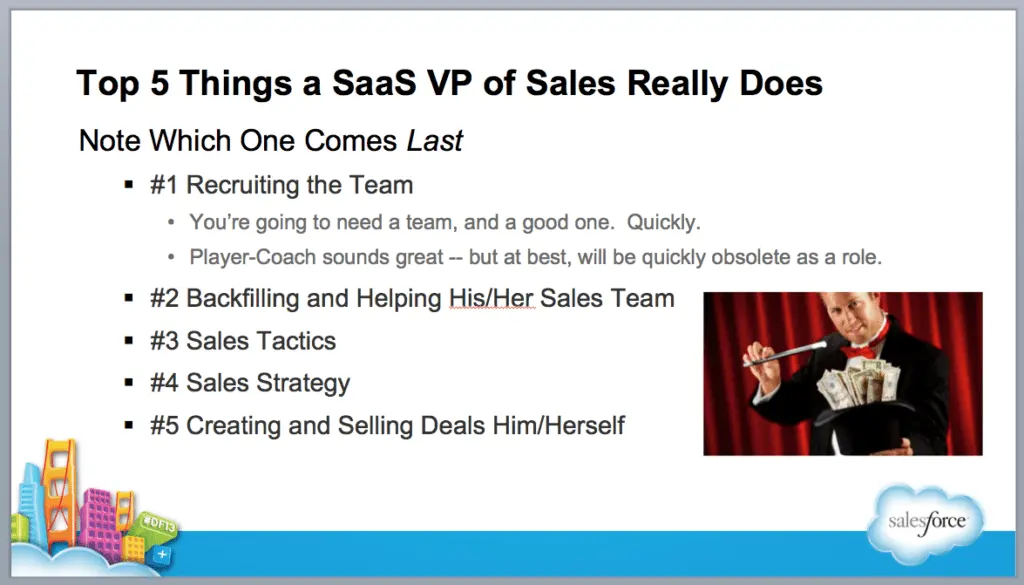
One of the most profound misconceptions in corporate governance is that human resources or external recruiting agencies handle hiring while executives merely manage the resulting teams. In a high-growth startup, 50% of a real VP’s job is recruiting.
True executive leaders do not wait for job descriptions to be posted and passive applications to trickle in. They operate with a perpetual pipeline. Elite VPs always keep one or two exceptional candidates in their back pocket—former colleagues, top-tier talent from previous organizations, or standout professionals they’ve tracked for years.
If a new VP has not successfully recruited and onboarded—or at minimum locked down commitments from—at least one phenomenal hire within their first 30 to 60 days, alarm bells should ring. A leader who cannot attract talent in their initial months will rarely build a powerhouse team later. If they cannot sell the company vision to prospective talent, they are not a real VP.
Criterion #2: Did their #1 key metric improve?
Founders frequently fall into the trap of believing that VPs need quarters of runway before moving the needle, especially if the company is facing macro headwinds or internal structural debt. Lemkin’s framework categorically rejects this excuse.

You cannot expect a miracle turnaround overnight, but you can and must expect early directional improvement in the department’s primary metric:
- VP of Sales (VPS): Revenue pipeline velocity, deal conversion rates, or closed-won ARR must show early positive momentum.
- VP of Marketing (VPM): Inbound lead generation, qualified opportunities, or customer acquisition cost (CAC) efficiency must improve.
- VP of Customer Success (VPCS): Net Revenue Retention (NRR), Customer Satisfaction (CSAT), or Net Promoter Score (NPS) indicators must stabilize or rise.
- VP of Engineering/Product (VPE/VPP): Deployment frequency, sprint velocity, or critical bug-fix turnaround times must accelerate.
The Reality in Tough Times: It is a common myth that evaluation standards should be relaxed during economic downturns or periods of company struggle. In reality, market friction makes the distinction between average and elite leaders crystal clear. When times are tough, a great VP does not complain about the macroeconomic climate; they take whatever leads and customers are available and optimize them to squeeze out better performance.
Can a great VP of Sales turn 20% growth into 100% growth overnight during a recession? Unlikely. But they can almost certainly turn 20% growth into 30% or 40% growth by instituting rigorous discipline, better objection handling, and tighter deal execution. If your VP’s primary output is excuses rather than metric movement, it is time to move on.
Criterion #3: Did they take part of the job off your plate?
When founders hire their first few executives, the primary objective is operational liberation. For months or years, the founder has been wearing every hat—closing enterprise deals, designing marketing campaigns, managing engineering sprints, or handling customer escalations.
When a high-performing VP arrives, some of that functional weight must lift off the founder’s shoulders almost immediately. For example, while a founder hiring a VP of Sales may still need to stay close to key enterprise accounts and participate in critical pitches, they should no longer carry the cognitive and operational burden of managing the day-to-day sales pipeline, forecasting, or rep coaching.
If a founder finds themselves working harder to manage, babysit, or compensate for the shortcomings of their new VP, the hire has failed Criterion #3.
Criterion #4: Does the team believe?
Perhaps the most infallible diagnostic tool available to a founder is the collective intuition of the existing team. Employees who have been in the trenches for months or years possess an acute radar for authentic leadership. They know immediately whether a newly hired executive is adding genuine value or simply hiding behind PowerPoint presentations and corporate buzzwords.
Within the first 30 days, team confidence should visibly build. Direct reports should express renewed clarity, excitement, and alignment. Conversely, if morale dips, skepticism grows, and team members begin whispering behind closed doors about the new leader’s incompetence or disconnect, the verdict is in. The team knows. Ignoring their unspoken consensus is a recipe for catastrophic attrition among your best individual contributors.
Official Perspectives: The Psychology of "Stretch" Hires vs. Execution
The debate over executive hiring often centers on the tension between seasoned enterprise veterans and "stretch" candidates—up-and-coming directors or senior managers taking their first crack at the VP role.
Industry consensus strongly supports the viability of stretch candidates, particularly in early-stage startups. These individuals often bring a hunger to prove themselves, an aggressive work ethic, and a willingness to roll up their sleeves that corporate-fatigued enterprise executives frequently lack. However, startup veterans emphasize a crucial caveat: A stretch candidate is acceptable only if they can execute the core responsibilities of the role.
The Danger of the "Partial Pass" Fallacy
The hardest part of the executive evaluation process is not recognizing when an employee fails; it is having the ruthless discipline to act on that recognition.
Founders are inherently optimistic. When an executive scores a 2/4 or a 3/4 on Lemkin’s test, founders frequently succumb to rationalization:
- "Well, they haven’t made any great hires yet, but their cultural fit is great."
- "Sales haven’t improved, but give them another quarter to build out their strategy."
- "They haven’t taken sales fully off my plate, but they are working really long hours."
According to scaling experts, partial passes do not count. Allowing a failing VP extra time out of misplaced empathy or fear of recruitment fatigue is financial and operational malpractice. Every month an underperforming executive remains in place, bad habits solidify, top performers grow frustrated and leave, and the structural deficit compounds.
Future Outlook: The Strategic Mandate for Decisive Action
As the venture ecosystem matures and capital efficiency becomes the definitive metric of startup survival, the margin for error in executive hiring has shrunk to near zero. Founders can no longer afford the luxury of "hope-based management."
Looking ahead, the successful startups of the next decade will be those led by founders who treat executive evaluation not as an uncomfortable confrontation, but as a clinical, data-driven science.
Key Takeaways for Founders Moving Forward:
- Embrace Radical Objectivity: Subjective feelings about an executive’s charisma, pedigree, or interview performance must be entirely subordinated to hard operational data captured within the first 60 days.
- Enforce the 4-Part Standard: Use Lemkin’s framework as a non-negotiable checklist. Did they hire great talent? Did core metrics improve? Are you unburdened? Does the team believe? If the answer to any of these is no, act immediately.
- Cut Your Losses Early: The pain of parting ways with a miscast VP during month two is a fraction of the agony of firing them after a disastrous year of stalled growth and burned capital.
Hiring VPs is undeniably tough, but managing them effectively requires an even rarer virtue: the courage to make hard decisions quickly, decisively, and without compromise. Your startup’s survival depends on it.