
Executive Overview
Yet, a profound reckoning is underway.
In a recent viral post, Amjad Masad, founder and CEO of software development platform Replit, captured the mood of an entire generation of technical founders: “I thought I hated sales culture. By the end of this year, more than half my company will be salespeople.”
Masad’s confession is not an isolated anomaly; it is a symptom of a broader structural shift rippling across the B2B software landscape. From AI powerhouses like Anthropic and OpenAI to older PLG pioneers like Slack and Atlassian, the data proves an immutable law of commercial software: Eventually, almost everyone builds a sales team.
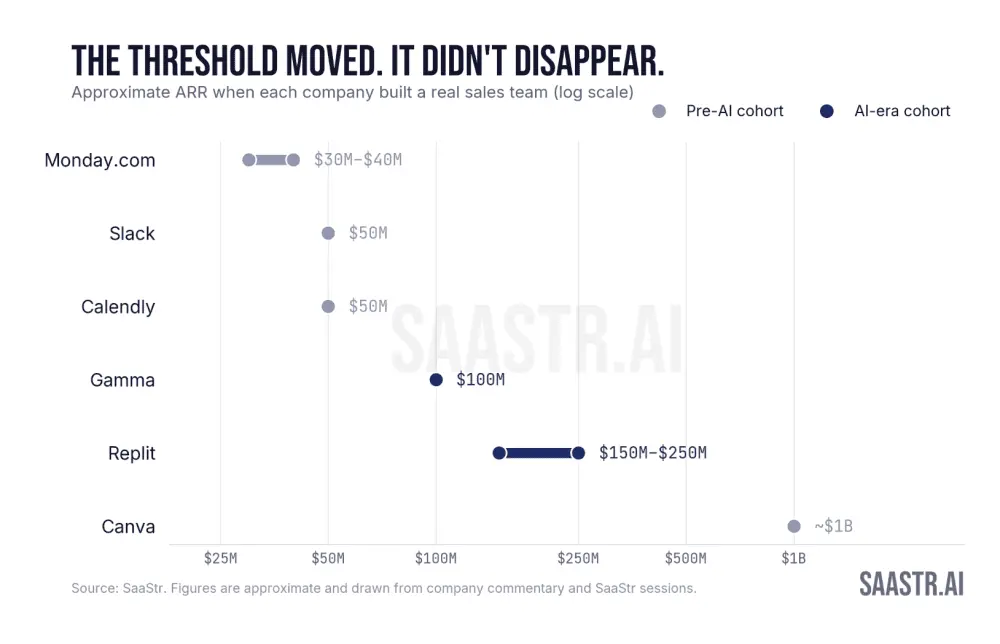
While the "freemium and self-serve" playbook allows companies to delay building a commercial engine—sometimes pushing it past $100 million or even $500 million in Annual Recurring Revenue (ARR)—it rarely allows them to escape it entirely. As bottom-up adoption collides with rigid enterprise procurement, security reviews, and six-figure contracts, technical founders are discovering that software cannot negotiate its own terms of service.
Detailed Chronology: The Evolution of the "Sales-Free" Illusion
To understand how we arrived at this juncture, we must examine how the threshold for building a sales team has shifted over time.
The Pre-AI Era: Riding the Wave of Self-Serve
Historically, the playbook for developer and productivity tools relied on frictionless onboarding. In February 2015, at the inaugural SaaStr Annual, Slack co-founder Stewart Butterfield famously noted that his company had scaled to $30 million in ARR without employing a single sales representative.
At the time, the industry buzzed with a singular question: Can you get to $100 million without a sales team?
Butterfield’s answer was nuanced, though often misinterpreted. Slack did not have "salespeople"; they had account managers. However, these account managers didn’t make outbound cold calls. Instead, they acted as "midwives" to the sale, interacting exclusively with users who had already decided to adopt Slack internally, but whose corporate bureaucracies required a vendor review, security analysis, and a legal markup.
The distinction was semantic rather than functional. When bottom-up adoption runs into enterprise IT procurement, a human must step in to bridge the gap. Slack eventually evolved into a hybrid product-led and sales-led giant, realizing that sustainable enterprise expansion requires dedicated human intervention.
The AI Cohort: Hyper-Scaling Past the Traditional Thresholds
In the current Artificial Intelligence boom, the speed of adoption has accelerated exponentially, pushing the "sales wall" even higher up the revenue ladder. Companies like Gamma, Lovable, and Anthropic have shattered historical growth curves, hitting massive ARR milestones with remarkably lean headcounts.
Consider Gamma, which scaled to $100 million ARR with just 50 employees and 600,000 paying subscribers—largely operating without a traditional sales team. Yet, co-founder and CEO Grant Lee later admitted on the SaaStr stage that waiting until inbound demand became overwhelming was a reactive scramble rather than a strategic design.
Similarly, Anthropic experienced explosive growth while maintaining a reputation for self-serve accessibility. Yet, behind the scenes, the company scaled its commercial team aggressively, adding over 140 salespeople in an 18-month window. By mid-2026, Anthropic had more open sales roles posted than engineering and research openings. Why? Because while a developer can swipe a credit card for a $20 monthly subscription, a Fortune 500 enterprise deploying AI agents across thousands of seats requires a million-dollar contract, customized terms, and deep technical alignment.

Supporting Context & Metrics: The Financial Reality of Go-To-Market
The numbers tell an unvarnished story about the true cost of scaling modern software businesses. According to the 15th annual survey by SaaS Capital—which analyzed over 1,000 private B2B companies—median spending on selling costs climbed to 15% of ARR, while customer success and support rose to 9%.
Furthermore, public market data reveals a stark division in Sales & Marketing (S&M) expenditures as a percentage of revenue among industry leaders. Companies with seat-based models and complex enterprise deployments continue to allocate a third or more of their revenue to go-to-market (GTM) efforts.
Even Atlassian—historically viewed as the ultimate poster child for a zero-sales-rep model—has seen its trajectory shift. While Atlassian relied heavily on a vast reseller channel rather than direct outbound sales post-IPO, its recent financial reports show go-to-market spending outpacing overall revenue growth. Twenty-five years in, operating within roughly 85% of the Fortune 500, Atlassian continues to pour resources into capturing unconverted demand sitting quietly inside accounts it has already won.
The Myth of Headcount vs. Capital
It is vital to distinguish between headcount and financial investment. When Amjad Masad states that more than half of Replit will be salespeople, he is executing an aggressive, accelerated strategy from a small base.
Broad industry data from Pave indicates that across companies with over 50 employees, total GTM headcount (spanning sales, marketing, success, and enablement) generally hovers around 15% to 20% of the total organization, rather than 50%. However, when factoring in compensation, commissions, tooling, and enablement, the capital allocation toward revenue generation dominates the operational budget.
Official Statements and Industry Insights: Reshaping the GTM Function
The integration of artificial intelligence is not shrinking the sales organization—it is fundamentally transforming its shape.
Data from Emergence Capital highlights a fascinating dichotomy: while the lowest, most automatable layer of sales—namely, Sales Development Representatives (SDRs) and Business Development Representatives (BDRs)—experienced widespread headcount reductions (with 36% of surveyed companies cutting SDR staff), technical and relationship-driven roles expanded. Account Executives, Sales Engineers, and Professional Services saw net headcount growth.
At SaaStr AI, Vercel COO Jeanne DeWitt Grosser shared how the company deployed an AI lead qualification agent that compressed a 10-person qualification team down to roughly 1.2 human operators. Rather than eliminating the team, Vercel upskilled those professionals into higher-value strategic roles while driving a 30% increase in SDR quotas.
"Go-to-market is moving closer to consulting than to selling," Grosser noted.
Similarly, OpenAI’s internal GTM teams reported that 96% of routine sales workflows are now executed alongside AI agents. The deterministic, repetitive data-gathering elements of sales are being offloaded to software, leaving human sellers to focus on what they do best: navigating complex enterprise negotiations, managing executive relationships, and orchestrating cross-functional implementations.
Future Outlook: What Technical Founders Must Learn
For technical founders entering the market today, the lesson from Replit, Anthropic, and Slack is clear: deferring a sales team is an operational choice, but ignoring it indefinitely is a strategic error.
- The Cost of Waiting Compounds: The longer a company delays building sales infrastructure—such as clean CRM data, usage signals tied to accounts, and formalized contracting workflows—the more painful and chaotic that build becomes when forced under pressure.
- Inbound Decay: Unanswered high-intent inbound demand is effectively an invitation for well-funded competitors to capture accounts that had already chosen your product.
- The Pivot from Product to Partnership: As software becomes easier to build via generative AI, product differentiation alone is no longer enough. Winning enterprise trust requires high-touch human engagement, strategic dinners, and consultative selling.
Amjad Masad’s realization—that watching customer dinners work changed his mind—underscores a timeless truth about enterprise software. You can build the greatest product in the world, put it on the internet, and let it spread through organic loops. But eventually, to cross the chasm into enterprise dominance, you have to step out from behind the screen, meet your customers face-to-face, and build a sales machine.