Executive Overview
The artificial intelligence boom has officially transitioned from a speculative land grab into an era of hyper-aggressive, high-stakes corporate consolidation. In what is rapidly becoming a watershed period for technology markets, venture capital and private equity are writing rules that defy historical financial paradigms.
The focal point of this structural shift is SpaceX’s audacious all-stock buyout of developer-tool phenom Cursor for a staggering $60 billion. What initially looked like an absurdly priced, margin-bleeding acquisition quickly revealed itself as a masterclass in strategic vertical integration: turning Cursor’s heavy inference costs into internal revenue for Elon Musk’s Colossus compute cluster.
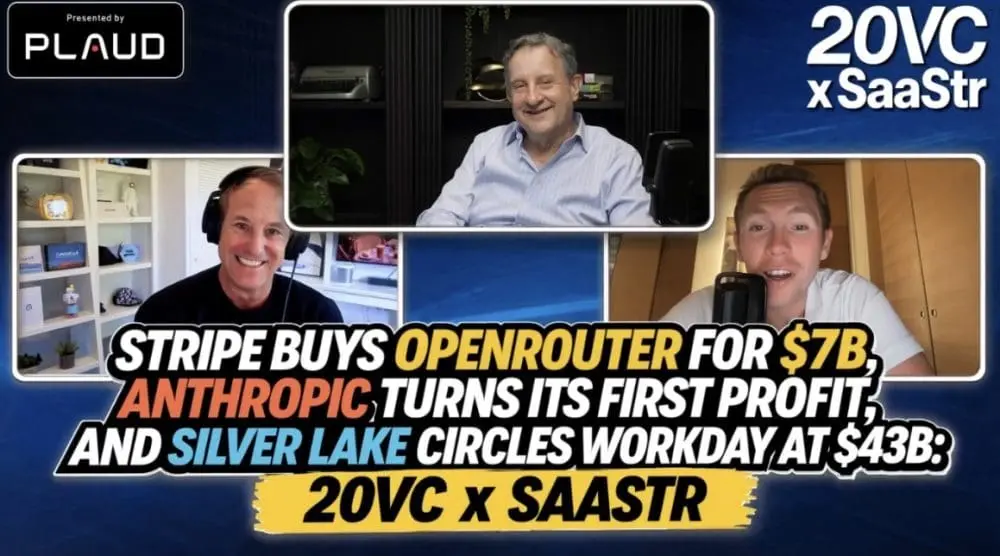
Simultaneously, Stripe is aggressively executing public-company-style M&A while still private—snapping up LLM-routing layer OpenRouter for an estimated $7 billion—while private equity giant Silver Lake anchors a mature-phase buyout of Workday at $43 billion.
Underpinning these astronomical valuations is a fundamental recalculation of enterprise software economics. According to industry heavyweights Rory O’Driscoll and Jason Lemkin, the arithmetic required for foundational AI players like Anthropic to reach monumental revenue milestones boils down to a stark new reality: $100,000 in annual token spend per engineer, paired with a 30% reduction in human headcount.
This investigative report breaks down the mechanics of these mega-deals, the underlying unit economics of the agentic revolution, and what the frantic pace of market consolidation means for the future of enterprise software.
Detailed Chronology & Deal Mechanics
1. The Cursor Acquisition: How $60 Billion Became a Bargain
Scarcely twelve months prior to its acquisition, Cursor was being written off by market critics. Facing ferocious competition from newly launched alternatives like Anthropic’s Claude Code, the platform’s future looked perilous. Yet, a decisive pivot toward a multi-model architecture injected new life into the company, catapulting it past half a billion in annual revenue on its way to a projected $6 billion by year-end.
When SpaceX stepped in with a $60 billion all-stock offer, it effectively derailed an ongoing $2B funding round at a $50B valuation led by Andreessen Horowitz.
- The Deal Terms: SpaceX didn’t bother running a traditional, protracted M&A process. Instead, they put an undeniable number on the table, added a $10 billion breakup fee to insure against regulatory or closing failure, and guaranteed complete operational autonomy.
- The Valuation Math: Valued at roughly 15 times current revenue (and under 10 times forward year-end revenue), Rory O’Driscoll noted that the multiple aligns with the fastest-growing assets in premier AI categories. Because SpaceX itself trades at roughly 40 times revenue, acquiring Cursor with its own high-currency paper was immediately accretive the moment the deal closed.
2. Stripe’s Dual Strategy: OpenRouter and the Art of Private-Company M&A
Stripe made waves by acquiring OpenRouter—led by Alex Atallah—for approximately $7 billion, coming a mere four months after OpenRouter’s $1.3 billion funding round.
- TAM Expansion vs. Consolidation: Stripe’s core business has always centered on absorbing complexity in exchange for a transaction fee. By swallowing OpenRouter, Stripe captures the routing layer of model selection and API integration. This is a classic TAM (Total Addressable Market) expansion play. Simultaneously, Stripe’s reported maneuvers regarding PayPal signal a consolidation play: leveraging massive scale, stripping G&A expenses, and capturing consumer wallets.
- The Speed Factor: In a market moving at breakneck speed, traditional five-year "build versus buy" frameworks are completely obsolete. Stripe deployed billions in cash and stock to secure a live, category-leading capability within a single week.
Supporting Context & Metrics: The Math Behind the AI Gold Rush
Evaluating these transactions requires throwing out traditional SaaS metrics and focusing intensely on forward growth, compute synergies, and enterprise unit economics.
The Gross Margin Fallacy
In the early days of Cursor and similar AI developer tools, venture capitalists routinely mocked their unit economics: companies were selling a dollar’s worth of tokens for significantly less than a dollar.
- However, market dynamics quickly rendered this criticism a second-order issue. When a core market explodes—such as AI-assisted software engineering—gross margin structures take a backseat to market share capture.
- As Rory O’Driscoll succinctly framed the synergy between Musk’s empire and Cursor: "Your gross margin problem is my revenue opportunity for my Colossus cluster." High inference costs paid to third parties vanish when the acquirer owns the underlying compute infrastructure.
Anthropic’s Arithmetic and the Road to $600B
As Anthropic marches toward an initial public offering (IPO), its financials are characterized by massive growth offset by off-balance-sheet compute commitments and heavy stock-based compensation (SBC).
- The Profit Milestone: Anthropic recently notched its first profitable quarter on $11.5 billion in Q2 revenue, driven by gross margins expanding from negative figures in early years to roughly 30%—with a trajectory toward 40% by year-end.
- The $600 Billion Question: Bulls project Anthropic-class revenue hitting $200 billion by 2028 and scaling to $600 billion shortly thereafter. However, rigorous demographic and economic filtering dismantles the simplistic "one billion knowledge workers" narrative.
- The United States accounts for roughly 50% of the world’s high-end knowledge worker software budget and 25% of global GDP.
- Out of roughly 83 million US workers, the vast majority are educators, healthcare workers, and administrative staff outside the direct AI replacement crosshairs.
- The core addressable market consists of roughly 5 million software-adjacent workers earning a collective $600 billion in annual wages.
- Therefore, generating $200 billion in revenue requires capturing approximately one-third of every salary dollar paid to US software workers.
The New Enterprise Unit Economics: $100K Tokens, 30% Fewer Heads
How do enterprises justify sweeping AI software budgets? Jason Lemkin and Rory O’Driscoll laid out the emerging mathematical steady-state for modern engineering teams:
- The Cost Structure: Running roughly 10 autonomous AI agents in parallel around the clock costs an enterprise close to $100,000 per year in token spend.
- The Headcount Equation: Fully loaded human wages hover near $200,000, augmented by $100,000 in AI tooling per person.
- The Productivity Tradeoff: In exchange for the token spend, engineering, systems administration, and QA teams are running 30% to 40% smaller.
CFOs are increasingly locking in AI budgets using this exact "100K-per-head" formula to hold human headcount flat while driving 2x to 3x velocity gains in shipping roadmaps. However, market dispersion is vast: while median companies spend modest amounts per head, top-tier tech-forward spenders on platforms like Ramp allocate up to $7,000 per month—reaching an eye-watering 50 cents of AI spend for every dollar of human salary.
Future Outlook & Industry Implications
1. The Software Systems of Record: Closed vs. Open
The $43 billion buyout of Workday by private equity firm Silver Lake—utilizing an equity check and heavy debt service against $10 billion in revenue and 35% operating margins—highlights the stark divergence between software business models:
- Closed Systems (e.g., Workday): These platforms are naturally buffered from autonomous AI agents siphoning off value, making them safe havens for predictable, mature-phase financial engineering.
- Open Ecosystems (e.g., Salesforce): Highly extensible platforms foster massive third-party innovation (such as Gong, Outreach, and Salesloft), but leave the underlying infrastructure highly vulnerable to being abstracted away by headless, agent-driven workflows.
2. M&A Momentum and Regulatory Scrutiny
The frantic pace of capital deployment shows no signs of slowing, though regulators are watching closely. Alongside massive funding rounds—such as recent monster closes where companies secure hundreds of millions at multi-billion-dollar valuations weeks apart—regulatory bodies like the DOJ are tightening oversight on venture capital. Investigations into overlapping board seats under Section 8 of the Clayton Act (touching power players like Andreessen Horowitz across overlapping portfolio mergers) signal that while current enforcement leans toward low-drama resolutions, the era of frictionless multi-board dominance is facing headwinds.
3. The Ultimate Takeaway for Founders
For early-stage and growth founders navigating this hyper-accelerated market, the lesson of the current M&A wave is stark. The astronomical valuations commanded by companies like Cursor are predicated on a rare alignment: being an indispensable asset whose greatest operational liability (compute/inference costs) directly solves a multi-billion-dollar infrastructure bottleneck for the buyer.
For the vast majority of startups lacking that precise structural synergy, brushing off gross margin concerns will remain a fatal miscalculation. In the AI megadeal era, speed is currency, but sound unit economics—or a buyer who owns the underlying iron—will ultimately decide who survives.
This report is derived from ongoing market analysis in collaboration with Harry Stebbings (20VC) and Rory O’Driscoll.