
Executive Overview
In the annual Culture & Methods Trends Report podcast, hosted by Shane Hastie (Lead Editor, Culture & Methods), an esteemed panel of QCon speakers and InfoQ contributors gathered to dissect the state of the industry. The panel—featuring Ben Linders, Rafiq Gemmail, Craig Smith, Vanessa Formicola, Shawna Martell, Phillip Mortimer, and Yinka Omole—explored a landscape defined by paradoxes. Organizations are producing more code than ever before, yet struggling with verification, accountability, cognitive overload, and the erosion of traditional team structures.
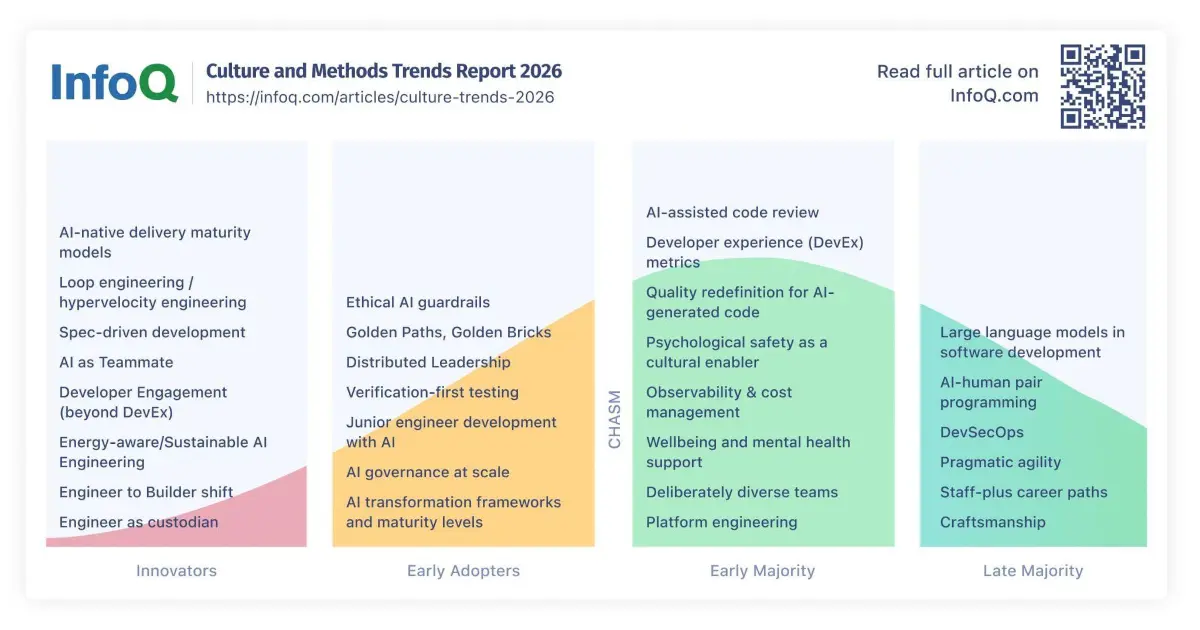
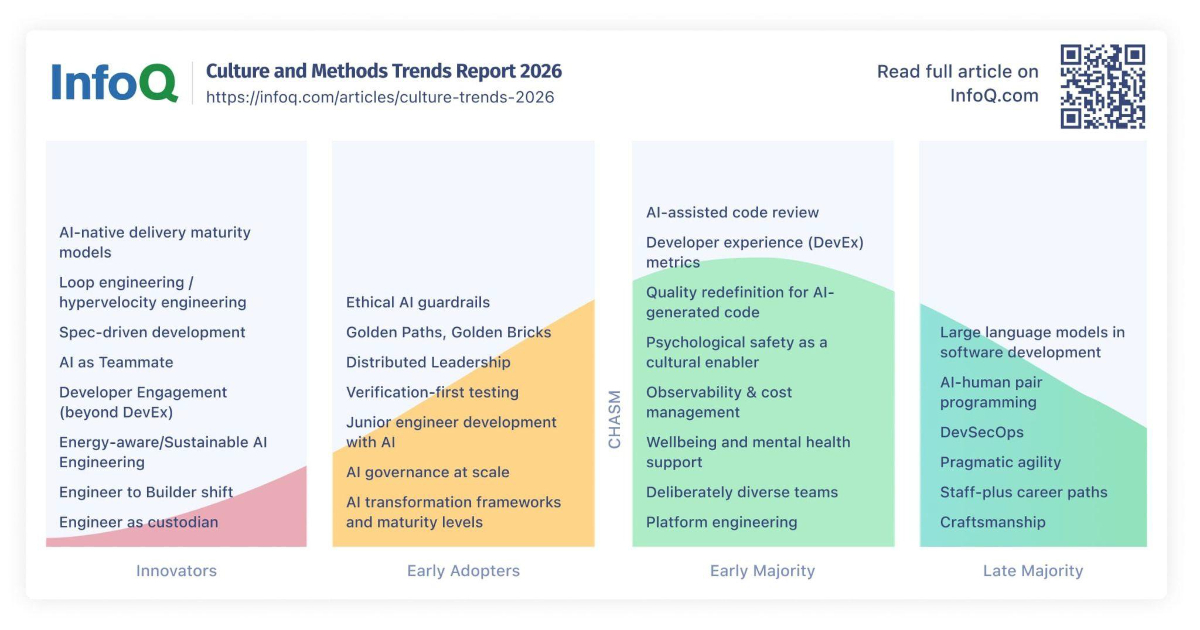
Utilizing Geoffrey Moore’s classic "crossing the chasm" mental model, the panel evaluated where current practices sit on the technology adoption lifecycle. The consensus is clear: the technical hurdles of integrating AI are increasingly manageable, but the cultural, structural, and ethical challenges are mounting. As AI agents handle automated swarms of pull requests and developers transition from direct contributors to system custodians, the industry must ask not just what we can build, but should we build it, and who is accountable when things break?
Detailed Chronology: The Evolution of Software Culture into 2026
To understand how the industry arrived at its current crossroads, it is vital to trace the trajectory of recent cultural shifts. For nearly a decade, InfoQ’s annual Culture and Methods reports have mapped the movement of practices across the early market into mainstream adoption.
The Foundation of Agility: The Haves and the Have-Nots
In the 2025 trends report, analysts warned of a widening chasm between organizations that had successfully internalized agile principles and those that treated agile as a mere checklist of ceremonies. Entering 2026, that gap has transformed into a chasm.
As Craig Smith highlighted during the discussion, organizations that failed to embrace foundational agility over the past twenty-five years are now attempting to accelerate workflows by layering AI generation on top of broken, 1995-era operational models. The result is catastrophic velocity without direction. The practices that truly matter—rapid feedback loops, robust observability, and absolute confidence in what is shipped—are more vital than ever because the chunk sizes of code and the potential blast radiuses of failures have scaled exponentially.
Hypervelocity Engineering and Cognitive Load
By 2026, the projections of AI adoption have materialized in staggering metrics. GitHub’s predicted surge from one billion pull requests to fourteen billion underscores an industry-wide transition into hypervelocity engineering. Developers are no longer writing isolated blocks of code; they are managing multiple AI agent sessions simultaneously, operating in parallel workstreams, and facing a 300% increase in code release volumes that frequently yield a 400% surge in bugs.
This hyper-acceleration has imposed an unprecedented cognitive load on human engineers. Panelist Phillip Mortimer posed a defining question for the era: Can humans genuinely read and comprehend all the code that AI generates? The pull request review process, originally designed for human-scale output, is buckling under the weight of automated creation, forcing the industry to reinvent how teams validate software architectures.
Supporting Context & Metrics: The Realities of AI-Assisted Development
The 2026 report draws heavily on empirical data from across the software ecosystem, revealing stark contrasts between hype and operational reality.
The Verification Gap and Trust Paradox
Data from the Sonar 2026 State of Code Developer Survey illustrates a profound contradiction: while artificial intelligence now accounts for an astonishing 42% of committed code, 96% of developers do not fully trust AI output, and a mere 48% consistently verify code before committing it.
This trust deficit has redefined the role of the software engineer. Yinka Omole observed during the panel that engineers are rapidly evolving into custodians rather than mere contributors. Rather than typing syntax line-by-line, senior technical talent spends its energy constructing guardrails, building validation platforms, and developing automated test harnesses to ensure that AI-generated artifacts align with business outcomes.
The Rise of "Workslop" and FinOps Realities
With code generation practically free, organizations face the downstream consequences of "workslop"—a term highlighted by the Harvard Business Review to describe AI-generated output that complicates work for downstream stakeholders. Shipping unverified, low-utility features at scale threatens to clog value streams with technical debt.
/filters:no_upscale()/articles/culture-trends-2026/en/resources/1graph-trends-report-2026-1785761406122.jpg)
Furthermore, economic realities are catching up with hyper-production. Token spend represents a substantial operational expenditure, cementing FinOps as an indispensable discipline. As Rafiq Gemmail and other panelists noted, many current AI capabilities are heavily subsidized by upstream providers. Organizations that couple their core operations to subsidized models must ask hard questions about long-term return on investment and architectural sustainability.
Environmental Toll and Sustainable Computing
The physical footprint of the AI build-out—demanding immense electricity and water consumption—presents a severe ethical dilemma during a critical window for global carbon reduction. Promisingly, market signals are beginning to reflect these real-world costs. Emerging models like Neuralwatt are pioneering pricing structures based on power consumption rather than raw token counts, forcing engineering teams to account for the environmental impact of their compute choices.
Official Statements & Panel Insights: Rethinking Teams and Careers
The structural makeup of software organizations is undergoing a radical, sometimes painful transformation.
From Two-Pizza Teams to One-Pizza Teams
Shane Hastie pointed to a profound shift in organizational topology: the classic "two-pizza team" championed by agile pioneers is shrinking into the "one-pizza team"—frequently consisting of just two human beings paired with a swarm of AI agents.
While these lean units can theoretically achieve unprecedented output, they also introduce severe risks. As the panel discussed, dissolving multidisciplinary teams into isolated individuals working alongside private AI instances destroys the serendipitous collaboration, organic knowledge transfer, and diverse viewpoints that drive creative problem-solving. Furthermore, studies highlighted by the panel—including Harvard research on workplace intensification—reveal that AI often increases burnout rather than reducing toil, amplifying anxiety in environments where up to 80% of workers fear displacement.
The Junior Developer Dilemma and the Redefinition of Seniority
The debate surrounding junior engineers and career progression generated sharp divisions among the panelists. Rejecting the notion that AI eliminates the need for entry-level staff, the panel shared cautionary tales of organizations attempting to "vibe-code" complex enterprise rebuilds with inexperienced teams—efforts that inevitably stalled.
/filters:no_upscale()/articles/culture-trends-2026/en/resources/2graph-trends-report-2026-1785761404976.jpg)
While AI tools act as massive force multipliers for experienced seniors with established domain judgment, they present steep hurdles for juniors trying to build foundational mental models. However, panelists noted an intriguing duality: while seniors spend time babysitting and debugging machine-generated code, junior engineers often possess greater cognitive plasticity, rapidly generalizing lessons from mistakes. Moving forward, the metrics of engineering seniority are shifting away from raw code volume toward personal accountability, architectural stewardship, and the ability to orchestrate complex technical ecosystems.
Future Outlook: Navigating the Human Frontier
As the industry looks past 2026, the roadmap for sustainable software development hinges on intentionality, governance, and an unwavering commitment to human-centric principles.
Key Recommendations for Organizations and Teams
To thrive in an era defined by AI abundance and heightened cognitive load, technical leaders must adopt a structured approach:
- Apply Risk-Based AI Adoption: Avoid the "all-or-nothing" trap. Match the level of AI automation and human oversight directly to the risk profile and business criticality of the software system.
- Prioritize Agile Foundations: Recognize that speed without agile fundamentals (fast feedback, continuous deployment, and clear value metrics) merely scales dysfunction.
- Redefine Pull Requests and Review Harnesses: Build advanced context stores and automated guardrails to manage code velocity without compromising security or maintainability.
- Foster Psychological Safety: Combat workplace anxiety and burnout by encouraging open dialogue, transparency, and sustainable working rhythms.
- Cultivate Domain Expertise: Ensure that technical and non-technical staff maintain deep critical thinking skills, keeping humans firmly in the loop to validate business problems against real customer needs.
Conclusion
Ultimately, the 2026 Culture & Methods Trends Report delivers a message that transcends technological shifts. As Shane Hastie reminded listeners in closing, quoting the enduring Māori proverb:
"He aha te mea nui o te ao? He tāngata, he tāngata, he tāngata."
(What is the most important thing in the world? It is the people, it is the people, it is the people).
In a world where code is abundant and algorithms are ubiquitous, human judgment, ethical accountability, creativity, and empathy remain the ultimate scarce resources. Organizations that prioritize their people while navigating the AI frontier will not only survive the transition—they will define the next generation of software engineering excellence.