
Executive Overview
Instead, Shopify delivered a blockbuster quarter that proved precisely the opposite. The company isn’t being disrupted by AI; it is accelerating because of it.
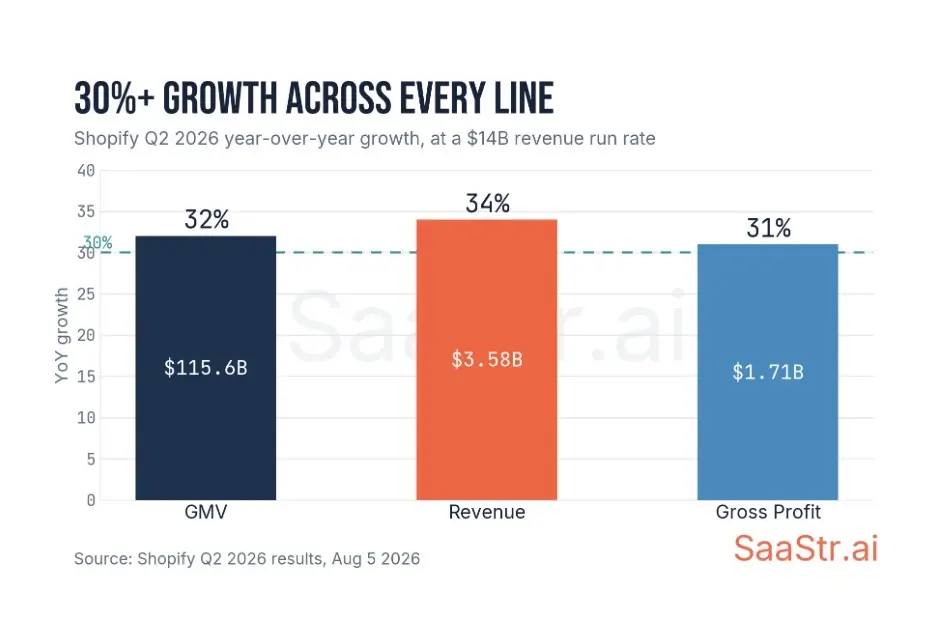
Operating at a massive $14 billion revenue run rate, Shopify posted staggering top- and bottom-line figures: Gross Merchandise Volume (GMV) hit $116 billion (up 32% year-over-year), total revenue climbed 34% to $3.6 billion, and free cash flow reached $654 million, translating to an impressive 18% free cash flow margin.
More importantly, Shopify’s Q2 2026 performance serves as a watershed moment for the broader tech and retail sectors. It provides the first empirical scoreboard for "agentic commerce"—the emerging paradigm where autonomous AI software agents, rather than human shoppers, discover, evaluate, and purchase products on behalf of users. Far from being sidelined, Shopify captured the agentic wave by weaponizing what it spent a decade building: clean, structured, highly queryable product data.
Detailed Chronology & Financial Breakdown
The seeds of Shopify’s Q2 triumph were planted years ago through difficult, structural corporate pivots, but the immediate financial manifestation blew past analyst consensus across every single operating metric.
The Headline Numbers at a Glance
- Gross Merchandise Volume (GMV): $116 billion, representing a 32% year-over-year increase. Notably, this marked the fifth consecutive quarter in which GMV grew by more than 30%.
- Total Revenue: $3.6 billion, up 34% year-over-year.
- Free Cash Flow: $654 million, securing an 18% free cash flow margin.
- Stock Reaction: An immediate ~18% spike in share price, wiping out the bulk of the stock’s 25% year-to-date slump.
President Harley Finkelstein summarized the sentiment during the earnings call, calling it "a monster quarter" characterized by simultaneous 30%+ growth in GMV, revenue, gross profit, and free cash flow—a rare quadfecta in modern corporate finance, where these metrics historically trade off against one another.
Supporting Context & Metrics: Five Critical Takeaways
A deeper inspection of Shopify’s Q2 report reveals structural shifts that extend far beyond e-commerce, offering vital lessons for the entire B2B software and transactional landscape.
1. The Rise of Agentic Commerce: AI Traffic, Orders, and Conversions Triple
The most compelling revelation from the quarter involves artificial intelligence channels. Traffic to Shopify merchant storefronts originating from AI channels tripled year-over-year, and orders originating from AI searches matched that trajectory, tripling as well.
Even more striking is the behavior of the AI shopper: new-buyer order rates from AI channels ran at twice the rate of traditional acquisition channels.
For merchants, this is the ultimate validation. AI channels are not merely re-routing existing demand or cannibalizing Google and social media traffic; they are generating entirely new demand, bringing in net-new customers at double the efficiency of legacy web acquisition vectors.
The Magic Behind the Metrics: Structured Data as the Ultimate Moat
Why are AI agents succeeding so brilliantly on Shopify? The answer lies in structured data.
Shopify Catalog now houses more than 1 billion products formatted in a way that machine-learning models and autonomous agents can read effortlessly. AI searches powered by this catalog convert at twice the rate of searches built on traditional web-scraping. An AI agent that has direct access to verified inventory, accurate real-time pricing, and precise product variants makes far superior recommendations than an agent forced to guess based on a rendered webpage.
- The B2B Takeaway: In the era of agentic buying, the ultimate winners will not necessarily be the companies with the flashiest AI wrappers. They will be the companies that own the clean, structured proprietary data that autonomous agents must query. Shopify spent a decade organizing chaotic retail inventories for mundane operational reasons, and that foundational discipline accidentally engineered an impenetrable moat.
2. Transactional vs. Subscription Growth: The Death of Pure-Play SaaS
Critics often attempt to evaluate Shopify through the lens of a traditional Software-as-a-Service (SaaS) business, but the revenue split tells a vastly different story:
- Subscription Solutions: Grew 22% to reach roughly 22% of total revenue.
- Merchant Solutions (Transactional): Grew a blistering 37%, cementing its place as the dominant economic engine of the company.
Monthly recurring revenue (MRR) sits at $221 million, compounding at 18% annually over five years. While respectable, it represents less than a quarter of what Shopify collects in a single quarter through merchant services. The hyper-growth engine—scaling at 37%—is tied directly to customer success rather than customer headcounts: payment processing, business financing, cross-border logistics support, and variable platform fees.
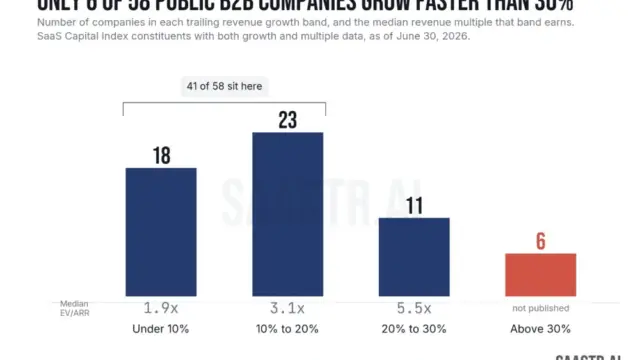
- The B2B Takeaway: This mirrors a macro-trend sweeping across public B2B technology. Seat-based subscription models are settling into the teens and low twenties, while consumption-, transaction-, and outcome-based revenue streams are scaling at 35%+. Shopify’s velocity isn’t driven by clever software pricing tiers; it is fueled by a business model that gets paid proportionally when its customers win.
3. Payments Penetration and the Trillion-Dollar Milestone
Shopify processed $78 billion in gross payments volume (GPV) in Q2 alone, representing 68% of all GMV generated across the platform. Cumulatively, GPV since inception crossed the historic $1 trillion threshold this quarter.
When two out of every three dollars spent on Shopify flow through its proprietary payment rails rather than a third-party gateway, payments cease to be a mere feature and become the foundational revenue engine.
Of course, this model introduces trade-offs. Gross profit grew 31%—lagging slightly behind the 34% revenue growth rate—because payments carry lower gross margins than pure software. Overall gross margin landed at 47.7%, with transaction and loan losses (primarily from Shopify Capital) hovering around 3.9% of revenue. Yet, management views this trade willingly: sacrificing gross margin percentage in exchange for vastly superior absolute gross profit dollars and an unshakeable operational lock-in with merchants.
4. Rule of 52 Efficiency: Operating Leverage and Hard Choices
Shopify’s efficiency story matched its top-line expansion. Operating expenses dropped by 300 basis points as a percentage of revenue, culminating in a "Rule of 52" profile (growth rate plus free cash flow margin) at a staggering $14 billion revenue run rate.
This financial health was not achieved by accident or minor quarterly trimming. It was the direct result of brutal, decisive actions taken years prior—including a 20% workforce reduction and the strategic divestiture of its logistics business.
- The B2B Takeaway: True operating leverage at scale requires structural clarity about corporate identity. Shopify stopped pretending to be a physical fulfillment warehouse company and doubled down on its identity as a software and payments infrastructure provider. The margins followed naturally.
5. Cohort Longevity and Upmarket Momentum
Skeptics have long pointed to Small and Medium Business (SMB) churn as Shopify’s Achilles’ heel. Small merchants go bankrupt regularly, creating a perpetual leak in the revenue foundation.
However, cohort data dismantles this narrative. The merchant cohort from Q1 2015 has expanded its aggregate revenue 3.3x since signup, representing a robust 12% compound annual growth rate sustained for over a decade. While individual mom-and-pop shops do churn, the survivors aggressively scale their GMV, adopt Shopify Payments, add sales channels, and expand globally fast enough to more than replace the fallen.
Concurrently, Shopify’s upmarket enterprise motion continues to accelerate. Q2 saw the launch or migration of retail giants like Holt Renfrew, Guess, Fred Segal, Avon, Country Road, and Arhaus, joining an elite enterprise roster that already features Canada Goose, Starbucks, Estée Lauder, General Motors, and L’Oréal.
Official Statements and Leadership Perspectives
The tone inside Shopify’s executive suite following the Q2 report was one of vindication. President Harley Finkelstein underscored the unprecedented nature of the quarter in his public commentary:
"Q2 is in, and it was a monster quarter. $116B in merchant sales, up 32% YoY. $3.6B revenue, up 34% YoY. $654M free cash flow, 18% margin. Five quarters running, GMV has grown more than 30%. The bigger story is underneath the numbers: every shift AI is creating happens to…"
Management emphasized that the convergence of soaring growth, expanding cash flows, and technological transformation validates the multi-year platform bets made during the post-pandemic reset.
Future Outlook & Broder Implications
As Shopify looks toward the second half of 2026, guidance remains exceptionally strong. Q3 operating expenses are projected to hover between 33% and 34% of revenue, with free cash flow margins expected to maintain their trajectory in the high teens to low twenties.
Beyond e-commerce, Shopify’s Q2 2026 performance establishes three foundational lessons applicable to the broader technology and enterprise sectors:
- Structured Data is King: In an AI-dominated economy, owning clean, accessible, proprietary data provides ultimate leverage against general-purpose models and scraping competitors.
- Usage Models Win: Transaction- and consumption-based business models continue to outperform traditional static seat licenses, aligning corporate success directly with customer growth.
- Resilience Through Scale: Platform ecosystems that successfully balance SMB volume retention with enterprise upmarket expansion can build compounding compounding flywheels that defy macroeconomic headwinds.
By proving that artificial intelligence serves as a powerful tailwind rather than a disruptive threat, Shopify has firmly cemented its status as the foundational operating system of modern global commerce.