Executive Overview
At the heart of Project Solara are two distinct hardware concepts: a compact, pocket-sized wearable AI badge tailored for office workers, and a diminutive desk display designed to surface critical enterprise data via voice and touch interactions. Built in collaboration with major silicon manufacturers such as Qualcomm and MediaTek, Solara is not intended to be a direct-to-consumer gadget manufactured by Microsoft. Instead, it serves as a sophisticated blueprint—a reference design meant to inspire hardware partners to build specialized enterprise AI devices.
Powered by the Microsoft Device Ecosystem Platform (MDEP)—an enterprise-grade operating system built on the Android Open Source Project (AOSP)—Solara aims to bridge the gap between autonomous AI agents and the physical environment. By equipping these gadgets with onboard cameras, fingerprint scanners, and touchscreens, Microsoft is giving AI agents the ability to perceive, analyze, and react to the physical workspace.
However, this bold vision arrives at a complicated juncture. The introduction of camera- and microphone-equipped wearable devices into corporate environments immediately revives acute anxieties surrounding employee privacy, biometric surveillance, data compliance, and consent. As major corporations like AccuWeather, Best Buy, CVS Health, and Target prepare to pilot these avant-garde devices, the tech industry is once again forced to weigh the immense productivity gains of ambient AI against the very real human cost of persistent workplace monitoring.
Detailed Chronology of the Microsoft Build 2026 Unveiling
The introduction of Project Solara unfolded across the grand stage of Microsoft Build 2026, marking a significant evolution in how the corporation conceptualizes enterprise hardware. For years, Microsoft’s hardware strategy has oscillated between traditional productivity tools (such as Surface laptops and tablets) and experimental mixed-reality gear (such as the now-defunct HoloLens). Solara represents a radical pivot toward lightweight, highly portable, agent-centric form factors.
The Key Concepts: The Wearable Badge and the Desk Display
During the keynote demonstrations, Microsoft executives showcased the two pillars of the Project Solara ecosystem:
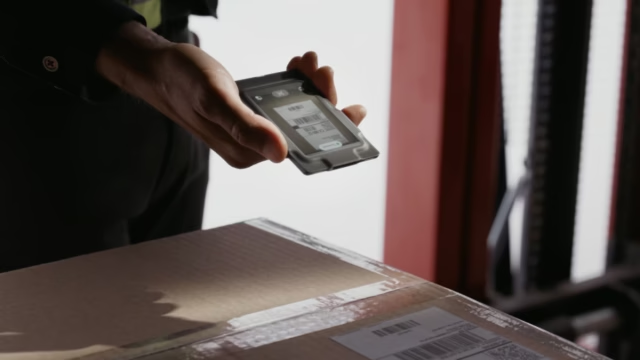
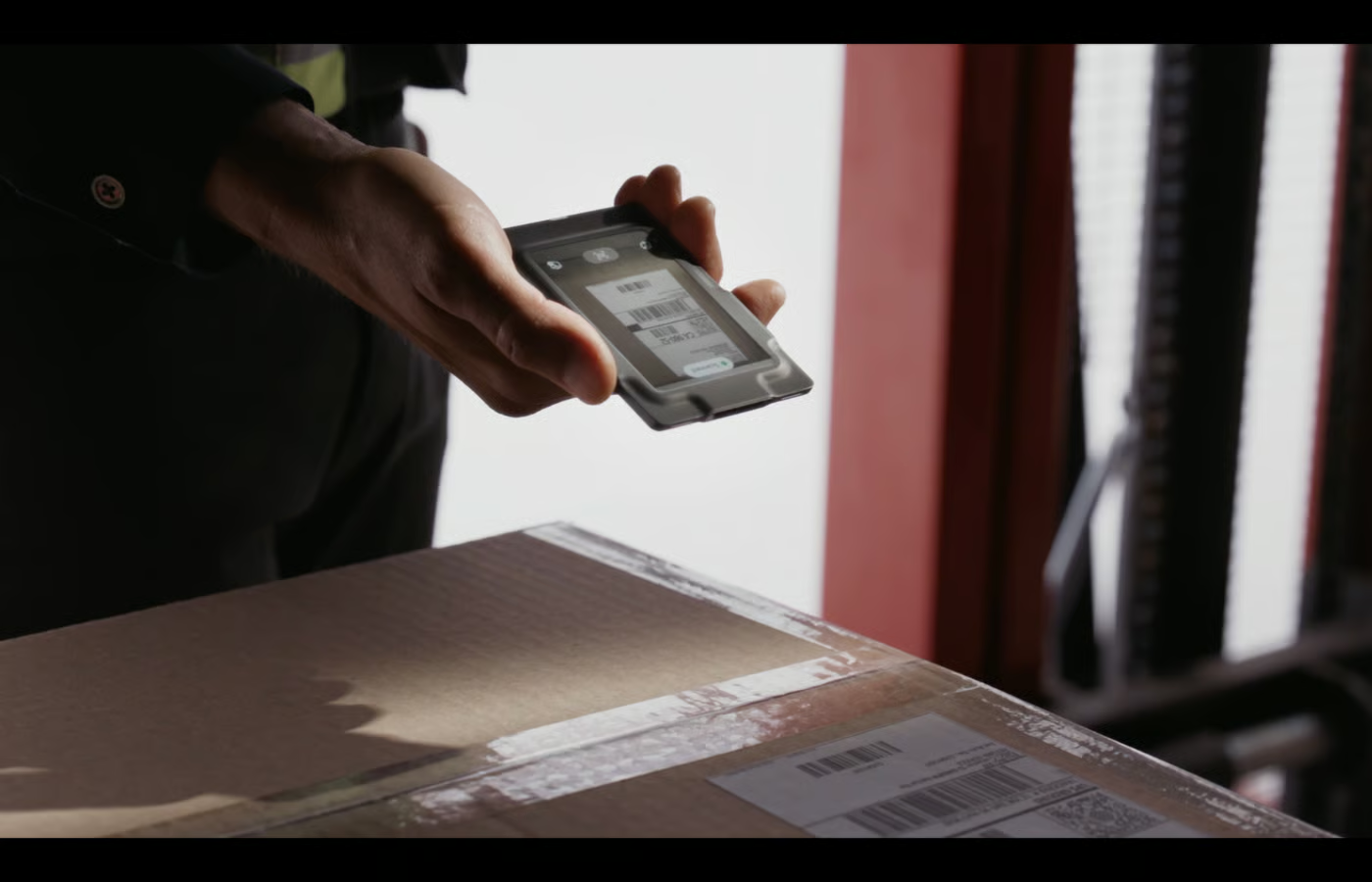
- The Wearable AI Badge: Roughly the dimensions of a standard corporate security access card, this device is engineered to be worn comfortably on a lanyard or securely clipped to clothing. Despite its modest size, it packs a remarkable array of hardware, including a high-resolution camera, a responsive touchscreen, and an integrated biometric fingerprint scanner. During a live demonstration, Microsoft executive Steven Bathiche casually activated the badge using his fingerprint before commanding it to capture photographs of the auditorium audience and dispatch them to the cloud for immediate processing and review.
- The Smart Desk Display: Functioning as a compact companion for enterprise desks, this minimalist display serves as a localized portal for Microsoft 365 services. Employees can bypass traditional desktop applications to view real-time data from Outlook, Excel, and Microsoft Teams, issue complex voice commands, and query localized AI agents entirely untethered from a standard PC workflow.
The Architectural Blueprint: Chip-to-Cloud Integration
Microsoft carefully positioned Project Solara not as a finished consumer gadget, but as an exhaustive "chip-to-cloud platform." The architecture relies heavily on strategic partnerships with leading silicon fabricators, most notably Qualcomm and MediaTek, who collaborated to ensure the underlying processors could handle local edge-AI inferencing with minimal power consumption.
Furthermore, Solara utilizes the Microsoft Device Ecosystem Platform (MDEP). Derived from AOSP (Android Open Source Project), MDEP has been heavily fortified by Microsoft to meet strict enterprise IT standards. It integrates seamlessly with standard IT management and security frameworks, including Microsoft Intune, Entra ID, and Windows Hello for Business. This ensures that enterprise administrators can provision, secure, wipe, and monitor Solara-enabled hardware with the exact same rigor applied to corporate laptops and mobile phones.
Supporting Context & Metrics: The Evolution of Workplace Hardware
To fully grasp the significance of Project Solara, one must examine the broader historical and technological landscape of enterprise hardware, the rise of autonomous AI agents, and the evolving dynamics of office productivity.
The Shift from Application-Centric to Agent-Centric Work
For decades, knowledge workers have interacted with technology through an application-centric lens: opening an email client to communicate, firing up a spreadsheet to analyze data, and launching a word processor to draft reports. The emergence of enterprise AI agents—autonomous or semi-autonomous software entities capable of executing multi-step workflows—fundamentally disrupts this model.
As AI agents become more sophisticated, keeping them trapped behind the glass of a traditional monitor or locked within specific browser tabs creates an artificial bottleneck. By moving agents onto wearable devices and ambient desk displays, Microsoft is attempting to externalize the AI interface. Workers no longer need to switch contexts on a PC screen to interact with an assistant; instead, the assistant travels with them, observing physical meetings, scanning documents in the real world, and orchestrating tasks on the fly.
The Historical Context of Microsoft Hardware Experiments
Microsoft’s journey into specialized enterprise hardware has been fraught with ambitious trials and high-profile retreats:
- HoloLens: Launched with immense fanfare as the future of mixed reality and spatial computing, the HoloLens line underwent multiple iterations before Microsoft ultimately wound down production in 2024. While widely adopted in specialized industrial and defense verticals, the hardware struggled to find a sustainable foothold in the general knowledge-worker economy due to high costs, bulkiness, and software fragmentation.
- Surface Hub: While successful as a collaborative, large-format whiteboard for conference rooms, the Surface Hub remains anchored to fixed physical spaces.
Project Solara represents a direct course correction from these previous endeavors. Instead of building expensive, highly specialized, self-contained computing behemoths, Microsoft is leaning into a reference design model. By outsourcing the physical manufacturing to third-party OEMs and focusing purely on the platform, silicon integration, and OS security layer, Microsoft mitigates its financial exposure while encouraging rapid ecosystem experimentation.
Industry Pilot Programs and Early Adopters
According to reports from The Verge, Microsoft is not launching Solara into a vacuum. A select cohort of enterprise heavyweights—including AccuWeather, Best Buy, CVS Health, and Target—are slated to participate in early pilot programs. These companies will test how wearable AI badges and desk displays can streamline floor-level operations, customer service workflows, and administrative overhead in retail and corporate environments alike.
Official Statements and Industry Reactions
The unveiling of Project Solara immediately sent ripples across the technology sector, prompting commentary from industry leaders, trade publications, and privacy advocates.
Microsoft CEO Satya Nadella championed the initiative during internal and external briefings, describing the Solara hardware line as an entirely "new form factor" for computing that reflects the realities of an AI-first world.
Elaborating on the technical motivations, Steven Bathiche explained the rationale behind integrating an active camera into a wearable badge:
"The camera lets agents better understand and help take action on the environment around them."
Tech media outlets quickly dissected the strategic positioning of the announcement. The Verge emphasized that Microsoft’s refusal to manufacture the devices directly is a calculated maneuver to catalyze hardware partners:
"Microsoft does not plan to sell the two concept devices directly. Instead, it hopes hardware makers will use Solara as a starting point for enterprise AI gadgets."
Concurrently, Engadget highlighted the crucial role played by hardware heavyweights, noting that partnerships with chipmakers like Qualcomm and MediaTek ensure the platform is flexible enough to accommodate wildly divergent device form factors and specialized sensor arrays down the road.
Privacy, Compliance, and Security Challenges
Despite the technical ingenuity behind Project Solara, the introduction of camera-equipped wearable badges into office environments has sparked immediate, fierce debate regarding employee privacy and surveillance.
The Spectre of Workplace Surveillance
The modern office is already a heavily monitored domain, subject to keystroke logging, badge swipes, email auditing, and video surveillance. However, a wearable device equipped with a high-definition camera, biometric sensors, and always-on (or easily triggered) microphones crosses a critical psychological and ethical threshold.
Critics and privacy advocates note that placing an AI-powered camera on an employee’s chest transforms that worker into a mobile surveillance node. Questions immediately arise regarding:
- Unintentional Recording: How can workers and visitors in common areas—such as cafeterias, restrooms, or break rooms—be guaranteed that they are not being passively recorded or transcribed?
- Third-Party Consent: If an employee activates their badge to photograph a client meeting or a conference presentation, do the individuals in the background have legal recourse or the ability to opt out?
- Data Retention and Ownership: Where is the visual and audio telemetry processed? Does it live securely within corporate tenant boundaries, or is it exposed to third-party cloud infrastructure?
The IT and Compliance Nightmare
From a Chief Information Security Officer (CISO) perspective, AI wearables represent a massive compliance headache. While Microsoft’s integration of Intune, Entra ID, and Windows Hello for Business provides a robust administrative shield—allowing IT departments to remotely wipe lost badges or enforce encryption standards—the sheer volume of unstructured, multimodal data generated by ambient AI devices threatens to overwhelm existing governance frameworks.
Regulatory bodies in the European Union and various U.S. states have grown increasingly hostile toward opaque biometric data collection and continuous workplace monitoring. For Solara-based devices to achieve widespread enterprise adoption, companies will need to establish unprecedentedly transparent policies, granular consent mechanisms, and ironclad data minimization guarantees.
Future Outlook: Where Do Ambient AI Wearables Go From Here?
Project Solara is emblematic of a broader, systemic shift across the technology sector. As generative AI matures, the industry is frantically searching for physical vessels capable of making AI tools more portable, intuitive, and seamlessly integrated into daily life.
We are witnessing a parallel convergence across the consumer and enterprise spaces. Meta’s ongoing investments in AI-powered smart glasses and rumored pendant wearables indicate that the market is rapidly converging on wearable AI as the natural successor to the smartphone-and-smartwatch era.
Whether Project Solara ultimately spawns a thriving market of commercial enterprise badges or remains an intriguing evolutionary stepping stone depends entirely on how the industry addresses the human element. The technological hurdles of chip-to-cloud integration, edge inferencing, and operating system security have largely been cleared by Microsoft, Qualcomm, and MediaTek.
The remaining battlefield is not silicon or software—it is trust. If enterprises cannot convince their workforce that wearable AI badges are tools for empowerment rather than instruments of automated surveillance, Project Solara’s ambitious vision of agent-first computing may find itself stymied by the very people it aims to assist. For now, all eyes remain fixed on the upcoming corporate pilots, where the true test of ambient workplace AI will finally begin.