
Executive Overview
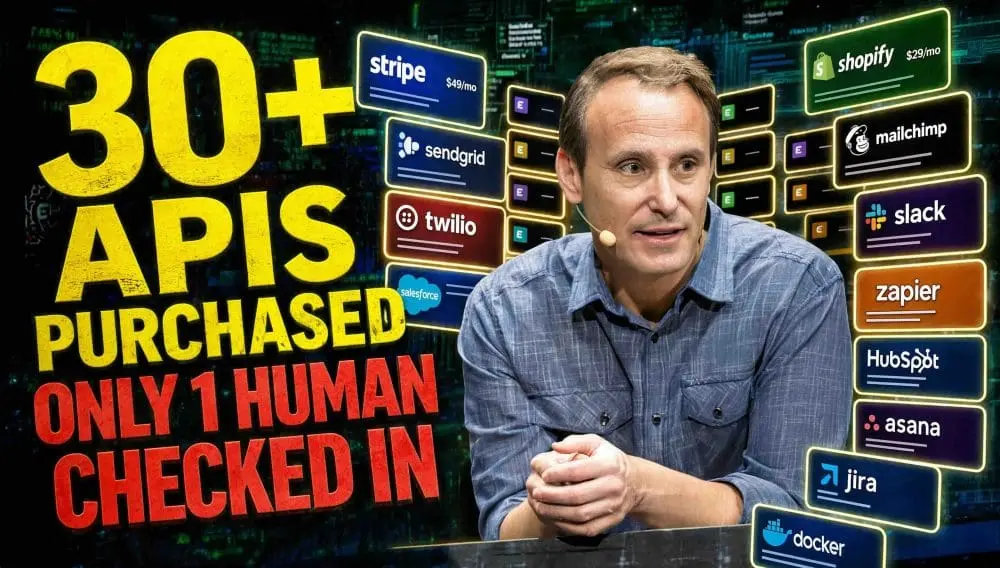
A recent, revealing case study from Jason Lemkin, founder of SaaStr—an organization currently running over 21 distinct AI agents in production and scaling its proprietary SaaStr AI Connect platform—pulls back the curtain on this industry-wide failure. Managing a complex technology stack requires constant integration of external services. Over the course of a single year, SaaStr signed up for more than 30 API providers, spanning search, data enrichment, structured parsing, email infrastructure, inference engines, and cloud storage.
Out of those 30+ enterprise and developer-focused vendors, exactly one company reached out to see if the product was actually working for its intended use case.
The remaining 29 vendors deployed automated email drip sequences, aggressive upselling triggers tied blindly to credit card upgrades rather than actual usage metrics, or—most commonly—nothing at all. By contrast, a single product manager at search infrastructure startup Exa deployed a four-sentence, highly personalized email timed precisely to actual usage. The result? A comprehensive 400-word product specification, deep architectural feedback, a newly minted design-partner relationship, and organic industry advocacy that far outpaces any traditional marketing return on investment (ROI).
This investigation explores the mechanics of that single exchange, deconstructs the systemic flaws plaguing contemporary customer success (CS) and product operations, and outlines a repeatable blueprint for B2B tech companies seeking to transform transactional onboarding into an engines of compounding growth.
Detailed Chronology: Anatomy of a Missed Market Opportunity
To understand the magnitude of the disconnect between B2B software vendors and their high-value technical buyers, one must examine the baseline operational environment of a modern software engineering team.
At SaaStr, engineering and product workflows move at breakneck speeds. Building and maintaining 21+ production-grade AI agents requires relentless testing, benchmarking, and iterating across disparate API ecosystems. When an engineering team evaluates a new API, the evaluation window is narrow, highly focused, and intensely practical. They are not looking for marketing whitepapers or invitations to introductory discovery calls; they are testing core functionality against strict throughput, latency, and pricing constraints.
The Great Silence from 30 Vendors
Over a twelve-month period, SaaStr onboarded more than 30 infrastructure and data APIs. According to Lemkin, the post-signup experience across the vast majority of these vendors fell into three predictable, ineffective buckets:
- The Automated Drip Void: Standardized onboarding sequences fired off on Day 0, Day 1, Day 3, and Day 7 regardless of user activity. These emails offered generic tips like "Here are 5 ways to get started" even for products that engineers had already deployed to production or, conversely, abandoned four minutes after creation.
- The Blind Upsell Trigger: The closest brush with proactive engagement came from a Coresignal sales representative. Days after Lemkin upgraded his subscription tier, the rep reached out. While articulate and well-prepared, the outreach was fundamentally flawed in its timing and motivation: it was triggered by a billing event (a credit card charge), not by a usage milestone. The rep was there to expand the account, not to evaluate product-market fit or troubleshoot developer friction. An upsell conversation based purely on billing telemetry provides zero actionable insight into user experience.
- Absolute Crickets: For the vast majority of the 30+ vendors, engagement post-signup was nonexistent. No human reached out. No automated system queried whether the API returned expected payloads or suffered from parsing errors. The accounts sat in databases as anonymous user IDs waiting for churn.
The Exa Exception
Amidst this desert of automated indifference, one company executed a masterclass in product-led growth (PLG) and user research. Four days after Lemkin ran his first substantive batch of API calls on Exa, he received a personal email from Alina, a member of Exa’s product team.
The message read:
"Hi Jason,
I’m on the product team here at Exa. I noticed you signed up and tested Exa.
If you have a one-liner on how we did (or what could have been done better), that would be greatly appreciated (& I’m happy to drop $50 of credits in your account).
Thanks a mil, Alina"
The contrast between this communication and standard B2B sales outreach was immediate. Within 33 minutes, Lemkin responded—not with a single sentence, but with a detailed, 400-word product spec. The response outlined specific benchmarking numbers, precise feature requests, and granular details regarding SaaStr’s throughput and pricing constraints.
In under three hours, Alina replied. Rather than offering a generic corporate acknowledgement ("Thanks, I’ve passed this along to our product team"), she provided two specific endpoint configurations and an honest, transparent admission regarding architectural limitations—clearly delineating what the current platform did and did not support.
Supporting Context & Metrics: Why the Exa Motion Succeeded
Deconstructing this exchange reveals five distinct pillars that modern product and customer success teams routinely mismanage.
1. The Power of the Micro-Ask
Most software vendors suffer from an inflated sense of a prospect’s available time. Pitching "Do you have 30 minutes for a quick introductory call?" is a high-friction calendar negotiation directed at a user who has no baseline evidence that the vendor is worth their time. Busy developers and technical founders routinely ignore these requests because their primary mandate is shipping product.
By contrast, asking for a "one-liner" lowers the psychological barrier to entry to a 15-second commitment. It can be answered from a smartphone while waiting in line for coffee or transitioning between meetings. Paradoxically, this microscopic ask is precisely what unlocked a comprehensive, highly detailed product specification. Technical buyers do not write specs in response to automated calendar links, but they readily share deep insights when approached with respect for their time.
2. Human-Centric, Roadmap-Adjacent Outreach
In an era where generative AI and automated outbound platforms allow sales teams to spin up hyper-personalized-looking email sequences at infinite scale, the marginal value of automated outreach has plummeted to zero. Conversely, the signal value of a real human being with direct influence over the product roadmap has skyrocketed.
Emails signed by "The Exa Team," automated no-reply aliases, or SDRs running rigid 7-touch sequences built around case studies carry zero authority. When an email arrives from a named human on the product team using their personal inbox, it signals to the user that their feedback will not disappear into a Jira backlog black hole. It signals agency, competence, and responsiveness.
3. Usage-Based Triggers vs. Calendar-Based Triggers
Traditional marketing automation relies on chronological triggers: Day 0, Day 1, Day 3. These schedules operate in total isolation from actual user behavior.
Alina’s outreach was triggered by a behavioral milestone: "I noticed you signed up and tested Exa." The trigger fired after the first meaningful batch of API calls. This timing hits the narrow golden window of product adoption:
- The user has just completed a real-world test, meaning the technical data is fresh.
- Their opinions, friction points, and evaluation metrics are fully formed.
- They have not yet locked in their architecture or permanently routed around operational roadblocks.
Approaching a user a week later is often too late; by then, they have either built workarounds or migrated to a competitor.
4. Native, Frictionless Incentives
Monetary incentives in B2B user research are notoriously clunky. Vendors frequently offer $100 Amazon gift cards conditioned on enduring a 45-minute user research interview governed by strict Non-Disclosure Agreements (NDAs) and managed via scheduling platforms.
Exa’s approach eliminated administrative friction entirely: $50 in API credits was dropped directly into the user’s account with zero paperwork, no raffles, and no mandatory video calls. For a developer or API provider, this incentive model boasts two distinct advantages:
- Near-Zero Marginal Cost: The cost to the vendor for internal platform credits is negligible, allowing this motion to scale across thousands of accounts without triggering internal budget conflicts.
- Aligned Activation: Paying a technical user in platform credits rewards them with more of the exact utility they are already evaluating. A cash gift card buys an opinion; API credits buy an opinion plus another high-intent batch of production traffic.
5. Closing the Feedback Loop with Technical Fluency
The graveyard of customer feedback is paved with polite rejections: "Thanks so much for sharing this, I’ve passed it along to our product team!" This institutional deflection teaches users never to bother engaging again.
Exa succeeded because the respondent understood the product cold. By replying within three hours with specific endpoint configurations and transparent admissions of current system limitations, they established immediate technical credibility. In developer ecosystems, an honest "we don’t support that yet" delivered by a knowledgeable engineer builds infinitely more trust than an enthusiastic, vague promise from a customer support representative who has never written a line of code against the API.
The Collapse of Organizational Silos
One of the most profound takeaways from this case study is how a single, well-executed email collapses three distinct corporate functions that traditional organizations stubbornly split across separate departments, timelines, and budgets:
[Traditional B2B Org]
├── Growth Team ──> Activation Check (Dashboards & Metrics)
├── Product Team ──> Research Interviews (Months Behind Market)
└── Sales/CS Team ──> Expansion Contracts (Post-Architecture Freeze)

[The Exa Model]
└── Single PM + $50 ──> Simultaneous Activation, Research, & Expansion- Activation Check: Typically owned by the growth team and monitored via abstract dashboard metrics rather than direct human inquiry.
- Product Research: Typically owned by the product team and executed through structured interview cycles that lag months behind actual market dynamics.
- Expansion: Typically owned by customer success or enterprise sales, initiating conversations post-contract—which is almost always after technical architecture has already been frozen.
By empowering a single product manager to execute a usage-triggered micro-survey backed by native product credits, Exa compressed what is normally a multi-quarter, multi-departmental friction loop into a single afternoon conversation.
Future Outlook: The Imperative for PLG Humanization
As artificial intelligence continues to lower the barrier to software creation and outbound sales automation, the volume of noise in the B2B marketplace will increase exponentially. Enterprise buyers and developer teams are already developing sophisticated immunity mechanisms against generic AI-generated sales pitches and automated lifecycle sequences.
The companies that win in the coming decade will not be those that scale their automated outbound engines to infinity, but those that strategically inject genuine human intelligence into automated data loops.
The Blueprint to Steal
For B2B SaaS founders, Chief Product Officers, and Head of Growth executives looking to replicate this success, the operational playbook is clear:
- Instrument Usage Triggers: Tie your CRM and customer success tooling to behavioral milestones (e.g., first successful API call, completion of a core workflow) rather than static calendar dates.
- Empower Product Teams: Shift outbound qualitative research out of marketing and sales silos and place it directly into the hands of product managers and engineers who own the roadmap.
- Keep the Ask Microscopic: Never demand 30 minutes of a busy user’s time upfront. Ask for a single line of feedback, a specific frustration point, or a quick rating.
- Denominate Incentives Natively: Reward users with your own product’s currency—credits, expanded limits, or tier unlocks—lowering your acquisition cost while driving deeper product engagement.
- Respond with Technical Authority: Ensure that when users take the time to reply, the response comes from someone who understands the codebase and can offer genuine technical candor.
When a company treats the first week of a new user account as an authentic conversation rather than a deterministic sales sequence, the returns compound dramatically. As demonstrated by Exa, a single honest question from a real person at the exact moment of product evaluation costs virtually nothing, yet it can unlock deep design partnerships, invaluable product specifications, and organic, industry-wide advocacy that no amount of advertising budget can ever buy.