

Executive Overview
The accounting profession is undergoing a structural transformation far more consequential than any technology shift witnessed over the past two decades. While cloud software revolutionized where work happened, and automated workflow tools changed how work moved, artificial intelligence (AI) is fundamentally altering who does the work. This paradigm shift has the potential to reshape the entire architecture of modern accounting firms, moving them away from historical organizational designs and toward agile, highly leveraged operating models.
For more than half a century, the traditional hierarchy of the accounting firm has been defined by a pyramid structure. Built heavily on manual labor, this model featured a wide base of entry-level staff performing repetitive, transactional tasks; a narrowing middle management layer tasked with reviewing and organizing that data; and a small, elite top tier of partners focused on high-level relationships and firm strategy.
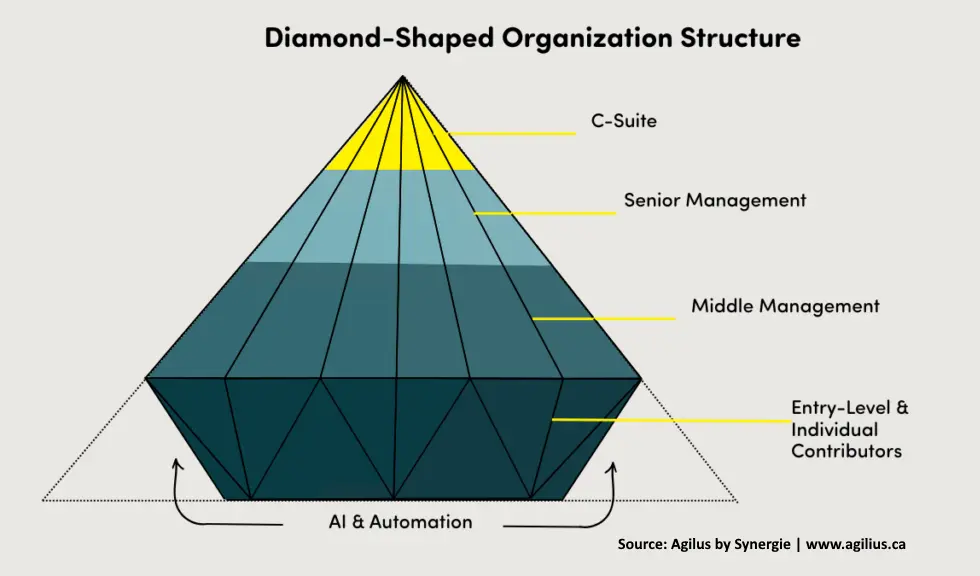
Today, artificial intelligence is dissolving the foundation of that model. As generative AI and machine learning algorithms absorb data entry, document collection, reconciliations, and first-pass analysis, the structural logic of the pyramid collapses. Firms can no longer scale simply by throwing more junior headcount at seasonal bottlenecks. Instead, the future belongs to firms that abandon the pyramid in favor of a diamond-shaped practice model—one that shrinks the entry-level tier, drastically expands the value-generating middle tier, and elevates partners into visionary strategic advisors.
Detailed Chronology: The Evolution of Firm Architecture
To understand why the current moment is so disruptive, it is vital to trace how technology has sequentially altered the practice of public and private accounting over the last twenty years.
Phase 1: The Cloud Revolution (The "Where" Era)
In the late 2000s and early 2010s, cloud computing liberated accounting from physical server rooms and desktop installations. Software platforms migrated to remote servers, allowing accountants to access books, client documents, and trial balances from anywhere. While this shift optimized remote collaboration and reduced IT infrastructure burdens, it did not fundamentally change the division of labor within the firm. Junior staff were still required to manually key in invoices, categorize expenses, and prepare working papers—the physical location of the desk had simply changed.
Phase 2: Workflow Automation (The "How" Era)
The subsequent decade introduced specialized practice management and workflow automation tools. These platforms streamlined how projects moved across desks and departments, reducing bottlenecks, standardizing checklists, and tracking task completion times. However, while workflows became smoother, human beings were still responsible for driving the data through those pipelines. The foundational pyramid of junior producers and senior reviewers remained firmly intact.
Phase 3: The Generative AI Disruption (The "Who" Era)
We have now entered the third, most radical phase of technological evolution. Artificial intelligence is not merely assisting with logistics or hosting; it is executing cognitive tasks. Advanced language models, intelligent document processing (IDP), and autonomous agents can now handle intake, document classification, routing, and preliminary financial statement analysis in seconds.
By taking over the execution layer, AI is dismantling the traditional apprenticeship model. Because junior accountants are no longer needed to perform routine, repetitive data manipulation, firms are forced to completely rethink how talent enters the profession, how internal training is conducted, and how firm profitability is generated.
Why the Pyramid No Longer Fits the Modern Work Environment
The traditional pyramid practice model made complete sense when firms required dozens of junior staff to manage the heavy lifting of compliance. Data entry, bank reconciliations, document gathering, tie-outs, and administrative chasing were predictable, highly time-consuming, and essential to every engagement.
Crucially, these tasks historically served as the foundational training ground for new accountants. Young professionals learned the mechanics of debits and credits, client operations, and tax schedules by grinding through manual work.
The Disruption of the Apprenticeship Pipeline
AI disrupts this logic entirely. When automation seamlessly manages the unseen background work—intake, preparation, anomaly detection, and first-pass tax preparation—the business case for maintaining a wide base of junior labor evaporates. Firms can no longer scale their revenues simply by adding bodies to the bottom of the org chart.
Instead, modern scalability is achieved by increasing the operational leverage of mid-level professionals. These skilled staff members interpret AI-generated outputs, manage complex technical exceptions, exercise critical judgment, and guide clients through increasingly turbulent economic landscapes.
The Rise of the Diamond-Shaped Firm
To survive this transition, visionary practice leaders are proposing an entirely new organizational structure: the diamond-shaped firm.
- The Top (Partners & Principal Advisors): Focused exclusively on high-value advisory services, long-term wealth and tax planning, and strategic relationship leadership.
- The Center (The Expanded Middle): The core engine of value creation. These mid-career professionals validate anomalies, contextualize financial results, manage cross-functional teams, and lead direct client consultations.
- The Base (Streamlined Entry-Level): A much leaner group focused heavily on developing core judgment, technological fluency, and critical thinking rather than logging hours on repetitive data entry.
This diamond shape reflects a profession undergoing a monumental pivot: moving from production to interpretation, from historical compliance to forward-looking counsel, and from mere task execution to strategic partnership.
Supporting Context & Metrics: Mobilizing Value in the Middle
In an AI-enabled practice, the middle layer ceases to be merely a checkpoint for reviewing junior work. It becomes the operational and strategic heartbeat of the firm.
Elevating Human Skills in an Automated World
Mid-level professionals in a diamond-shaped firm operate as strategists. They ensure that automated workflows produce accurate, contextually relevant outcomes, translate dense technical complexity into plain-English clarity, manage risk, and coordinate cross-functional advisory teams. Their success is no longer measured by how many boxes they checked on a compliance checklist, but by how effectively they guide clients through uncertainty.
This shift radically elevates the importance of innate human skills. Far from making accountants obsolete, technology is rendering the human elements of the profession exponentially more valuable:
- Communication: Explaining complex financial scenarios with empathy and clarity.
- Curiosity: Asking the right questions to uncover hidden client opportunities.
- Trust-Building: Serving as a reliable, empathetic sounding board during financial stress.
Strategic Staffing and Talent Development
Transitioning to a diamond practice model requires a complete overhaul of human resource strategies, recruitment pipelines, and professional development programs.
Hiring for the Future, Not the Past
Firms that continue hiring according to the traditional pyramid model will quickly find themselves overstaffed at the bottom, financially strained, and underdeveloped in the middle. Conversely, forward-thinking firms that hire for the diamond model will position themselves to scale revenues exponentially without experiencing linear payroll inflation.
This means hiring fewer entry-level generalists for data-processing roles and seeking out:
- Mid-career professionals capable of managing complex exceptions, overseeing quality control, and directing client relationships.
- Non-traditional talent, including data analysts, software technologists, and AI specialists who can continuously optimize the firm’s tech stack.
Reinventing Training and Onboarding
Because new accountants will no longer learn the mechanics of accounting by grinding through manual spreadsheets, professional development must evolve. Onboarding programs must replace manual labor repetition with scenario-based judgment training, technology fluency workshops, advisory frameworks, and deep mentorship. The primary learning mechanism of the modern firm is mentorship, not data entry.
Official Perspectives and Industry Leadership
Industry thought leaders and forward-looking practitioners emphasize that structural passivity is the greatest risk facing accounting firms today. Waiting for the market to force a redesign will leave firms scrambling to catch up with nimbler competitors.
"The firms that succeed will be those that intentionally redesign their structure, not those that wait for the structure to change around them," notes Luke Frye, CPA and Accountant in Residence at Canopy. "AI is not replacing accountants. It is replacing the pyramid. The firms that embrace the diamond-shaped model will operate with greater capacity, stronger relationships, and a more resilient talent strategy."
Leadership in an autonomous, AI-driven firm requires a fundamentally different skill set. Managing partners must rethink how they measure employee performance, allocate capital resources, and design internal workflows. Success demands:
- Standardized Processes: Creating clean, repeatable processes that feed seamlessly into automation tools.
- Rigorous Quality-Control Frameworks: Ensuring automated outputs are consistently audited for bias, error, or regulatory shifts.
- Frictionless Client Experiences: Designing touchpoints that prioritize transparency, speed, and ease of communication.
Future Outlook: The Next Decade Belongs to the Reshaped Firm
The geometry of the accounting profession is undergoing an irreversible evolution. Diamonds may well be a firm’s best strategic asset in the decades ahead.
As artificial intelligence matures, the firms that cling to legacy pyramid models will struggle with bloated cost structures, uninspired junior staff, and stagnant service offerings. On the other hand, firms that proactively adopt the diamond-shaped model will unlock unprecedented operational capacity. They will operate with lean, highly skilled teams, foster deeper and more profitable client relationships, and maintain resilient, future-proof talent strategies.
Ultimately, the accounting firms of tomorrow are being built today. They are built for high-value advisory, engineered for technological autonomy, and anchored in the irreplaceable power of human-centered professional guidance. The choice for firm leaders is simple: intentionally redesign your architecture now, or watch the future of the profession pass you by.
About the Author
Luke Frye, CPA, is the Accountant in Residence at Canopy. Drawing on his extensive background in accounting technology startups and private practice, Frye works closely with modern accounting firms to help them build smarter, highly scalable, and future-ready business models.