

Executive Overview
This high-profile maneuver underscores a growing, controversial trend across the tech sector: replacing headcount with hyper-efficient autonomous systems. ClickUp’s strategy relies heavily on deploying thousands of internal AI agents to manage complex workflows, shifting the paradigm of white-collar labor from direct task execution to system management, agent oversight, and human-AI orchestration. While remaining employees face new expectations to multiply their operational output exponentially, the company has dangled unprecedented financial incentives—including million-dollar salary bands—for those who achieve outsized, measurable impacts through AI.
However, this radical pivot sparks critical questions about the future of work. As software companies increasingly lean on autonomous technologies to shrink teams, business leaders and industry analysts are left scrutinizing whether these dramatic restructuring efforts yield sustainable business resilience or merely short-term efficiency gains at the expense of human capital.
Detailed Chronology of the Shift
The restructuring at ClickUp did not happen in a vacuum; it represents the culmination of a multi-year technological integration that has steadily woven generative artificial intelligence and autonomous agents into the fabric of daily enterprise operations.
From Productivity Experiments to Operational Overhauls
For years, technology firms treated generative AI as an experimental tool—a sandbox where employees could draft emails, summarize meeting notes, or write basic code snippets. However, as large language models matured and enterprise-grade AI agents emerged, leaders began envisioning a fundamentally different corporate structure.
In the months leading up to the May 2026 workforce reduction, ClickUp aggressively accelerated its internal integration of artificial intelligence. Reports indicated that the enterprise software provider deployed roughly 3,000 internal AI agents designed to autonomously handle multi-step, complex operational tasks previously managed by human employees.
The Layoff Announcement and Structural Realignment
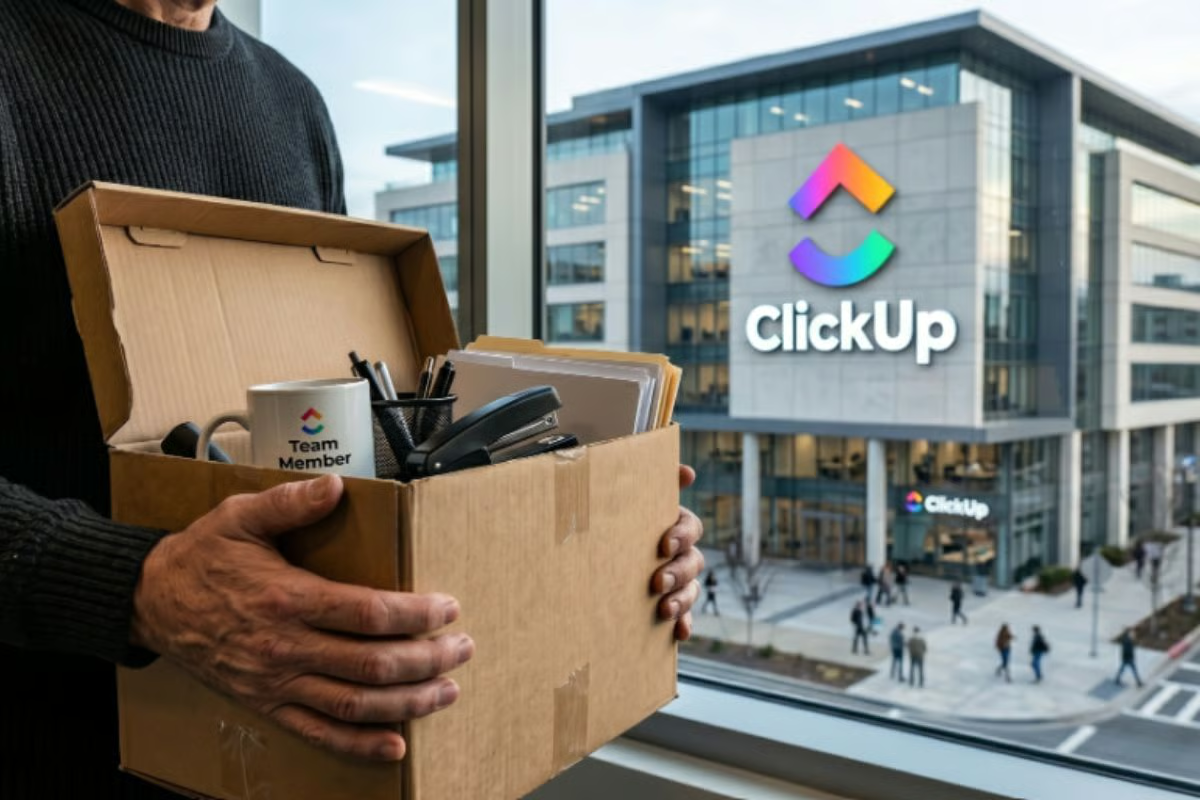
Last week, the realization of this technological shift materialized in the form of sweeping layoffs. Cutting over a fifth of its staff, ClickUp moved swiftly to dismantle traditional team hierarchies. CEO Zeb Evans communicated the pivot not as a reactionary measure to declining revenues, but as a proactive redesign of the company’s operating model.
Under the newly minted "100x org" framework, the remaining workforce was immediately realigned into three distinct categories:
- Builders: Engineers and technical specialists focused on developing, refining, and scaling the underlying software infrastructure and automation loops.
- System Managers: Operators whose primary responsibility is to direct, supervise, and optimize fleets of AI agents rather than executing individual tasks manually. For instance, reports highlighted growth operations managers at the firm overseeing upwards of 37 autonomous agents simultaneously.
- Front-Liners: Personnel dedicated to high-touch human responsibilities, specifically focusing on complex customer relationships, strategic partnerships, and qualitative problem-solving that automation cannot yet replicate.
This structural re-engineering signals a profound evolution in corporate job descriptions, where an employee’s value is increasingly measured by their capability to orchestrate software-driven output rather than their individual output capacity.
Supporting Context & Metrics: The Financial and Market Landscape
To fully grasp the gravity of ClickUp’s recent maneuver, one must examine the company’s trajectory and the broader macroeconomic climate driving software sector downsizing.
Valuation and Workforce Scaling
Founded as a cloud-based productivity and collaboration platform tailored for enterprise teams, ClickUp experienced meteoric growth during the pandemic-era software boom. By 2021, the company achieved a private market valuation of approximately $4 billion. Fueled by venture capital and soaring demand for remote collaboration tools, its headcount scaled rapidly, surpassing 1,000 employees by 2023.
However, the subsequent cooling of the tech investment climate, coupled with a relentless industry-wide push toward operational profitability and capital efficiency, forced leadership to re-evaluate burn rates. The introduction of generative AI provided a convenient—and, in management’s view, necessary—lever to permanently alter the company’s cost-to-output ratio.
Industry-Wide Trends and Gartner Insights
ClickUp is far from an isolated actor in this dramatic reshaping of the labor market. The strategy of leveraging autonomous technology to justify smaller headcounts has become a prevailing theme across the technology sector, echoing recent workforce reductions seen at companies like Coinbase, Meta, and LinkedIn.
Data from industry research firms highlights the scale of this phenomenon. A prominent Gartner survey cited by market analysts revealed that approximately 80% of organizations currently deploying autonomous AI technology have implemented workforce reductions as a direct result. Yet, the same data points to a lingering operational ambiguity: while trimming headcount produces immediate cost savings on paper, these reductions have not universally translated into sustainable financial returns, enhanced product quality, or long-term business resilience.
For CIOs and enterprise decision-makers, ClickUp’s experiment serves as a high-stakes litmus test for whether a smaller, AI-augmented workforce can genuinely sustain long-term innovation without burning out remaining personnel.
Official Statements and Executive Vision
The rationale behind ClickUp’s restructuring has been heavily defined by the public and internal pronouncements of its executive leadership, most notably CEO Zeb Evans. By reframing the layoffs through an unapologetically futuristic lens, Evans sought to distance the company’s strategy from conventional austerity measures.
The "100x Org" and Million-Dollar Salary Bands
In communications shared widely across the tech industry, Evans emphasized that the financial capital saved by reducing the workforce would not simply vanish into corporate reserves or short-term profit margins. Instead, the company committed to redirecting those funds toward the top-tier talent retained through the transition.
"Most savings from this change will flow directly back into the people who stay," Evans wrote, as reported by TechCrunch. "We’ll be introducing million-dollar salary bands."
Elaborating on this meritocratic, hyper-aggressive compensation philosophy, Evans noted that traditional HR structures and rigid corporate pay scales are ill-equipped for an AI-first era. According to reporting from Business Insider, Evans explicitly stated: "If you create outsized impact using AI, you’ll be paid outside of traditional bands."
This compensation model attempts to solve a central dilemma of the AI transition: how to retain top performers who successfully leverage autonomous tools to generate revenue and productivity equivalent to departments many times their size. By dangling unprecedented financial rewards, ClickUp is effectively betting that a leaner, highly incentivized workforce can outpace legacy competitors burdened by bureaucratic bloat and manual workflows.
Future Outlook: The Viability of the AI-First Workplace
As the dust settles on ClickUp’s dramatic restructuring, the tech sector is left to ponder a fundamental question: Is the "100x organization" a visionary blueprint for the future of work, or a perilous gamble that risks organizational institutional knowledge and employee burnout?
The Promise of Human-AI Orchestration
Proponents of the AI-first model argue that routine, manual task execution is an inefficient use of human intelligence. By delegating data processing, workflow tracking, scheduling, and basic content generation to fleets of autonomous agents, workers are freed to focus on high-level strategic thinking, creative problem-solving, and empathetic customer engagement. In theory, this allows smaller teams to achieve enterprise-scale output, disrupting legacy competitors who remain tethered to traditional, linear scaling models.
The Hidden Risks and Implementation Challenges
Conversely, critics and organizational psychologists warn of significant hidden pitfalls. Operating as a "system manager" overseeing dozens of AI agents introduces new forms of cognitive fatigue. Employees are forced into constant supervisory roles, reviewing automated outputs for hallucinations, security vulnerabilities, and compliance errors—a process that can sometimes prove more mentally taxing than creating the work from scratch.
Furthermore, aggressive headcount reductions can severely erode a company’s institutional memory and mentorship pipelines. When 22% of a workforce is cut overnight, junior and mid-level employees lose vital human mentors, relying instead on artificial intelligence models that lack contextual nuance, cultural understanding, and deep historical awareness of the company’s product philosophy.
Strategic Takeaways for Business Leaders
For enterprise leaders, CIOs, and human resources executives observing ClickUp’s transformation, the key takeaway is the absolute necessity of structured governance. Adopting an AI-first operational model requires more than simply issuing pink slips and deploying software agents; it demands robust frameworks for data security, ethical oversight, clear accountability metrics, and sustainable performance evaluation.
ClickUp has cast a bold vote of confidence in the autonomous future, establishing a high-risk, high-reward precedent that will be closely watched across the global economy. Whether this aggressive model scales successfully—or serves as a cautionary tale of over-automation—will depend entirely on how effectively organizations balance the relentless pursuit of output with the irreplaceable value of human ingenuity.