
Executive Overview
Unlike their predecessors, which were largely confined to text generation and summarization, modern AI agents possess the capacity to plan, execute, and dynamically adapt multi-step workflows. They seamlessly interface with external software tools, relational databases, enterprise resource planning (ERP) systems, and complex Application Programming Interfaces (APIs)—all without requiring continuous human oversight.
Whether these systems are autonomously navigating global supply chain disruptions, writing and deploying production-grade software code, or analyzing thousands of real-time financial transactions to catch sophisticated fraud vectors, they are no longer merely assisting knowledge workers. Instead, they are executing entire operational workflows from end to end.
According to recent industry benchmarks, enterprises early to adopt agentic architectures are realizing dramatic productivity gains. By shifting human employees out of routine, mechanical execution loops and elevating them into strategic oversight and governance roles, organizations are redefining operational efficiency. This article explores five core industrial use cases where AI agents are fundamentally rewriting the rules of engagement, backed by practical developer resources to help engineers build and deploy these systems firsthand.
Detailed Chronology: From Static Chatbots to Autonomous Agents
To understand the magnitude of the current shift, it is essential to trace the rapid evolution of artificial intelligence over recent years:
- The Generative Boom (2022–2023): The mainstream debut of Large Language Models (LLMs) introduced conversational interfaces to the masses. While revolutionary for creative writing and basic information retrieval, these models were fundamentally stateless and reactive. They answered questions one prompt at a time, prone to hallucination when tasked with multi-step reasoning, and entirely dependent on human copy-pasting to execute downstream actions.
- The Retrieval-Augmented Generation (RAG) Era (2024): Organizations sought to ground LLMs in proprietary data by connecting them to vector databases. This allowed chatbots to accurately answer specific internal queries, but systems remained largely confined to read-only information retrieval. They still could not act, modify, or execute tasks within external systems.
- The Rise of Function Calling and Tool Use (2025): AI labs introduced native function-calling capabilities, enabling models to recognize when they needed external data or compute resources. Models could now generate structured JSON payloads to trigger external APIs, planting the seeds for true software agency.
- The Agentic Production Epoch (2026): Today, autonomous frameworks (such as LangChain, AutoGen, and CrewAI) allow multiple specialized agents to collaborate, reason through obstacles, maintain long-term memory, and self-correct when execution paths fail. Agentic AI is no longer a futuristic concept; it is the operational backbone of modern digital enterprises.
Supporting Context & Metrics: The Enterprise Impact
The economic driving forces behind the agentic shift are rooted in efficiency and scalability. Industry data highlights compelling transformations across sectors:
- Reduced Average Handle Times (AHT): Customer support operations utilizing multi-tool AI agents report up to a 60% reduction in ticket resolution times for tier-one and tier-two inquiries.
- Engineering Acceleration: Software development teams leveraging autonomous coding agents have observed velocity increases of 40% in boilerplate feature generation and bug patching.
- Compliance Accuracy: Financial institutions deploying contextual agentic workflows for anti-money laundering (AML) report a significant drop in false-positive alerts, freeing compliance officers to focus on genuine systemic threats.
5 Real-World Use Cases Where AI Agents Are Transforming Industries
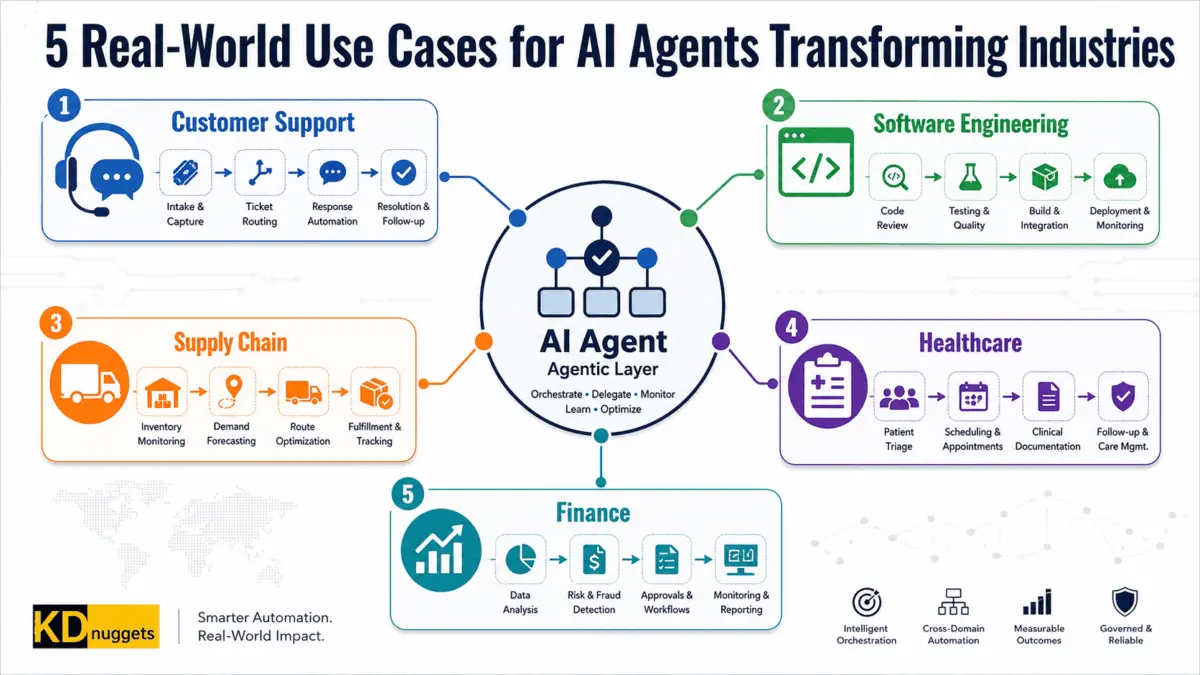
1. Automating End-to-End Customer Support and Triage
Traditional customer service models have long relied on rigid, rule-based chatbots designed primarily to deflect incoming inquiries. These systems frequently frustrate users with circular logic trees and an inability to resolve anything beyond the simplest FAQs. Modern customer expectations demand rapid, accurate resolutions across asynchronous channels, including email, live chat, SMS, and social media platforms simultaneously.
Today’s AI support agents integrate deeply with Customer Relationship Management (CRM) platforms, billing software, and logistics databases. When a customer requests a refund, modifies a subscription, or reroutes a package, the support agent does not merely draft an email response—it executes the transaction across disparate back-end systems.
Key Operational Impacts:
- Multi-Channel Context Preservation: Agents maintain a unified state across communication channels, ensuring customers never have to repeat their issue when switching from web chat to email.
- Autonomous Exception Handling: Rather than escalating standard edge cases to human supervisors, agents evaluate policy constraints and execute approved refunds or cancellations programmatically.
- Human-Centric Escalation: When emotional nuance or complex relationship management is required, the agent hands off the case to a human representative accompanied by a concise, structured executive summary of the issue.
Learning Resource: To dive deeper into connecting language models to external ticketing systems and CRM APIs, explore the official LangChain Documentation on building specialized customer support agents.
2. Accelerating Software Engineering and Testing
Software development lifecycles are undergoing a structural transformation through the deployment of autonomous coding agents. Moving far beyond simple inline autocomplete tools, these agents operate directly within version control systems. Given a high-level GitHub issue or user story, an engineering agent can clone the repository, search the codebase architecture, write the required code, execute local unit tests, debug failing assertions, and submit a fully documented pull request.
Key Features of Engineering Agents:
- Repository-Wide Comprehension: Utilizing vector embeddings and advanced code-parsing tools, agents analyze entire dependency trees and architecture maps to ensure new code adheres to established design patterns.
- Automated Regression Testing: Agents write and run targeted test suites, iterating on their own code until all edge cases pass successfully before requesting human review.
- Shift in Developer Focus: By absorbing routine bug fixes, dependency updates, and boilerplate feature construction, engineering agents allow human developers to focus on high-level system architecture, security auditing, and core product design.
Learning Resource: To observe open-source agents resolving genuine software engineering issues autonomously on real GitHub repositories, check out the SWE-agent Project.
3. Orchestrating Adaptive Supply Chains
Global supply chains remain highly vulnerable to volatile disruptions, ranging from unexpected port congestion and extreme weather events to geopolitical trade policy shifts and sudden raw material shortages. Traditional logistics management often suffers from latency, as human analysts manually aggregate siloed data feeds to formulate response plans.
Modern logistics enterprises deploy cooperative multi-agent systems that continuously ingest global data streams—weather radars, maritime tracking APIs, customs databases, and supplier inventories. The moment a disruption is detected, the agent network recalculates optimal shipping routes, renegotiates delivery windows with regional partners, and updates warehouse fulfillment schedules within minutes.
What Supply Chain Agents Offer:
- Real-Time Collaborative Optimization: Distinct agents representing different nodes in the supply chain (e.g., warehousing, freight forwarding, procurement) negotiate parameters autonomously to minimize delay and cost.
- Predictive Risk Mitigation: Agents flag potential vulnerabilities days before they materialize, suggesting preemptive inventory redistribution.
- Drastic Compression of Response Times: Tasks that historically required days of cross-departmental coordination and email chains are resolved programmatically in moments.
Learning Resource: Read up on Multi-Agent Reinforcement Learning (MARL) concepts at the Berkeley AI Research (BAIR) Lab to understand how distinct computational agents negotiate and optimize complex logistical networks.
4. Streamlining Clinical Triage and Healthcare Workflows
Clinician burnout has reached a systemic crisis point globally, driven largely by administrative overhead and electronic health record (EHR) documentation burdens. Empirical studies consistently demonstrate that physicians spend nearly as much time on paperwork as they do on direct patient care.
AI agents are increasingly deployed in clinical environments to securely manage patient intake data, coordinate inter-departmental scheduling, draft clinical notes from ambient audio consultations, and pre-verify insurance claims. By handling the administrative layer of healthcare operations, these systems return valuable time to medical professionals.
Healthcare Agent Applications:
- Secure EHR Integration: Agents parse unstructured patient histories and clinical notes, organizing them into standardized formats while adhering to strict privacy regulations.
- Administrative Triage: Managing appointment scheduling, prescription refill authorizations, and referral routing without human intervention.
- Payer-Provider Coordination: Automating prior authorization requests by cross-referencing clinical documentation with complex insurance policy guidelines.
Learning Resource: Review the Kore.ai Healthcare Framework to examine how enterprise platforms manage HIPAA-compliant, multi-step clinical workflows at scale.
5. Scaling Anti-Money Laundering (AML) and Fraud Detection
Financial institutions operate in a perpetual arms race against sophisticated fraud networks. Traditional rule-based transaction monitoring systems frequently generate massive volumes of false-positive alerts. This operational noise overwhelms compliance teams, occasionally allowing genuinely sophisticated illicit transactions to slip through undetected.
Modern financial institutions utilize AI agents to conduct deep, contextual investigations into flagged accounts. When a suspicious transaction pattern occurs, an agent does not simply trip a binary alarm; it pulls historical account activity, checks associated corporate registries, analyzes transaction velocity, and drafts a comprehensive Suspicious Activity Report (SAR) complete with evidentiary links.
Why Financial Agents Transform Compliance:
- Contextual Investigation: Agents cross-reference global sanction lists, beneficial ownership registries, and news feeds to evaluate risk comprehensively.
- Reduction of False Positives: By evaluating nuanced behavioral patterns rather than rigid transactional thresholds, agents drastically reduce manual review overhead.
- Audit-Ready Documentation: Every step taken by the investigative agent is logged in a transparent chain of reasoning, ensuring full regulatory compliance and auditability.
Learning Resource: Explore the specialized courses on DeepLearning.AI covering AI for finance to understand how machine learning models are trained for advanced anomaly detection and risk scoring.
Official Statements and Industry Perspective
As enterprises rapidly reconfigure their IT stacks around agentic workflows, industry leaders emphasize that governance and human oversight remain paramount.
"We are moving past the era where artificial intelligence simply talks about work," notes Vinod Chugani, an AI and data science educator specializing in enterprise automation frameworks. "Agentic AI represents the moment technology begins executing complex, multi-step operations reliably. However, the true competitive advantage does not lie in eliminating human involvement entirely, but in redefining the division of labor—letting agents handle high-volume, rule-bound execution while humans elevate into strategic oversight, exception handling, and governance roles."
Enterprise architects echo this sentiment, stressing that successful adoption requires robust monitoring guardrails, API security protocols, and continuous evaluation loops to ensure autonomous systems adhere to organizational compliance mandates.
Future Outlook
The trajectory of agentic AI points toward increasingly sophisticated, decentralized architectures. Over the next several years, we can anticipate several key developments:
- Autonomous Multi-Agent Swarms: Organizations will move from deploying isolated, single-purpose agents to orchestrating collaborative swarms of specialized agents that negotiate, debate, and solve enterprise-wide challenges dynamically.
- Standardized Agent Protocols: The emergence of universal communication protocols between AI agents will allow systems built by different vendors to interoperate securely across corporate boundaries.
- Enhanced Edge Execution: As hardware efficiency improves, lightweight agentic frameworks will run locally on edge devices, reducing latency and enhancing data privacy in sensitive operational environments.
Summary
The transition from generative AI to agentic AI marks a fundamental maturity milestone in the history of computing. Across customer support, software engineering, supply chain management, healthcare, and finance, a consistent structural pattern emerges: agents absorb the high-volume, time-sensitive execution layer of complex workflows, while human professionals shift permanently into roles of oversight, architectural design, and strategic decision-making.
This division of labor is no longer a distant theoretical vision; it is actively running in production environments across global enterprises. Wherever a high-volume, repetitive execution layer sits between human intent and operational execution, an autonomous agent is poised to take the wheel.
About the Author
Vinod Chugani is an AI and data science educator dedicated to bridging the gap between emerging artificial intelligence technologies and practical enterprise applications for working professionals. His core focus areas include agentic AI systems, machine learning deployment, and advanced automation workflows. Through his work as a technical mentor and instructor, Vinod has supported numerous data professionals through skill development, technical upskilling, and career transitions. Bringing analytical rigor and expertise from quantitative finance to his hands-on teaching methodology, his content consistently emphasizes actionable strategies, robust frameworks, and real-world architectures that professionals can implement immediately.