
Executive Overview
A common misconception plagues the industry: the belief that "AI" represents a single, homogenous profession. In reality, artificial intelligence is an expansive ecosystem spanning mathematical research, complex software engineering, and applied strategic problem-solving. Each sector rewards vastly different cognitive strengths, technical foundations, and educational investments.
Drawing from extensive mentorship data encompassing over a thousand individual guidance sessions with data science students, industry insiders note that individuals frequently waste months—or even years—chasing the wrong skills for the wrong roles due to generalized career advice. Companies routinely post job descriptions under identical titles—such as "AI Engineer"—that conceal wildly divergent technical expectations, ranging from deploying large language models (LLMs) to simply chaining together foundational API calls.
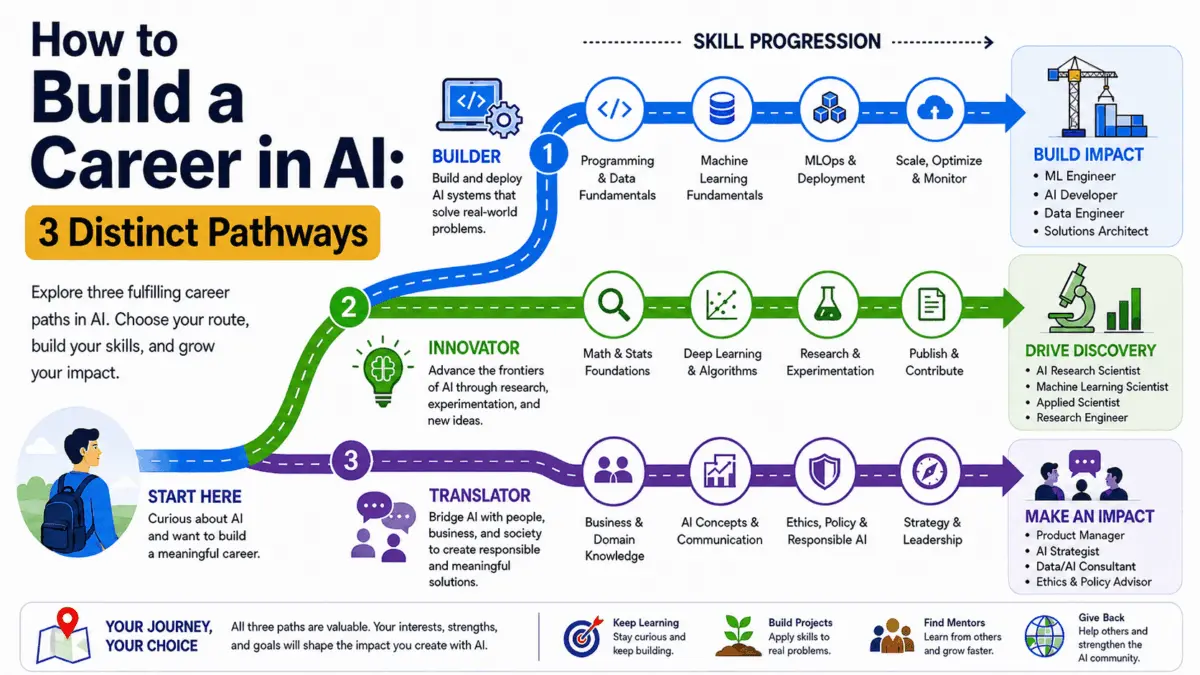
To cut through this confusion, industry educators have categorized the modern AI workforce into three distinct operational pathways: The Builder, The Innovator, and The Translator. Understanding the nuances of these three trajectories is no longer merely helpful; it is a critical prerequisite for anyone hoping to build a sustainable, future-proof career in the age of machine intelligence.
Detailed Chronology & Evolution of the AI Job Market
To understand why career fragmentation has reached its current peak, it is necessary to examine how the AI employment landscape has evolved over the past decade.
Phase 1: The Academic Monopoly (Pre-2017)
In the early days of the modern deep learning boom, artificial intelligence was almost exclusively the domain of academia and elite corporate research labs (such as DeepMind, Google Brain, and OpenAI). The barrier to entry was exceptionally high, requiring advanced doctoral degrees in computer science, mathematics, or specialized physics. Professionals in the field were uniformly "Innovators"—individuals inventing entirely new neural network architectures, loss functions, and optimization algorithms.
Phase 2: The Open-Source Democratization (2018–2022)
As frameworks like TensorFlow, PyTorch, and scikit-learn matured, the barrier to entry began to lower. Pre-trained models became accessible to software engineers without doctoral degrees. This period birthed The Builder pathway. Organizations realized that implementing existing algorithms could drive immense business value, creating a massive demand for software engineers who understood how to ingest data, train models on GPUs, and push applications into production environments.
Phase 3: The Generative AI Explosion & The Rise of the Translator (2023–Present)
The launch of ChatGPT and subsequent foundational models fundamentally disrupted the labor market once again. Suddenly, companies across every conceivable sector—from healthcare and law to agriculture and retail—wanted to integrate AI. However, most businesses did not need researchers to invent new architectures, nor did they need low-level systems engineers to train models from scratch. They needed professionals who understood what the technology could realistically accomplish, where it failed, and how to align it with business objectives. This economic reality catalyzed the explosive rise of The Translator.
Today, the AI job market sits at the intersection of all three phases, creating a complex hiring ecosystem where mismatched expectations lead to high rates of professional burnout and misallocated educational investment.
The Three Core AI Pathways Decoded
+---------------------------------------------------------------------------------+
|                        THE ARTIFICIAL INTELLIGENCE ECOSYSTEM                    |
+---------------------------------+-------------------------------+---------------+
|                                 |                               |               |
|          WAY 1: BUILDER         |        WAY 2: INNOVATOR       |  WAY 3: TRANSLATOR   |
|     (Engineering & Systems)     |     (Research & Science)      | (Strategy & Domain)   |
|                                 |                               |               |
|  • Focus: Scalability & Uptime  |  • Focus: Algorithmic Novelty | • Focus: Alignment & Value|
|  • Stack: Python, PyTorch, Cloud|  • Stack: Math, Linear Alg.   | • Domain Expertise, Product |
|                                 |                               |               |
+---------------------------------+-------------------------------+---------------+
Pathway 1: The Builder (Engineering and Deployment)
Builders are the bedrock of applied artificial intelligence. They take experimental, functional models and transform them into robust, reliable, and scalable systems that can handle millions of enterprise users without collapsing.
Core Responsibilities and Mindset
The daily work of a Builder centers around writing clean code, architecting efficient data pipelines, managing model versioning, and monitoring system performance. If you find deep satisfaction in logical problem-solving, debugging complex asynchronous code, and seeing immediate, tangible results from the software you deploy, this is your natural home.
The Most Common Misstep
Aspiring Builders frequently labor under the misconception that this pathway requires inventing novel algorithms. Consequently, they spend all their time studying complex mathematical proofs while neglecting standard software engineering principles.
"I worked with a mentee who possessed phenomenal benchmark accuracy on his models, yet he had never versioned a model, monitored concept drift, or written a data validation layer," notes technical educator Vinod Chugani. "He was genuinely surprised to learn that production engineering interviews test software reliability and system design just as heavily as modeling capability."
Recommended Technical Stack
- Programming Languages: Python, SQL
- Core Libraries: scikit-learn, PyTorch, LangChain (for orchestration)
- Infrastructure: Docker, Kubernetes, and at least one major cloud provider (AWS, GCP, or Azure).
Pathway 2: The Innovator (Research and Science)
If Builders ensure that AI systems run efficiently in production, Innovators push the absolute boundaries of what those systems are capable of achieving. They operate at the bleeding edge of computer science, striving to invent novel architectures rather than simply applying existing ones.
Core Responsibilities and Mindset
Innovators live in ambiguity. Their work involves reading cutting-edge academic papers from arXiv, designing novel neural network topologies, running costly training runs, and publishing findings. This is by far the most mathematically demanding pathway, relying heavily on advanced linear algebra, multi-variable calculus, probability theory, and complex optimization.
The Most Common Misstep
The primary trap in this pathway is romanticizing research without meeting the rigorous foundational prerequisites. Many students gravitate toward research simply because it commands prestige, ignoring the reality of their mathematical backgrounds.
"Fascination with artificial intelligence is necessary, but it is not sufficient," experts warn. "This path rewards individuals who are deeply comfortable with high failure rates, mathematical uncertainty, and long-term commitments to graduate-level study or specialized corporate research labs."
Recommended Entry Points
- Foundational Courses: The DeepLearning.AI Machine Learning Specialization and fast.ai’s Practical Deep Learning for Coders.
- Academic Focus: Peer-reviewed journals, optimization theory, and advanced probability texts.
Pathway 3: The Translator (Product, Strategy, and Ethics)
Often overlooked in technical circles, the Translator pathway represents the area where the vast majority of professionals are actually best positioned to succeed.
Core Responsibilities and Mindset
Translators serve as the crucial bridge between raw technological capability and organizational execution. You do not need to write production-level code or compute gradients here, but you do need high technical literacy: understanding what AI can achieve, where its systemic blind spots lie, and what regulatory or ethical risks it introduces.
Challenging Cultural Biases
There is a pervasive cultural bias within the tech industry that rewards the creation of complex models over the practical, effective application of existing tools. Students quickly absorb this bias, often assuming that non-coding roles are merely "consolidation prizes."
This assumption is economically and operationally flawed. In most enterprises, the single most valuable asset is knowing which business problems are actually worth solving with AI, selecting the correct off-the-shelf tools, and clearly communicating analytical results to stakeholders who must act upon them.
"When a clinical nurse came to me chasing machine learning engineering solely for the salary figures, an honest conversation revealed her true advantage," explains Chugani. "Her deep domain expertise in clinical workflows was an unassailable edge that a fresh computer science graduate simply could not replicate."
Recommended Tools
- Practical Frameworks: The Hugging Face LLM Course and applied workflow automation tools.
- Skill Focus: Product management, user experience design, risk assessment, and domain-specific regulatory frameworks.
Comparative Matrix: Choosing Your Strategic Alignment
| Pathway | Ideal Personality & Strengths | Typical Educational Background | Core Skill Focus |
|---|---|---|---|
| The Builder | Enjoys designing systems, writing clean code, and ensuring operational reliability at scale. | Computer Science, Software Engineering, IT Infrastructure. | Python, PyTorch, Docker, Cloud Architecture, Data Pipelines. |
| The Innovator | Passionate about theoretical mathematics, open-ended problem solving, and pushing boundaries. | Graduate studies in Mathematics, Statistics, Physics, or Computer Science. | Linear Algebra, Probability, Calculus, Neural Network Architecture. |
| The Translator | Excels at strategic thinking, cross-functional communication, and understanding human needs. | Business Administration, Law, Healthcare, Design, or specific domain fields. | Product Sense, Technical Literacy, UX Design, Domain Expertise. |
Official Insights & Industry Metrics
As enterprises scramble to capture value from artificial intelligence, human resources data highlights a distinct structural imbalance in the hiring market. According to recent enterprise workforce surveys:
- The Oversupply of Generalists: Over 65% of entry-level applicants possess generic portfolios featuring standard tutorials (such as basic image classification or simple chatbot wrappers), failing to demonstrate deep competence in any single pathway.
- The Engineering Deficit: Hiring managers report that while there is an abundance of individuals who understand high-level AI concepts, there is an acute shortage of Builders who understand MLOps, model monitoring, and scalable deployment.
- The Translation Gap: Businesses routinely cite project failure rates exceeding 50% for AI initiatives—not due to faulty algorithms, but due to a lack of Translators who can properly align technical deliverables with actual operational workflows.
Industry leaders consistently emphasize that specialization is key. Attempting to be a generalist across all three pathways usually results in superficial competency, making it exceedingly difficult to pass rigorous technical or strategic interviews.
Future Outlook: Where the Industry is Heading
Looking toward the horizon, the artificial intelligence landscape will continue to mature and specialize. Several distinct trends are reshaping the career landscape:
- Agentic Workflows and Automation: The shift from passive chat-based interfaces to autonomous AI agents will increase the demand for Builders who can orchestrate multi-agent systems reliably.
- Regulatory Scrutiny and AI Governance: As governments worldwide introduce stringent AI legislation (such as the European Union’s Artificial Intelligence Act), the demand for Translators specializing in ethics, compliance, and risk management will skyrocket.
- Democratization of Coding: As code generation models become more advanced, the purely mechanical aspects of software writing will be increasingly automated, elevating the importance of architectural design, strategic problem formulation, and domain expertise.
Ultimately, choosing a career in artificial intelligence should not be an exercise in chasing whatever job title currently commands the highest headline salary. It is an exercise in honest self-assessment. Whether you choose to build the core infrastructure, invent the foundational mathematics, or steer the strategic direction of organizational adoption, long-term success belongs to those who pick their pathway deliberately—and commit to mastering its foundational disciplines.