
Executive Overview
Project management methodologies are not mere administrative fashion statements; they are specialized systems designed to cater to distinct goals, constraints, resource allocations, and team dynamics. Selecting the appropriate approach requires a deep understanding of your operational ecosystem before a single task is assigned.
At its core, a project management methodology defines the structural rules, foundational principles, and precise sequence of work a team follows from kickoff to closeout. It serves as the operating system for execution. For example, while both Waterfall and Agile can operate on the same software tools—such as task lists, calendars, and digital dashboards—they process work in fundamentally different ways.
Waterfall functions like a locked-down enterprise legacy system: highly structured, sequential, and built around rigid gate-checks. Agile operates more like a cloud-native operating system built for continuous updates: iterative, responsive, and purposefully engineered to evolve alongside shifting project variables.
Understanding the critical distinctions between a methodology, a framework, and a process is the first step toward optimization. A methodology dictates the governing rules and philosophy. A framework translates those rules into structural guidelines and repeatable patterns. A process represents the specific, tactical steps carried out by individual contributors to get the work done.
The strategic value of utilizing a defined project methodology is validated by empirical data. According to Wellingtone’s State of Project Management Report, approximately 58% of project managers mostly or always apply a formal project management methodology. Implementing the right framework helps organizations mitigate scope creep, improve resource utilization, enhance stakeholder transparency, and avoid critical financial pitfalls.
Detailed Chronology and Evolution of Management Paradigms
Project management methodologies have evolved significantly over the past century, mirroring shifts in global industry, industrial engineering, and software development.
- The Early Industrial Era (Late 19th to Mid-20th Century): The roots of modern project management trace back to industrial engineering pioneers like Henry Gantt, who developed the Gantt chart in the 1910s to visualize task schedules. This era prioritized predictability, sequential operations, and physical manufacturing, laying the groundwork for linear models.
- The Critical Path Revolution (1950s): Developed independently by the U.S. Navy for the Polaris missile program and by DuPont for chemical plant maintenance, the Critical Path Method (CPM) introduced mathematical modeling to complex scheduling, transforming how large-scale engineering and construction initiatives were managed.
- The Software Crisis and the Birth of Agile (1990s to 2001): As software development grew increasingly complex, traditional linear models began to fail because software requirements were inherently fluid. This friction culminated in the publication of the Agile Manifesto in 2001, shifting the paradigm from rigid planning to iterative delivery, customer collaboration, and responsive adaptation.
- The Rise of Hybrid Operations (2020 to Present): As digital transformation blurred the lines between traditional industries (like construction and healthcare) and technology, organizations increasingly rejected binary choices. The contemporary era is defined by hybrid methodologies, blending predictive planning with adaptive execution to address complex enterprise realities.
Project Management Methodologies Compared
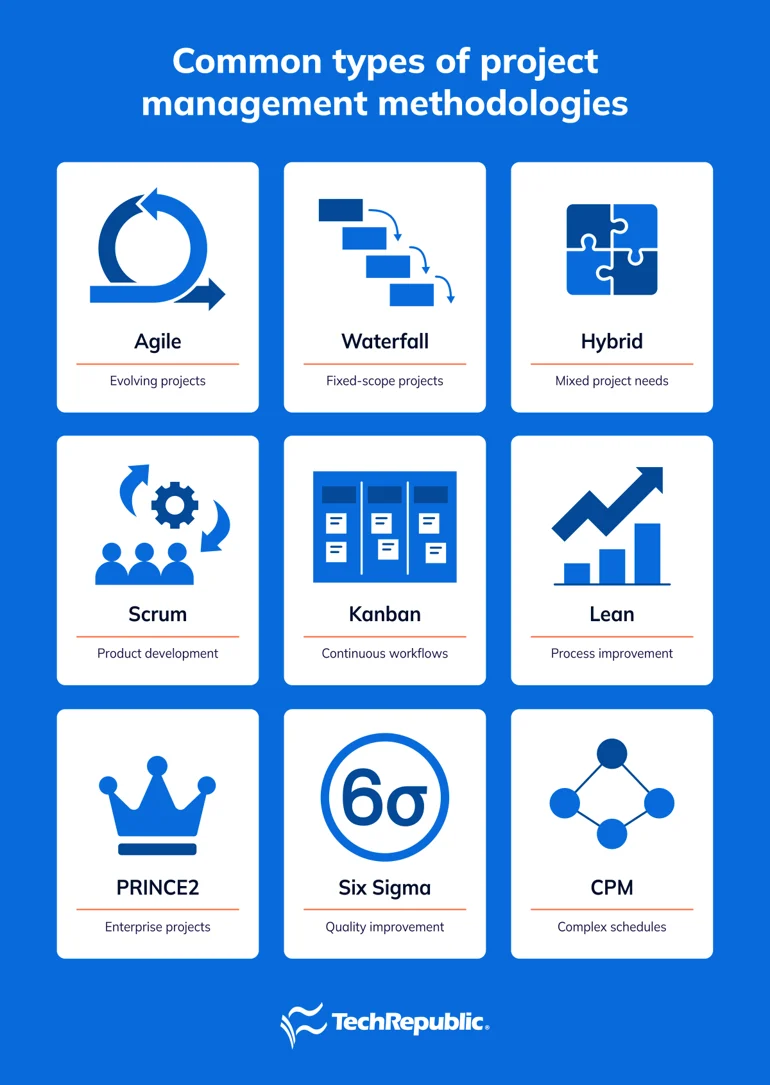
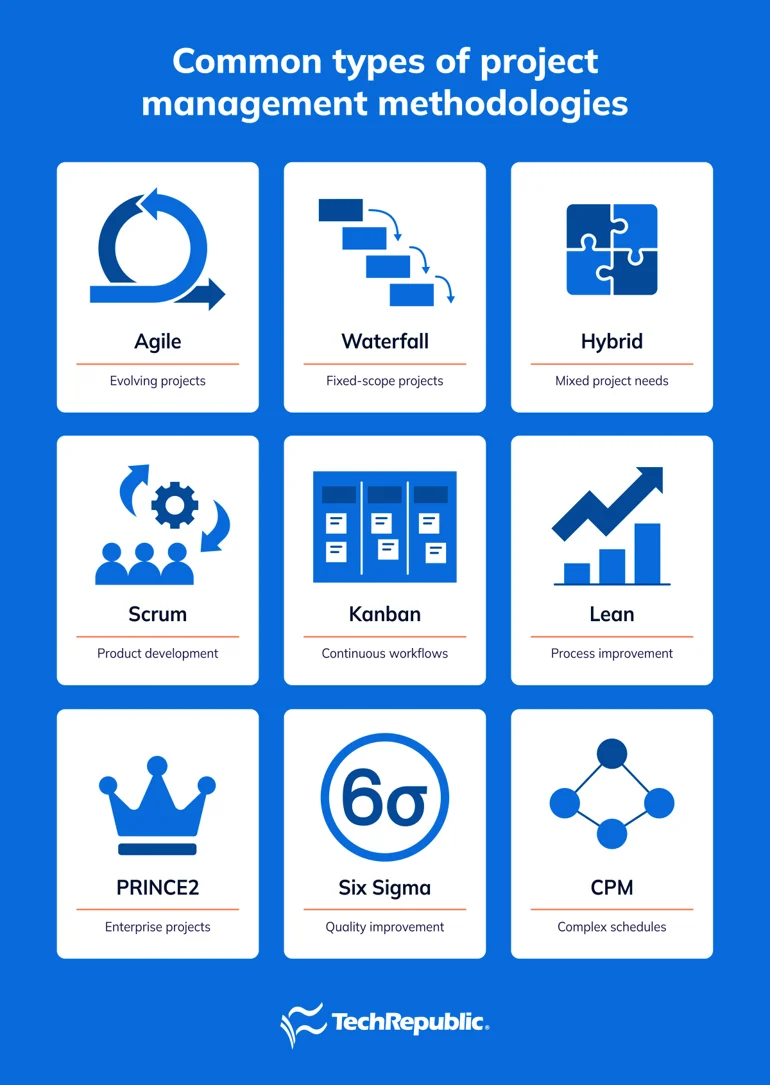
To help organizations align their strategic goals with the right operational framework, the following comparison matrix outlines the primary methodologies utilized in modern enterprise environments:
| Methodology | Best For | Key Characteristic | Primary Advantage | Primary Limitation |
|---|---|---|---|---|
| Agile | Evolving projects | Iterative delivery | Adapts rapidly to change | Susceptible to scope creep |
| Waterfall | Fixed-scope projects | Sequential phases | Clear, straightforward planning | Inflexible when changes occur |
| Lean | Process improvement | Waste reduction | Increases operational efficiency | May overlook long-term strategy |
| PRINCE2 | Enterprise projects | Stage-based governance | Strict control and oversight | Documentation-heavy overhead |
| CPM | Complex schedules | Critical task tracking | Optimizes resource scheduling | Reduced operational flexibility |
| Hybrid | Mixed project needs | Combined approaches | Balances control with agility | Requires precise boundary definition |
| Six Sigma | Quality improvement | Data-driven decisions | Drastically reduces defects | Requires specialized training |
Deep Dive: Core Methodologies and Their Ecosystems
Agile and Its Frameworks (Scrum and Kanban)
Agile was engineered to solve a specific problem: building products when teams do not have all the answers at project inception. By organizing work into short iterations—typically called sprints lasting one to four weeks—Agile allows teams to reassess priorities based on continuous stakeholder feedback.
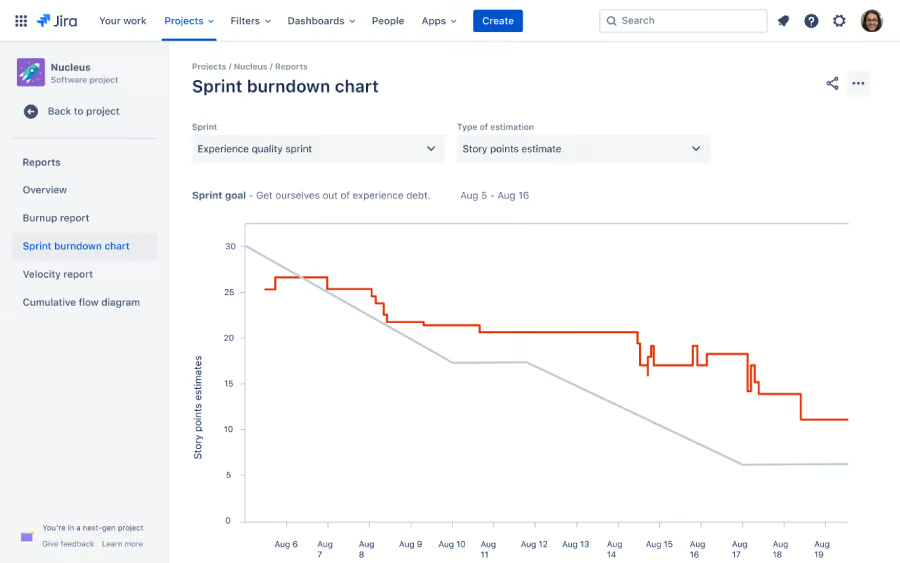
- Scrum: A structured Agile framework defined by specific roles (Product Owner, Scrum Master, Developers), sprint planning, daily stand-ups, and retrospective ceremonies. It thrives in software and product development environments where predictable delivery rhythms are paramount. Tools like Jira support Scrum teams through burndown charts and velocity tracking.
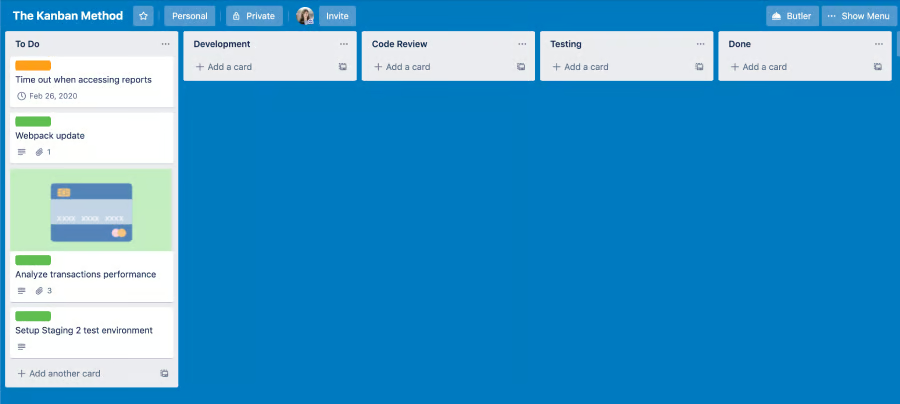
- Kanban: A visual workflow framework that emphasizes limiting work-in-progress (WIP) to eliminate bottlenecks. Utilizing visual boards with columns representing workflow stages (e.g., To Do, In Progress, Code Review, Done), Kanban is ideal for support desks, content production, and maintenance queues where tasks arrive continuously. Software like Trello makes Kanban execution accessible through drag-and-drop card interfaces.
Waterfall
Waterfall addresses the need for a predictable, linear master plan where every phase must receive formal sign-off before downstream execution begins. Progress flows sequentially through requirements gathering, system design, implementation, testing, and deployment.
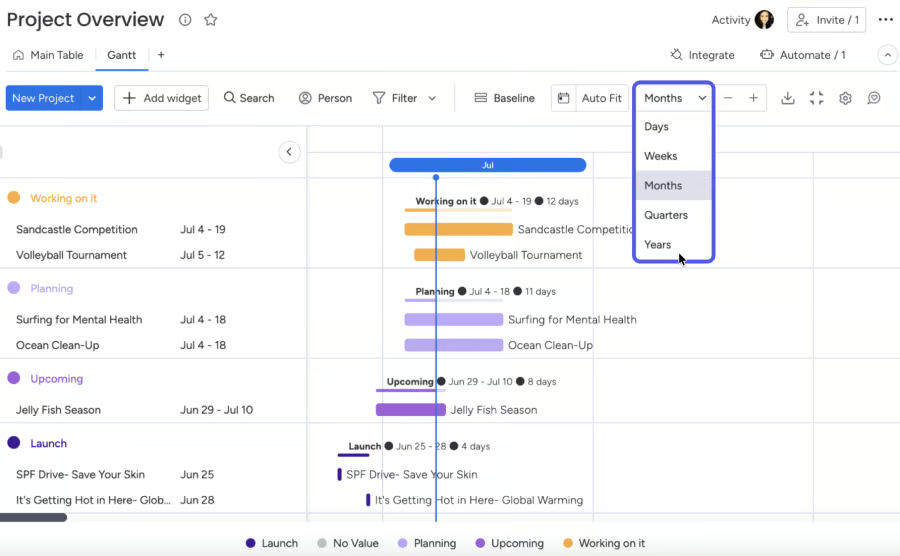
Waterfall is the gold standard for construction, manufacturing, and government contracts where scope is strictly locked and regulatory compliance requires exhaustive audit trails. Project management platforms like monday.com utilize advanced Gantt charts and dependency mapping to support this sequential discipline.
Hybrid Methodologies
When a project contains distinct components that demand rigid regulatory compliance alongside creative, iterative development, pure models fail. Hybrid methodologies bridge this gap by combining predictive governance (such as Waterfall for procurement and budgeting) with adaptive execution (such as Agile sprints for software design).
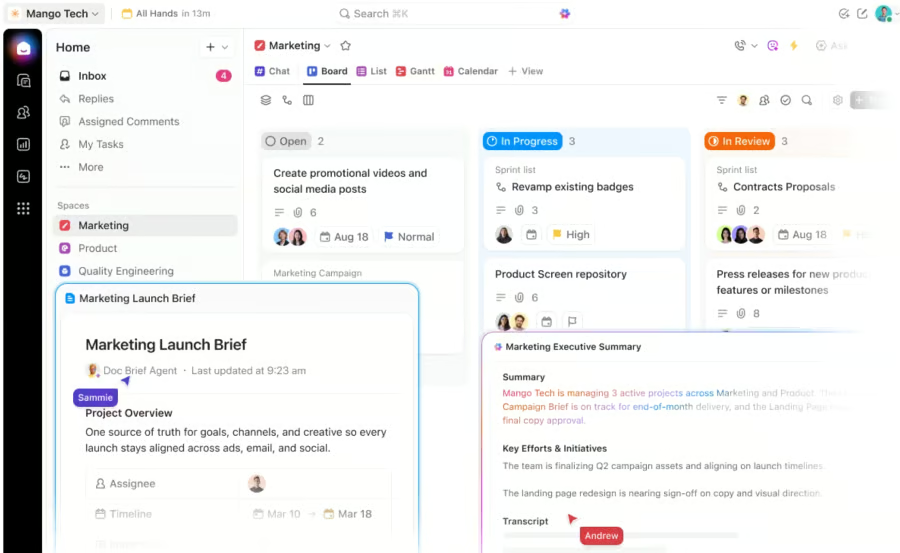
According to Project Management Institute (PMI) data, hybrid adoption surged from 20% in 2020 to 31.5% in recent years, reflecting its vital role in modern enterprise operations. Platforms like ClickUp facilitate hybrid workflows by housing Gantt charts, Kanban boards, and sprint views within a unified workspace.
Lean and Six Sigma
Originating from manufacturing innovations, Lean focuses relentlessly on the elimination of operational waste—including excessive approvals, redundant handoffs, and unnecessary wait times. Miro templates often assist Lean teams in performing value-stream mapping to optimize cycle times.
Six Sigma approaches quality improvement through the DMAIC framework (Define, Measure, Analyze, Improve, Control). By utilizing statistical analysis to eliminate variation and reduce defects, Six Sigma ensures high-precision outputs in sectors like healthcare, finance, and advanced manufacturing.
Supporting Context and Metrics: Industry Alignment
Methodology adoption is heavily influenced by sector-specific constraints:
- Software Development: Heavily dominated by Agile and Scrum for product development, while DevOps teams leverage Kanban for continuous deployment pipelines.
- Construction and Engineering: Strictly utilize Waterfall and the Critical Path Method (CPM). Because physical infrastructure cannot be "refactored" like code, rigorous sequence planning and critical task tracking are non-negotiable.
- Healthcare IT: Increasingly relies on Hybrid frameworks, employing Waterfall for compliance and medical device procurement, paired with Agile for clinical software configuration.
- Government and Public Sector: Frequently utilize PRINCE2 (Projects IN Controlled Environments) due to its emphasis on structured business cases, stage-gate reviews, and strict public accountability.
Future Outlook: Emerging Trends in Project Governance
As artificial intelligence, automated resource forecasting, and distributed remote workforces reshape the global economy, project management methodologies are undergoing their own transformation.
The future points away from rigid ideological adherence to any single methodology. Instead, enterprise organizations are moving toward adaptive project ecosystems—environments powered by AI-driven analytics that dynamically suggest workflow adjustments based on real-time team velocity, risk indicators, and budget consumption.
Furthermore, the boundary between project management and enterprise product operations will continue to dissolve. Organizations that succeed in the coming decade will be those that view methodologies not as religious dogmas, but as flexible toolkits tailored to empower human ingenuity, manage risk, and deliver measurable business value.