
Executive Overview
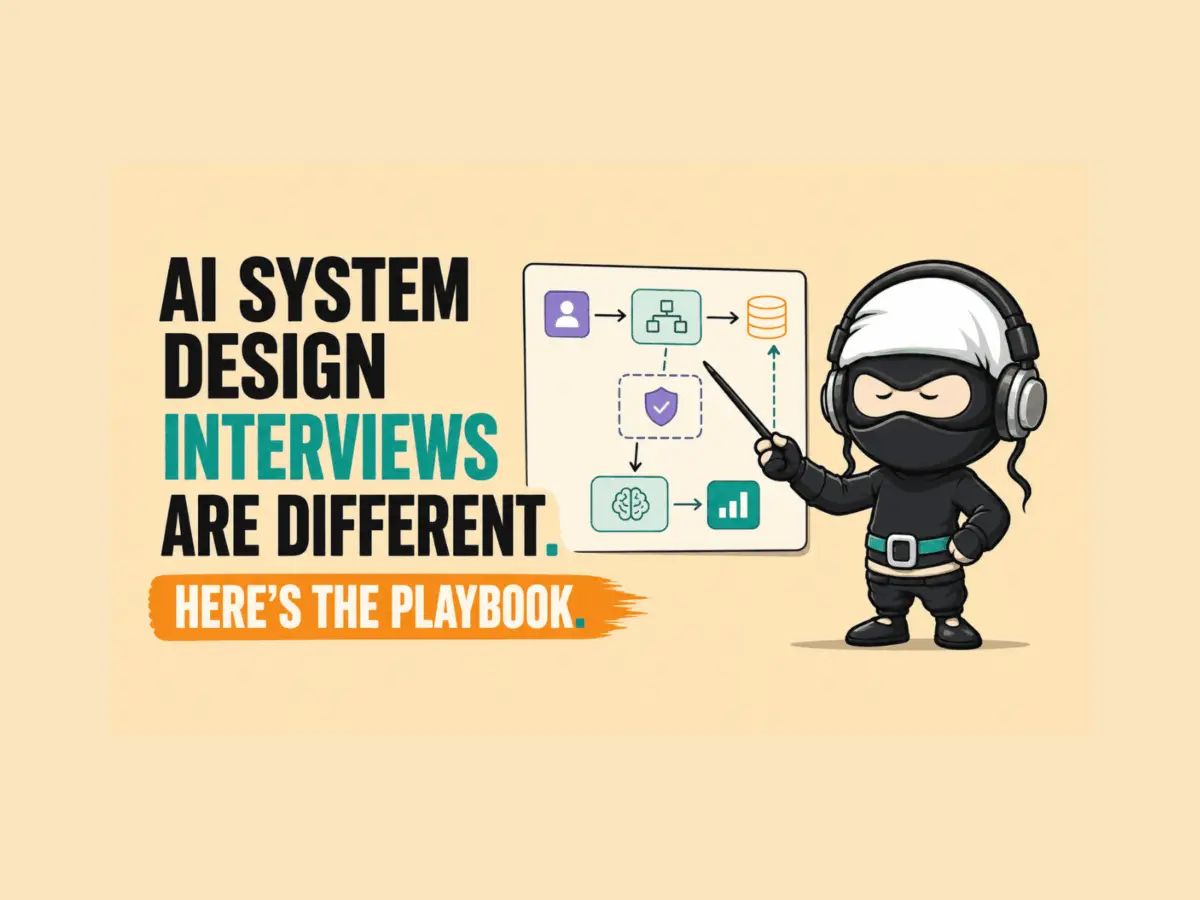
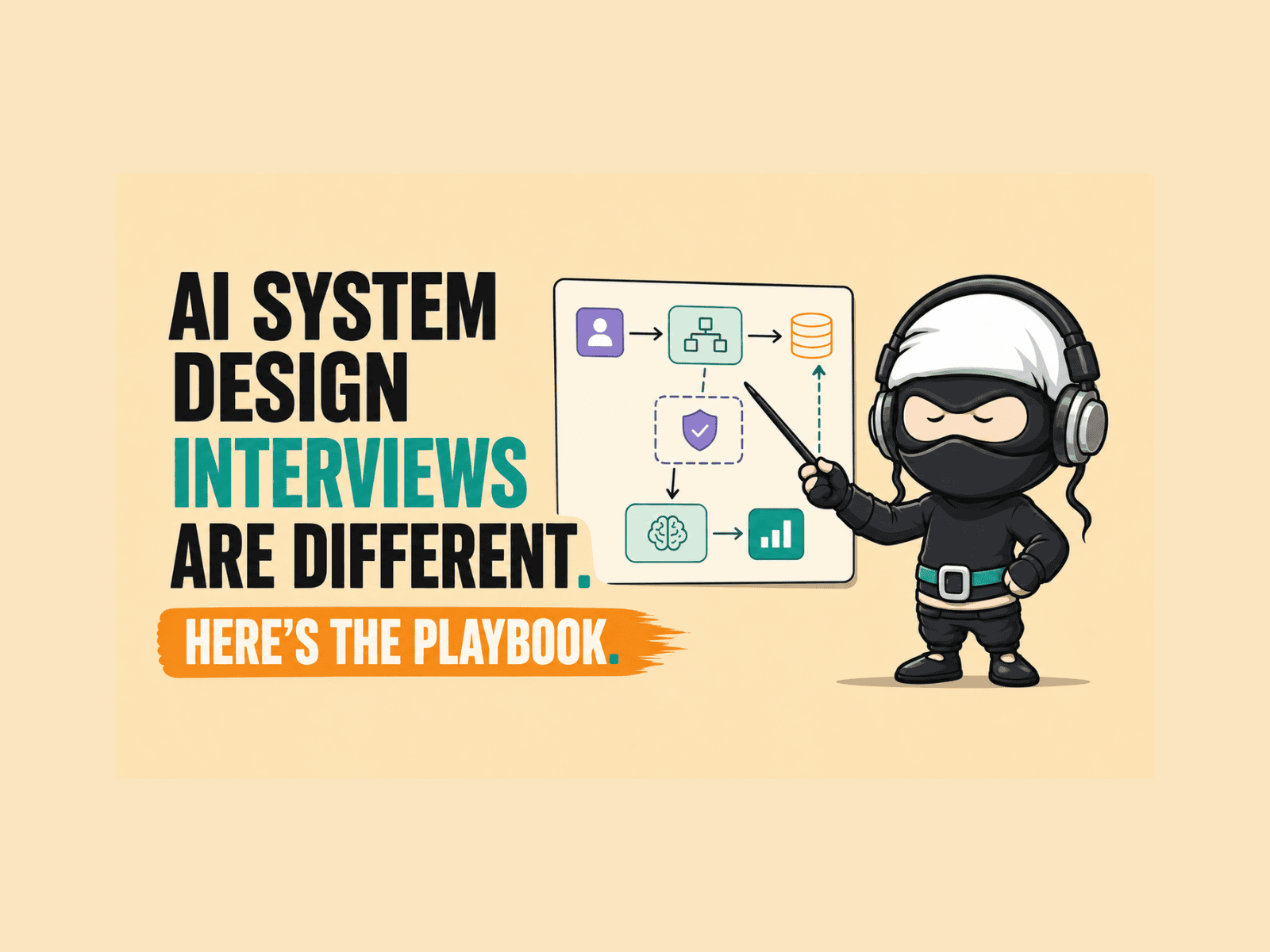
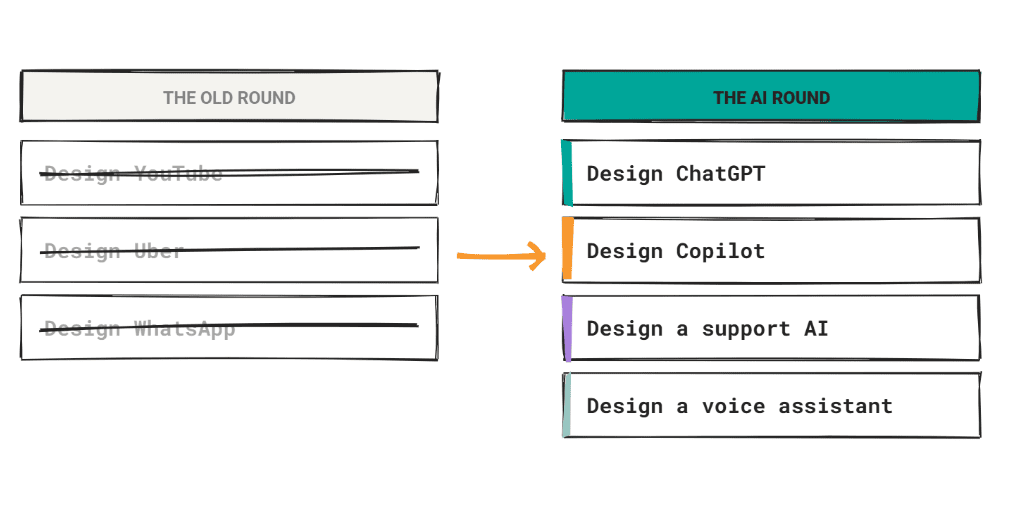
Today, the technical hiring landscape has undergone a seismic shift. Companies hiring AI Engineers, Applied Scientists, and Generative AI Specialists are asking an entirely new class of questions: "Design ChatGPT," "Design a customer support AI," "Design GitHub Copilot," "Design an AI code reviewer," or "Design a legal document assistant."
This transformation is not merely cosmetic; it reflects a fundamental change in how software is conceptualized and built. While countless engineers can successfully invoke a Large Language Model (LLM) API within a script, far fewer possess the architectural mastery required to build the complex, resilient systems surrounding those models—and fewer still can defend those design choices under pressure. Modern AI system design interviews are explicitly engineered to test this competency.
Rather than forcing candidates to memorize distinct, siloed answers for every conceivable AI product prompt, industry experts advocate for a unified, highly adaptable framework. By mastering core architectural primitives—such as Retrieval-Augmented Generation (RAG), intelligent model routing, multi-layered guardrails, robust evaluation, and agentic loops—engineers can tackle any AI system design prompt with the confidence of a seasoned principal architect.
Detailed Chronology: The Evolution of AI-First Hiring
To understand why system design interviews have mutated so rapidly, one must examine the meteoric rise of the AI engineering role over the past several years.
The 2023–2026 Hiring Boom
The widespread commercial adoption of generative AI models following the release of foundational LLMs triggered an unprecedented hiring surge. According to labor market analyses, the AI Engineer position was ranked as the fastest-growing job in the United States technology sector for consecutive years. By 2025, job postings for AI-centric engineering roles had skyrocketed by 143% year-over-year.
LinkedIn workforce data reveals that the role added tens of thousands of postings in the US market between 2023 and 2025. Simultaneously, the aggregate share of artificial intelligence and machine learning job listings within the broader tech market expanded exponentially—growing from roughly 10% to 50% over the same timeframe.
From Model Internals to Product Architecture
As the volume of hiring scaled, corporate recruitment processes adapted. Early AI interviews frequently mirrored traditional data science roles, focusing heavily on model training, hyperparameter tuning, and deep neural network architectures. However, as pre-trained foundational models from providers like OpenAI, Anthropic, and open-source communities became commodities, the industry’s bottleneck shifted.
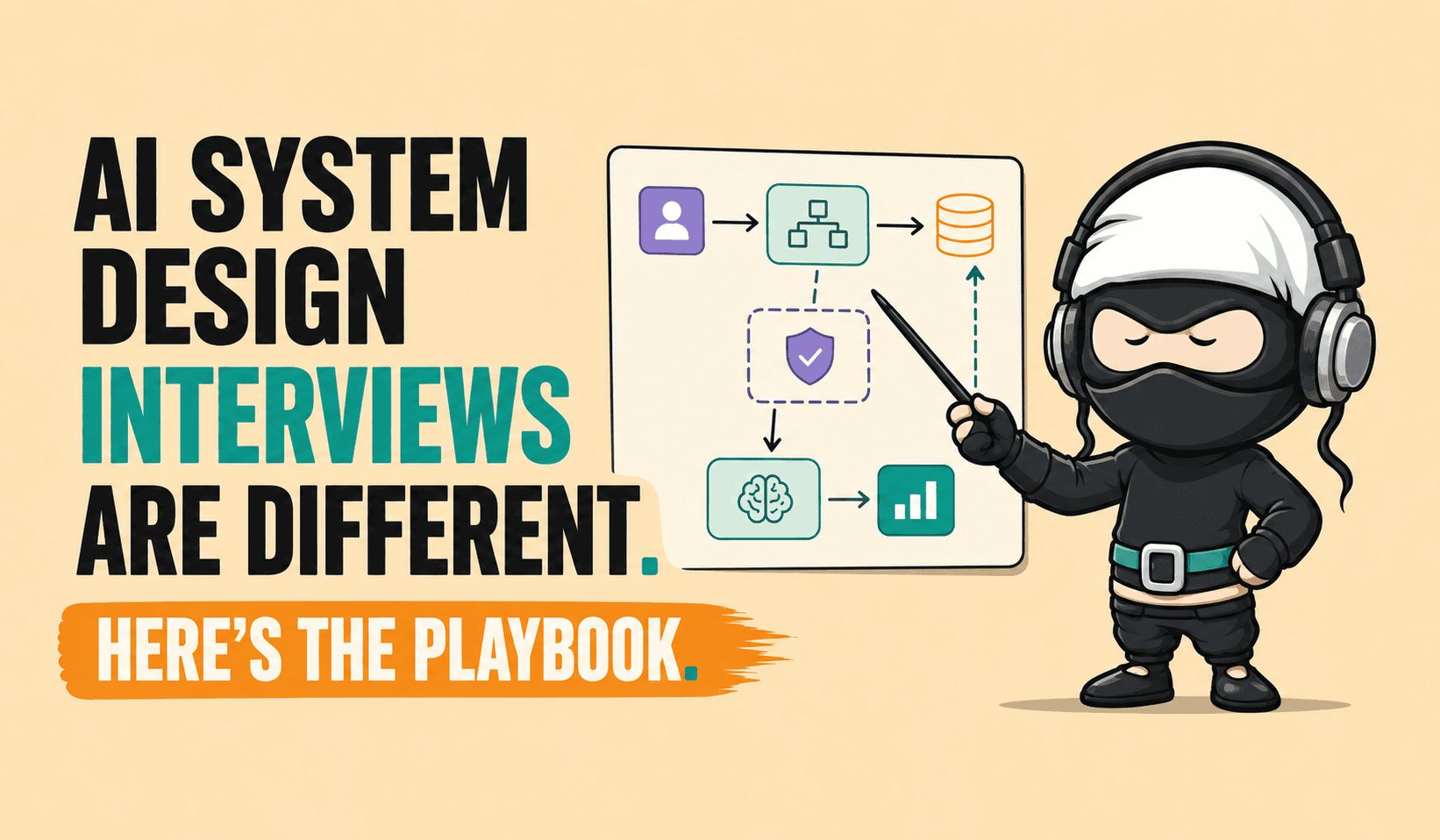
The primary challenge for tech companies was no longer building the base model, but productizing it. Consequently, interview rounds shifted toward how engineers wrap LLMs into scalable, enterprise-grade applications. Evaluation metrics now prioritize designing agentic workflows, integrating complex retrieval pipelines, and—crucially—reasoning about strict cost constraints. Deep, academic knowledge of model internals has taken a backseat to pragmatic systems engineering.
By late 2025 and early 2026, standardized field guides compiled from candidate interview debriefs identified four dominant prompt archetypes:
- The Conversational AI Chatbot (e.g., ChatGPT-style interfaces)
- Document Q&A and Retrieval-Augmented Generation (RAG) systems
- AI-Driven Coding Agents and Assistants (e.g., GitHub Copilot-style IDE extensions)
- Autonomous Voice and Multimodal Assistants
Supporting Context & Metrics: Evaluating Probabilistic Systems
The fundamental challenge of modern AI system design lies in a philosophical and mathematical shift: moving from deterministic software engineering to designing probabilistic, cost-constrained systems.
The Nature of the Evaluation
Traditional CRUD (Create, Read, Update, Delete) services are deterministic. If a database query is executed with valid parameters, the output is guaranteed. AI systems, by contrast, are fundamentally non-deterministic. A prompt fed into an LLM can yield varying responses based on temperature settings, system prompt drift, or underlying token probability distributions.
Educational platforms and technical interview reports emphasize that strong candidates distinguish themselves by demonstrating how they navigate conflicting trade-offs. In an AI system, latency, cost, quality, and safety frequently pull in opposite directions:
- Pushing for maximum response quality might require utilizing massive frontier models, which drastically increases latency and per-token costs.
- Implementing aggressive caching and prompt compression to drive down costs and latency can introduce quality degradation or context loss.
Senior-level interview loops typically focus intensely on failure modes. Rather than skimming a broad surface area, interviewers will drill deeply into 3 to 5 specific areas, asking questions like: "What went wrong the last time you deployed this in production, and how did you patch the vulnerability?" Production experience—specifically the scars earned from shipping real systems—is the ultimate differentiator.
Core Primitives You Must Master
Across virtually all AI system design prompts, successful architectures rely on a standard set of building blocks. Candidates must be capable of drawing, explaining, and defending these five core primitives:
1. Retrieval-Augmented Generation (RAG)
At its baseline, a RAG architecture consists of a query encoder, a retriever that fetches a ranked list of relevant documents from an external corpus, and a generator that conditions its response on both the original user query and the retrieved context.
Production-grade RAG systems are significantly more complex. They incorporate advanced document chunking strategies, dense and sparse embedding pipelines, hybrid vector-keyword retrieval, semantic caching, evaluation logging, and strict access-control boundaries to ensure users cannot retrieve unauthorized data. Empirical studies indicate that well-engineered RAG architectures reduce model hallucinations by an estimated 40% to 71%.
2. Model Routing
Because operational expenditure (OpEx) is a major concern, efficient routing is paramount. Frontier models (such as GPT-4-tier engines) can cost upwards of $10 to $30 per million input and output tokens, while generating responses in 3 to 5 seconds.
Consider an autonomous agent handling 10,000 enterprise customer support conversations daily, with each conversation consuming 5,000 tokens. Running this entire workload on a single frontier provider can easily exceed $7,500 per month.
Smart architects implement intelligent model routing. Because 60% to 80% of routine user requests can be satisfactorily handled by smaller, highly optimized open-source models (like Llama-3-8B or Mistral-7B), routing routine queries to cheap models while escalating complex requests to frontier models routinely saves 40% to 70% on infrastructure bills.

3. Guardrails
Safety and compliance cannot be treated as an afterthought. Modern AI architectures enforce guardrails at two distinct operational layers:
- Pre-LLM Guardrails: Handle input validation, malicious prompt-injection defense, and real-time Personally Identifiable Information (PII) redaction.
- Post-LLM Guardrails: Enforce output schemas, manage refusal policies, and execute automated fact-checking against the retrieved context.
Layered guardrails—incorporating system prompts, RAG grounding, explicit citation enforcement, confidence scoring, and real-time monitoring—can drop hallucination risks from a baseline rate of 3–20% down to negligible levels (reducing risk by 71% to 89%).
4. Evaluation and Observability
Debugging non-deterministic applications requires specialized observability tooling. Engineers must log model versions, retrieval metadata, tool-execution traces, safety intervention decisions, latency metrics, and precise cost-per-request tracking. Best practices dictate using immutable prompt hashes rather than raw text logging for privacy and efficiency.
Robust systems combine offline evaluations (such as LLM-as-a-judge frameworks calibrated against human ground-truth data) with online metrics (monitoring faithfulness, context recall, and answer relevance in production).

5. Agentic Loops
For complex workflows—such as autonomous code reviewers, deep research assistants, or multi-step customer support agents—architects rely on agentic loops. The standardized request lifecycle flows as follows:
- Request Intake $rightarrow$ Context Assembly $rightarrow$ LLM Reasoning $rightarrow$ Action Validation $rightarrow$ Sandboxed Execution $rightarrow$ Result Processing $rightarrow$ State Update $rightarrow$ Loop or Terminate.
Crucially, strong designs maintain strict separation of concerns: the LLM is restricted to reasoning and planning, the orchestrator controls workflow state, the policy engine governs execution permissions, and an isolated sandbox environment executes code or external tool calls.
Official Reference Architectures and Case Studies
Citing real-world, highly scaled reference architectures demonstrates to interviewers that your knowledge extends far beyond theoretical blog posts and tutorials.
GitHub Copilot
One of the most comprehensively documented AI systems in production is GitHub Copilot. Its Integrated Development Environment (IDE) extension captures the code surrounding the cursor, alongside critical contextual signals such as open files, active imports, and language metadata, to construct a finely tuned prompt.

Copilot utilizes Fill-in-the-Middle (FIM) prompting. By gathering neighboring tabs and file-path headers, the system sends an assembled prompt to GitHub’s backend infrastructure, which filters the payload for safety and routes it to optimized models running on Microsoft Azure. Industry data shows that FIM yields approximately a 10% relative lift in code-completion acceptance rates compared to legacy prefix-only prompting strategies. Furthermore, GitHub operates secondary scoring models to evaluate completions for quality and security before rendering them to the developer.
The 7-Step Universal System Design Framework
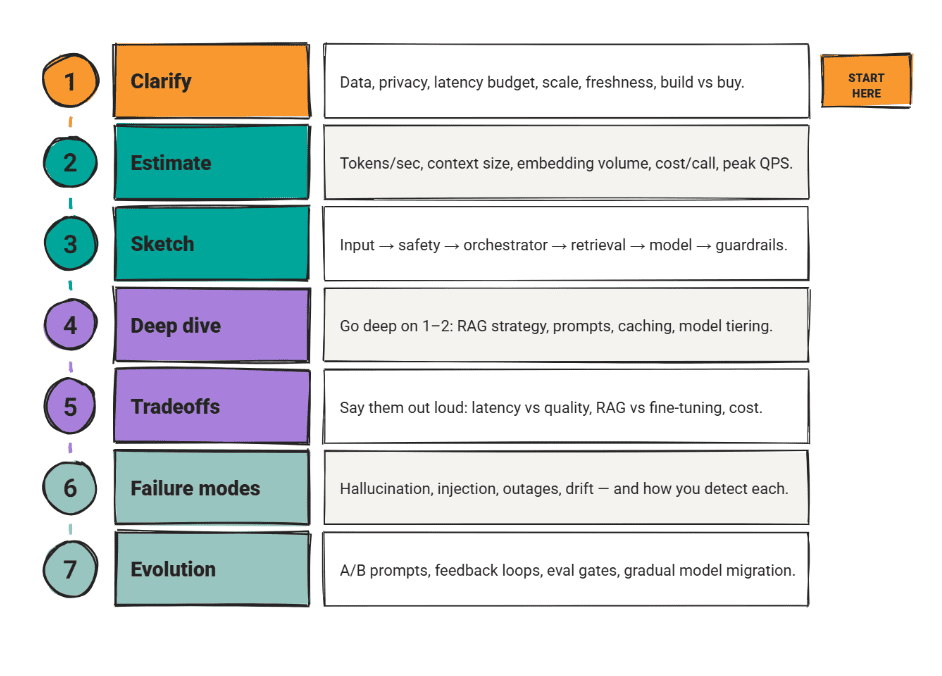
To prevent candidates from freezing up when presented with an unfamiliar prompt, industry veterans recommend applying a repeatable, 7-step interview framework:
- Clarify Requirements and Constraints: Spend the first 3 to 5 minutes asking clarifying questions about functional requirements, scale, latency tolerances, and budget limitations. Jumping straight to a solution without clarifying requirements is the single most commonly reported failure mode in interview debriefs.
- Estimate Load and Capacity: Calculate estimated token throughput, concurrent user requests, database storage requirements for vector embeddings, and expected cost profiles.
- Sketch High-Level Architecture: Draw out the core end-to-end data flow, identifying ingestion points, APIs, orchestration layers, and storage backends.
- Deep Dive into Critical Components: Expand upon 1 or 2 high-risk components (e.g., designing the RAG retrieval pipeline or the agentic tool-calling loop) and defend your technical choices.
- Address Trade-Offs: Explicitly articulate the compromises made between latency, cost, quality, and safety.
- Plan for Failure Modes and Observability: Discuss how the system handles provider outages, model hallucinations, prompt injection attacks, and multi-tenant data isolation. Establish your logging and evaluation strategy.
- Scale and Evolve: Conclude by explaining how the architecture scales horizontally under peak load and how model versioning or fine-tuning will be managed over time.
Common Interview Pitfalls
Even technically brilliant engineers frequently stumble in AI system design loops due to avoidable psychological and structural traps:
- Designing Before Clarifying: Succumbing to anxiety and drawing architectural boxes within the first 60 seconds without nailing down business constraints and success criteria.
- Listing Components Without Rationale: Dropping buzzwords like "Vector DB," "Reranker," and "Guardrail Layer" onto a diagram without being able to explain what catastrophic failure occurs if any single piece is removed.
- Ignoring Economics: Proposing an architecture that runs models at a financial loss by failing to account for token costs, inference latency, or hardware utilization.
- Hand-Waving Failure Modes: Failing to address adversarial attacks (like prompt injection) or system degradation during third-party LLM provider outages. When citing hallucination reduction metrics, candidates must always present realistic ranges rather than absolute, uncontextualized figures.
Future Outlook
As artificial intelligence transitions from a speculative technological novelty into the foundational infrastructure of modern software engineering, the expectations placed on engineers will continue to mature. The era of treating AI models as magical black boxes accessed via simple API calls is officially over.

The future belongs to engineers who can architect robust, cost-effective, and safe intelligent systems that bridge the gap between probabilistic machine learning models and deterministic enterprise infrastructure. By mastering the fundamental primitives, embracing a structured design framework, and rigorously evaluating trade-offs, engineers can navigate any AI system design interview—and build the next generation of resilient AI-powered products.