
Choosing the optimal learning pathway in 2026 requires careful strategic alignment. A professional’s ideal route depends entirely on their current technical baseline, daily responsibilities, and ultimate career trajectory. Whether an enterprise leader aims to govern machine learning initiatives from the C-suite, a software engineer seeks to deploy production-grade large language models (LLMs), or an absolute beginner looks to decode the underlying mechanics of neural networks, the educational market offers targeted interventions.
This comprehensive guide analyzes the 10 best generative AI and machine learning courses and professional certificates available in 2026. Programs are curated across varying skill tiers—from introductory literacy modules to advanced, university-backed technical credentials—providing learners with a definitive roadmap for skill acquisition.
Comparative Matrix: Top AI Education Programs for 2026
To assist professionals in selecting the ideal program for their budget, timeline, and career objectives, the following matrix compares the leading generative AI and machine learning courses available in 2026:
| Course & Provider | Cost Structure | Estimated Duration | Skill Level | Completion Credential |
|---|---|---|---|---|
| Coursera: AI for Everyone | Free to audit; $59/mo or $399/yr for Coursera Plus | ~7 hours | Beginner | Certificate (Paid tier) |
| AWS: Building a Generative AI-Ready Org | Free | ~1 hour | Beginner | None |
| DataCamp: Understanding AI | Free basic access; $13.75/mo (billed annually) | ~2 hours | Beginner | Statement of Accomplishment |
| Google Cloud: Intro to GenAI Path | Free with basic tier; Pro options available | ~5 hours | Beginner | Skill Badges (Vertex AI) |
| IBM: Introduction to AI via Coursera | Free to audit; $59/mo via Coursera Plus | ~10 hours | Beginner | Certificate (Paid tier) |
| AWS Generative AI Developer Kit | $29/mo or $449/yr (AWS Skill Builder) | Variable | Intermediate | None listed |
| HarvardX: Computer Science for AI | Free to audit; $466.20 verified certificate | ~5 months | Beginner | Professional Certificate |
| MIT: Professional Certificate in ML & AI | $325 application fee + $2,500–$4,900 per course | 16+ days | Advanced | Professional Certificate |
| Stanford Online: AI Professional Program | $1,950 per course ($5,850 minimum) | 10 weeks/course | Advanced | Professional Certificate |
| Udacity: AI Nanodegree Program | $249/mo or $846 for 4 months | ~40 hours | Advanced | Nanodegree Certificate |
Beginner Pathways: Laying the Foundational AI Literacy
For organizational leaders, project managers, and tech-adjacent professionals seeking to understand the vocabulary and macro-impact of artificial intelligence without writing code, several introductory programs stand out for their pedagogical clarity and industry reputation.
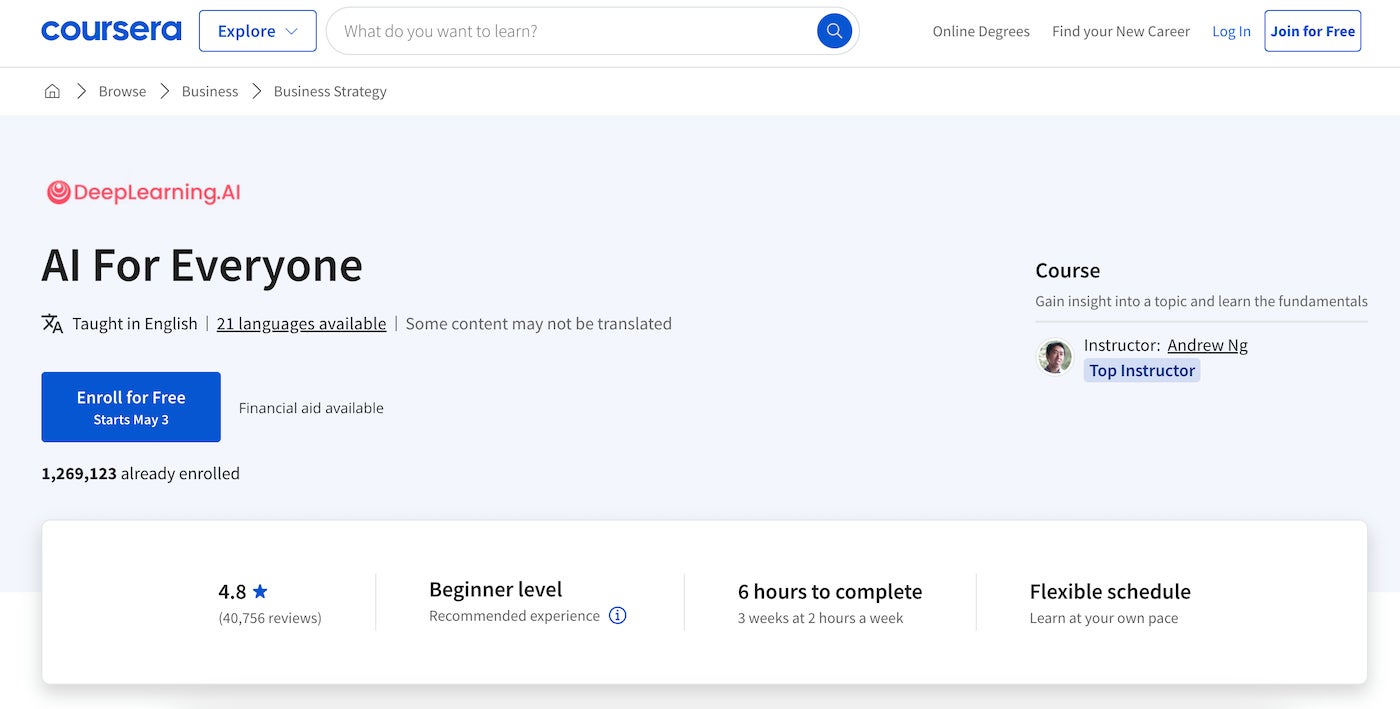
1. Coursera’s AI for Everyone (Instructor: Andrew Ng)
Taught by deep-learning pioneer and DeepLearning.AI founder Andrew Ng, this self-paced course has enrolled over one million learners globally. Ng, co-author of the seminal 2009 GPU deep learning paper that laid the groundwork for modern AI hardware, structures the curriculum into four digestible modules designed to demystify machine learning workflows, data collection, and AI project lifecycles.
- Pricing: Free to audit; full access requires Coursera Plus ($59/month or $399/year).
- Duration: Approximately 7 hours.
- Pros & Cons: Exceptional instruction from a recognized industry legend; however, the video content can feel dated regarding rapid generative AI updates, and the UI can occasionally feel cluttered.
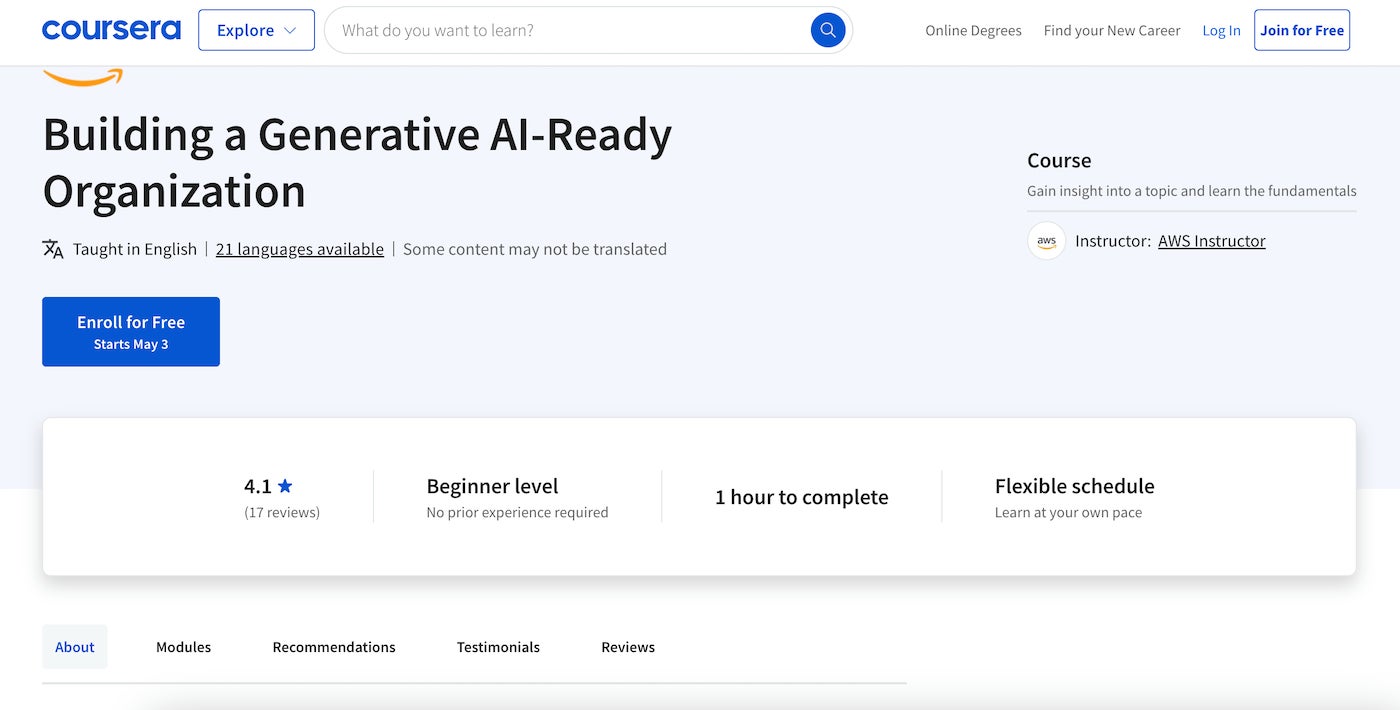
2. AWS’s Building a Generative AI-Ready Organization
Tailored specifically for C-suite executives and business leaders, this non-technical module establishes a top-down philosophy for governing machine learning deployments. It bridges the communication gap between executive visionaries and technical engineering teams.
- Pricing: Completely free of charge (no completion certificate awarded).
- Duration: Approximately 1 hour.
- Pros & Cons: Excellent baseline for stakeholder discussions; however, the content is heavily generalized and leverages a dual-platform interface between AWS and Coursera that some users find cumbersome.
3. DataCamp’s Understanding Artificial Intelligence
DataCamp approaches AI literacy through a holistic lens, blending technical concepts with social impact and enterprise utility. Crucially, it includes an exclusive module dedicated to business infrastructure and organizational readiness.
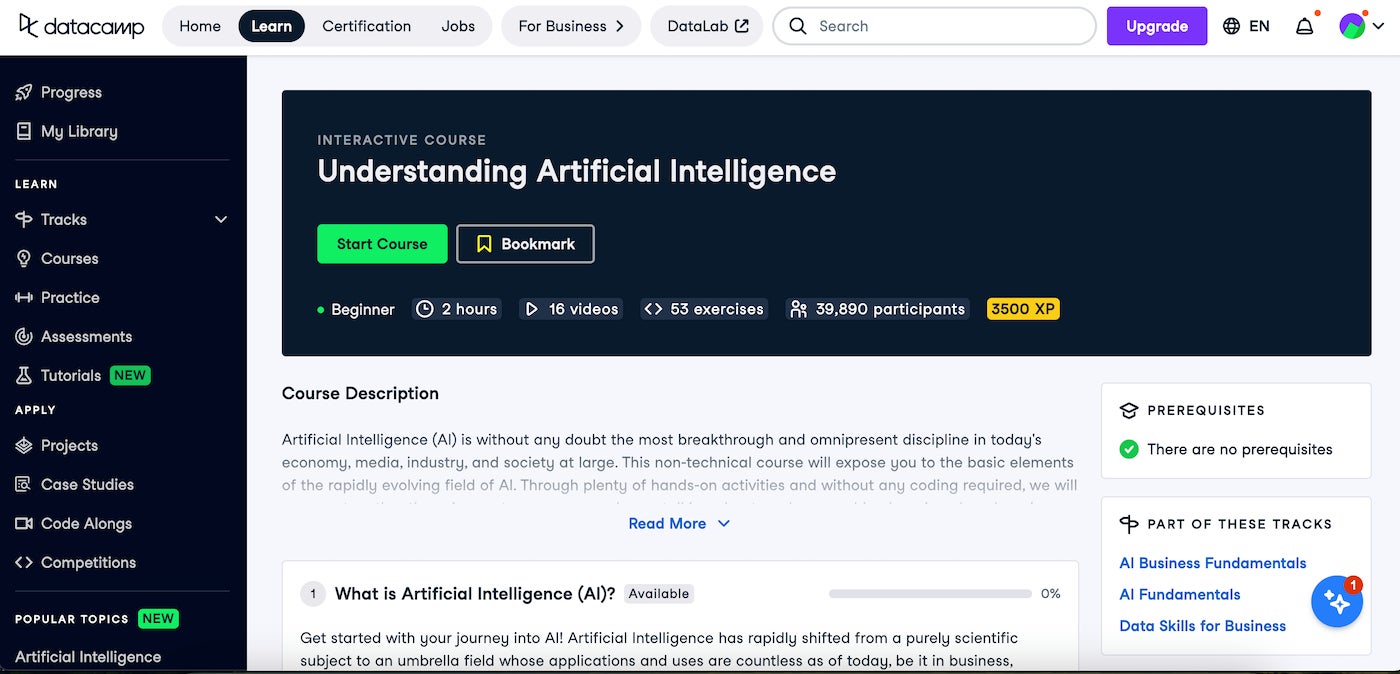
- Pricing: Free limited tier; Premium subscription is $13.75/month (billed annually).
- Duration: Approximately 2 hours.
- Pros & Cons: Engaging gamified milestones help maintain focus, though the heavy use of platform pop-ups and promotions can distract some learners.
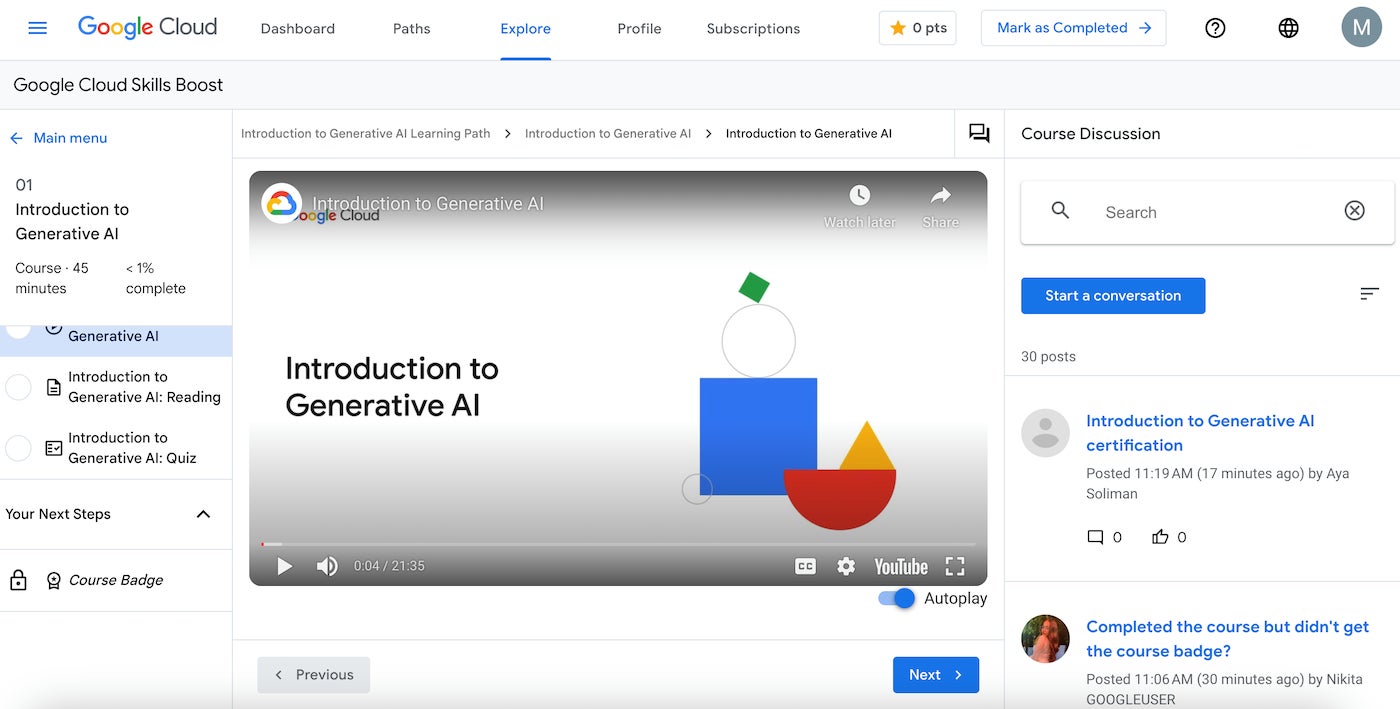
4. Google Cloud’s Introduction to Generative AI Learning Path
Hosted on Google Cloud Skills Boost, this learning path explores foundational large language models while deeply integrating proprietary Google ecosystems such as Vertex AI. The curriculum also prioritizes responsible AI, guiding learners through ethical guardrails.
- Pricing: Free.
- Duration: ~5 hours of structured video and assessment content.
- Pros & Cons: Modern, energetic presentation style with clean UI; biased heavily toward Google’s proprietary tooling ecosystem.
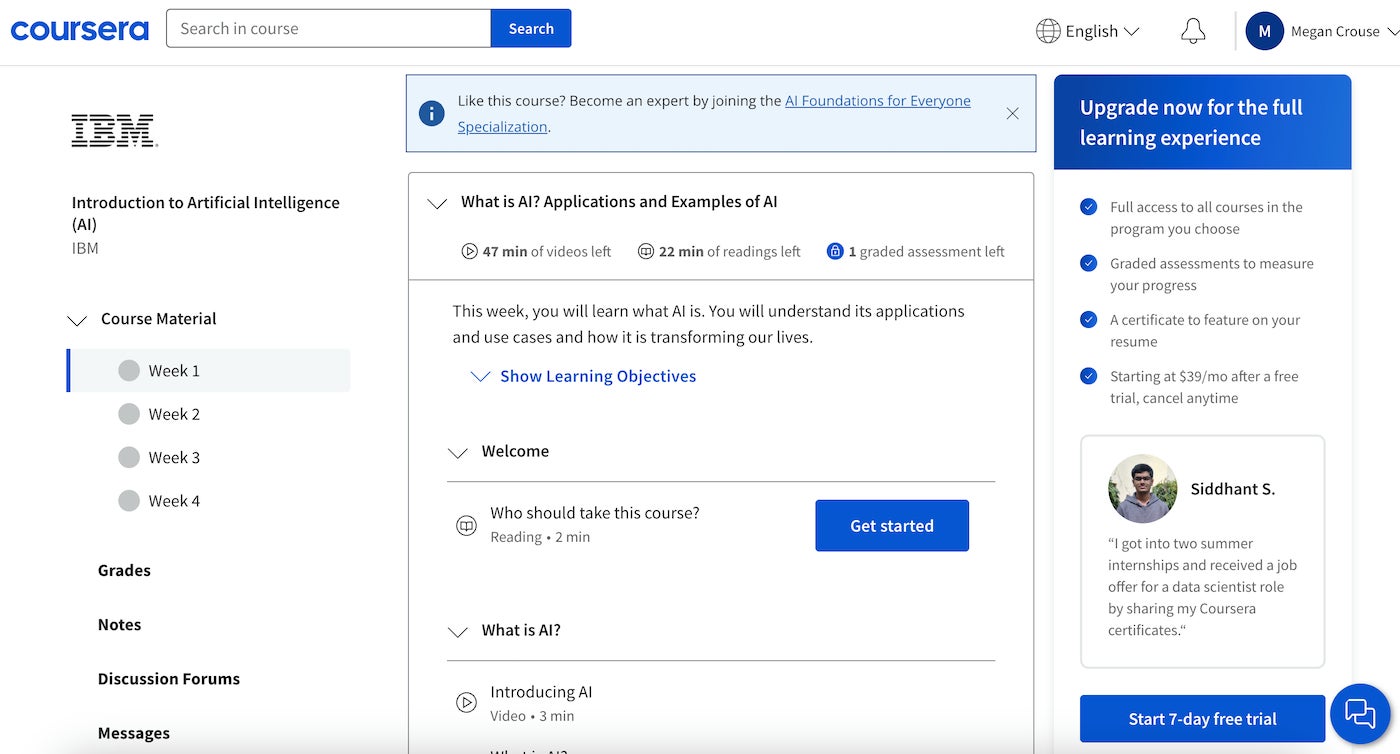
5. IBM’s Introduction to Artificial Intelligence (via Coursera)
Delivered by enterprise practitioners, this eight-hour program delivers real-world context on how AI is deployed across legacy corporate environments, concluding with vital examinations of ethical dilemmas and algorithmic bias.
- Pricing: Free audit option; paid tier via Coursera Plus.
- Duration: ~10 hours.
- Pros & Cons: Integrates cleanly into broader Coursera professional certificates, but relies heavily on video interviews with specialists rather than hands-on code labs.
Intermediate and Advanced Tracks: Engineering the Future
As learners transition from theoretical consumers of AI to active developers and enterprise architects, programming competence—predominantly in Python, linear algebra, and calculus—becomes mandatory.
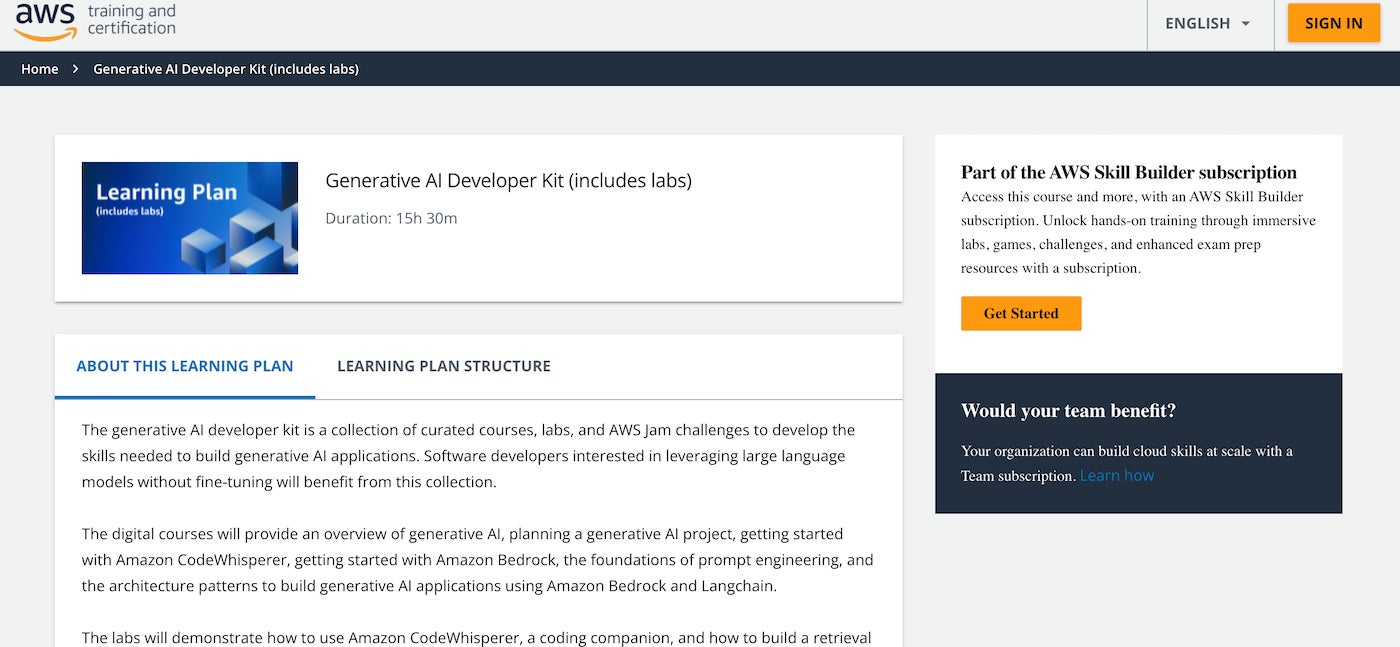
6. AWS Generative AI Developer Kit
Tailored for developers already operating within or transitioning to the Amazon Web Services ecosystem, this kit combines foundational theory with hands-on labs using Amazon Bedrock and gamified AWS Jam challenges.
- Pricing: Requires an AWS Skill Builder subscription ($29/month or $449/year).
- Duration: ~16.5 hours.
- Pros & Cons: Highly practical for AWS-centric organizations, though the knowledge gained has limited portability outside of proprietary Amazon cloud services.
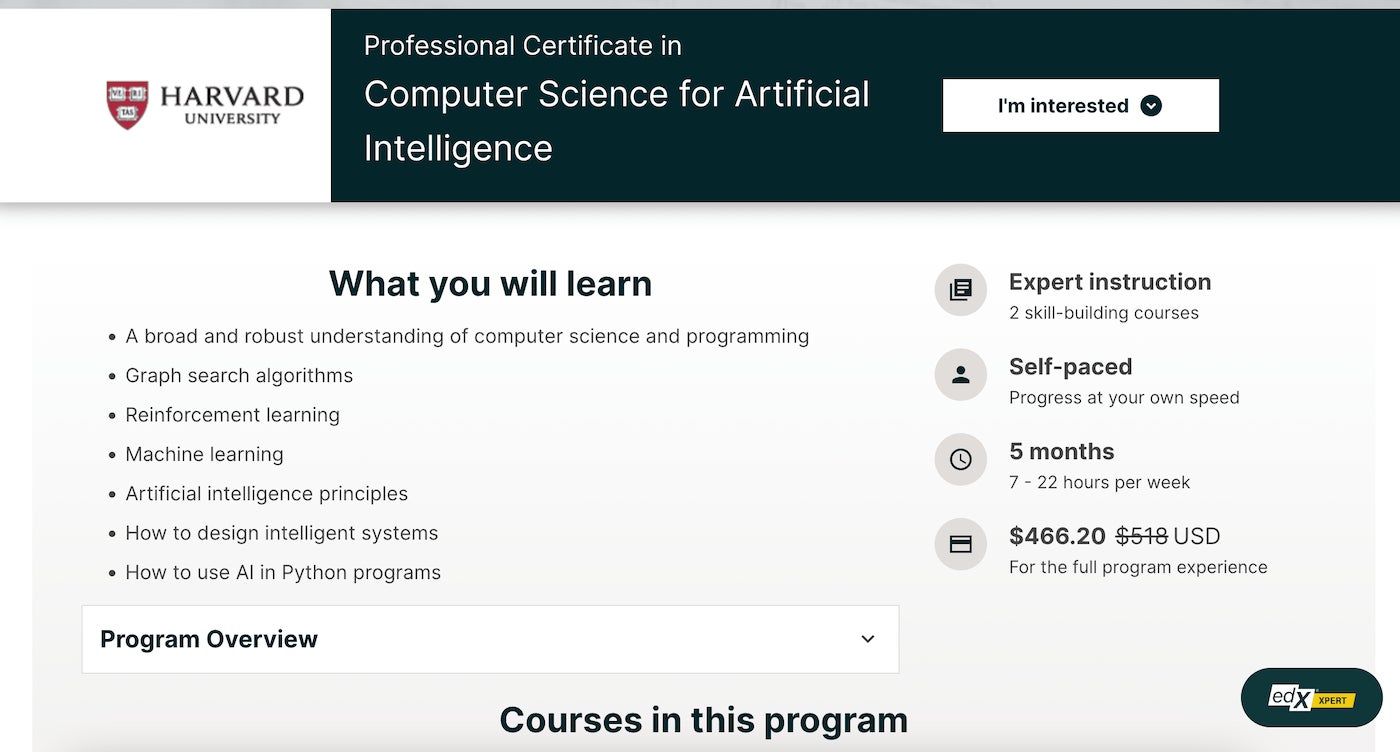
7. HarvardX Computer Science for Artificial Intelligence Professional Certificate
Combining Harvard’s renowned CS50 introduction to computer science with specialized training in Python-based AI engineering, this program bridges computer science fundamentals with modern probabilistic reasoning.
- Pricing: Free audit; $466.20 for the verified professional certificate.
- Duration: ~5 months (7–22 hours per week).
- Pros & Cons: Unmatched academic pedigree and thorough curriculum, though it commands a significant time commitment and a notable financial investment.
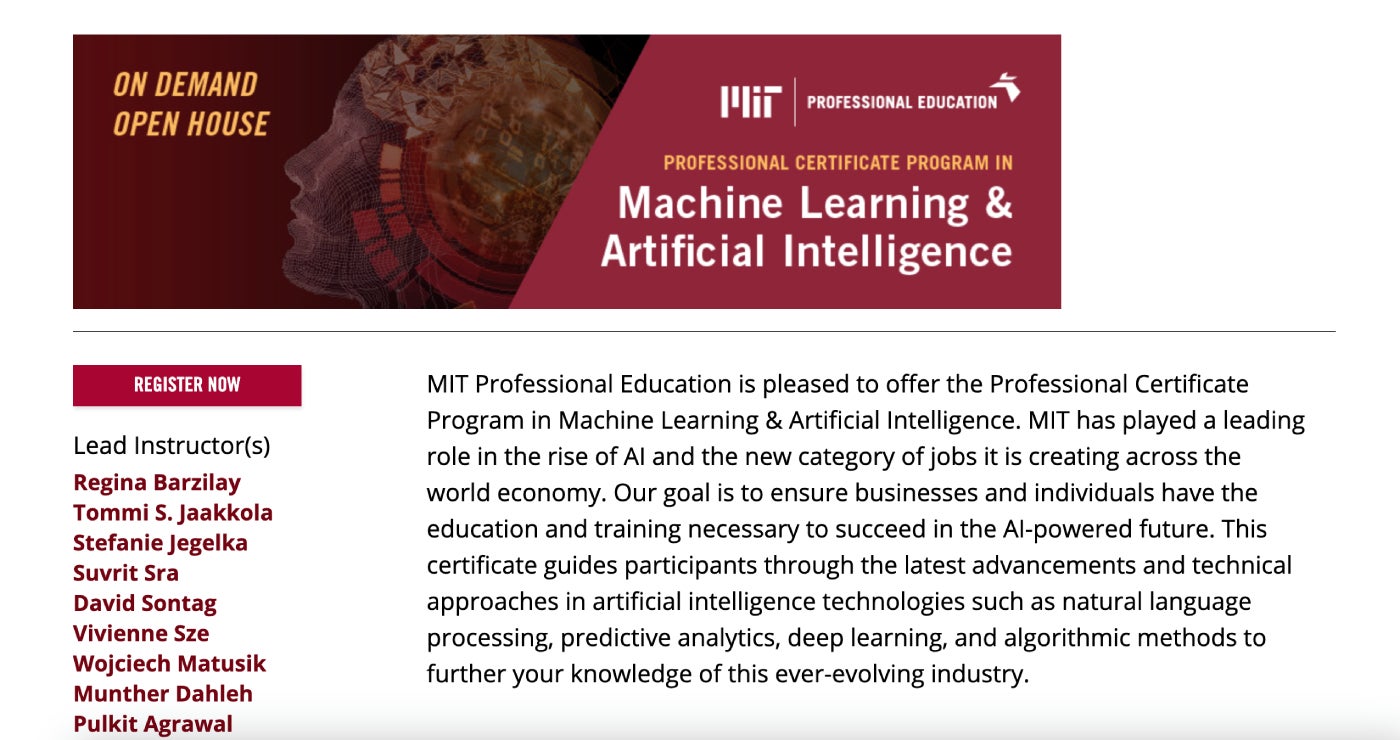
8. MIT Professional Certificate in Machine Learning & Artificial Intelligence
Designed strictly for senior technical professionals boasting at least three years of experience in computer science, data analysis, or electrical engineering, MIT’s rigorous program mirrors traditional graduate coursework.
- Pricing: $325 nonrefundable application fee, with individual course modules ranging from $2,500 to $4,900.
- Duration: Minimum of 16 days of qualifying intensive coursework.
- Pros & Cons: Direct access to the prestigious MIT Alumni Network; however, it lacks the flexibility of self-paced online platforms and represents a major financial commitment.
9. Stanford Online Artificial Intelligence Professional Program
Focusing on building and fine-tuning enterprise AI models from scratch, Stanford’s elite professional track requires learners to master rigorous algorithmic design, machine learning fundamentals, and advanced probabilistic models.
- Pricing: $1,950 per course (minimum of 3 courses required for certification, totaling $5,850).
- Duration: 10 weeks per course (10–15 hours weekly).
- Pros & Cons: Exceptional academic rigor and direct 1-on-1 access to leading researchers, offset by high costs and demanding time constraints.
10. Udacity’s Artificial Intelligence Nanodegree Program
Rather than focusing solely on generative text models, Udacity’s intensive technical nanodegree teaches the foundational search algorithms, probabilistic graphical models, and scheduling systems that underpin enterprise robotics and automated planning.
- Pricing: $249 per month or $846 bundled for the first four months.
- Duration: ~3 months (~40 total hours of deep project work).
- Pros & Cons: Highly rigorous technical foundation with real-world projects, though user reviews note occasional pacing inconsistencies and variable course freshness.
Frequently Asked Questions (FAQs)
Is it worth taking an AI course in 2026?
Yes. Despite market stabilization, certified AI competencies continue to command substantial wage premiums and open doors to high-growth engineering and managerial roles. Beyond immediate job market utility, structured learning builds critical mental models for navigating rapidly evolving enterprise software environments.
Can I learn artificial intelligence without knowing how to code?
Introductory and executive-level courses (such as those offered by AWS, Coursera, and DataCamp) require zero programming background. However, transitioning into developer, machine learning engineer, or data scientist roles necessitates fluency in programming languages—primarily Python—alongside foundational competencies in linear algebra, calculus, and statistics.
How were these courses selected for evaluation?
This curated list was established by analyzing provider reputation, market recognition, curriculum depth, cost-to-value ratio, and alignment with modern enterprise requirements. Each program was audited for practical utility, ensuring learners receive actionable training regardless of their starting skill tier.