
Executive Overview
Today, the software industry is witnessing a seismic shift from passive code generation to autonomous, agentic workflows. Modern AI coding agents are expected to navigate sprawling legacy repositories, modify interconnected codebases, execute terminal commands, orchestrate test suites, autonomously debug failures, and preserve architectural integrity over hours of continuous computation. As the axiom in machine learning dictates, "What gets measured gets improved." Without rigorous, highly representative evaluation metrics, engineering teams are flying blind.
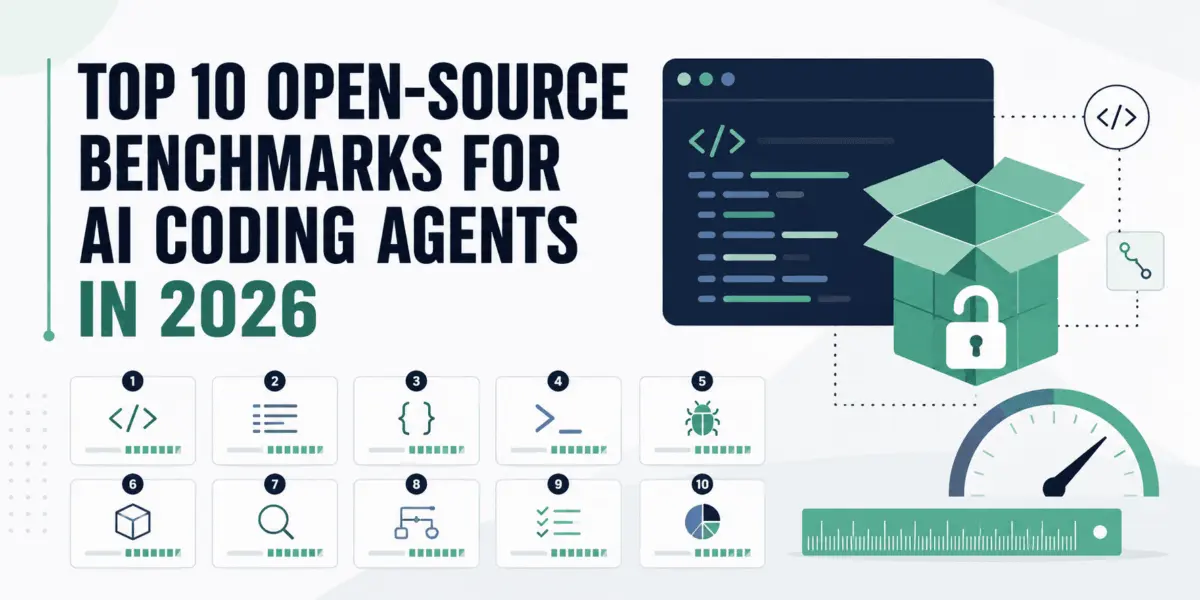
To solve this, the open-source community has rallied around sophisticated evaluation suites designed to stress-test agentic capabilities. These modern benchmarks track everything from terminal fluency and multi-language comprehension to architectural foresight and resistance to generational code decay (often referred to as "code slop"). This report examines the top 10 open-source agentic coding benchmarks defining the state of the art, providing engineering leaders and researchers with an authoritative roadmap of how AI coding capability is measured, audited, and advanced.
Detailed Chronology and Architectural Taxonomy of Benchmarks
The evolution of coding benchmarks reflects the rapid expansion of LLM capabilities. From static code snippets to fully autonomous terminal operations, the timeline of evaluation frameworks reveals an industry striving to capture genuine software engineering competence.
[Traditional Unit Tests]
       │
       ▼ (2023-2024)
[SWE-bench / Terminal-Bench] ──► Foundational Repo-Level & Shell Operations
       │
       ▼ (2025)
[Multi-SWE-bench / SWE-Bench Pro] ──► Enterprise Complexity & Multi-Language Support
       │
       ▼ (2026 & Beyond)
[Senior SWE-Bench / ProgramBench / SlopCodeBench] ──► Architecture, Iterative Drift & Senior-Level Judgment
1. SWE-bench: The Baseline Standard for Repository-Level Resolution
Developed to bridge the gap between toy problems and real-world software engineering, SWE-bench remains the foundational benchmark against which virtually all agentic systems are measured.
- Mechanism: An AI agent is presented with a real GitHub issue and a complete snapshot of a real-world repository. The objective is to autonomously generate a precise patch that resolves the issue.
- Scale & Scope: Comprising 2,294 software engineering tasks sourced from 12 prominent Python repositories, SWE-bench demands that an agent locate relevant files, comprehend contextual dependencies, modify code, and pass automated verification tests. Variants like SWE-bench Lite and SWE-bench Verified have mitigated noise, making it a ubiquitous baseline for researchers. Although critics note signs of benchmark saturation, its universal adoption ensures it remains the primary metric for comparative analysis.
2. Terminal-Bench: Validating Shell Fluency and Infrastructure Operations
Software engineering does not happen in a vacuum; it occurs within terminal windows, continuous integration (CI) pipelines, and sandboxed environments. Terminal-Bench evaluates whether an AI agent can operate natively within a real terminal environment.
- Mechanism: Rather than outputting a static patch, the agent interacts directly with a shell. It must compile source code, provision development servers, install package dependencies, execute diagnostic tests, and resolve security vulnerabilities.
- Scale & Scope: Terminal-Bench utilizes an execution harness that links models directly to sandboxed Linux environments. By measuring terminal fluency, file system navigation, and iterative error handling, it closely mirrors the day-to-day realities of systems engineers. Ecosystem evolutions like Terminal-Bench 2.1 introduce continuous validation protocols, while its advanced successor, Frontier-Bench, addresses increasingly complex domain-diverse environments.
3. SWE-Bench Pro: Stress-Testing Long-Horizon Enterprise Workflows
While standard SWE-bench captures open-source bug fixes, enterprise software engineering involves messy, large-scale, long-horizon problems. SWE-Bench Pro was constructed to evaluate agents under production-grade conditions.
- Mechanism: Operating on the familiar issue-to-patch paradigm, this framework increases the complexity, scope, and context requirements of assigned tasks.
- Scale & Scope: Featuring 1,865 problems drawn from 41 actively maintained codebases, SWE-Bench Pro segments its tasks into public, held-out, and commercial splits. It forces agents to generate larger, more complex patches. However, auditing highlights that dataset quality remains an active area of refinement, with independent reviews pointing to ~30% noise ratios—such as overly strict or broken test cases—underscoring the continuous challenge of curating authentic enterprise data.
4. Senior SWE-Bench: Evaluating Code Maintainability and Design Judgment
Junior developers write code that works; senior engineers write code that others can maintain, extend, and refactor. Senior SWE-Bench targets the qualitative dimensions of software engineering that traditional benchmarks ignore.
- Mechanism: The benchmark evaluates agents on tasks that demand senior-level architectural judgment, including feature implementation from vague specifications, deep-dive bug investigations, performance tuning, and strict adherence to codebase design conventions.
- Scale & Scope: The initial release encompasses 100 meticulously reviewed tasks across 12 open-source repositories, vetted through multi-layered human review. By penalizing agents that produce functionally correct code that violates architectural idioms, this benchmark aligns evaluation with real-world code review standards.
5. Agents’ Last Exam (ALE): Professional Workflows and Multi-Domain Execution
As coding agents evolve into generalized digital workers, their evaluations must expand beyond pure computer science tasks. Agents’ Last Exam (ALE) measures long-horizon agents across high-value professional workflows.
- Mechanism: ALE tests AI systems on complex, multi-step professional tasks with verifiable real-world outcomes, spanning 55 subdomains across 13 distinct industry clusters.
- Scale & Scope: Recently spotlighted during frontier model releases (such as GPT-5.6 Sol, which achieved a high-water mark of 53.6), ALE evaluates how software engineering seamlessly intersects with data manipulation, technical research, file system management, and cross-domain verification.
6. DeepSWE: Eliminating Memorization via Native Generation
A persistent threat to modern evaluation is data contamination—where models inadvertently or intentionally ingest benchmark solutions during pre-training. DeepSWE addresses this vulnerability head-on.
- Mechanism: Instead of mining historical, merged GitHub pull requests (which models may have memorized), DeepSWE features original, long-horizon engineering tasks written entirely from scratch by human experts.
- Scale & Scope: Containing 113 complex tasks across TypeScript, Go, Python, JavaScript, and Rust, DeepSWE executes evaluations within isolated containerized environments using program-based verifiers. Crucially, it grades observable behavioral outcomes rather than enforcing strict patch-matching, making it a gold standard for authentic capability assessment.
7. SlopCodeBench: Quantifying Iterative Degradation and Code Slop
Software development is inherently iterative: requirements shift, code is refactored, and features are stacked upon legacy implementations. SlopCodeBench evaluates the compounding effects of iterative software modification.
- Mechanism: The benchmark tracks what happens when an AI coding agent repeatedly extends and modifies its own prior solutions across multiple developmental cycles.
- Scale & Scope: Encompassing 20 language-agnostic problems distributed across 93 evaluation checkpoints, SlopCodeBench monitors path dependence, architectural drift, structural erosion, and code verbosity. It provides vital insights into how well an agent maintains long-term structural integrity over extended coding sessions.
8. Multi-SWE-bench: Breaking Python Monoculture
Enterprise development is polyglot. Relying solely on Python-centric benchmarks creates a dangerous blind spot for organizations building across heterogeneous technology stacks. Multi-SWE-bench expands the core philosophy of SWE-bench into global programming languages.
- Mechanism: It tests multilingual issue resolution across Java, TypeScript, JavaScript, Go, Rust, C, and C++.
- Scale & Scope: Comprising 1,632 rigorously annotated task instances, Multi-SWE-bench forces agents to navigate diverse package managers, native build systems, disparate type systems, and multi-file repository architectures, offering a truly global assessment of polyglot coding competence.
9. ProgramBench: Rebuilding Complete Systems from Binaries
Fixing a single bug or adding a localized feature is vastly different from architecting an application from the ground up. ProgramBench evaluates whole-program generation.
- Mechanism: Given only a compiled binary executable and basic reference documentation, an AI agent must architect, structure, and implement an entire codebase that faithfully reproduces the binary’s behavior.
- Scale & Scope: Featuring 200 distinct tasks, ProgramBench deploys agent-driven fuzzing frameworks to generate upwards of 248,000 rigorous behavioral test cases. It measures core software architecture, abstraction design, implementation planning, and end-to-end systematic execution.
10. Aider Polyglot: Rapid, Lightweight Multi-Language Verification
For rapid experimentation and continuous integration testing during model development, heavyweight repository benchmarks can be prohibitively slow. Aider Polyglot offers a streamlined alternative.
- Mechanism: Utilizing 225 challenging Exercism-based programming exercises across C++, Go, Java, JavaScript, Python, and Rust, it evaluates both initial code generation and iterative bug repair following failing unit tests.
- Scale & Scope: While smaller in scope than repository-level suites like SWE-bench, Aider Polyglot provides an accessible, language-diverse, and highly practical benchmark for comparing rapid code-editing performance across competing models.
Supporting Context & Metrics: The Quantitative Landscape
Evaluating agentic coding models requires multidimensional metrics that move far beyond binary pass/fail grades. The following comparative matrix outlines the operational scope, primary target languages, and core evaluation metrics across the top 10 benchmarks:
| Benchmark Name | Primary Focus | Target Languages | Key Evaluation Metrics | Noise / Contamination Mitigation |
|---|---|---|---|---|
| SWE-bench | Repository-level bug fixing | Python | Patch correctness, unit test pass rate | Verified splits, sanitized test harnesses |
| Terminal-Bench | Terminal & OS operations | Language-agnostic (Shell) | Command success, state verification | Sandbox isolation |
| SWE-Bench Pro | Long-horizon enterprise tasks | Multi-language | Enterprise patch integration, context utilization | Public/held-out/commercial splits |
| Senior SWE-Bench | Architecture & maintainability | Multi-language | Design alignment, code review standards | Multi-layer human review |
| Agents’ Last Exam | Professional workflows | Multi-domain | End-to-end task completion, tool orchestration | Cross-domain verification |
| DeepSWE | Contamination-free reasoning | TypeScript, Go, Python, Rust | Behavioral verification, original task execution | Human-authored from scratch |
| SlopCodeBench | Iterative specification drift | Language-agnostic | Structural stability, verbosity, convergence | Multi-checkpoint tracking |
| Multi-SWE-bench | Multilingual issue resolution | Java, TS, JS, Go, Rust, C/C++ | Cross-ecosystem build & test success | Multilingual annotation pools |
| ProgramBench | Whole-program generation | Binary-to-Source | Architectural matching, functional fuzzing | Agent-driven fuzzing (248k+ tests) |
| Aider Polyglot | Rapid code editing & repair | C++, Go, Java, JS, Python, Rust | First-attempt accuracy, repair iteration speed | Standardized Exercism exercises |
Official Statements and Industry Perspectives
The rapid maturation of agentic coding benchmarks has sparked intense debate among AI research laboratories and enterprise software architects regarding how progress should be measured and verified.
"What gets measured gets improved. As agents transition from answering isolated prompt queries to orchestrating complex, multi-file software lifecycles, our evaluation suites must evolve to capture the friction of real-world development—including terminal execution, dependency management, and long-horizon architectural drift."
— Leading Open-Source AI Research Consensus
Recent technical audits released by frontier AI organizations have also highlighted the persistent challenges of dataset integrity. An audit published by OpenAI on coding evaluations emphasized the delicate balance between benchmark difficulty and data hygiene:
"As benchmarks scale into enterprise domains like SWE-Bench Pro, maintaining signal-to-noise ratio is paramount. Approximately 30% of legacy issue datasets contain brittle or overly constrained test cases that reward artifact memorization rather than genuine problem-solving. Moving forward, the industry must prioritize synthetically generated, contamination-free, and behavior-verified evaluation frameworks."
Furthermore, engineering leaders across the software sector note that benchmark scores must be contextualized within specific production environments. A model scoring exceptionally high on Python-centric issue resolution (such as SWE-bench) may falter significantly when tasked with maintaining architectural consistency across a polyglot microservices architecture evaluated by frameworks like Senior SWE-Bench or Multi-SWE-bench.
Future Outlook: The Next Horizon of AI Code Evaluation
As we look toward the remainder of the decade, the trajectory of AI coding agents and their corresponding benchmarks points toward several distinct evolutionary imperatives:
- Eradication of Data Contamination: With models possessing near-total recall of public GitHub repositories, future benchmarks will increasingly rely on dynamically generated, synthetic repositories and human-authored challenges (akin to DeepSWE) that cannot be memorized during pre-training.
- Shift Toward Continuous & Iterative Metrics: Single-shot code generation is obsolete. Benchmarks will increasingly focus on longitudinal tracking—measuring how an agent performs across dozens of iterative refactoring cycles, requirement pivots, and long-term architectural maintenance (as pioneered by SlopCodeBench).
- Integration of Security and Compliance Audits: Future evaluation suites will integrate automated security vulnerability scanning, license compliance verification, and performance profiling directly into the core grading harness, ensuring that autonomous agents do not introduce technical debt or vulnerabilities into production pipelines.
- Holistic Software Lifecycle Management: The ultimate evolution of coding benchmarks will merge software engineering evaluation with generalized digital labor frameworks (such as Agents’ Last Exam), assessing an agent’s capability to bridge product specification, UI/UX design implementation, database administration, and continuous deployment workflows into a unified, autonomous operation.
Ultimately, no single benchmark tells the complete story of an AI coding agent. SWE-bench tests issue resolution, Terminal-Bench evaluates real-world tool fluency, ProgramBench explores whole-program architecture, and emerging metrics measure senior-level design judgment. As AI agents continue their rapid ascent into core software engineering infrastructure, the benchmarks designed to test them will remain the ultimate arbiters of progress, steering the industry toward safer, more reliable, and truly autonomous software development.