Executive Overview
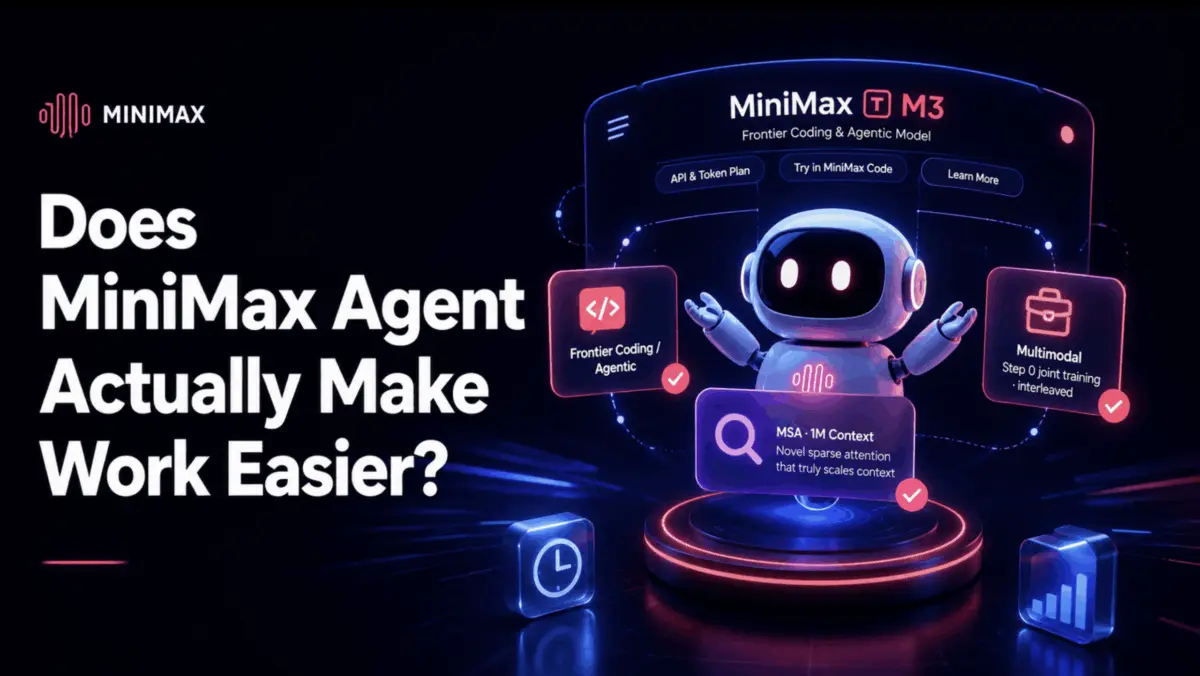
When MiniMax published its architecture breakdown, it warranted more than a casual glance or a surface-level summary. Beneath the branding lies a critical question facing software engineering teams: Does wrapping an advanced frontier model in a multi-agent framework fundamentally streamline workflows, or does it simply displace the exact same operational friction into less visible layers of the system?
To cut through the marketing noise, this investigation explores MiniMax’s architectural evolution—including its transition to the Mavis brand and Agent Teams—and pairs it with a practical, hands-on API integration test. By evaluating the trade-offs between token economy, structural overhead, and multi-agent consensus, this article provides a rigorous, data-driven assessment of whether MiniMax’s latest generation of tooling genuinely lightens the developer’s load.
Detailed Chronology: From General Assistant to "Mavis" and the M3 Architecture
Understanding the current state of MiniMax requires tracing a rapid sequence of product iterations, rebrandings, and licensing pivots that have reshaped the platform over the past year.
Mid-2025: The Genesis of MiniMax Agent
MiniMax first unveiled its general-purpose agent in mid-2025, pitching it as an enterprise-grade assistant engineered to handle long-horizon, multi-step tasks autonomously. According to early internal telemetry cited by the company, the tool quickly achieved high adoption, becoming a daily driver for more than half of MiniMax’s internal engineering and product teams within two months of deployment. Despite this internal success, early versions suffered from the classic ailment of monolithic agents: a tendency to drift, lose contextual coherence over extended execution windows, and exhibit what engineers dubbed "context anxiety"—where the model abruptly pauses to ask human operators whether it should proceed because its internal confidence has degraded.
May 27, 2026: The Mavis Overhaul and Agent Teams
On May 27, 2026, MiniMax rolled out a comprehensive architectural upgrade, officially rebranding the product to Mavis (an acronym for “MiniMax as a Jarvis”). Rather than focusing exclusively on raw parameter scaling, the update introduced Agent Teams. This paradigm abandons the single-model-doing-everything approach in favor of a cooperative ecosystem featuring distinct operational roles: a Leader, multiple Workers, and a Verifier.
Concurrently, MiniMax restructured its commercial ecosystem, merging its separate TokenPlan and Agent Plan tiers into a unified subscription. This consolidation granted developers access to the command-line interface (CLI), the core API, and the Mavis agent product under a single API key and shared credit pool.
The Licensing Pivot: M2.7 to M3
The company’s model lineage has also undergone strategic shifts. While earlier models like MiniMax-M2 and M2.5 shipped as fully open-weight releases under permissive licensing frameworks, M2.7 introduced a notable departure. Although MiniMax published the M2.7 weights on Hugging Face, it quietly updated its commercial terms shortly thereafter, requiring explicit written authorization for commercial deployment while keeping research and personal use unrestricted.
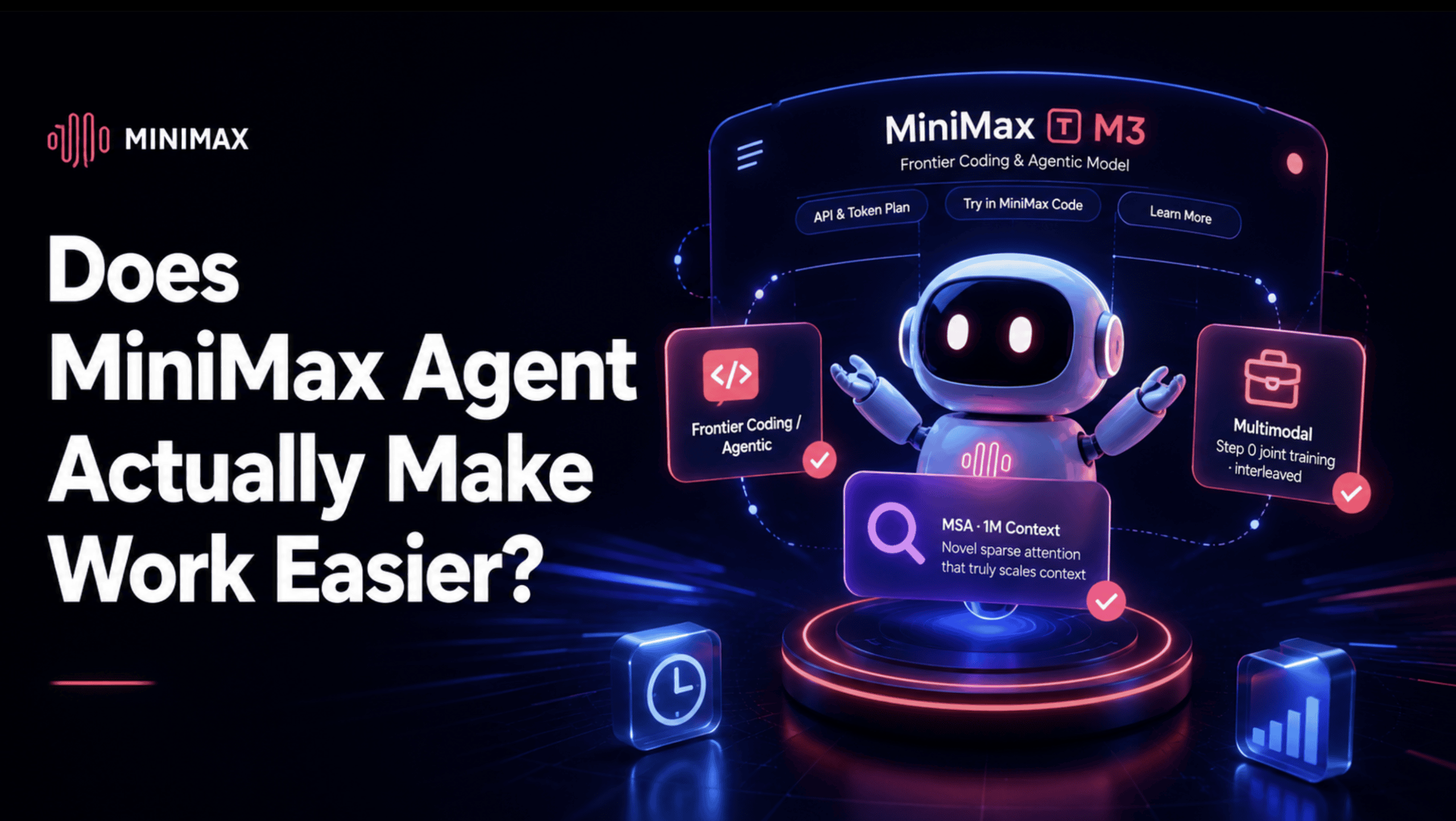
The latest flagship iteration, MiniMax-M3, powers the ecosystem evaluated in this analysis. M3 introduces a proprietary sparse attention architecture capable of handling up to a 1-million-token context window alongside native multimodal ingestion, positioning it directly against tier-one frontier models.
Supporting Context & Metrics: The Anatomy of Agent Teams
To evaluate the engineering validity of Mavis, one must examine the mechanics of the Leader-Worker-Verifier hierarchy and contrast it with existing multi-agent topologies, such as OpenAI’s handoff-based Agents SDK, LangGraph’s supervisor node graphs, or Claude Code’s team primitives.
+-------------------------------------------------------------+
|                        LEADER AGENT                         |
|  - Evaluates task complexity                                |
|  - Decomposes into atomic sub-tasks                         |
|  - Manages persistent state via Team Engine                 |
+------------------------------+------------------------------+
                               |
            +------------------+------------------+
            |                                     |
            v                                     v
+-----------------------+             +-----------------------+
|    WORKER AGENT A     |             |    WORKER AGENT B     |
|  - Executes sub-task  |             |  - Executes sub-task  |
|  - Generates artifacts|             |  - Generates artifacts|
+-----------------------+             +-----------------------+
            |                                     |
            +------------------+------------------+
                               |
                               v
+-------------------------------------------------------------+
|                       VERIFIER AGENT                        |
|  - Checks output against requirements                       |
|  - Triggers automated rollbacks if verification fails       |
+-------------------------------------------------------------+
The Persistent State Machine: Team Engine
Unlike naive multi-agent implementations that treat agent collaboration as a single, opaque function call returning a monolithic block of text, MiniMax’s Agent Teams rely on a persistent state machine known as the Team Engine. The engine tracks every discrete sub-task through strict lifecycle states: producing, verifying, and done. If a Worker’s output fails the Verifier’s checks, the Team Engine automatically feeds the error state back into the production pipeline, orchestrating corrections without requiring manual human intervention.
Quantifying the Hidden Costs of Collaboration
MiniMax’s engineering disclosure refreshingly details the economic and computational drawbacks of multi-agent collaboration. The company identifies three primary overhead vectors:
- Handoff Cost: The token expenditure required to serialize, reformat, and transfer context as a task transitions from a research agent to a drafting agent, and finally to a formatting agent.
- Sharing Cost: The cumulative tax of keeping every agent synchronized with a shared context window. Every additional kilobyte of shared background data increases the input token cost for every worker across every execution round.
- Aggregation Cost: The systemic difficulty of taking parallel draft outputs generated by multiple workers and merging them into a cohesive document with unified voice, accurate citations, and zero internal contradictions.
Most notably, MiniMax cites internal data regarding the Cost of Consensus. Unstructured multi-agent debates among homogeneous models can consume 2.1 to 3.4 times the token volume of a single agent self-correcting its output, frequently yielding zero accuracy gains—and in some cases, degraded results. This admission underpins the necessity of structured hierarchies: multi-agent concurrency without strict role governance is merely an expensive way to generate noise.
Official Statements & Hands-On API Implementation
To bridge the gap between architectural theory and empirical reality, we subjected MiniMax-M3 to a real-world API test. MiniMax designed its API to be fully compatible with the Anthropic message format, allowing developers to utilize the standard anthropic Python SDK simply by re-routing the base endpoint.
Project Setup
Initialize a secure Python environment and install the required dependencies:
mkdir minimax-test && cd minimax-test
python3 -m venv venv
source venv/bin/activate
pip install anthropic python-dotenv
Configure your environment variables in a .env file:
# .env
ANTHROPIC_API_KEY=your-minimax-key-here
ANTHROPIC_BASE_URL=https://api.minimax.io/anthropic
The Task Execution Script
The following script instantiates an Anthropic-compatible client targeting MiniMax-M3. It executes a structured prompt requiring both text generation and programmatic tool utilization (a word-counting utility), logging turn counts and exact token consumption to quantify operational overhead.
# run_task.py
import os
import json
from dotenv import load_dotenv
import anthropic

load_dotenv()

# The Anthropic client automatically reads ANTHROPIC_API_KEY and ANTHROPIC_BASE_URL from env
client = anthropic.Anthropic()

MODEL = "MiniMax-M3"

# Defining a straightforward tool: word counting.
# This validates real tool-use execution loops without external service dependencies.
TOOLS = [
    "name": "count_words",
    "description": "Counts the number of words in a block of text.",
    "input_schema":
        "type": "object",
        "properties": "text": "type": "string",
        "required": ["text"],
    ,
]

def count_words(text: str) -> int:
    return len(text.split())

def run_task(task: str, max_turns: int = 6) -> dict:
    """
    Executes a multi-turn task through the MiniMax-M3 model, handling tool calls
    dynamically and returning a detailed execution telemetry report.
    """
    messages = ["role": "user", "content": task]
    total_input_tokens = 0
    total_output_tokens = 0
    turns_used = 0

    for turn in range(max_turns):
        turns_used = turn + 1
        response = client.messages.create(
            model=MODEL,
            max_tokens=1024,
            tools=TOOLS,
            messages=messages,
        )

        total_input_tokens += response.usage.input_tokens
        total_output_tokens += response.usage.output_tokens

        # Termination condition: model did not request tool execution
        if response.stop_reason != "tool_use":
            final_text = "".join(
                block.text for block in response.content if block.type == "text"
            )
            return
                "answer": final_text,
                "turns_used": turns_used,
                "input_tokens": total_input_tokens,
                "output_tokens": total_output_tokens,


        # Handle tool execution requests and feed structured results back
        messages.append("role": "assistant", "content": response.content)
        tool_results = []
        for block in response.content:
            if block.type == "tool_use" and block.name == "count_words":
                result = count_words(block.input["text"])
                tool_results.append(
                    "type": "tool_result",
                    "tool_use_id": block.id,
                    "content": str(result),
                )
        messages.append("role": "user", "content": tool_results)

    return "answer": None, "turns_used": turns_used, "error": "Hit max_turns without finishing"

if __name__ == "__main__":
    task = (
        "Write a two-sentence description of what a circuit breaker does "
        "in software systems, then use the count_words tool to tell me "
        "exactly how many words your description contains."
    )
    report = run_task(task)
    print(json.dumps(report, indent=2))
Pricing and Economic Viability
Evaluating whether an agentic framework "makes work easier" requires analyzing direct financial costs. MiniMax-M3 standard tier pricing lists at $0.30 per million input tokens and $1.20 per million output tokens (reflecting a promotional 50% discount off standard rates).
Compared to tier-one frontier models such as Claude Opus (averaging $5.00 per million input and $25.00 per million output tokens), MiniMax offers substantial cost efficiencies—roughly 17x cheaper on inputs and 21x cheaper on outputs. However, developers must account for multiplier effects: cheaper tokens do not automatically translate to a lower total cost if an unstructured multi-agent architecture requires excessive turns, redundant tool calls, or continuous supervisory retries.
Future Outlook & Industry Implications
Synthesizing the architectural documentation, API telemetry, and economic realities yields a measured conclusion. MiniMax Agent (Mavis) successfully streamlines specific workflows—specifically long-horizon tasks featuring clear verification criteria, extensive multi-source research synthesis, and automated code generation backed by rigorous test suites. In these environments, dividing responsibilities among a Leader, Workers, and a Verifier outperforms a single monolithic model prone to mid-task drift.
Conversely, for short, low-complexity tasks, this multi-agent overhead functions as pure computational tax. As artificial intelligence systems mature throughout 2026 and beyond, the industry is moving past the phase of uncritical agent hype. The most valuable takeaway from MiniMax’s engineering disclosure is not its multi-agent graph structure, but its transparency regarding failure modes and operational costs.
Before deploying agentic frameworks into production environments, engineering leaders should apply MiniMax’s internal litmus test: Is this task sufficiently long, complex, and verifiable that the overhead of orchestration and verification pays for itself, or would a single well-scoped model call accomplish the goal faster and cheaper? In most development scenarios, answering that single question constitutes the entirety of the evaluation you need.