
Executive Overview
The underlying stakes could not be higher. In modern digital commerce, data security, latency, and response quality directly impact a company’s bottom line. When an artificial intelligence system stumbles—whether by leaking sensitive proprietary data, hallucinating incorrect troubleshooting steps, or failing to capture a brand’s unique voice—it erodes customer trust instantaneously. In severe cases, these failures translate into costly compliance breaches, damaged brand reputation, and direct financial loss. According to IBM’s comprehensive 2025 data breach report, the average global cost of a data breach now stands at a staggering $4.44 million, underscoring the absolute necessity for watertight security protocols in automated workflows.
Despite these high stakes, off-the-shelf large language models (LLMs) and generic chatbot frameworks frequently fall short of enterprise expectations. While foundational LLMs boast breathtaking capabilities, they suffer from inherent architectural constraints. Token limits, inefficient context utilization, and a persistent vulnerability to hallucinations plague these models, particularly when exposed to domain-specific knowledge bases and strict response formatting requirements.
This reality forces a fundamental question upon enterprise architects: How do you build an artificial intelligence that inherently knows how to answer like a seasoned domain expert, knows what to answer based on verified, real-time data, and still operates with the speed, safety, and cost-efficiency required for production environments?
Drawing from extensive real-world model development experience, the definitive answer does not lie in relying on a single model or a monolithic technique. Instead, it requires a sophisticated, multi-layered architectural approach. This methodology must strategically decouple what a model knows from how it responds, marrying the precision of external data retrieval with the stylistic mastery of targeted model adaptation.
Detailed Chronology: The Evolution of the Architectural Breakthrough
The journey toward a robust enterprise AI support system is rarely linear. It demands a rigorous, iterative process of identifying critical failure points, testing conventional solutions, and engineering novel hybrid frameworks. Below is the chronological progression of how engineers navigated these obstacles to arrive at an optimized hybrid architecture.
Phase 1: Identifying the Core Structural Bottlenecks
During the initial design and prototyping phase, four fundamental challenges quickly emerged as major road blocks to deploying a reliable customer support chatbot.
- The Illusion of Effective Context Limits: Modern foundational LLMs frequently advertise massive context windows spanning 16K, 32K, or even 128K tokens. However, practitioners working closely with these systems in production quickly realize that attention spans break down long before these theoretical limits are reached. When massive volumes of text are passed into a prompt, models notoriously suffer from "primacy-recency bias," underutilizing or entirely ignoring information buried in the middle of the prompt. For enterprise environments—where internal knowledge bases easily span millions of tokens—simply throwing more text at the model is an ineffective strategy.
- Weak Utilization of Long-Tail Information: Even when the exact correct information is present within a massive prompt, LLMs frequently misinterpret it, ignore it, or give disproportionate weight to irrelevant sections. This phenomenon is extensively documented in academic literature, such as Stanford University’s seminal "Lost in the Middle" study, which highlights how long-context inputs inevitably lead to incomplete reasoning unless tightly controlled.
- Precision versus Performance Trade-offs in Retrieval: Introducing retrieval mechanisms introduces real-world latency and compute overhead. If a system retrieves too much data, the bloated context window inflates response times and dilutes model attention. Conversely, if it retrieves too little, the risk of hallucinations skyrockets. The core engineering hurdle is not retrieval itself, but precision retrieval—guaranteeing the absolute minimum sufficient context required for factual correctness without overwhelming the infrastructure or the model.
- Unchecked Hallucinations Under Missing Context: Unlike human operators who readily admit when they do not know an answer, LLMs are fundamentally wired to generate text continuously. When critical information is missing from their inputs, they rarely abstain; instead, they fabricate confident, highly plausible-sounding answers. In a customer support environment, this behavior is entirely unacceptable, directly violating trust, correctness, and regulatory compliance.
Phase 2: Testing Isolated Approaches (RAG vs. Fine-Tuning)
Recognizing that passing raw, unmanaged context was a dead end, development teams evaluated two dominant paradigms in modern AI engineering: Retrieval-Augmented Generation (RAG) and Fine-Tuning.
- Deploying RAG for Precision: Engineers built a curated, searchable knowledge base comprising internal Q&A pairs, product manuals, technical documentation, and policy reference materials. At inference time, a retriever fetched only the most relevant content chunks and injected them into the prompt. While this significantly reduced hallucinations and grounded responses in verified data, it revealed a glaring flaw: RAG supplies facts, but it cannot dictate style. Even with 100% accurate context, the model’s outputs exhibited wild variations in tone, formatting, and procedural depth. In evaluation benchmarks, small language models paired with raw RAG achieved only about 70% output correctness because they failed to maintain a conversational tone or guide users toward deeper technical resolutions.
- Deploying Fine-Tuning for Tone and Reasoning: To solve the stylistic and reasoning deficit, engineers fine-tuned the Qwen model on roughly 1,000 expert Q&A pairs. The goal was not to inject raw facts, but to teach the model how to apply domain-specific terminology, maintain brand voice, follow rigid response structures, and handle complex support edge cases. To avoid catastrophic forgetting and exorbitant GPU costs, teams implemented Low-Rank Adaptation (LoRA) adapters, adjusting only a small fraction of parameter matrices while preserving the base model’s general knowledge. The results showed a dramatic improvement in tone alignment (reaching roughly 90%). However, factual accuracy plummeted to roughly 50% when the model was forced to rely solely on its static parameters to answer queries about rapidly changing product features and long-tail policies.
Phase 3: Synthesizing the Hybrid Architecture
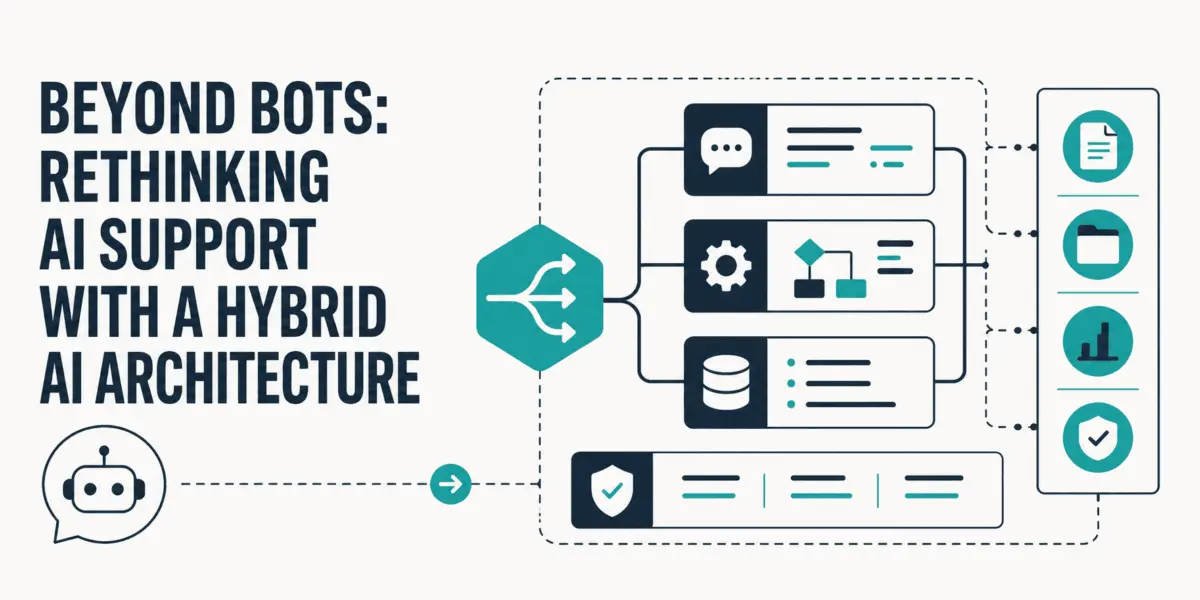
Faced with the limitations of isolated methodologies, engineers realized that fine-tuning and retrieval solve entirely different halves of the enterprise equation. Fine-tuning teaches an AI how to answer, while retrieval supplies what to answer.
By combining a fine-tuned Qwen model with a precision RAG pipeline, the system achieved a symbiotic balance. The fine-tuned model’s deep understanding of domain context and required output formats empowered it to parse and apply retrieved context far more effectively than a generic base model ever could.
Supporting Context & Metrics
To objectively measure the efficacy of this hybrid architecture, development teams ran rigorous comparative evaluations across three distinct configurations: Pure RAG, Pure Fine-Tuning, and the Hybrid (RAG + Fine-Tuned) approach. The empirical metrics paint a definitive picture of why hybrid architectures represent the future of enterprise AI support.
| Evaluation Metric | Pure RAG Approach | Pure Fine-Tuning Approach | Hybrid Architecture (RAG + Fine-Tuned) |
|---|---|---|---|
| Factual Correctness | ~70% | ~50% | ~73% (Highest overall accuracy) |
| Tone & Style Alignment | Variable / Unreliable | ~90% | ~75% (Significantly stabilized) |
| Handling Long-Tail Queries | Moderate (Dependent on retrieval) | Poor (Prone to hallucination on new data) | High (Grounded in real-time retrieval) |
| Context Window Efficiency | High (Targeted chunk injection) | N/A (Static parametric knowledge) | High (Optimized minimal sufficient context) |
As the performance metrics demonstrate, while pure fine-tuning achieved the highest stylistic alignment, its catastrophic drop in factual accuracy rendered it dangerous for dynamic support environments. Conversely, pure RAG maintained solid factual grounding but failed to deliver consistent, brand-aligned conversational experiences.
The hybrid model successfully bridged this gap, outperforming both isolated methods in factual correctness while retaining strong, reliable tone control. By keeping context windows small, query-specific, and surgically injected into an already domain-adapted model, teams successfully eliminated latency bottlenecks, controlled token consumption, and drastically reduced operational costs.
Official Statements & Industry Perspective
Reflecting on the broader industry implications of these architectural shifts, data science leaders emphasize that the era of deploying raw, out-of-the-box foundational models for specialized enterprise tasks is rapidly coming to a close.
"The core misconception in early enterprise AI adoption was the belief that a single model could be forced to handle everything—memorizing facts, understanding nuance, and maintaining rigid formatting all at once," notes Alakh Sharma, Data Scientist at Talentica Software and an alumnus of the Indian Institute of Science, Bangalore.
"Our work consistently demonstrates that separating the retrieval of truth from the generation of style is non-negotiable. Fine-tuning teaches the model how to think and speak like an expert, but retrieval supplies the ground truth. When you combine them intelligently, you stop fighting the limitations of the technology and start unlocking genuine business value."
Industry analysts echo this sentiment, pointing out that as customer expectations for digital assistants rise, enterprises can no longer afford the reputational and financial fallout of model hallucinations. Security frameworks, data governance policies, and latency requirements dictate that future AI deployments must be modular, auditable, and structurally sound.
Future Outlook
The successful deployment of hybrid AI architectures in customer support marks a major turning point for enterprise software development, but it also opens the door to next-generation advancements. As organizations continue to refine these systems, several key trends are poised to shape the future of AI-driven enterprise operations:
- Advanced Dynamic Retrieval Routing: Future iterations of hybrid systems will move beyond static vector databases, incorporating intelligent routing agents capable of dynamically deciding whether a query requires real-time document retrieval, API calls to transactional databases, or pure parametric generation based on the complexity of the user’s intent.
- Edge-Optimized LoRA Swaps: As parameter-efficient fine-tuning techniques like LoRA continue to mature, enterprises will increasingly deploy modular adapter libraries. This will allow a single base model to dynamically hot-swap stylistic and domain-specific adapters on the fly, tailoring its persona instantly depending on which department or client brand it is servicing.
- Automated Feedback Loops and Continuous Learning: The next frontier of hybrid architecture involves closing the loop between user interactions and model updates. By capturing anonymized correction logs from human supervisors, automated pipelines will continuously fine-tune LoRA adapters and re-index vector knowledge bases with zero human downtime.
Ultimately, the evolution from generic chatbots to specialized hybrid AI systems signifies the maturation of artificial intelligence as an enterprise-grade utility. By respecting the intrinsic mathematical and architectural limitations of large language models—and engineering around them with disciplined systems design—organizations can finally build AI support systems that are simultaneously safe, remarkably accurate, blindingly fast, and reliably human in their delivery.