
Executive Overview
Simultaneously, deal volume contracted by 13% year-on-year, confirming that the downturn is not merely a reflection of a few missing megadeals, but rather indicative of a broad-based, macro-level cooling in market activity. The average deal value also slipped markedly, dropping from $9.6 million in Q2 2025 to $6.8 million in Q2 2026. This dual compression—fewer transactions executed at lower valuations—illustrates a risk-off sentiment among institutional investors and venture capitalists alike.
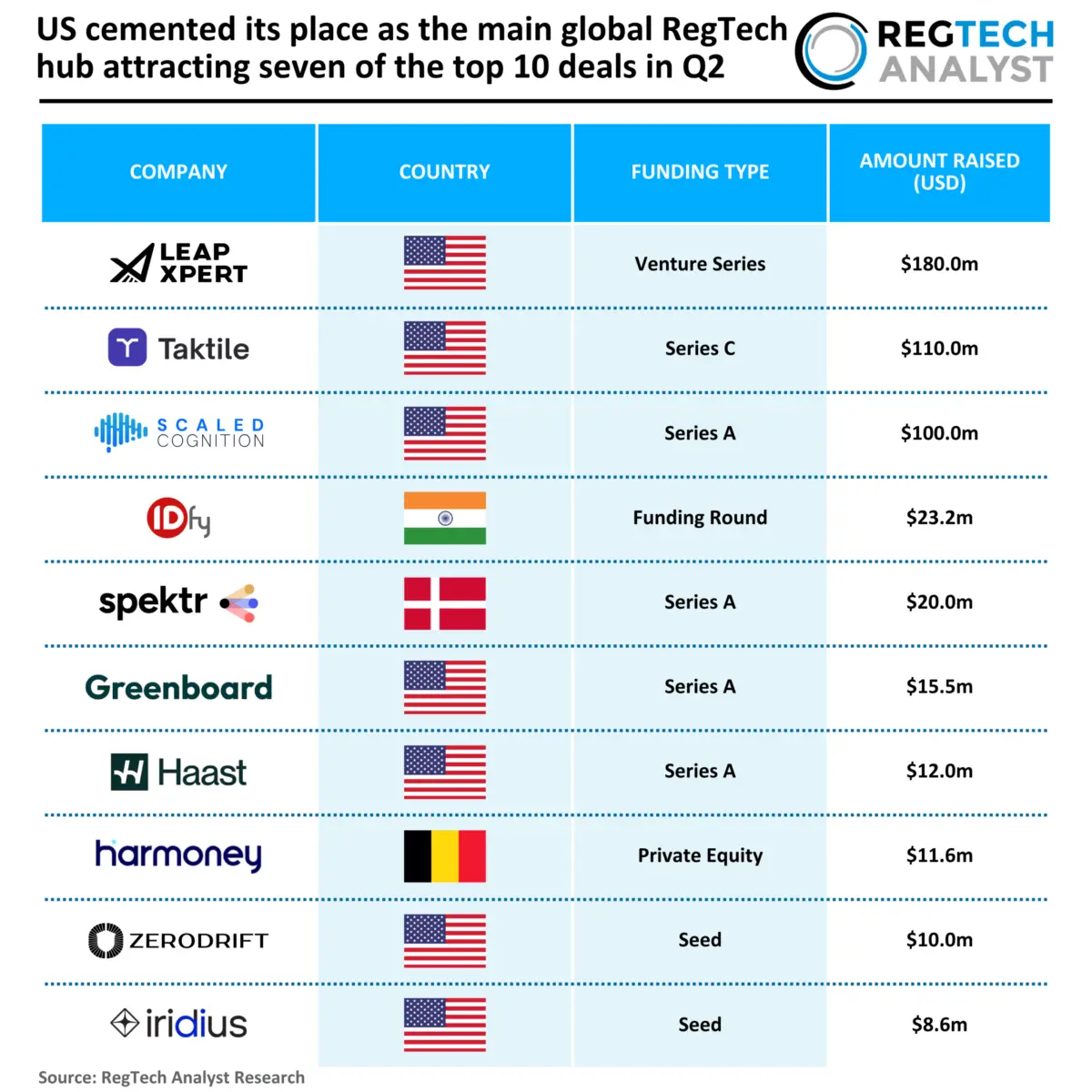
Despite the broader contraction, the sector continues to evolve rapidly. The upper tier of the market is undergoing a structural geographic shift. The United States has further consolidated its status as the undisputed global capital of RegTech innovation, capturing seven of the top ten global deals in Q2 2026, up from six in Q2 2025. Meanwhile, traditional European and Middle Eastern strongholds faced a sharp retrenchment, clearing the way for emerging jurisdictional entrants from India, Denmark, and Belgium.
Crucially, the Q2 figures highlight that investor appetite is far from dead; instead, it has become hyper-selective. Capital is aggressively concentrating around high-utility, transformative technologies—particularly artificial intelligence and machine learning platforms that promise immediate, quantifiable cost efficiencies. A prime example of this trend is Taktile’s $110 million Series C funding round, which underscores how enterprise-grade, autonomous decision-making engines are commanding massive valuations even in a tightening funding climate.
Detailed Chronology and Quantitative Breakdown of Q2 2026
To understand the trajectory of RegTech investment in the second quarter of 2026, one must examine the granular mechanics of how capital flowed from January through June, culminating in the Q2 results.
The quarter began against a backdrop of macroeconomic uncertainty, persistent high interest rates, and evolving global regulatory mandates. Financial institutions (FIs) and insurance providers continued to grapple with complex compliance burdens, yet their technology budgets faced intense internal scrutiny. This cautious corporate spending environment directly translated into venture capital boardrooms, where investment committees demanded higher hurdles for profitability, capital efficiency, and immediate ROI before approving term sheets.
Funding and Deal Volume Metrics
- Q2 2025 Baseline: $1.2 billion raised across 124 total deals (Average deal size: $9.6 million).
- Q2 2026 Results: $734.8 million raised across 108 total deals (Average deal size: $6.8 million).
- Year-on-Year Change: A 38% decrease in total capital raised, a 13% decline in deal count, and a 29.1% reduction in average deal value.
The progressive decline in average deal size from $9.6 million to $6.8 million is perhaps the most revealing metric of the quarter. It indicates that early-stage (Seed and Series A) funding rounds may be holding relatively steady in volume, while growth-stage and late-stage rounds (Series B through pre-IPO) are experiencing severe valuation corrections or are being deferred indefinitely. Founders seeking mega-rounds are finding a recalcitrant market, forcing many to opt for bridge rounds, internal extensions, or strategic debt financing rather than dilutive equity raises at down-valuations.
Geographic Shifting: The US Hegemony and the European Shakeup
The geographic distribution of top-tier RegTech investments in Q2 2026 reveals a fascinating story of American consolidation coupled with profound instability across international hubs.
The American Gravitational Pull
United States-based companies cemented their dominance at the top of the global funding league tables, capturing seven of the top ten global RegTech deals during the quarter. This represents an incremental gain from the six top-tier spots the US claimed in Q2 2025.
This gravitational pull toward the US market is driven by several structural factors:
- Regulatory Complexity: The fragmented and stringent US regulatory environment—overseen by agencies such as the SEC, FINRA, CFPB, FinCEN, and various state-level regulators—creates a persistent, high-stakes demand for automated compliance solutions.
- Deep Venture Ecosystem: American venture capital firms, particularly those specialized in B2B SaaS and enterprise fintech, possess the dry powder and risk tolerance required to back complex infrastructure plays.
- AI Talent Concentration: The proximity of leading RegTech startups to major US technology hubs facilitates rapid integration of frontier artificial intelligence models into legacy financial workflows.
The Disruption of International Hubs
While the US strengthened its grip on the top tier, the non-US contingent underwent a dramatic reshuffling. In Q2 2025, countries such as the United Kingdom, Israel, Germany, and France routinely featured among the largest transactions globally. In stark contrast, all four of these established European and Middle Eastern markets were entirely absent from the Q2 2026 top ten rankings.
This sudden vacuum was filled by an eclectic mix of new jurisdictional entrants. India, Denmark, and Belgium each secured a position among the global top ten deals for the first time in recent comparable periods. This transition signals that world-class regulatory technology innovation is decentralizing geographically. It demonstrates that regional ecosystems outside the traditional Western tech corridors are maturing rapidly, producing specialized compliance solutions capable of attracting global venture capital attention despite macro headwinds.
Spotlight on Excellence: Taktile’s $110 Million Series C Round
The standout transaction of the quarter—and a masterclass in how modern RegTech companies are commanding capital—was the $110 million Series C funding round secured by Taktile, an advanced AI transformation platform designed to help banks and insurers build and operate autonomous, agent-driven decision systems within heavily regulated environments.
The Investment Syndicate
The massive funding round was spearheaded by the Growth Equity team at Goldman Sachs Alternatives. It attracted participation from an elite consortium of venture capital heavyweights, including Balderton Capital, Index Ventures, Tiger Global, Y Combinator, and Dig Ventures. The caliber of this investor syndicate underscores the market’s appetite for software solutions that bridge the gap between cutting-edge artificial intelligence and ironclad institutional compliance.
The Technology and Value Proposition
Financial institutions operate under crushing administrative and regulatory overhead. Industry estimates indicate that global financial institutions spend an average of $72.9 million per year on Know Your Customer (KYC) and Anti-Money Laundering (AML) processes alone.
Taktile addresses this financial and operational drain by providing an enterprise-grade platform that automates high-stakes compliance and risk workflows. These workflows span:
- Comprehensive KYC and AML onboarding checks.
- Advanced financial crime detection mechanisms.
- Complex insurance claims assessment and underwriting processes.
Crucially, Taktile’s architecture solves one of the greatest hurdles facing enterprise AI adoption: governance. Rather than operating as an impenetrable "black box," Taktile provides a transparent governance and rule-management framework. This allows business leaders, risk officers, and compliance heads across credit, fraud, and underwriting departments to directly manage, audit, and explain automated decisions without requiring deep data science intervention.
Proven ROI and Client Impact
In a market where enterprise software buyers demand immediate proof of value, Taktile’s client roster—which includes high-growth fintechs and digital banks such as Mercury, Monzo, and Pleo—is already reporting transformative operational metrics.
Key performance indicators achieved by Taktile clients include:
- A dramatic 75% reduction in AML false positives, drastically cutting the manual labor hours required by compliance investigation teams.
- Anticipated cost savings exceeding $90 million in claims processing for one of the world’s largest multinational insurance carriers.
Strategic Roadmap
Taktile management has confirmed that the proceeds from the $110 million Series C round will be deployed to accelerate two primary strategic initiatives:
- R&D and Product Enhancement: Deepening the platform’s generative AI and autonomous agent capabilities to handle even more complex, multi-step regulatory workflows.
- Global Expansion: Scaling go-to-market operations, sales, and engineering support across key target geographies, including the United States, Europe, the Middle East, and Africa (EMEA), and Latin America (LatAm).
Supporting Context & Industry Metrics
To place the Q2 2026 figures into proper historical perspective, industry analysts point to a multi-year maturation cycle within the RegTech sector.
The Evolution from "Check-the-Box" to Strategic Enabler
In the early days of RegTech (circa 2015–2020), adoption was primarily driven by defensive necessity. Banks and financial institutions bought software to avoid regulatory fines, satisfy baseline auditing requirements, and digitize archaic paper-based filing systems. These point solutions were often siloed, creating operational friction rather than seamless efficiency.
By 2026, the mandate has fundamentally shifted. RegTech is no longer viewed merely as a cost-of-doing-business insurance policy against regulatory penalties. Instead, executive leadership teams view sophisticated compliance infrastructure as a core competitive advantage. Platforms that utilize advanced automation and machine learning do not just prevent fines—they accelerate customer onboarding velocity, optimize risk-based pricing, reduce operational overhead, and safeguard enterprise reputation in an era of increasingly sophisticated financial crime.
Macroeconomic Pressures vs. Technological Imperatives
The 38% year-on-year drop in funding must be contextualized against broader macroeconomic realities. Venture capital dry powder has normalized from the historic highs recorded during the 2021–2022 funding boom. Investors are no longer underwriting speculative growth at all costs; unit economics, path-to-profitability, and net revenue retention (NRR) are now the primary lenses through which startups are evaluated.
However, the counter-force to this fiscal conservatism is the explosion of regulatory mandates worldwide. From the implementation of stringent new artificial intelligence governance acts (such as the EU AI Act) to expanding crypto-asset regulations (like MiCA in Europe) and tightening global sanctions enforcement, the regulatory perimeter is expanding exponentially. Financial institutions cannot scale their compliance headcount linearly to match this expanding regulatory burden; automation is their only viable survival strategy. This structural tailwind ensures that high-performing RegTech companies addressing acute pain points will continue to secure capital, even if total market funding numbers contract.
Official Statements and Industry Perspectives
While formal press releases regarding Q2 2026 funding rounds emphasize growth and resilience, venture capitalists and industry analysts have shared candid assessments of the current market climate.
Speaking on the shifting dynamics of enterprise software investment, representatives from Goldman Sachs Alternatives noted that the bifurcation in the market is widening. Companies offering incremental improvements are struggling to raise capital, while category-defining platforms capable of delivering systemic operational transformation—such as autonomous AI decision engines—remain heavily contested assets among top-tier institutional investors.
Similarly, compliance officers across tier-one global banks have increasingly voiced frustration with legacy compliance vendors whose systems generate high volumes of false positives, bogging down human analysts and degrading the customer experience. This operational friction has created an open lane for disruptive, API-first, and AI-native platforms to capture enterprise market share, explaining why growth-stage rounds for category leaders continue to close despite macro headwinds.
Future Outlook: What Lies Ahead for RegTech?
As the industry looks toward the second half of 2026 and into 2027, several key trends and catalysts are poised to shape the trajectory of the global RegTech sector:
1. The Consolidation Wave
With average deal sizes shrinking and early-stage capital becoming more selective, weaker RegTech startups unable to achieve cash-flow breakeven or secure bridge financing will face difficult choices. This environment is expected to trigger a significant wave of mergers and acquisitions (M&A). Well-capitalized incumbents, private equity firms, and traditional financial institutions looking to acquire proprietary technology rather than build it from scratch will likely snap up struggling or promising early-stage innovators at attractive valuations.
2. Generative AI Moves from Pilot to Production
The hype cycle surrounding generative AI in compliance is officially giving way to hard deployment realities. Financial institutions that spent 2024 and 2025 conducting proof-of-concept (PoC) trials with AI-driven KYC, AML, and fraud detection tools are now rolling them out into production environments. Vendors that can demonstrate verifiable, auditable accuracy—minimizing hallucinations and algorithmic bias while satisfying stringent regulatory audit trails—will capture outsized market share.
3. Geographic Diversification
While the United States will undoubtedly retain its leadership crown in the near term, the emergence of India, Denmark, and Belgium in the Q2 2026 top deals suggests that global fintech and regulatory innovation is spreading outward. Expect to see regional compliance hubs emerge to address localized regulatory frameworks, eventually exporting their technologies across international borders.
4. Regulatory Sandboxes and Public-Private Collaboration
Regulatory bodies worldwide are increasingly launching digital sandboxes and innovation hubs to collaborate directly with RegTech developers. By fostering closer alignment between regulators and software creators, these initiatives are expected to streamline the approval process for new compliance technologies, lowering the barrier to entry for early-stage disruptors.
Conclusion
The Q2 2026 RegTech investment data paints a picture of a market undergoing a healthy, albeit painful, maturation process. While top-line figures—such as the 38% drop in global funding and the compression of average deal sizes to $6.8 million—reflect a disciplined, risk-off venture capital environment, the underlying fundamentals of the sector remain robust.
The market is aggressively rewarding substance over hype. Companies that solve existential, high-cost problems for financial institutions—such as Taktile’s autonomous AI decision platform—are proving that massive capital is still available for category leaders. As financial institutions navigate an increasingly complex global regulatory landscape, the imperative for automated, intelligent, and scalable compliance infrastructure will only intensify, setting the stage for a strategic rebound as market conditions stabilize.
Copyright © 2026 RegTech Analyst. All rights reserved.