
Executive Overview
Project management methodologies are not mere administrative checklists; they are foundational operating systems that govern how teams process work, mitigate risk, and deliver value. According to recent data from Wellingtone’s State of Project Management Report, approximately 58% of project managers mostly or always apply a defined methodology to their initiatives. However, the success of these implementations depends entirely on alignment with specific project constraints, team dynamics, stakeholder expectations, and organizational culture.
This comprehensive analysis explores the landscape of modern project management methodologies—ranging from Agile and Waterfall to Hybrid, Lean, Six Sigma, and PRINCE2—and offers an authoritative guide on how to evaluate complexity, match frameworks to industry verticals, and avoid systemic selection errors.
Detailed Chronology and Evolution of Project Management Methodologies
The evolution of project management reflects the broader transformation of global industry—shifting from rigid, highly physical manufacturing processes to fluid, digital, and knowledge-based economies. Understanding this chronological progression clarifies why modern project managers have such a diverse toolkit at their disposal.
The Industrial Foundation: Linear and Sequential Control
For decades, large-scale engineering, construction, and manufacturing projects relied heavily on sequential planning. The Critical Path Method (CPM), developed in the late 1950s by DuPont and Remington Rand, introduced mathematical rigor to scheduling by calculating the longest sequence of dependent tasks and identifying slack time. This era also solidified the foundations of Waterfall project management, where phases flowed strictly from requirements gathering through design, implementation, testing, and deployment.
These linear models were built for predictability. When physical materials, heavy machinery, and vast civil infrastructure were involved, iterating on a completed foundation was financially prohibitive. Linear governance ensured that every phase was documented, scrutinized, and signed off before the next phase began.
The Quality Revolution: Lean and Six Sigma
As global competition intensified in the late 20th century, organizations shifted their focus from merely finishing projects on time to systematically eliminating waste and reducing defects.
- Lean Manufacturing, pioneered by Toyota, focused on continuous process improvement and the aggressive elimination of operational waste—such as excessive approvals, unnecessary handoffs, and idle waiting times.
- Six Sigma, developed by Motorola in the 1980s, introduced data-driven quality control using the DMAIC framework (Define, Measure, Analyze, Improve, Control) to drive down process variation and defects.
Together, these methodologies transformed operations across manufacturing, healthcare, and finance, proving that project management could be mathematically optimized for efficiency and quality consistency.
The Digital Shift: The Rise of Agile and Adaptive Frameworks
As software and digital products began dominating global commerce in the late 1990s and early 2000s, traditional linear frameworks began to buckle. Software development rarely featured static requirements; customer feedback, emerging technologies, and competitive pressures demanded rapid iteration.
The publication of the Agile Manifesto in 2001 codified a shift away from rigid documentation toward customer collaboration, individuals and interactions, working software, and responding to change. Frameworks like Scrum and Kanban emerged to operationalize this mindset, dividing work into short iterative sprints and continuous visual workflows.
The Modern Era: Hybrid Integration and Agile at Scale
Today, the strict ideological divide between "linear" and "adaptive" methodologies has dissolved. Modern enterprises routinely manage complex portfolios where different components demand contrasting approaches. As a result, Hybrid methodologies—which combine the predictive control of Waterfall with the iterative speed of Agile—have experienced surging adoption. Organizations no longer look for a single universal standard; instead, they build context-aware operating models tailored to the exact demands of each initiative.
Supporting Context & Metrics: Methodology vs. Framework vs. Process
To navigate modern project management successfully, leaders must first clarify the structural hierarchy of how work is defined. These three terms—methodology, framework, and process—are frequently conflated, yet they occupy distinct tiers in operational design:
- Methodology: The overarching system of rules, principles, and philosophy that governs how a project gets done from kickoff to close. It dictates the underlying logic of the operation (e.g., Waterfall’s sequential predictability vs. Agile’s iterative adaptation).
- Framework: A semi-structured blueprint or set of guidelines that translates methodology into actionable structures (e.g., Scrum, Kanban, or the PMBOK guide). It provides the container and boundaries within which teams operate.
- Process: The specific, repeatable sequence of steps and tasks executed by team members to produce a specific output or deliverable.
Operational Tip: A simple way to remember the hierarchy: Methodology sets the rules, frameworks translate them into structure, and processes carry out the work.
Industry Metrics on Adoption and Performance
Statistical insights from global project management institutions highlight how organizations utilize these approaches:
- Methodology Standardization: Wellingtone’s research indicates that 58% of project managers consistently apply a defined project management methodology, linking standardized practices to improved project visibility and risk mitigation.
- The Rise of Hybrid Models: According to the Project Management Institute’s (PMI) Pulse of the Profession report, global adoption of hybrid project management methodologies surged significantly, reflecting an enterprise-wide demand for flexible governance that accommodates both predictable regulatory constraints and rapid software iteration.
Core Methodologies Compared
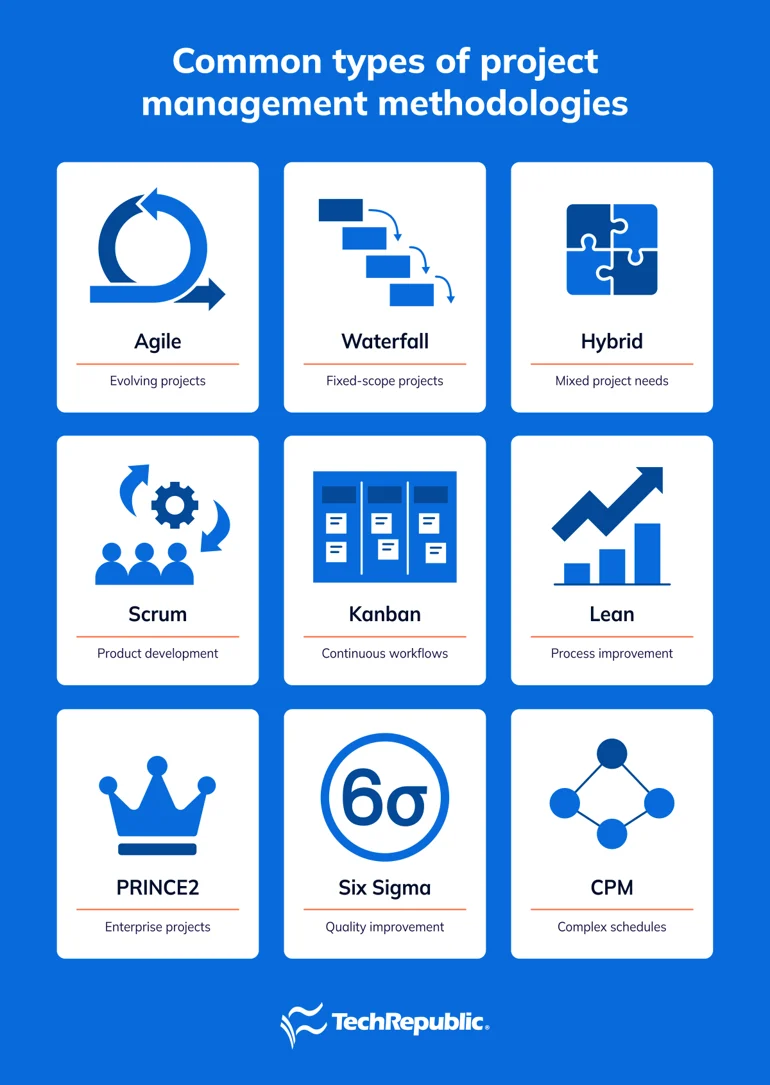
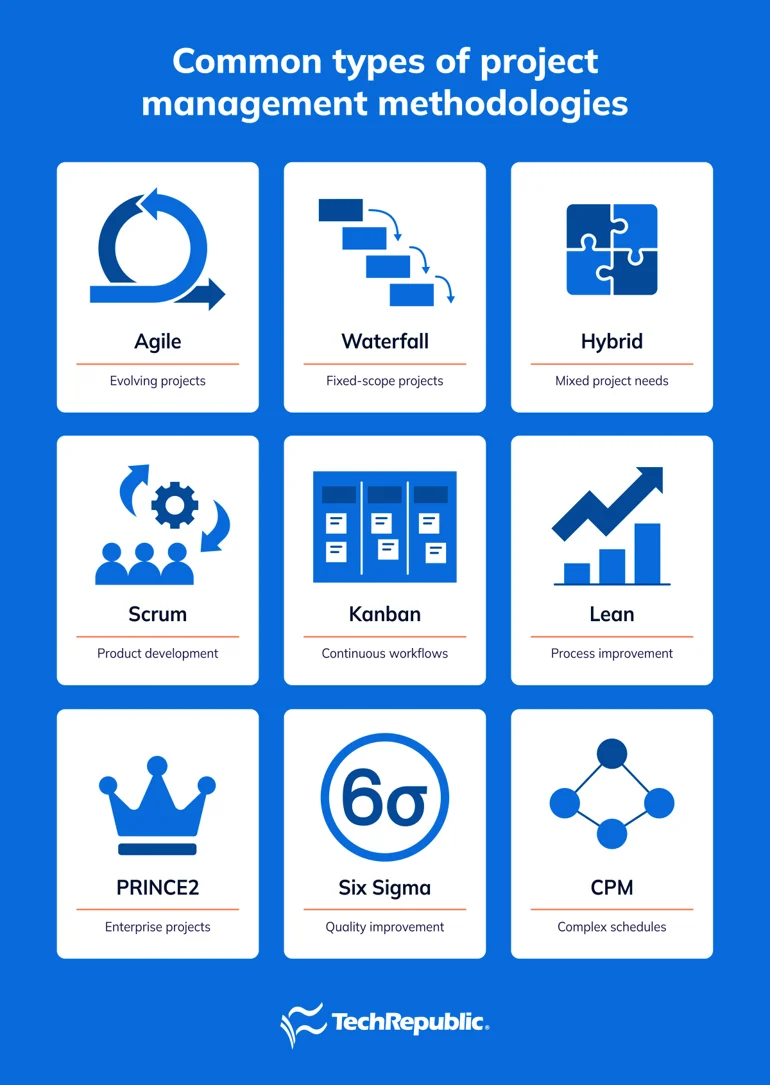
| Methodology | Best For | Key Characteristic | Primary Advantage | Primary Limitation |
|---|---|---|---|---|
| Agile | Evolving, dynamic projects | Iterative delivery cycles | Adapts rapidly to shifting requirements | Scope can easily drift without strict boundaries |
| Waterfall | Fixed-scope, regulated projects | Sequential, gated phases | Highly predictable planning and documentation | Extremely difficult and costly to change mid-stream |
| Lean | Operational process improvement | Systematic waste reduction | Drastically increases operational efficiency | May overlook long-term strategic needs |
| PRINCE2 | Large enterprise & public sector | Stage-based governance | Strict control, audit trails, accountability | Documentation-heavy; can slow down fast-moving teams |
| CPM | Complex schedules with hard deadlines | Critical task tracking | Identifies timeline bottlenecks | Inflexible when underlying task estimates shift |
| Hybrid | Mixed project requirements | Combined methodologies | Balances flexibility with rigid control | Requires precise boundary-setting to avoid confusion |
| Six Sigma | Quality control & defect reduction | Data-driven statistical analysis | Reduces errors and standardizes output | Requires specialized training (Green/Black Belts) |
Deep-Dive Analysis of Leading Methodologies
1. Agile, Scrum, and Kanban
Agile is built around the reality that teams often cannot know all the answers at project kickoff. By organizing work into short iterations (sprints) typically lasting one to four weeks, Agile teams continuously inspect and adapt based on stakeholder feedback.
-
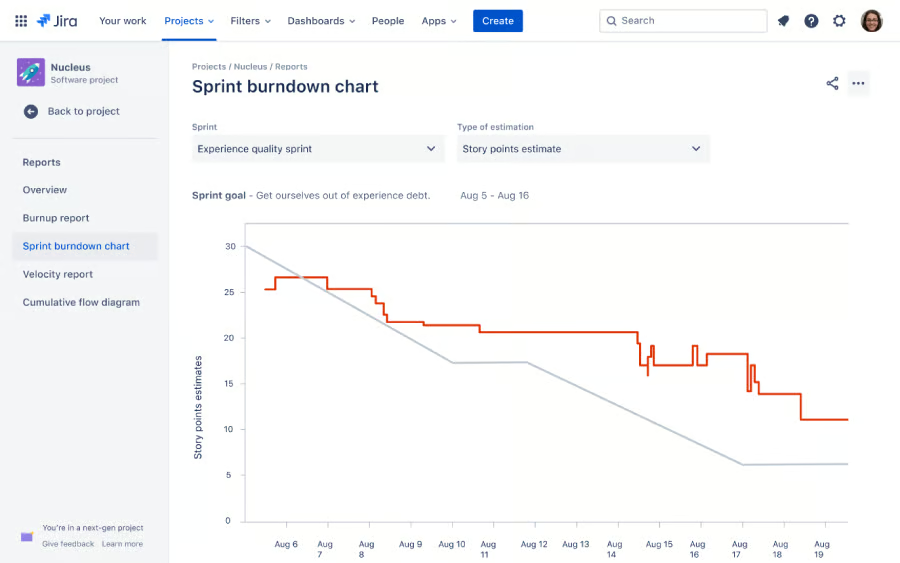
Scrum introduces specific roles (Product Owner, Scrum Master), backlog planning, and regular ceremonies (dailies, retrospectives) to maintain a predictable delivery rhythm. Tools like Jira provide deep support for sprint planning, velocity tracking, and burndown charts.
-
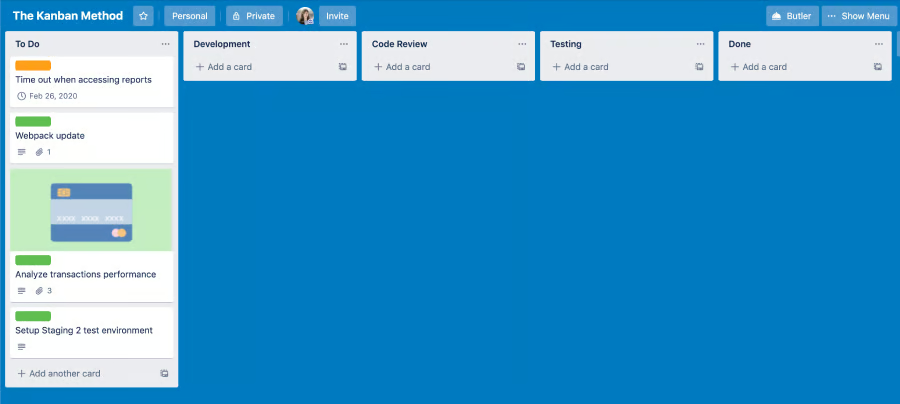
Kanban visualizes work on a physical or digital board (supported by tools like Trello) and limits work-in-progress (WIP) to eliminate bottlenecks. It is ideal for continuous workflows such as customer support queues, maintenance, and bug fixes.
-
Limitations: Agile falters when budgets, timelines, and deliverables are fixed and non-negotiable from day one.
2. Waterfall and the Critical Path Method (CPM)
Waterfall is a linear, sequential approach where projects flow downward through distinct phases: requirements, design, implementation, verification, and maintenance. Each phase requires formal approval before the next begins.
-
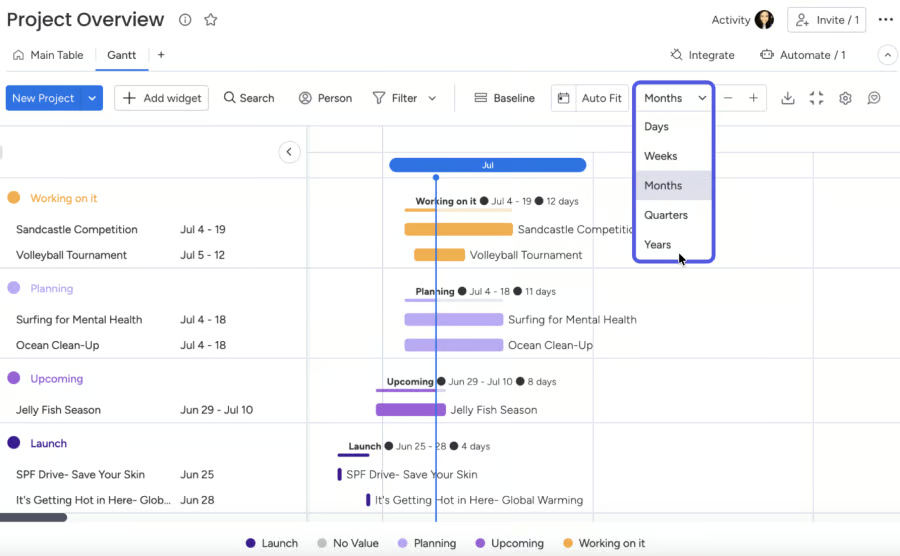
Critical Path Method (CPM) complements this by mapping complex dependencies to determine the longest sequence of dependent activities, identifying precisely which tasks dictate the final delivery date. Platforms like monday.com utilize Gantt charts and dependency mapping to support this phase-by-phase rigor.
-
Limitations: Waterfall lacks agility. If a critical requirement changes late in the execution phase, revisiting earlier stages can derail budgets and timelines.
3. Hybrid Methodologies
Hybrid approaches integrate predictive (Waterfall) and adaptive (Agile) practices within a single initiative. For example, an enterprise software deployment might use Waterfall for initial vendor procurement, infrastructure setup, and compliance validation, while utilizing Agile sprints for user interface design and software development.
Unified workspace platforms like ClickUp allow teams to house Gantt charts, Kanban boards, and sprint views under one roof, preventing tool fragmentation.
- Limitations: Teams that declare themselves "hybrid" without clearly defining where traditional governance ends and iterative sprints begin often create operational chaos rather than flexibility.
4. Lean and Six Sigma
- Lean focuses entirely on eliminating non-value-adding activities—such as excessive approvals, waiting periods, and redundant handoffs. Collaborative canvas tools like Miro are frequently used for value stream mapping to identify operational waste.
- Six Sigma uses statistical rigor and the DMAIC framework to eliminate defects and reduce process variation in manufacturing, healthcare, and finance. Combined into Lean Six Sigma, these methodologies deliver unmatched efficiency and quality control.
5. PRINCE2 (Projects IN Controlled Environments)
PRINCE2 is a process-driven methodology that emphasizes business justification, defined management structures, and stage-gate governance. Widely adopted across European government bodies and large enterprises, PRINCE2 ensures that every project maintains a verified business case and clear accountability at every tier of execution.
- Limitations: The extensive documentation overhead can stifle innovation and slow down smaller, rapid-response teams.
Official Statements and Industry Insights
Industry leaders emphasize that methodology selection is ultimately a strategic governance decision rather than an IT preference.
"Choosing a project management framework is not an exercise in fashion or modern tech culture," notes a leading enterprise governance consultant. "When organizations adopt frameworks that run counter to their regulatory obligations, stakeholder expectations, and financial contracting structures, they invite systemic failure. The methodology must serve the business model—never the other way around."
Furthermore, organizational behavior experts emphasize that culture dictates methodology success just as much as technical requirements: “You cannot successfully overlay an autonomous, highly iterative Agile culture onto an executive leadership team that demands fixed three-year budget forecasts and immutable milestone sign-offs. Culture eats methodology every single time.”
Future Outlook: The Next Decade of Project Management
As artificial intelligence, automated workflow orchestration, and distributed global workforces redefine the corporate landscape, project management methodologies are undergoing their most profound evolution yet.
- AI-Driven Predictive Hybridization: Emerging project management technologies are beginning to use predictive analytics to dynamically adjust project workflows. Rather than manually selecting between Agile and Waterfall, AI systems will analyze real-time team velocity, task dependencies, and external risk factors to recommend or automate workflow adjustments on the fly.
- Context-Aware Governance: The binary debate between "Agile vs. Waterfall" is rapidly giving way to hyper-customized, fluid operating models. Organizations are building modular frameworks that draw on Lean waste reduction for operational tasks, Scrum for product creation, and PRINCE2 governance for compliance.
- The Rise of Automated Compliance Tracking: As regulatory scrutiny increases across healthcare, finance, and federal contracting, automated audit trails integrated directly into project management platforms will reduce the administrative overhead of methodologies like PRINCE2 and Waterfall, making rigorous governance far less burdensome.
Ultimately, mastering project management methodology in the modern era requires deep situational awareness. Leaders must evaluate project complexity, stakeholder expectations, regulatory constraints, and organizational culture before committing to a framework. By matching the methodology to the mission, organizations can protect their margins, empower their teams, and secure predictable, high-quality outcomes.