

Executive Overview
Yet, while the industry has diagnosed the symptoms at the top and bottom of the organizational chart—the students entering the field and the senior partners steering major firms—it has largely overlooked the critical glue holding the middle together.
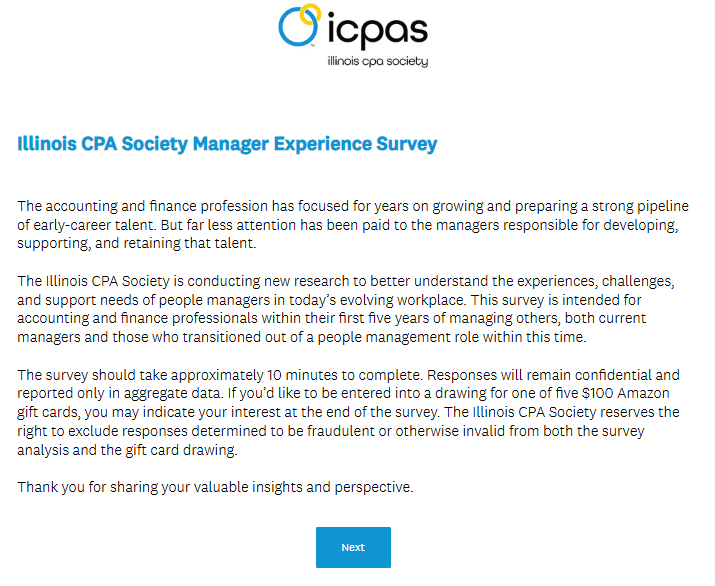
Enter the Illinois CPA Society (ICPA), which is spearheading a transformative shift in workforce research. Recognizing that the industry’s retention and development strategies often miss the daily realities of mid-level leadership, the ICPA has officially launched its new Manager Experience Survey. This comprehensive research initiative zeroes in on a neglected demographic: accounting and finance professionals within their first five years of managing others, as well as those who recently transitioned out of people management roles.
By pivoting the analytical lens away from raw headcount and toward the day-to-day experiences of frontline people managers, the ICPA aims to diagnose the systemic pressures, professional hurdles, and support deficiencies facing the people who directly mold the future of the accounting profession. This article explores the motivations behind the survey, the broader staffing challenges plaguing the industry, and what this research means for the future of firm management and talent retention.
Detailed Chronology: The Evolution of the Accounting Talent Crisis
To understand the urgency behind the ICPA’s new initiative, it is essential to trace how the accounting profession arrived at its current structural inflection point.

Phase 1: The Gathering Storm (2018–2020)
Long before global disruptions upended traditional workplace models, forward-looking accounting societies and human capital analysts began sounding alarms over the aging demographic of the CPA population. A significant wave of retirements among Baby Boomer firm owners and partners loomed on the horizon. Simultaneously, data began to show a flatlining—and eventual decline—in the number of students completing the traditional 150-credit-hour educational requirement needed for CPA licensure.
Phase 2: Pandemic Pressures and the Great Resignation (2021–2023)
The onset of the COVID-19 pandemic accelerated underlying vulnerabilities. Burnout surged as remote and hybrid work models forced firms to rapidly digitize workflows while managing historic workloads. During the subsequent "Great Resignation," accounting firms experienced unprecedented attrition rates, particularly among mid-level associates and senior accountants who found lucrative exit opportunities in corporate finance, private equity, or entirely different industries.
Phase 3: The Pipeline Fixation and the "Missing Middle" (2024–2025)
As the shortage of entry-level talent intensified, industry research hyper-focused on university recruitment pipelines. Scholarships, alternative paths to licensure, and marketing campaigns designed to rebrand the profession became the primary focus of state societies and national institutes.
However, a dangerous blind spot emerged. Firms were successfully (and sometimes unsuccessfully) hiring entry-level staff, but they were dumping these inexperienced professionals onto newly minted, ill-equipped managers. These frontline managers—often accountants with just a few years of technical experience—were suddenly thrust into leadership roles without formal management training. Burdened by their own billable-hour targets and complex client demands, these managers burned out, leading to quiet quitting or complete exits from the profession.
Phase 4: A Holistic Approach to Talent (Late 2025–Present)
Recognizing that patching the entry-level pipeline is futile if the middle of the organization acts as a sieve, institutions like the ICPA have begun expanding their research scope. The launch of the Manager Experience Survey marks a mature phase in the industry’s self-assessment: moving beyond raw recruitment metrics to interrogate internal firm culture, operational support, and the psychological contract between firms and their mid-tier leaders.
Supporting Context & Metrics: The Modern Staffing Landscape
The timing of the ICPA’s survey is underscored by a turbulent macroeconomic and labor environment that continues to challenge accounting practices of all sizes. Recent data from across the professional services sector paints a vivid picture of why support for mid-level managers is more critical than ever.
Prolonged Hiring Cycles and Unfilled Roles
Recent labor metrics reveal that 44% of employers report persistent unfilled roles as the hiring process itself grows increasingly protracted. In the accounting sector, where specialized skills and regulatory familiarity are non-negotiable, open positions remain vacant for months.
When firms operate understaffed, the burden of execution falls disproportionately on frontline managers. These individuals are expected to bridge the capacity gap by working extended hours, stepping in to perform technical tasks usually handled by junior staff, and absorbing administrative friction caused by slow hiring pipelines.
The Threat of Uncontrolled Growth
For firms that are expanding, rapid growth without scalable infrastructure creates its own existential risks. Industry experts note that without robust, automated operational frameworks, even thriving CPA firms quickly resort to "heroics"—relying on the sheer willpower and round-the-clock labor of a few dedicated managers to keep engagements on track.
When firms rely on management heroics rather than systematic support, the consequences are predictable:

- Eroding Profit Margins: Inefficiencies and rework eat away at realization rates.
- Compromised Quality: Rushed reviews increase the risk of audit failures and tax compliance errors.
- Declining Responsiveness: Clients experience delays, straining long-term relationships.
- Mass Attrition: Frontline managers, caught between demanding firm leadership and overwhelmed junior staff, head for the exits.
Shifting Executive Leadership
The emphasis on culture and talent management is also reflecting at the very top of major firms. For instance, recent high-profile leadership transitions—such as KPMG US naming Jason LaRue as its next vice chair of talent and culture, succeeding retiring veteran Sandy Torchia—demonstrate that major accounting networks are elevating human capital strategies to the C-suite. Firms are realizing that culture, retention, and manager enablement are no longer secondary HR concerns; they are core business imperatives that dictate market survival.
Official Statements and Research Objectives
The Illinois CPA Society’s decision to launch the Manager Experience Survey is rooted in a desire to move from broad industry observations to actionable, data-driven solutions.
While previous ICPA studies have comprehensively mapped the macro-level issues surrounding graduation rates and entry-level recruitment, the society recognized a profound void in institutional knowledge regarding the day-to-day realities of mid-level leaders.
"While entry-level staff shortages and graduation rates have been the subject of extensive study, far less attention has been paid to the managers responsible for developing, supporting, and retaining entry-level talent," notes the ICPA research team. "To build on the ICPA’s prior work and address the needs of the next talent layer, the society is conducting new research to better understand the experiences, challenges, and support needs of people managers in today’s evolving workplace."
Target Demographics and Core Inquiries
The Manager Experience Survey is specifically designed for accounting and finance professionals who fall into two distinct categories:

- Current professionals who have been managing others for five years or less.
- Individuals who transitioned out of a people management role within this same five-year window (providing critical insights into why young managers choose to step back from leadership).
The survey aims to uncover critical qualitative and quantitative data points, including:
- Training Gaps: What formal or informal leadership training do accountants receive before supervising others?
- Resource Allocation: Do managers feel they have the institutional tools, technology (including emerging AI tools and automated workflows), and administrative backing necessary to lead effectively?
- Work-Life Integration: How do billable-hour pressures intersect with the time required to mentor, coach, and support junior team members?
- Retention Drivers: What specific factors cause young managers to feel disillusioned or burned out, and what interventions would make them stay?
Future Outlook: Reengineering the Accounting Career Path
The findings of the ICPA’s Manager Experience Survey, once compiled and analyzed, are expected to serve as a vital blueprint for CPA firms, corporate accounting departments, and educational institutions striving to modernize the profession.
Moving Beyond Technical Competence
Historically, the accounting profession has operated under an implicit, flawed assumption: If an accountant is technically proficient at preparing tax returns or auditing financial statements, they will naturally make an effective people manager.
The reality of the modern workplace shatters this assumption. Managing remote and hybrid teams, navigating generational differences in workplace expectations, mentoring burned-out juniors, and leveraging complex automation platforms require an entirely different skill set than technical accounting.
Future-focused firms will need to overhaul their promotion tracks, ensuring that moving into management is accompanied by comprehensive leadership development programs, reduced billable-hour expectations during the transition phase, and clear channels for upward feedback.

The Role of Technology and AI
As firms increasingly adopt advanced technologies—ranging from cloud-based collaborative platforms to agentic artificial intelligence—the nature of entry-level accounting work is shifting. Routine data entry and basic reconciliation are rapidly being automated.
This technological evolution places an even greater premium on frontline managers. Rather than merely reviewing calculations, managers must act as strategic coaches, guiding junior staff toward higher-level advisory services and Client Accounting Services (CAS). If managers are overwhelmed and unsupported, firms will fail to successfully integrate these new technologies into their operational fabric.
Conclusion: A Call to Action for the Profession
The accounting profession stands at a historic crossroads. Solving the talent crisis requires more than just enticing new students into university accounting programs; it requires protecting, nurturing, and retaining the vital cohort of professionals sitting in the middle of the organizational hierarchy.
By giving voice to frontline managers through initiatives like the ICPA’s Manager Experience Survey, the industry is taking a long-overdue step toward building sustainable, resilient, and human-centric firms capable of thriving in a complex future. Qualified professionals within their first five years of management are encouraged to lend their voices to this critical research, ensuring that the future of accounting management is shaped by those experiencing it firsthand.