Lina Hope is a reporter for Tech Ledgers covering Data Analytics & Business Intelligence. She/He is based in Indonesia.
24 August 2026 • 10 min read
The landscape of software development and data science is undergoing a profound structural shift. The paradigm has evolved from writing imperative code line-by-line to orchestrating intelligent agents capable of autonomous problem-solving, architectural design, testing, and deployment. At the vanguard of this transformation is xAI with its latest frontier model, Grok 4.6, and its native terminal-based interface, Grok Build.
Executive Overview
Engineered specifically for complex coding tasks, agentic workflows, and intensive knowledge work, Grok 4.6 demonstrates frontier-level capabilities that rival the industry’s most advanced systems. Notably, xAI’s latest iteration matches the performance of GPT-5.6 Sol on the prestigious Artificial Analysis Intelligence Index. However, raw model benchmarks only tell part of the story. The true differentiator lies in the synergy between the model and its execution environment. Grok Build—an interactive, full-screen Terminal User Interface (TUI)—provides a frictionless sandbox where Grok 4.6 can write files, execute shell commands, scrape documentation, run unit tests, and iteratively debug its own output.
To evaluate this ecosystem under real-world conditions, this technical report examines an end-to-end data science project executed entirely through natural language prompts within Grok Build. The objective: build, train, evaluate, containerize, and deploy a predictive machine learning model to forecast customer wait times at a busy coffee shop, scaling from a blank directory to a live, cloud-hosted API using exactly four prompts. The results offer a compelling glimpse into the future of automated engineering pipelines.
Detailed Chronology: From Blank Directory to Cloud Deployment
The execution of the coffee shop wait-time prediction project showcases the multi-step autonomy of Grok Build powered by Grok 4.6. Rather than requiring continuous human intervention for micro-decisions, the agent autonomously navigated the lifecycle of a data science project across four sequential milestones.
Phase 1: Environment Initialization and Installation
Before initiating the project workflow, Grok Build must be provisioned within the developer’s local environment. xAI distributes prebuilt binary packages supporting Windows, macOS, Linux, and the Windows Subsystem for Linux (WSL). For Unix-like environments, installation is streamlined via a shell script:
curl -fsSL https://x.ai/cli/install.sh | bash
For Windows environments utilizing PowerShell, the installation utility is executed via:
irm https://x.ai/cli/install.ps1 | iex
Upon successful installation, verifying the binary version confirms operational readiness:
grok --version
>> grok 1.0.4 (d846eb93d9)
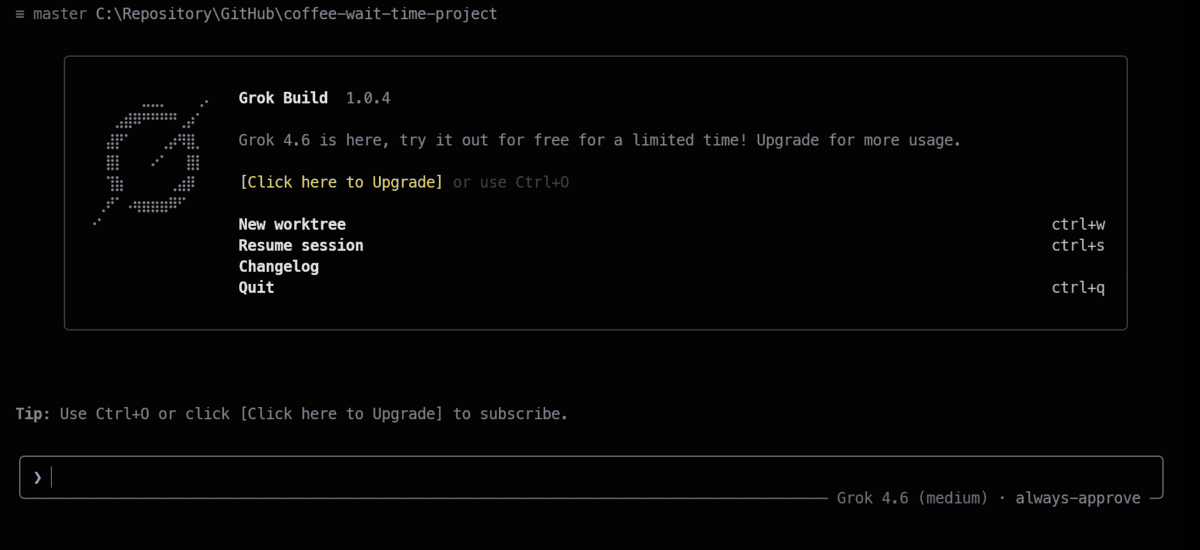
To establish a clean workspace, a dedicated directory (coffee-wait-time-project) was initialized, and the interactive terminal agent was invoked using the grok command. Upon launch, the TUI manages secure browser-based authentication before granting the agent full programmatic access to the local filesystem and shell.
Phase 2: Prompt 1 – Data Generation, Cleaning, and Exploratory Data Analysis (EDA)
The first programmatic objective tasked Grok Build with generating a synthetic, statistically robust dataset mirroring real-world retail anomalies, cleaning the data, performing exploratory analysis, and compiling analytical artifacts.
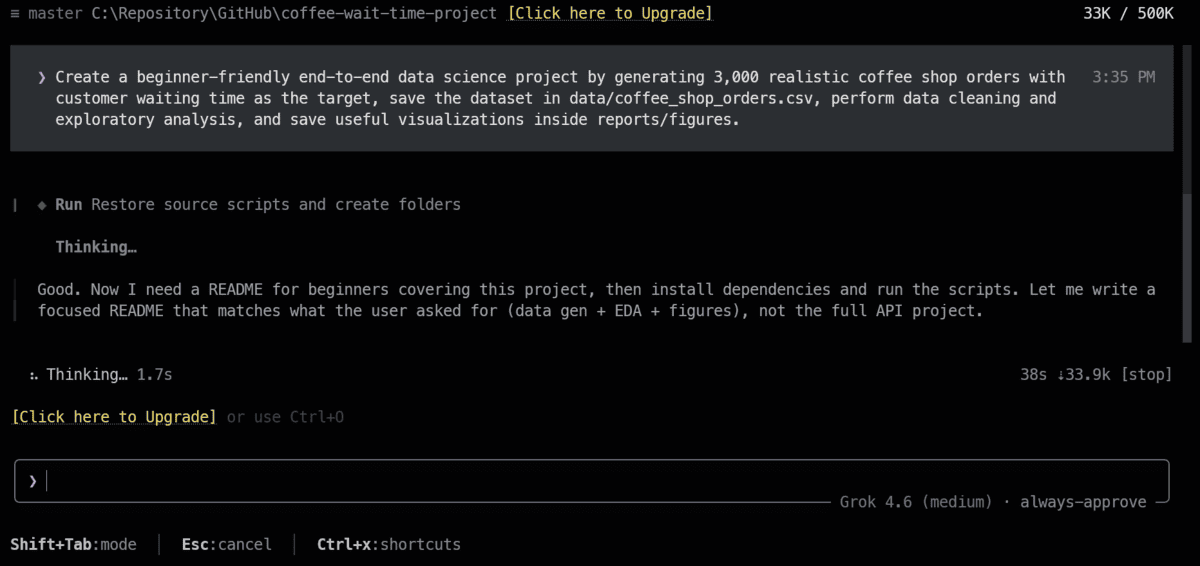
The Prompt:"Create a beginner-friendly end-to-end data science project by generating 3,000 realistic coffee shop orders with customer waiting time as the target, save the dataset in data/coffee_shop_orders.csv, perform data cleaning and exploratory analysis, and save useful visualizations inside reports/figures."
Upon parsing the prompt, Grok Build autonomously created the necessary directory structures, wrote a Python data generation script accounting for compounding variables (e.g., peak rush hours, barista headcount, inventory complexity, and order volume), and executed it.
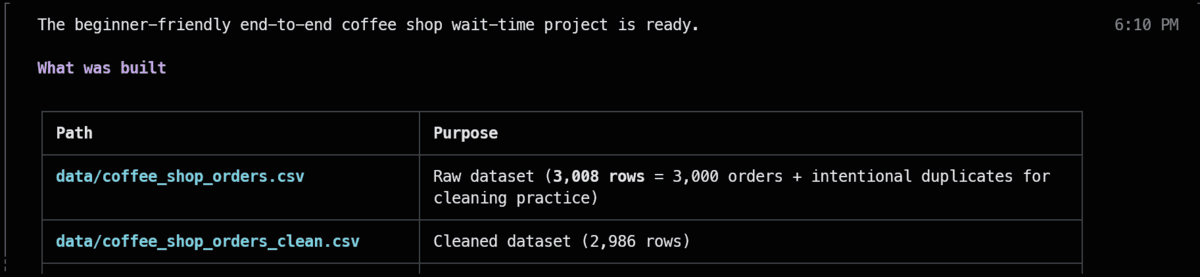
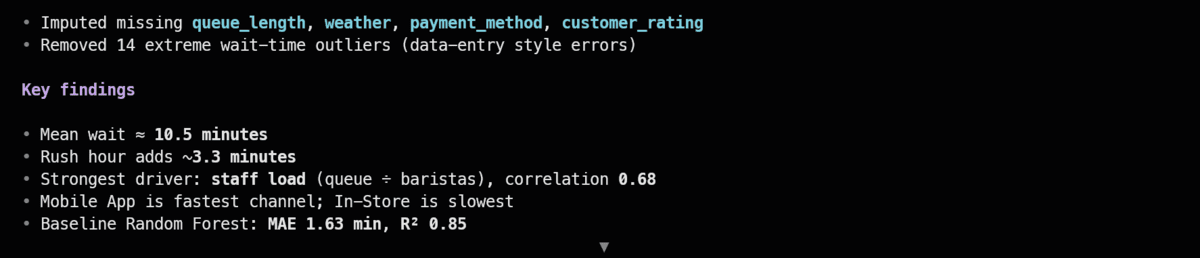
The resulting raw dataset of 3,000 entries was subjected to automated data hygiene protocols. Grok Build identified and isolated missing values and pruned 14 extreme statistical outliers, finalizing a pristine dataset comprising 2,986 rows. Initial exploratory data analysis yielded immediate domain insights:
The baseline average customer wait time sat at approximately 10.5 minutes.
Rush-hour ordering conditions introduced a consistent penalty of roughly 3.3 minutes.
Staff load exhibited the strongest univariate correlation with wait time, scoring 0.68.
To prove concept viability early, the agent drafted an exploratory baseline Random Forest model, which achieved a respectable Mean Absolute Error (MAE) of 1.63 minutes and an $R^2$ score of 0.85 on preliminary splits.
Phase 3: Prompt 2 – Advanced Modeling and Pipeline Serialization
With the exploratory foundation established, the second prompt directed the agent to build a rigorous, production-grade modeling pipeline capable of comparing multiple model architectures.
The Prompt:"Prepare the coffee shop data using a reusable scikit-learn preprocessing pipeline, train Linear Regression, Random Forest, and Gradient Boosting models, compare them using MAE, RMSE, and $R^2$, evaluate the best model with charts and test predictions, and save the complete winning pipeline as models/coffee_wait_time_pipeline.joblib."
Grok Build constructed an end-to-end scikit-learn pipeline handling categorical encoding and numerical feature scaling natively to prevent data leakage. It subsequently initialized three distinct regression algorithms:
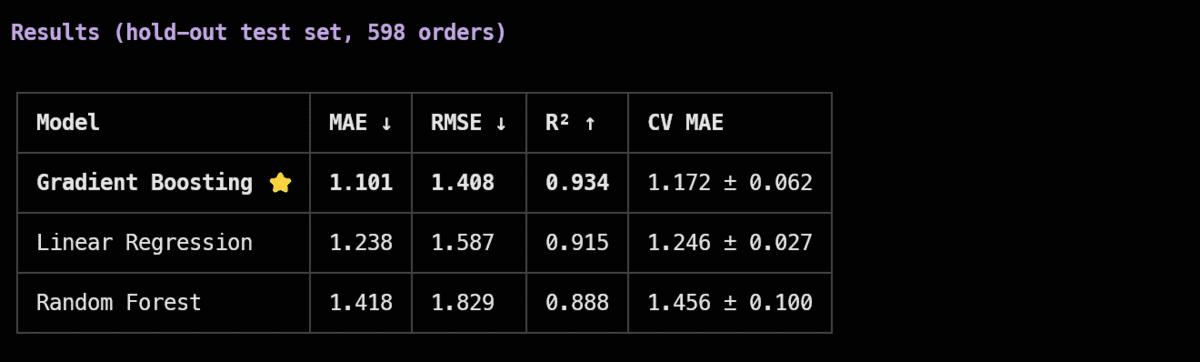
During this intensive execution phase, the session encountered local resource limits, prompting an upgrade to a paid usage tier. Upon typing the continuation directive ("continue"), Grok Build seamlessly recovered state, resumed execution without context loss, and completed the training regimen against a hold-out test set comprising 598 orders.
The comparative evaluation clearly established Gradient Boosting as the superior architecture:
Mean Absolute Error (MAE): 1.101 minutes
Root Mean Squared Error (RMSE): 1.408 minutes
Coefficient of Determination ($R^2$): 0.934
The winning pipeline—encapsulating both the preprocessing transformations and the optimized Gradient Boosting estimator—was successfully serialized and saved to disk as models/coffee_wait_time_pipeline.joblib.
Phase 4: Prompt 3 – API Development via FastAPI and Automated Testing
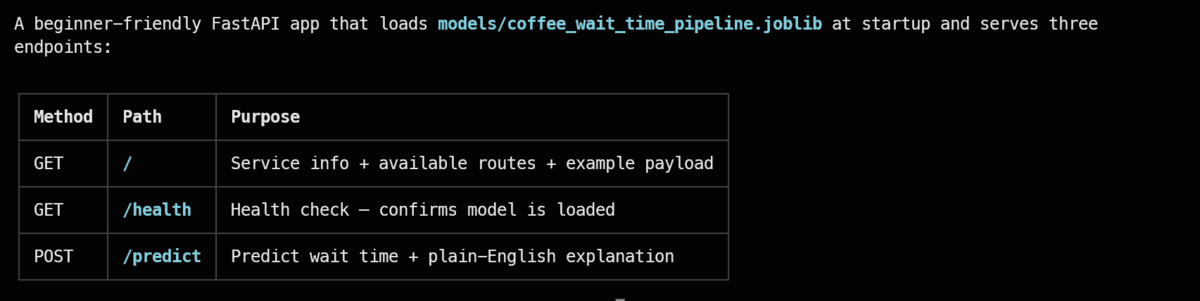
Transforming a static machine learning model into an accessible software service requires a robust web framework. The third prompt instructed Grok Build to wrap the serialized pipeline in a production-ready asynchronous web application.
The Prompt:"Create a beginner-friendly FastAPI application in main.py that loads models/coffee_wait_time_pipeline.joblib, provides root, health-check, and prediction endpoints, validates coffee order inputs with Pydantic, returns the estimated waiting time and a short explanation, handles errors clearly, and includes examples in the automatic API documentation."
Grok Build engineered an asynchronous FastAPI application designed to load the serialized pipeline into memory upon application startup, eliminating redundant disk I/O during request handling. To safeguard data integrity, strict input validation schemas were defined using Pydantic, ensuring invalid data types or out-of-range parameters (such as negative quantities or malformed timestamps) are caught at the boundary layer with descriptive error messages.
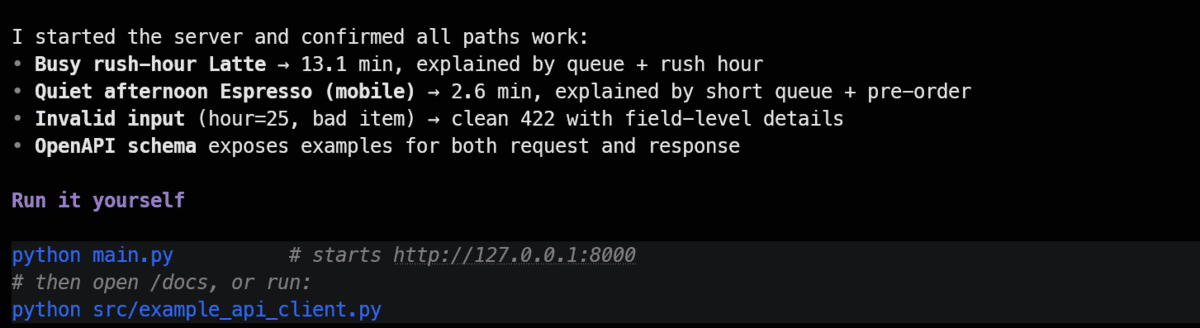
Crucially, rather than relying on the human operator to test the endpoints, Grok Build autonomously initiated a local uvicorn server instance, fired synthetic HTTP requests via internal testing scripts, validated response payloads, and verified that both standard inference and error-handling pathways functioned flawlessly.
Phase 5: Prompt 4 – Cloud Deployment and Production Verification
The final phase of the workflow challenged the agent to bridge the gap between local execution and cloud-native distribution.
The Prompt:"Prepare this project for FastAPI Cloud by confirming fastapi dev works, configuring the application entry point if needed, ensuring the saved model and required files are included, running fastapi deploy, pausing only if browser authentication is required, testing the live root, health, prediction, and docs endpoints, fixing deployment errors, and showing me the final public API URL."
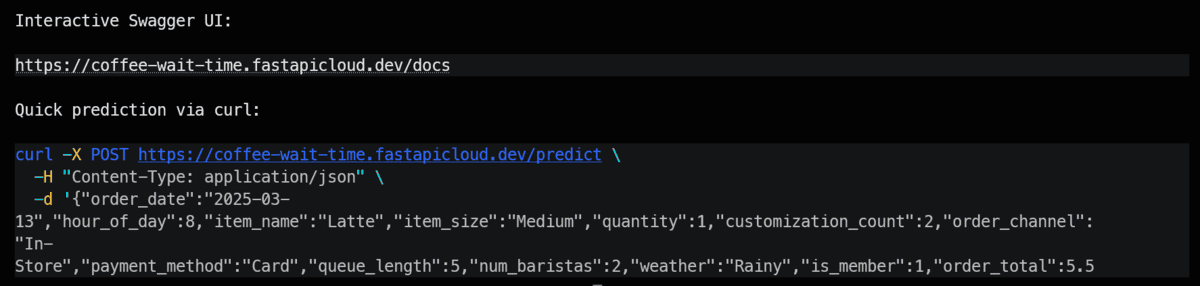
Following a browser-based authentication handshake required by FastAPI Cloud, Grok Build managed the containerization requirements, verified project dependencies, and pushed the service to production. Upon successful deployment, the agent returned the public Swagger documentation URL alongside a fully formatted curl test command.
Executing a live inference request against the production endpoint:
curl -X POST https://coffee-wait-time.fastapicloud.dev/predict
  -H "Content-Type: application/json"
  -d '"order_date":"2025-03-13","hour_of_day":8,"item_name":"Latte","item_size":"Medium","quantity":1,"customization_count":2,"order_channel":"In-Store","payment_method":"Card","queue_length":5,"num_baristas":2,"weather":"Rainy","is_member":1,"order_total":5.50'
Returned the following production JSON response:
  "predicted_wait_time_minutes": 13.06,
  "explanation": "Estimated wait time is about 13.1 minutes, mainly due to a moderate queue (5 people), rush-hour timing.",
  "model_name": "Gradient Boosting",
  "model_metrics":
    "MAE": 1.101,
    "RMSE": 1.408,
    "R2": 0.934
The live Swagger UI interface confirmed that automated documentation, input schema validation, and real-time inference were fully operational in a live production environment. Finally, Grok Build autogenerated an exhaustive README.md cataloging the architectural workflow, model performance metrics, and reproduction instructions.
Supporting Context & Comparative Metrics
To understand the engineering significance of Grok 4.6 and Grok Build, one must examine how frontier coding agents evaluate against traditional development workflows and competitive offerings.
Quantitative Model Benchmarks
According to xAI’s internal evaluations and third-party aggregators such as the Artificial Analysis Intelligence Index, Grok 4.6 operates at the highest tier of commercial reasoning and coding models. Its capability profile emphasizes:
Multi-Step Agentic Persistence: Maintaining contextual coherence across dozens of successive shell commands, file modifications, and compilation cycles.
Codebase Navigation: The ability to map complex repository structures without hallucinating missing dependencies or misconfiguring environment variables.
Comparative Task Efficiency Matrix
Development Metric
Traditional Manual Coding
Early-Gen AI Assistants (2023)
Grok Build + Grok 4.6 (Current)
End-to-End Setup Time
4 to 8 hours
1 to 2 hours
15 to 25 minutes
Boilerplate Generation
Manual writing
Snippet pasting
Autonomous scaffolding
Error Debugging
Stack-trace analysis & trial-and-error
Prompt-based troubleshooting
Autonomous self-correction & testing
Deployment Overhead
Manual Docker/Cloud CLI configuration
Semi-automated config writing
One-command conversational deployment
The reduction in friction is not merely a matter of typing speed; it represents a fundamental compression of the feedback loop. By unifying the editing surface, terminal execution, web browsing, and model inference into a single TUI workspace, context switching is eliminated.
Official Statements and Architectural Philosophy
xAI’s engineering team designed Grok Build to address the fragmentation inherent in modern software development. While third-party extensions and chat-based browser interfaces require developers to constantly copy-paste code snippets between isolated environments, Grok Build was architected as a native operating extension for the model itself.
"We built Grok Build to remove the friction between thought and execution," notes internal xAI technical documentation regarding the TUI release. "When the frontier model powering the intelligence is structurally aware of the terminal execution environment, file systems, and network boundaries, debugging ceases to be a manual choreography of error-copying. The agent simply observes the stack trace, modifies the source code, re-runs the test suite, and verifies the outcome independently."
This philosophy aligns with the broader industry movement toward agentic autonomy. Rather than viewing artificial intelligence as an advanced autocomplete engine, xAI positions Grok 4.6 as an autonomous junior engineer capable of managing complete vertical slices of technical execution under human supervision.
Future Outlook: The Evolution of Terminal Agents
The successful execution of an end-to-end data science project—from raw synthetic data generation to a cloud-deployed API with automated documentation and testing—signals a paradigm shift in how technical applications will be built over the next decade.
Several key trajectories emerge from this technological leap:
Democratization of Complex Engineering: Domain experts (such as data analysts, financial modelers, or biologists) who possess deep contextual knowledge but lack exhaustive syntax expertise can now instantiate production-grade software infrastructure using natural language.
The Rise of Native Agentic Interfaces: Standalone chat windows are rapidly giving way to deeply integrated terminal environments and Integrated Development Environment (IDE) agents that possess root-level execution awareness.
Heightened Demand for Architectural Oversight: As mechanical coding and deployment tasks become fully automated, the human role will ascend higher up the value chain, shifting from syntax authorship to rigorous system architecture, security auditing, and ethical evaluation.
As xAI continues to refine the Grok model family and expand the capabilities of Grok Build, the boundary between human intent and software realization will continue to blur. For software engineers and data scientists alike, mastering the art of agentic orchestration is no longer an experimental pursuit—it is the foundational skill of the modern engineering era.