
Executive Overview
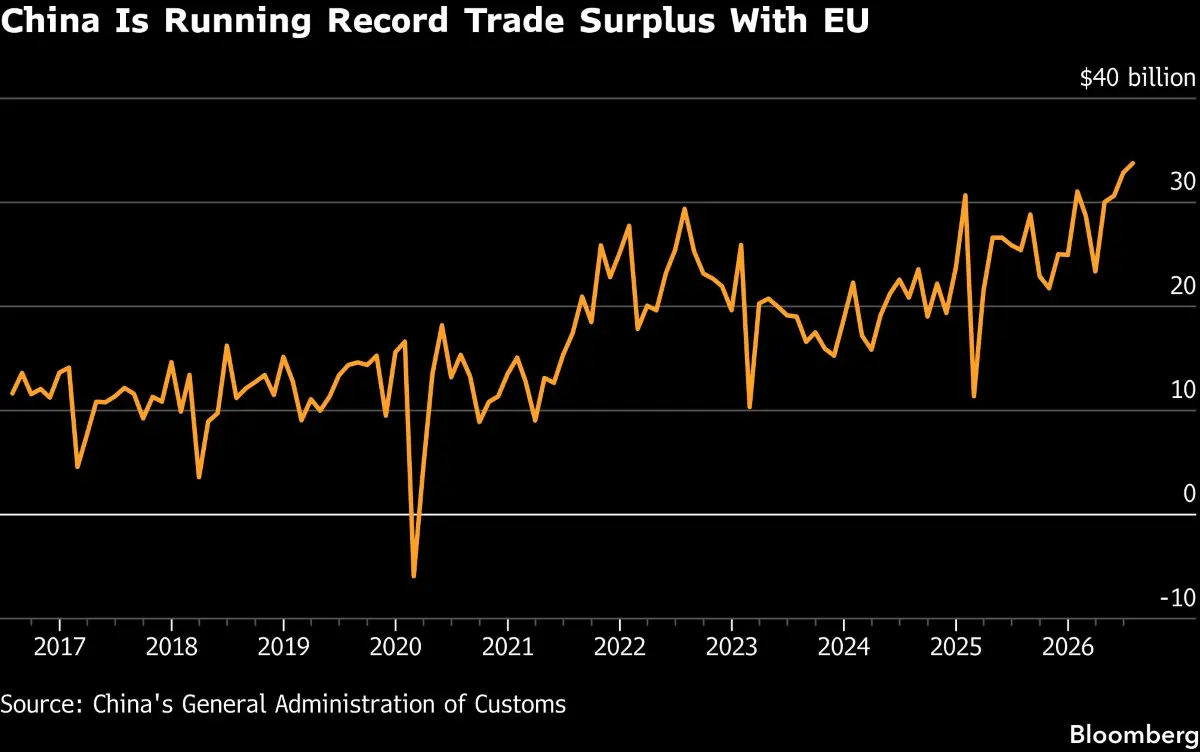
This staggering figure underscores the immense economic stakes involved in the brewing standoff, which is rapidly evolving from localized industrial disputes into a broad strategic challenge. While Beijing has managed to stabilize its trade relationship with the United States following the turbulent tariff wars of previous years, its economic diplomacy with Brussels is deteriorating. This deterioration is occurring against the backdrop of a rapidly approaching October deadline—a critical milestone set by European leaders to address soaring, record-breaking trade imbalances.
European policymakers increasingly view these widening imbalances not merely as a routine market anomaly, but as a systemic strategic risk to the continent’s industrial base, supply chain security, and economic sovereignty. The EU absorbs roughly 15% of China’s total outbound foreign sales, a massive market that has seen shipments steadily rise in recent months despite cooling global demand.
However, Goldman Sachs economists Xinquan Chen and Chelsea Song caution that while the sheer breadth of potential EU curbs is alarming on paper, it does not translate directly into an immediate, one-to-one export loss. The ultimate economic impact will depend heavily on final policy specifics, legislative negotiations, and the enforcement mechanisms deployed by Brussels. Furthermore, Beijing is far from defenseless; it commands formidable buffers, including unmatched cost competitiveness, deep integration into global supply chains, and strategic leverage over critical raw materials.
As both sides brace for potential escalation, global markets are watching closely to see whether pragmatic commercial interests can successfully temper the geopolitical ambitions driving this high-stakes regulatory confrontation.
Detailed Chronology and Policy Timeline
To understand the current impasse between Brussels and Beijing, one must examine the steady, methodical escalation of European trade defense mechanisms over recent years. What began as targeted anti-dumping investigations into specific Chinese industrial goods has transformed into a sweeping, multi-pronged defensive strategy.
The Build-Up to the October Deadline
For months, European Commission leadership has expressed growing alarm over the flood of heavily subsidized Chinese goods entering the single market. The flashpoints have multiplied rapidly across the automotive, green technology, and heavy manufacturing sectors. This mounting pressure culminated in a series of investigations and policy announcements aimed at rectifying structural trade imbalances ahead of a pivotal October deadline.
During this window, EU leaders are expected to finalize and implement robust countermeasures designed to level the playing field. This deadline serves as a political and administrative crucible, forcing member states to unite behind a coherent, assertive trade posture that can withstand potential retaliation from Beijing.
The Expansion of the Carbon Border Adjustment Mechanism (CBAM)
Among the most significant milestones in this timeline is the phased rollout of the EU Carbon Border Adjustment Mechanism (CBAM). Initially framed as an environmental tax to prevent "carbon leakage"—where European companies relocate production to regions with laxer environmental regulations—the CBAM has rapidly evolved into a potent trade defense instrument.
According to Goldman Sachs, a prospective expansion of the CBAM represents a major escalation in trade friction, with China facing the largest exposure among all major trading partners. While the initial phase of the mechanism targeted basic, upstream industrial commodities like iron, steel, aluminum, cement, and fertilizers, the forthcoming expansion threatens to sweep an additional $58 billion worth of downstream Chinese exports into its regulatory web.
This impending inclusion of complex manufactured goods marks a qualitative shift in EU trade policy, bringing advanced industrial products directly under the scrutiny of European environmental standards.
The EV Tariffs and Upcoming Plug-in Hybrid Measures
The automotive sector has served as the ground zero for contemporary EU-China trade skirmishes. Following an extensive anti-subsidy investigation that concluded battery electric vehicles (BEVs) from China benefited from unfair state support, the European Commission implemented provisional and later definitive compensatory tariffs on Chinese-built EVs.
According to the latest Goldman Sachs findings, this protectionist momentum is not slowing down. The EU is actively preparing to introduce fresh, punitive tariffs targeting plug-in hybrid electric vehicles (PHEVs). These measures are designed to plug regulatory loopholes exploited by automakers seeking to bypass purely electric-focused trade barriers, signaling to Beijing that Europe’s automotive shielding will be comprehensive and airtight.
Supporting Context and Metrics: Dissecting the Exposure
The quantitative dimensions of the EU-China trade relationship reveal both the depth of China’s reliance on the European market and the specific sectors most vulnerable to Brussels’ regulatory offensive.
The 27% Exposure Figure and Its Nuances
The headline figure from Goldman Sachs—that roughly 27% of China’s annual nominal exports to the EU could fall under existing and proposed trade measures—demands careful contextualization. Xinquan Chen and Chelsea Song emphasize that this metric establishes the ceiling of regulatory exposure rather than an immediate loss of revenue.
[Total Chinese Exports to EU: 100%]
 └── [Covered by Existing/Proposed EU Measures: ~27%]
      ├── [Electric Vehicles & Automotive Products]
      ├── [Steel, Aluminum, & Basic Metals]
      └── [Machinery & Downstream Electrical/Transport Equipment ($58B CBAM Risk)]
 └── [Unaffected / Lower Risk Exports: ~73%]
The actual economic damage sustained by Chinese exporters will be contingent upon the precise wording of final legislative texts, exemptions granted during implementation phases, and the adaptability of Chinese manufacturing networks. Nevertheless, the sheer magnitude of the 27% figure illustrates how deeply integrated yet increasingly contested bilateral trade has become.

Sectoral Vulnerability: Machinery and Advanced Equipment
The expansion of trade curbs—particularly the broadening scope of the CBAM and targeted anti-dumping duties—places complex manufactured goods directly in the crosshairs. Goldman Sachs highlights that electrical equipment, transport machinery, and general mechanical apparatuses represent the primary areas of risk.
To understand the gravity of this risk, one must look at recent macroeconomic contributions. Last year, these three industrial sectors alone accounted for an impressive 4.9 percentage points of China’s total 8.5% nominal export growth to the European Union.
If these sectors face sustained regulatory headwinds, steep tariffs, or cumbersome bureaucratic verification processes under carbon-accounting rules, the engine driving China’s export-led growth to Europe could experience a severe deceleration.
The Timeline for CBAM Implementation on Downstream Goods
Despite the anxieties surrounding the CBAM expansion, economic analysts note that the immediate commercial threat to downstream products is still some distance away. Goldman Sachs estimates that effective implementation of the expanded CBAM targeting complex machinery and transport equipment is unlikely to occur before 2028.
Furthermore, the structure of the mechanism may mitigate its immediate financial sting. The actual tax rate levied on complex downstream products will likely represent only a small fraction of the final export price. This suggests that while compliance costs will rise significantly, the direct price-competitiveness blow may be absorbed more easily than upfront prohibitive tariffs—at least in the initial years of the policy’s lifecycle.
Official Statements and Economic Perspectives
As the geopolitical temperature rises, market analysts, financial institutions, and policy experts are weighing in on the likely trajectory of the standoff. While the risks are palpable, professional consensus suggests that both sides possess strong structural incentives to avoid a full-scale, mutually destructive trade war.
The Goldman Sachs Assessment: Resilience Meets Restriction
In their August 23 research report, Goldman economists Xinquan Chen and Chelsea Song offered a nuanced perspective that balances caution with pragmatic realism.
"Broader restrictions would threaten China’s market-share gains, though cost competitiveness, leverage in critical materials and Europe’s commercial interests should cushion the impact," the economists wrote.
They noted that while these regulatory maneuvers present a clear "downside risk" to China’s macroeconomic export outlook—especially with the EU absorbing roughly 15% of total Chinese foreign sales last year—Beijing is far from defenseless. China’s enduring manufacturing cost advantages, coupled with substantial, ongoing improvements in product quality and technological sophistication, act as a formidable buffer against Western protectionism.
The Strategic Value of Rare Earth Elements
Perhaps the most potent counterweight in Beijing’s diplomatic arsenal is its near-monopoly on critical raw materials. The European Union remains structurally dependent on China for more than 90% of its rare earth elements by weight—materials that are utterly indispensable for Europe’s green energy transition, defense manufacturing, and digital infrastructure.
This stark asymmetry in resource access provides European officials with a powerful incentive to tread carefully. Brussels must balance its desire to protect domestic industries with the imperative to secure uninterrupted access to the Chinese market and avoid triggering severe, retaliatory chokeholds on critical supply chains.
"We therefore expect EU policy to become tougher, but to stop short of measures likely to trigger a severe response from Beijing," Chen and Song concluded in their report.
This view is echoed by various trade diplomats in Brussels, who privately acknowledge that while a tougher stance is politically necessary to appease domestic industrial lobbies, an uncontrolled tit-for-tat escalation would inflict catastrophic collateral damage on European corporations deeply entrenched in the Chinese consumer market, such as German automakers and luxury goods manufacturers.
Future Outlook: Navigating the Storm
Looking ahead, the economic relationship between the European Union and China is entering a transformative, highly regulated phase. The era of frictionless, volume-driven market expansion is definitively over, replaced by a complex, defensive trading architecture defined by national security, environmental standards, and industrial policy.
Key Variables to Watch
- The October Threshold: The immediate focus remains on the upcoming policy announcements and trade defense verdicts due this October. How aggressively the European Commission implements its anti-subsidy findings will set the tone for bilateral relations heading into 2026.
- Implementation Timelines and Loopholes: As seen with the CBAM expansion slated for 2028, the gap between political rhetoric and practical execution offers a vital window for corporate lobbying, diplomatic negotiations, and supply chain re-routing.
- Beijing’s Retaliatory Caliper: Should the EU cross an invisible threshold of punitive action, markets will closely monitor Beijing’s willingness to weaponize its dominance over rare earth elements and critical minerals, testing the resilience of European supply chains.
Ultimately, the standoff between Brussels and Beijing exemplifies the broader global transition toward managed trade and economic fragmentation. While Goldman Sachs’ analysis suggests that mutual economic interdependencies will prevent a total rupture, the baseline for doing business between the world’s two major trading blocs has permanently shifted.
Both economies must now navigate a narrow corridor between necessary protection and catastrophic isolation, where every regulatory decree carries global reverberations.