
Executive Overview
Rather than deploying a broad brush across all sectors, the White House has executed a targeted maneuver. Critical inputs vital to the infrastructure and manufacturing engines of the United States—most notably crude oil, potash fertilizer, and foundational battery minerals like nickel, cobalt, and lithium—have been conspicuously exempted. Instead, the administration has focused its punitive measures on consumer and industrial goods for which domestic alternatives exist or alternative global supply chains can be rapidly mobilized, such as furniture, wine, clothing, cement, and culturally resonant symbols like hockey equipment.
Consequently, only about 5.2% of total Canadian exports to the United States are subject to the new duties. However, the true significance of this latest trade escalation extends far beyond short-term import metrics. The maneuver has reignited long-standing grievances over automotive trade policies, dairy quotas, and the geopolitical race for critical minerals. Furthermore, by dusting off Section 338 of the Depression-era Smoot-Hawley Tariff Act of 1930—a legal justification never before invoked by a modern administration—the White House has opened a dangerous new legal and constitutional front. With Canadian Prime Minister Mark Carney vowing a "dollar-for-dollar" retaliation and legal challenges looming on the horizon, the North American Free Trade landscape has entered its most volatile chapter in decades.
Detailed Chronology: From Breakdown to Retaliation
The road to the weekend tariff imposition was paved by months of mounting frustration, stalled diplomacy, and contrasting negotiation styles between Washington and its two primary North American partners.
The Diplomatic Divergence: Mexico vs. Canada
In recent months, the tripartite dynamic established under the United States-Mexico-Canada Agreement (USMCA) has frayed asymmetrically. Bilateral talks between the U.S. and Mexico have concluded three constructive rounds of negotiations, characterized by trade analysts as cooperative and conciliatory. Mexican leadership has opted for a diplomatic posture designed to de-escalate tensions and avoid economic shocks.
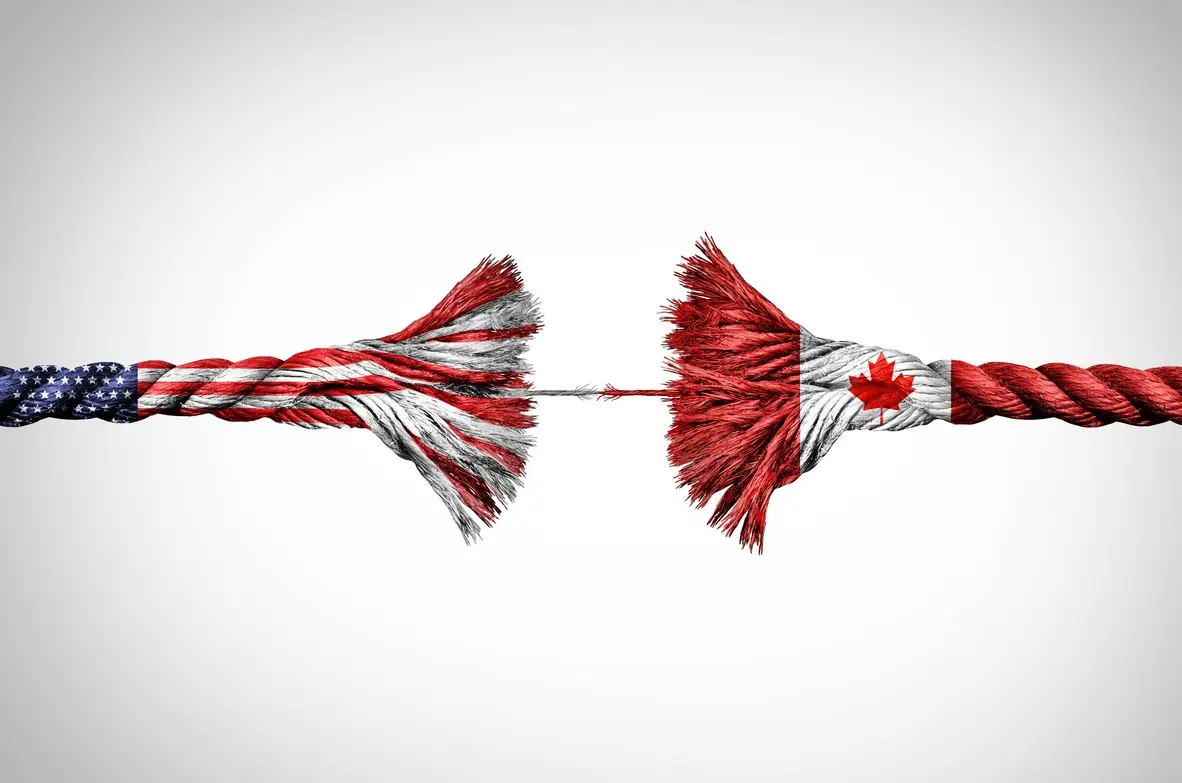
Canada, by contrast, has adopted an unyielding, hardline stance. The friction reached a boiling point in 2025 when Canada became the only major trading partner outside of China to enact retaliatory tariffs against the U.S. Though those measures were eventually rolled back, they served as a deeply symbolic warning shot. When trade discussions definitively collapsed over the weekend, Prime Minister Carney did not mince words, immediately pledging to match the U.S. 50% levies "dollar for dollar."
Marcos Carias, North American economist at trade credit insurance provider Coface, captures the underlying sentiment of the Canadian strategy: "Canada’s message to the U.S. is that we’re ready to negotiate, but we’re not coming to this as pushovers. We have things we care about."
The Invocation of Smoot-Hawley
To enact the 50% tariffs, the administration took the unprecedented step of invoking Section 338 of the Tariff Act of 1930—famously known as the Smoot-Hawley Tariff Act. Designed during the depths of the Great Depression and historically blamed for deepening global economic collapse, Section 338 grants the executive branch the authority to impose discriminatory or supplementary tariffs up to 50% against foreign nations found to be engaging in unreasonable or unjust trade practices disadvantageous to U.S. commerce.
This move marks a dramatic shift in the administration’s legal strategy. Earlier this year, the U.S. Supreme Court struck down the use of the International Emergency Economic Powers Act (IEEPA) as a valid justification for broad-based tariffs. In response, the White House has scrambled to find statutory footing that can withstand judicial scrutiny, relying variously on Section 301 of the Trade Act of 1974 (targeting countries for failing to curb forced labor) and now, for the first time, the dust-covered mechanisms of Smoot-Hawley.
Supporting Context & Metrics: Anatomy of the $20 Billion Tariff
To understand why economists believe the immediate macroeconomic fallout will be contained, one must examine the precise architecture of the tariff list. The measures apply to roughly $20 billion in Canadian goods, representing a mere 5.2% of total Canadian exports heading south.
The Exemptions: Protecting the U.S. Engine
The White House demonstrated acute sensitivity to vulnerabilities within the domestic supply chain by carving out strategic exemptions. According to Coface analysis, the administration carefully avoided items that would instantly trigger inflationary spikes for American consumers and manufacturers.
- Crude Oil: Canadian crude accounts for an staggering 63% of total U.S. crude oil imports. Imposing a 50% tariff on this category would have instantaneously crippled American refineries and sent gasoline prices skyrocketing nationwide.
- Potash Fertilizer: Canada holds an estimated 1.1 billion metric tons of potash reserves—roughly one-third of the global total. This dwarfs the 220 million metric tons found in the United States, making the American agricultural sector deeply reliant on northern supply.
- Critical Minerals: Nickel, cobalt, and lithium—essential inputs for electric vehicle (EV) batteries, advanced defense systems, and the broader green energy transition—were entirely excluded from the tariff schedule.
"The White House is being very careful to avoid critical items for the U.S. economy," notes Carias.
Politically Sensitive Targets
While macroeconomic shockwaves have been deliberately muted, the targeted sectors are far from accidental. The administration has trained its sights on Canadian goods carrying intense political and cultural resonance, including dairy products, wine, clothing, cement, furniture, and hockey equipment.
By taxing items deeply embedded in Canadian regional economies and cultural identity, Washington has maximized political visibility. These measures serve as high-profile political levers designed to inflict localized pressure on Canadian provinces without derailing Wall Street or triggering a generalized economic contraction in the United States.
The USMCA Fracture
A particularly contentious point in the current standoff is the status of the United States-Mexico-Canada Agreement. Products that ostensibly qualify for duty-free treatment under the USMCA are not exempt from this latest round of tariffs.
This policy directly challenges the framework of the trade pact, echoing complaints first raised when the administration levied universal tariffs on steel, aluminum, and automotive products under Section 232 of the Trade Expansion Act of 1962. Although the USMCA remains legally in effect until its scheduled expiration in 2036—complete with provisions for annual joint reviews—President Trump has consistently refused to engage in formal preliminary talks regarding a 16-year renewal of the pact.
Official Statements & Industry Perspectives
The escalating trade war has drawn sharp critiques, cautious defenses, and deep legal uncertainty from economic analysts, trade experts, and government officials alike.
The Economic Assessment: Coface on Strategy vs. Reality
In briefings analyzing the trade breakdown, Coface emphasized the dual nature of the administration’s playbook. While the economic impact is cushioned by strategic exemptions, the political fallout is intentional.
"Trump seems to be targeting Canadian industrial categories with particular economic and cultural sensitivity, such as dairy, wine and hockey equipment, increasing the political visibility of the measures despite their limited macroeconomic significance," Coface’s research report states.
The Battle Over Critical Minerals
The broader strategic canvas involves the global race for supply chain dominance, particularly concerning China. The United States is desperate to sever its reliance on Beijing for rare earth metals and critical minerals. Because Canada sits atop immense reserves of these materials, Washington views preferential, unhindered access to Canadian mineral wealth as a national security imperative—even as it concurrently funds domestic extraction and processing.
By applying heavy pressure through tariffs in other sectors, the U.S. is attempting to force Ottawa’s hand on critical mineral supply agreements and bilateral trade concessions. However, Canada’s hardline resistance suggests that coercive tactics may achieve the opposite effect, hardening political resolve north of the border.
The Long Shadow of Legal Challenges
Beyond economics and diplomacy lies the courtroom. The legality of invoking century-old legislation to bypass modern trade agreements is expected to be intensely contested.
Tariffs levied under Section 338 of the 1930 Smoot-Hawley Act require an explicit, formal finding of unreasonable, unjust, or discriminatory trade practices by the target nation. While administration attorneys believe this provides a sturdier statutory bridge than the discredited IEEPA framework, legal scholars are poised to challenge the executive branch’s authority to override active, ratified trade treaties like the USMCA via Depression-era statutes.
"The whole tariff story doesn’t end the day they go in and are collected," Carias warns. "You have to wait for them to be validated legally. With all of these [actions] coming, the path of these instruments in court is as important to follow as when and if they get applied."
Future Outlook: Navigating Uncharted Waters
As North America stands at a critical juncture in commercial diplomacy, the trajectory of U.S.–Canada relations will depend on how several high-stakes variables unfold in the coming months.
- The Retaliation Cycle: Prime Minister Carney’s promise of dollar-for-dollar retaliation threatens to spark an escalating tit-for-tat cycle. If Canada follows through with comprehensive counter-tariffs on U.S. manufactured goods and agricultural exports, the localized friction currently insulating the broader U.S. economy could spread rapidly into key American swing states and export-driven industries.
- Judicial Review: The courtroom battles over Section 338 and Section 301 will serve as a profound constitutional test of executive trade powers. A ruling by federal courts or the Supreme Court striking down the administration’s tariff justifications would instantly destabilize current trade policy and force a return to congressional oversight.
- The Future of the USMCA: With the agreement’s annual review mechanisms approaching and formal 16-year renewal talks completely stalled, the long-term viability of North American economic integration is in jeopardy. If the framework is systematically bypassed through unilateral tariff actions, businesses operating across the continent will be forced to adapt to a permanently fragmented, high-friction trade environment.
Ultimately, while the immediate $20 billion tariff package has been meticulously engineered to spare vital U.S. energy and agricultural supply chains from catastrophic shock, the broader collateral damage is mounting. By weaponizing historical tariffs and alienating a historically close ally, the administration has transformed North American trade policy into a high-stakes legal and political gamble whose ultimate outcome remains profoundly uncertain.