

Executive Overview
To identify the premier business email solutions currently available, a rigorous evaluation of six leading market options was conducted across 27 distinct criteria. These criteria spanned core email functionality, cybersecurity posture, administrative overhead, pricing structures, third-party integrations, day-to-day usability, and overall suitability for small-to-medium businesses (SMBs).

The evaluation revealed that Google Workspace claims the title of best overall platform due to its unmatched balance of usability, collaborative productivity apps, and administrative simplicity. Microsoft 365 emerged as a powerful alternative for Windows- and Office-heavy ecosystems, while Zoho Mail took the crown as the premier choice for budget-constrained operations. Other contenders, including Fastmail, Proton Mail, and Hostinger Mail, successfully cater to specialized niches such as standalone email simplicity, absolute data privacy, and bundled website-and-email hosting architectures.
| Business Email Provider | Best For | Starting Price (Billed Annually) | Expert Score (Out of 5) | Starting Storage |
|---|---|---|---|---|
| Google Workspace | Best overall for small businesses | $7/user/month | 4.53 | 30GB pooled storage/user |
| Microsoft 365 | Microsoft-powered workplaces | $6/user/month | 4.51 | 50GB mailbox + 1TB OneDrive/user |
| Zoho Mail | Low-cost business email | $1/user/month | 4.47 | 5GB mailbox/user |
| Fastmail | Standalone business email | $5/user/month* | 4.26 | 50GB mail + 10GB file storage/user |
| Proton Mail | Privacy-focused businesses | $6.99/user/month | 4.06 | 15GB storage/user |
| Hostinger Mail | Bundled website and email hosting | $0.39/mailbox/month** | 3.96 | 5GB mailbox |
*Fastmail’s displayed price can vary by contract term; verify totals at checkout. **Hostinger’s introductory price requires a 48-month commitment and renews at standard rates.

Detailed Chronology and Platform Breakdowns
1. Google Workspace: Best Overall for Small Businesses
- Expert Score: 4.53 / 5
- Starting Price: $7 per user per month (annual commitment)
Google Workspace secured the highest overall ranking in this evaluation by providing a seamless fusion of Gmail’s universally recognized interface with enterprise-grade cloud storage, security controls, and real-time collaboration suites. For organizations onboarding non-technical team members, Gmail offers a negligible learning curve because most users are already intimately familiar with its consumer counterpart.
The platform’s true strength lies in its unified ecosystem. Email messages transition naturally into shared Google Docs, Sheets, Slides, Google Meet video conferences, or Calendar invitations without requiring users to switch browser tabs or applications. Furthermore, Google’s Business Starter tier incorporates basic generative AI capabilities via Gemini right inside Gmail, expanding across deeper application layers in more advanced plans.
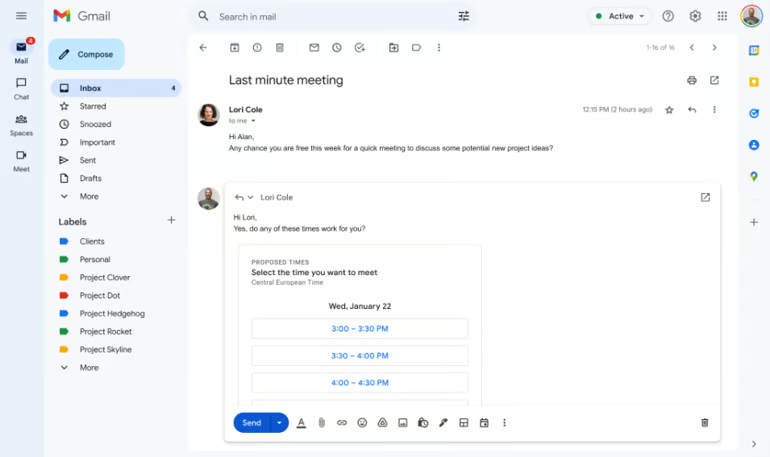
While Google Workspace lacks an integrated domain registrar and reserves complex features—such as Vault, eDiscovery, and deep endpoint management—for its higher-tier plans, it represents the most frictionless all-around environment for modern teams.
2. Microsoft 365: Best for Microsoft-Powered Workplaces
- Expert Score: 4.51 / 5
- Starting Price: $6 per user per month (annual commitment)
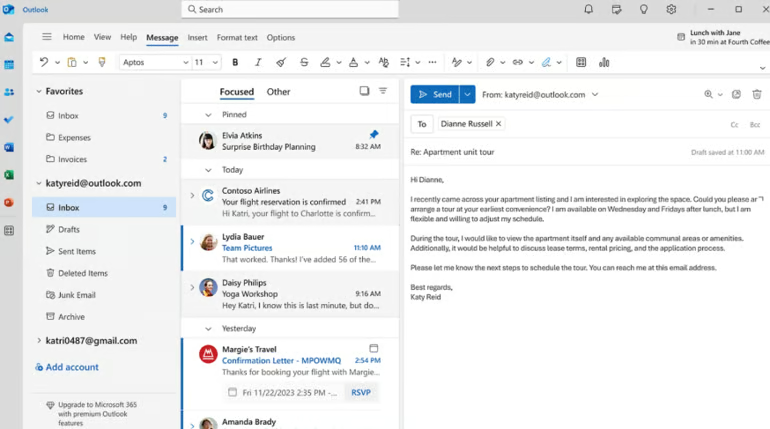
Microsoft 365 missed the top spot by a razor-thin margin, though it outscored competitors in raw mailbox capacity, granular administration, advanced security, and enterprise scalability. For environments already dependent on Outlook, Word, Excel, Teams, and SharePoint, Microsoft 365 is the indisputable platform of choice.

One of Microsoft 365’s standout structural benefits is its robust handling of shared mailboxes, distribution groups, and calendar delegations. A 50GB shared mailbox (e.g., support@ or billing@) typically does not demand an independent user license, provided interacting personnel hold eligible Exchange Online entitlements.
Though Microsoft 365 demands a steeper configuration curve and presents a more complex administrative dashboard than Google Workspace, its long-term governance controls make it ideal for structured enterprises.
3. Zoho Mail: Best Low-Cost Business Email
- Expert Score: 4.47 / 5
- Starting Price: $1 per user per month (annual commitment)
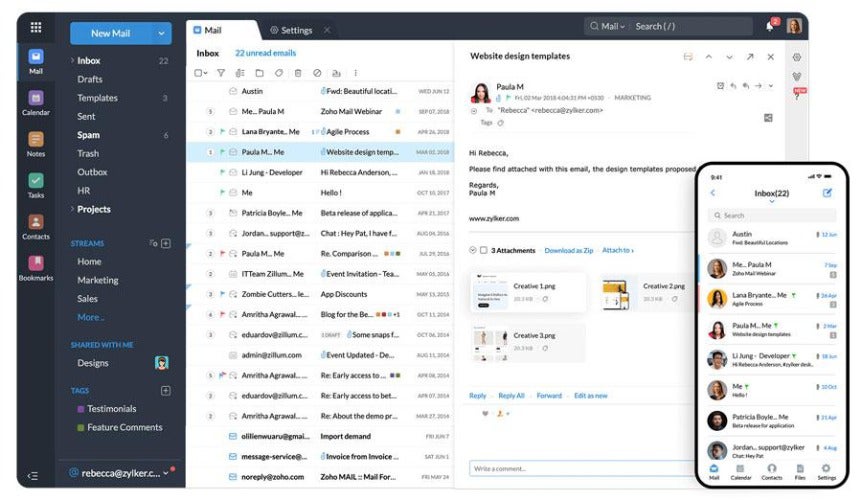
Zoho Mail leads the market in sheer economic value. With paid email plans beginning at an accessible $1 per user per month, it undercuts almost every major competitor while offering a free custom-domain tier for up to five users in select regions.
Critically, Zoho does not strip out foundational corporate controls to achieve its low price point. The platform supports custom domains, mail aliases, administrative groups, shared calendars, multi-factor authentication (MFA), migration pipelines, and complete SPF, DKIM, and DMARC configuration dashboards. It is especially potent for businesses already leveraging broader Zoho applications like Zoho CRM, Books, or Projects.

While its native interface lacks the ubiquitous familiarity of Gmail or Outlook, and its free tier excludes POP, IMAP, and ActiveSync access, Zoho Mail remains the premier destination for cost-conscious operations.
4. Fastmail: Best Standalone Business Email Service
- Expert Score: 4.26 / 5
- Starting Price: $5 per user per month (annual commitment)
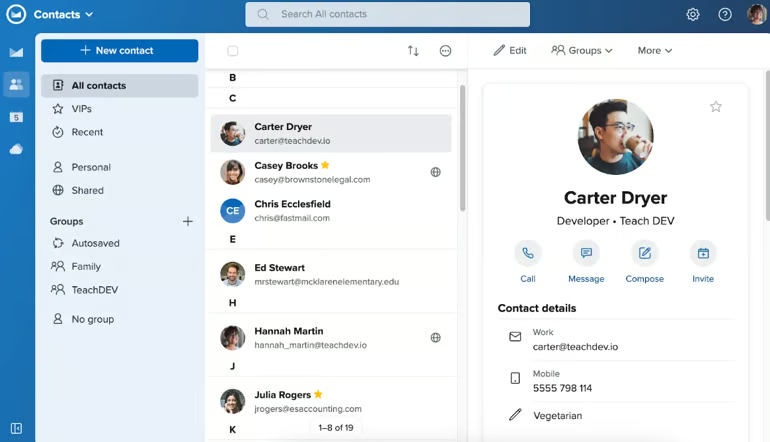
Fastmail is engineered specifically for companies that want a lightning-fast, dedicated email service free from the bloat of bundled document suites or video conferencing software. Instead of attempting to rival Google or Microsoft on office productivity tools, Fastmail hyper-focuses on email delivery, calendars, contacts, custom domains, and an ultra-clean user experience.
Fastmail excels in mailbox management, supporting IMAP protocols so teams can comfortably route mail through Apple Mail, Thunderbird, Outlook, or mobile clients. Organizations can also mix and match subscription tiers across employees and enjoy prorated billing adjustments. While it lacks native document creation suites and enterprise-level compliance tools, Fastmail is a stellar choice for streamlined operations.
5. Proton Mail: Best for Privacy-Focused Businesses
- Expert Score: 4.06 / 5
- Starting Price: $6.99 per user per month (annual commitment)
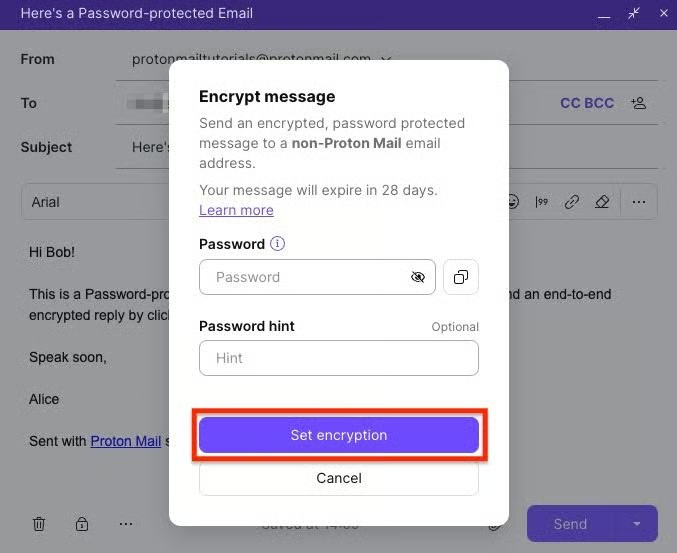
For enterprises operating in regulated sectors or handling sensitive client intelligence, Proton Mail offers industry-leading security. Communications exchanged between Proton accounts are automatically secured via end-to-end encryption, while zero-access encryption architecture prevents Proton itself from reading stored message content. Users can also transmit password-protected messages to external recipients outside the Proton network.

Backed by ISO 27001 certification and independent SOC 2 Type II compliance audits, Proton Mail’s business plans offer custom domains, administrative dashboards, secure calendars, and migration tools. The primary trade-off is third-party interoperability; strict encryption frameworks can occasionally complicate integrations with conventional productivity services.
6. Hostinger Mail: Best for Bundled Website and Email Hosting
- Expert Score: 3.96 / 5
- Starting Price: $0.39 per mailbox per month (requires multi-year commitment)
Hostinger Mail targets entrepreneurs looking to spin up a digital brand from scratch by consolidating domain registration, website hosting, and business email under a single umbrella. Hostinger’s proprietary hPanel guides administrators effortlessly through DNS configurations, mailbox creation, and data imports.
Hostinger has modernized its service by introducing AI writing assistants, summarization tools, and "Agentic Mail" features capable of triggering webhook actions for automated AI workflows. However, it lacks the deep shared productivity suites and robust compliance engines found in Google or Microsoft ecosystems, making it best suited for solo operators and small web-centric startups.
Supporting Context and Evaluation Metrics
To eliminate subjective bias, the evaluation methodology was built upon six core pillars, scored independently on a 0-to-5 scale:

- Email Functionality & Performance: Delivery speeds, storage capacities, synchronization reliability, alias management, and search efficiency.
- Security & Compliance: Native spam/phishing filters, encryption standards, data-residency options, and compliance certifications (SOC 2, ISO, HIPAA readiness).
- Administration & Usability: Ease of initial domain setup, user onboarding friction, permission controls, and UI intuitiveness.
- Pricing & Value: Total cost of ownership, billing flexibility, hidden renewal hikes, and free-tier viability.
- Ecosystem & Integrations: Availability of native calendars, cloud storage, document suites, CRM hooks, and third-party API connectivity.
- Scalability: How effectively the platform adapts as an organization grows from a single user to hundreds of seats.
Strategic Considerations: Choosing Your Email Host
When selecting a business email provider, decision-makers must look beyond introductory monthly rates and analyze long-term operational impact. Five critical factors demand attention:
- Total Cost of Ownership at Scale: Watch out for steep introductory rates that spike dramatically upon renewal (as seen with several budget and hosting-bundled providers). Calculate costs based on multi-year projections.
- Storage and Mailbox Limits: Consider whether pooled storage (such as Google’s model) or fixed per-user mailbox limits (like Microsoft’s 50GB allocation) better serve your team’s media and document retention habits.
- Integration Requirements: Determine whether your team requires deep integration with cloud document suites, customer relationship management (CRM) tools, or project management software.
- Administrative Burden: Assess your internal IT capabilities. If you lack a dedicated system administrator, prioritize user-friendly dashboards like those offered by Google Workspace or Zoho.
- Security and Regulatory Mandates: If your business handles legal, financial, or healthcare data, prioritize providers offering end-to-end encryption, advanced threat protection, and verifiable compliance audits.
Future Outlook: The Evolution of Business Email
As the digital workspace continues to transform, the traditional boundaries of email are dissolving. Looking ahead, business email providers are rapidly evolving into intelligent communication hubs. The integration of generative artificial intelligence—exemplified by Google’s Gemini, Microsoft’s Copilot, and Hostinger’s AI agents—is shifting email from a passive messaging channel into an active operational assistant capable of drafting communications, summarizing sprawling threads, and triggering automated business workflows.
Furthermore, mounting cybersecurity threats mean that basic spam filtering is no longer sufficient. Enterprise email providers are expected to double down on zero-trust architectures, advanced phishing defense heuristics, and quantum-resistant encryption protocols. For small businesses, investing in a robust, scalable email provider today is no longer just about looking professional—it is about securing the digital core of the entire enterprise for the challenges of tomorrow.