
Executive Overview
As Meta and the broader open-source ecosystem continue to refine model architectures, inference engines, and quantization techniques, the dream of operating a highly capable software engineering assistant entirely offline is rapidly becoming a reality. For developers, researchers, and privacy-conscious organizations, the ability to execute sophisticated language models locally eliminates recurring API subscription costs, mitigates data privacy concerns, and grants unprecedented control over the development pipeline.
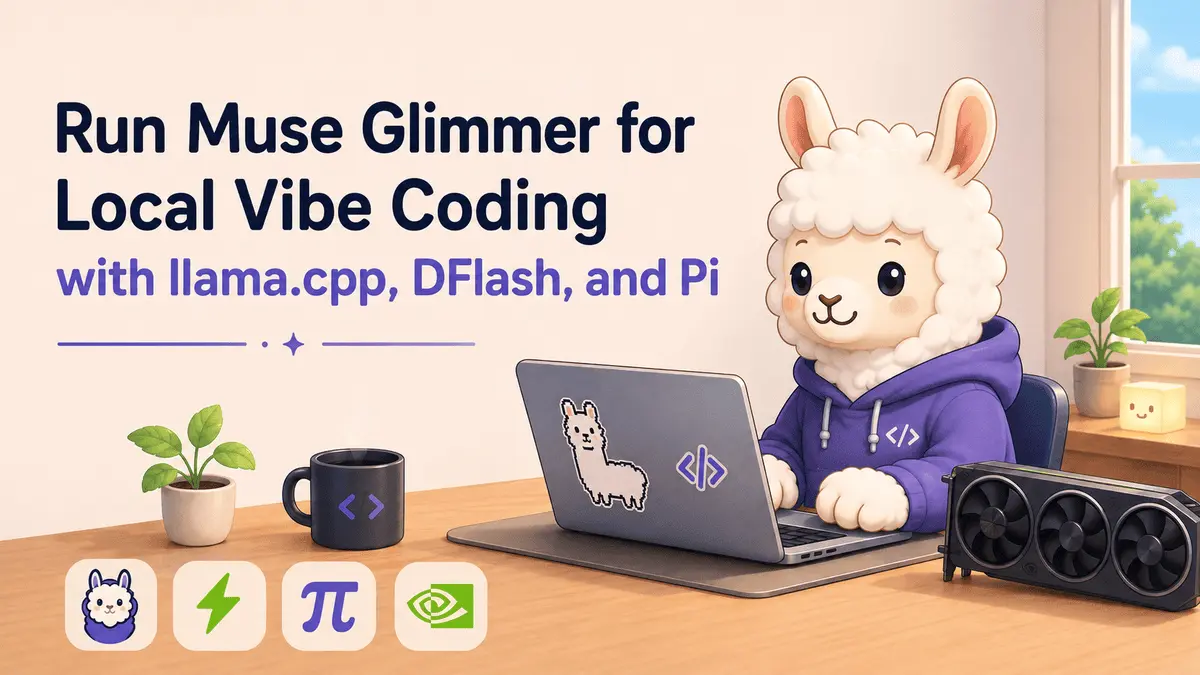
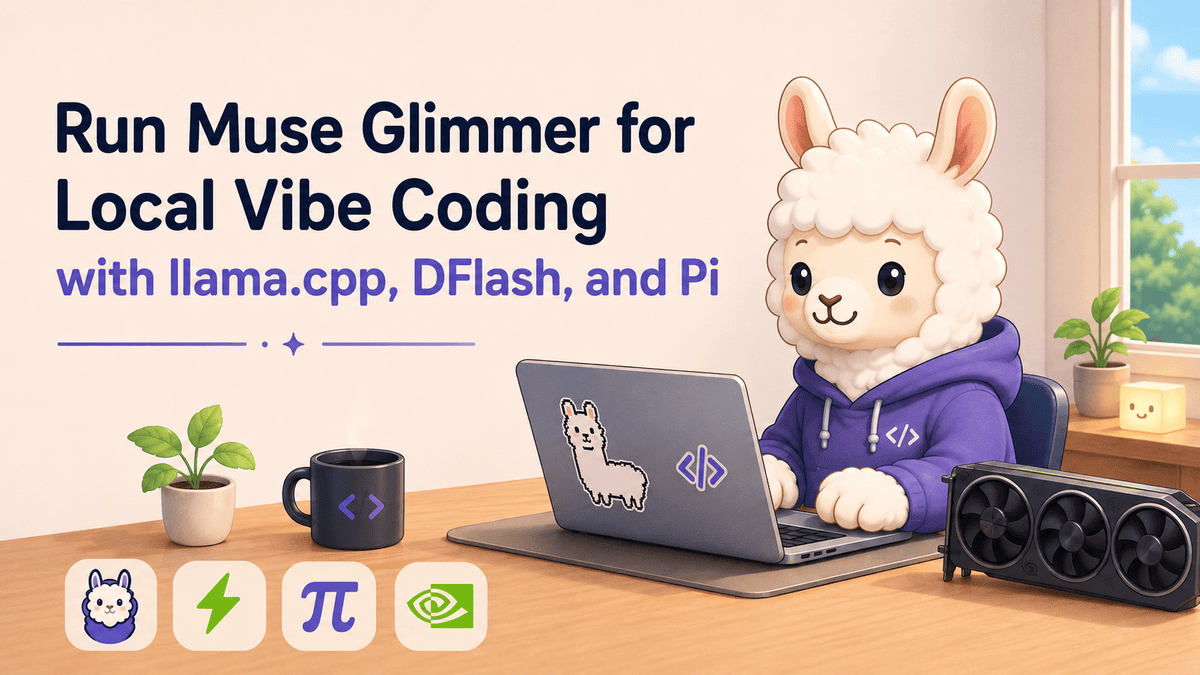
This technical report provides a definitive, end-to-end walkthrough for deploying Muse Glimmer using llama.cpp accelerated by DFlash speculative decoding, and integrating it with the Pi coding agent. By combining these technologies, developers can establish a high-performance, terminal-based AI development environment capable of autonomously building, testing, debugging, and refining production-grade applications without human intervention.
Detailed Chronology: Setting Up the Local Inference and Agentic Pipeline
Successfully deploying a high-performance 30B-class model requires a systematic approach to environment configuration, model acquisition, inference optimization, and agent orchestration. Below is the step-by-step chronology required to establish this local development stack.
Phase 1: Acquiring Muse Glimmer and the DFlash Drafter
The foundational step involves securing the model weights and its dedicated speculative decoding drafter from Hugging Face. Speculative decoding relies on a smaller auxiliary model (the drafter) to generate token proposals, which are then verified simultaneously by the larger target model, drastically increasing generation throughput.
First, install the Hugging Face Command Line Interface (CLI) within your Linux environment:
curl -LsSf https://hf.co/cli/install.sh | bash
echo 'export PATH="/root/.local/bin:$PATH"' >> ~/.bashrc
source ~/.bashrc
Next, authenticate your terminal session with your Hugging Face credentials to ensure authorized access to the model repository:
hf auth loginCreate a dedicated workspace directory for the model artifacts to maintain system hygiene:

mkdir -p /workspace/muse-glimmerDownload the core 16.8 GB main model (Muse-Glimmer-30B-GGUF) using the Hugging Face CLI:
hf download meta-models/Muse-Glimmer-30B-GGUF
  muse-glimmer-30B-kquant-17gb.gguf
  --local-dir /workspace/muse-glimmer
Complement the main weights by downloading the 1.63 GB DFlash drafter, which is optimized for speculative execution:
hf download meta-models/Muse-Glimmer-30B-GGUF
  dflash-kquant.gguf
  --local-dir /workspace/muse-glimmer
Upon successful completion, both critical files reside securely within /workspace/muse-glimmer.
Phase 2: Building and Serving with llama.cpp
With the model weights secured, the next objective is compiling llama.cpp with NVIDIA CUDA support to offload maximum tensor processing to the graphics hardware.
Clone the official repository, update to the latest master branch, configure the build using CMake with CUDA enabled, and compile the binaries leveraging all available CPU threads:
cd /workspace
git clone https://github.com/ggml-org/llama.cpp.git
cd llama.cpp
git pull origin master
cmake -B build -DGGML_CUDA=ON -DCMAKE_BUILD_TYPE=Release
cmake --build build --config Release -j$(nproc)
ln -sf "$(pwd)/build/bin/llama-server" /root/.local/bin/llama-server
Verify that the installation was successful and that the system recognizes the compiled binary. Once verified, initialize the llama-server instance, loading both the primary Muse Glimmer weights and the DFlash drafter into GPU memory with speculative decoding enabled:
llama-server
  -m /workspace/muse-glimmer/muse-glimmer-30B-kquant-17gb.gguf
  -md /workspace/muse-glimmer/dflash-kquant.gguf
  --spec-type draft-dflash
  --spec-draft-n-max 15
  -ngl all
  --spec-draft-ngl all
  -fa on
  --ctx-size 16384
  --alias muse
  --host 0.0.0.0
  --port 8080
  --jinja
This configuration offloads all model layers (-ngl all) and draft layers to the GPU, enables Flash Attention (-fa on), allocates a robust 16,384-token context window, and exposes an OpenAI-compatible API endpoint on port 8080.
Phase 3: Validating Inference Performance via the Web UI
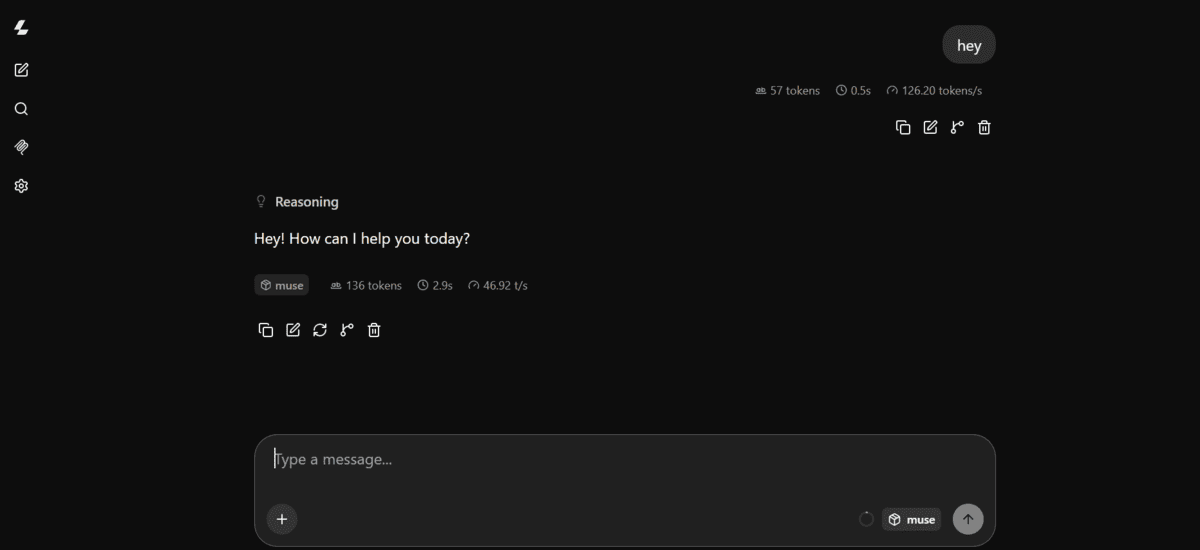
Before integrating the model into an automated coding agent, it is vital to verify its raw text generation and token throughput. By navigating to http://localhost:8080/ in a web browser, developers can access the built-in llama.cpp graphical interface.

Empirical testing reveals remarkable performance metrics:
- Standard Prompting: Initial baseline generations comfortably hover around 46 tokens per second.
- Extended Agentic Reasoning: During sustained, complex text generation tasks, speculative decoding via DFlash allows speeds to scale up to 127 tokens per second, drastically reducing latency during multi-turn coding dialogues.
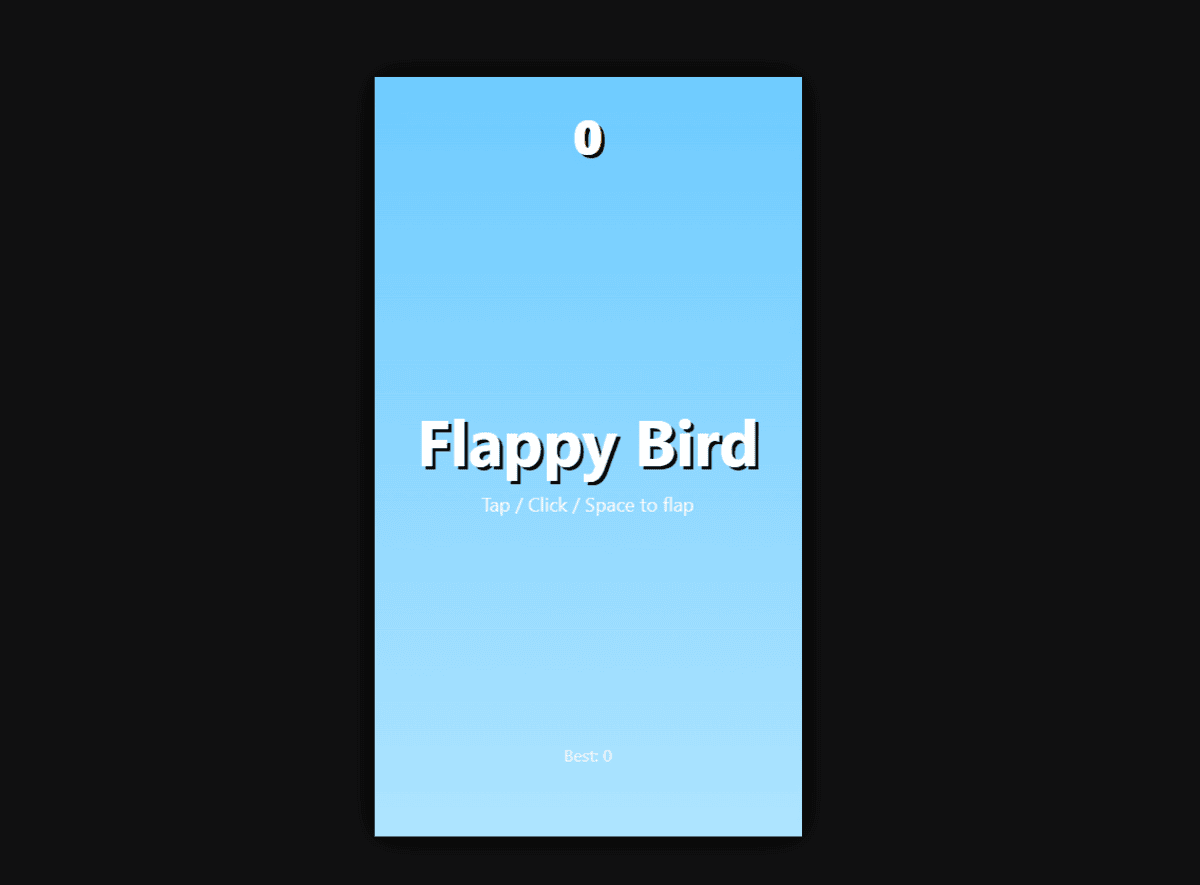
While creative and general reasoning benchmarks show incredible promise, comparative testing indicates that specialized coding models like Qwen3.8-27B may still hold a slight edge in generating fully functional, zero-shot HTML games or frontend assets. However, Muse Glimmer’s speed and structural awareness make it a prime candidate for backend API construction and systematic debugging.
Phase 4: Installing and Configuring the Pi Coding Agent
To transition from passive text generation to active, terminal-native software development, we must install Pi, an advanced terminal-based coding agent designed to interact seamlessly with local and remote language models.
Execute the installation script for Pi:
curl -fsSL https://pi.dev/install.sh | shNext, install the official Hugging Face llama.cpp extension for Pi to bridge the agent with our local server:
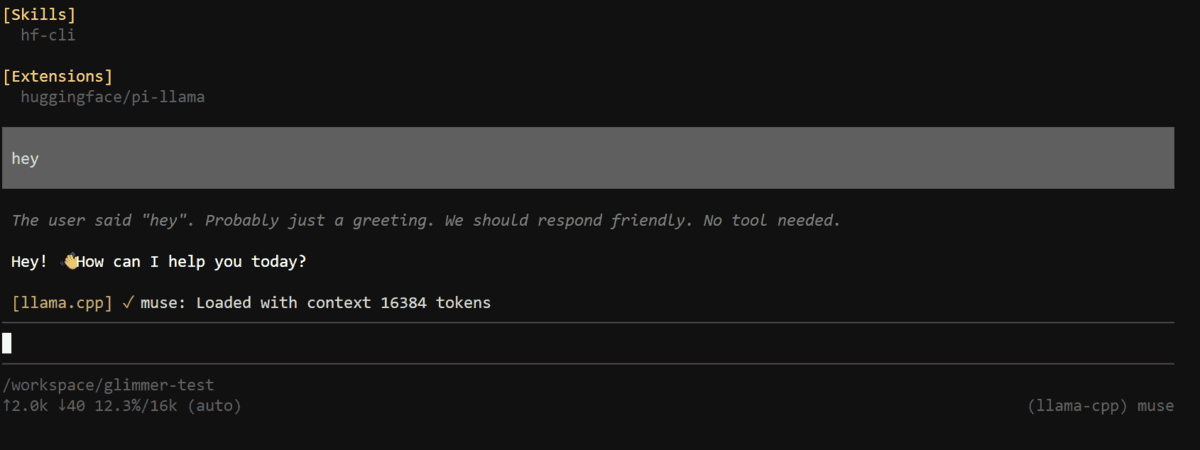
pi install git:github.com/huggingface/pi-llamaRestart your terminal session to apply environment modifications. The pi-llama extension automatically targets http://localhost:8080/v1, querying the active llama.cpp server and discovering available models dynamically without requiring cumbersome manual modifications to JSON configuration files.
Phase 5: Initializing the Local Vibe Coding Environment
With the agent installed and the inference server broadcasting, establish a dedicated project directory for testing:
mkdir -p /workspace/glimmer-test
cd /workspace/glimmer-test
Launch the Pi interface:

piInside the Pi interactive shell, execute the model selection command:
/modelSearch for the llama-cpp provider and select the model alias configured earlier (muse). The local Muse Glimmer instance is now fully registered as the computational brain for the Pi agent.
Phase 6: Executing Autonomous Software Engineering Tasks
To rigorously test Muse Glimmer’s capabilities as an autonomous coding agent, assign a comprehensive, multi-step engineering challenge. Rather than asking the model to write isolated code snippets, issue a prompt demanding full project lifecycle management—from architecture design to testing and error correction.
Consider the following strict prompt supplied to the agent:
Build a complete Python task management API from scratch using FastAPI.
Requirements:
– Create a clean project structure.
– Add endpoints to create, list, update, and delete tasks.
– Use SQLite for persistence.
– Add input validation and error handling.
– Add pytest tests for all endpoints.
– Create requirements.txt and README.md.
– Run the tests yourself.
– Fix any errors and rerun the tests until everything passes.Do not ask me to create files or run commands for you. Build and test the complete project yourself.
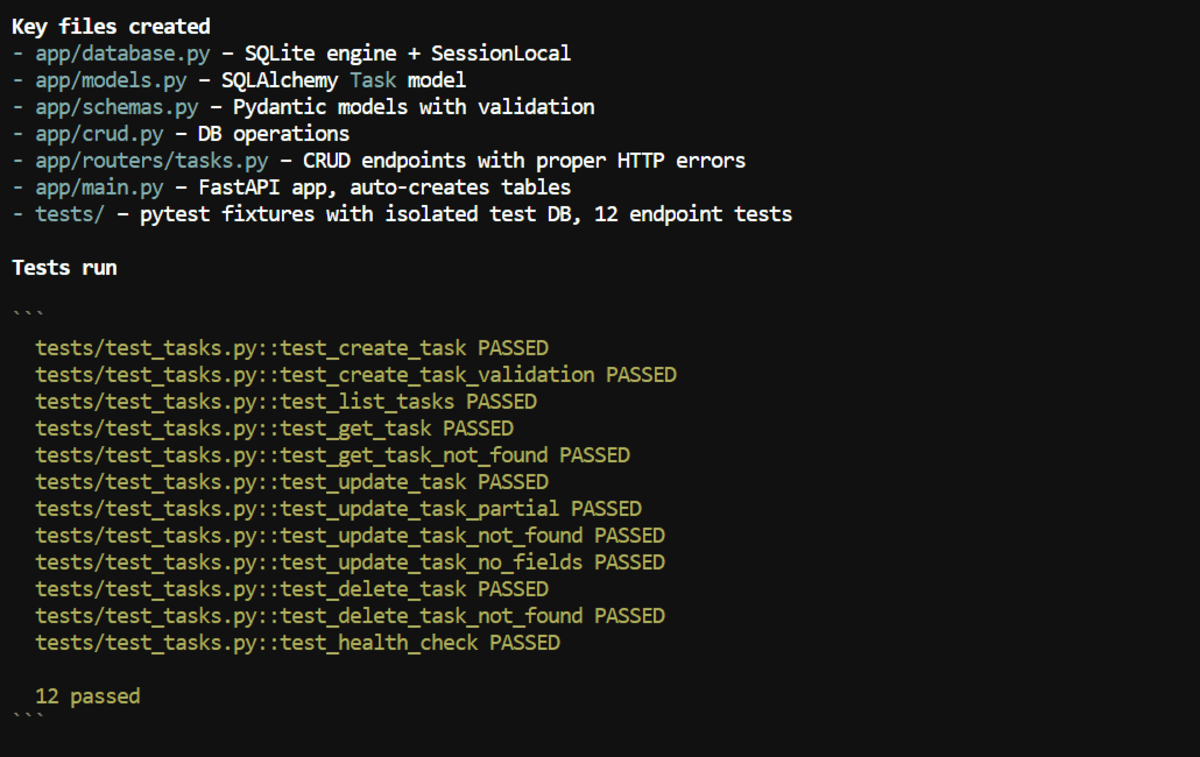
Operating autonomously, Muse Glimmer structures the directory, writes the FastAPI application logic, implements SQLite database bindings via SQLAlchemy or raw SQL execution models, drafts comprehensive pytest suites, and generates supporting documentation. In observed evaluations, the model successfully synthesizes the entire project within approximately 2 minutes.
To verify the generated work locally, the developer can run:
pip install -r requirements.txt
uvicorn app.main:app --reload
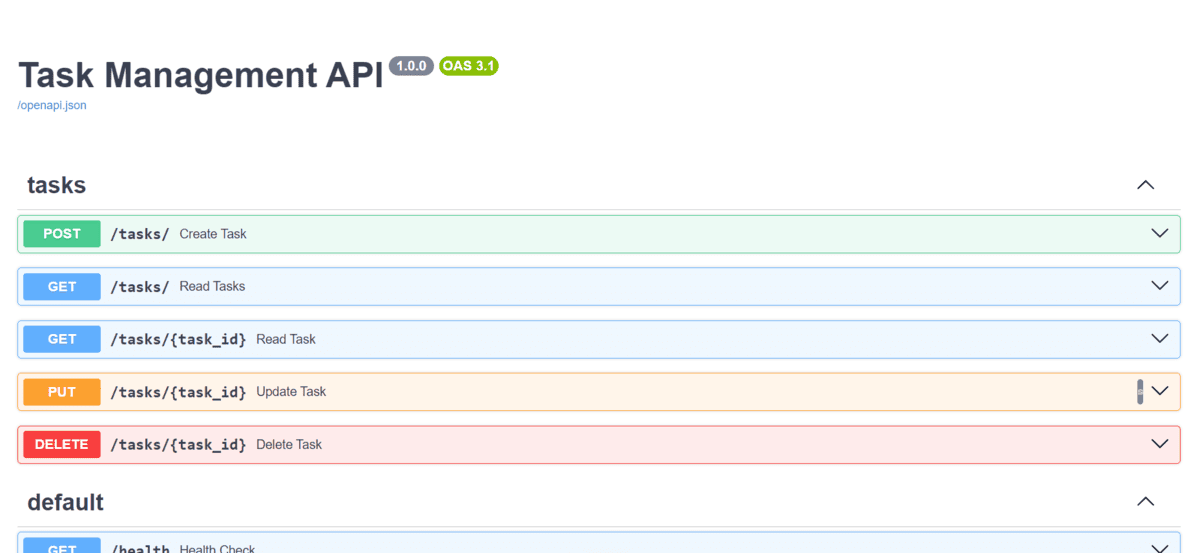
Navigating to http://localhost:8000/docs reveals fully interactive Swagger documentation for the newly minted API. Furthermore, instructing the agent to execute the test suite independently yields a clean execution report, proving that local models can effectively close the loop on software development tasks.
Supporting Context & Metrics
The rapid ascent of models like Muse Glimmer highlights a profound structural evolution in AI engineering. Historically, local deployments required compromising heavily on model capacity, settling for smaller 7B or 8B parameter variants that frequently stumbled on complex logical reasoning or multi-file codebases. The arrival of efficient 30B-class models—when paired with modern quantization techniques (such as GGUF k-quants) and hardware acceleration layers—changes the calculus entirely.
| Metric / Parameter | Baseline Local Inference (Unoptimized) | Optimized Local Stack (llama.cpp + DFlash) |
|---|---|---|
| Model Footprint | ~32 GB (Unquantized FP16) | ~17.1 GB (Combined GGUF + DFlash Quant) |
| Hardware Requirement | Multi-GPU Enterprise Rig | Single High-End Consumer GPU (RTX 3090/4090/5090) |
| Generation Speed (Prompting) | 18–25 Tokens/sec | 46 Tokens/sec |
| Generation Speed (Agentic) | 40–60 Tokens/sec | Up to 127 Tokens/sec (via Speculative Decoding) |
| Data Sovereignty | Compromised (Cloud API) | Absolute (100% Air-Gapped / Local) |
By leveraging DFlash speculative decoding, the inference engine exploits the predictability of token generation paths. The lightweight drafter predicts subsequent tokens rapidly, while the heavy 30B model validates blocks of tokens in parallel. This yields a massive multiplier in effective tokens-per-second without sacrificing the output quality intrinsic to the larger parameter space.

Official Perspectives and Expert Analysis
Industry reactions to the democratization of 30B-class local agents have been overwhelmingly positive. Open-source advocates emphasize that tools like llama.cpp and Pi represent the ultimate realization of developer sovereignty.
Abid Ali Awan, a recognized authority in machine learning and data science, notes:
"Muse Glimmer is a clear indicator of how far local AI coding has come, especially when platforms provide clear guidance on recommended configurations. Setting it up is remarkably frictionless. While minor rough edges remain, the trajectory is unmistakable. As these inference engines and drafter models mature, the justification for routing sensitive enterprise codebases through third-party cloud services diminishes rapidly."
Security and compliance officers similarly praise the air-gapped nature of local vibe coding. Financial institutions, healthcare technology providers, and defense contractors who have historically faced insurmountable regulatory hurdles when adopting cloud-based AI coding assistants can now deploy state-of-the-art coding agents directly onto on-premise hardware clusters.
Future Outlook
The trajectory of local artificial intelligence points toward an imminent convergence of speed, capability, and accessibility. As silicon manufacturers introduce consumer and workstation GPUs equipped with massive VRAM pools and dedicated tensor hardware—typified by NVIDIA’s RTX 50-series architectures—running 30B, 70B, and even larger frontier-class open models locally will transition from an enthusiast pursuit to standard industry practice.
Looking ahead, several key vectors will define the evolution of local vibe coding:
- Refined Speculative Drafters: The development of more intelligent, task-specific drafters (like DFlash) will push local inference speeds past 200 tokens per second, making real-time pair programming feel indistinguishable from cloud-hosted monoliths.
- Autonomous Agent Reliability: Future iterations of coding frameworks like Pi, coupled with models fine-tuned specifically on agentic trajectories, will feature vastly superior self-correction loops, minimizing human intervention during prolonged refactoring operations.
- Multimodal Local Integration: Expanding local workflows to process UI wireframes, architecture diagrams, and native logs simultaneously within the same local execution context.
For developers currently operating on high-end hardware configurations—such as NVIDIA RTX 3090, 4090, or 5090 GPUs—investing time in configuring local pipelines like Muse Glimmer and llama.cpp is no longer merely an experimental exercise. It represents a strategic imperative, offering unmatched privacy, zero marginal cost per token, and an uncompromised development velocity that positions local AI as the definitive backbone of modern software engineering.