

Executive Overview
Navigating international markets used to require a massive capital expenditure. Historically, businesses that wanted to hire talent abroad had to establish localized corporate entities, hire legal counsel in foreign jurisdictions, navigate complex foreign tax structures, and risk heavy non-compliance penalties. Today, the global workforce paradigm has shifted dramatically. Companies can now leverage an Employer of Record (EOR) to bypass these structural hurdles entirely.
An EOR acts as the legal employer on paper for your international personnel. While you maintain total, day-to-day managerial control over the employee’s actual workload, deliverables, and performance, the EOR handles the administrative burden: payroll execution, tax withholdings, statutory benefits administration, and strict adherence to local labor laws.

However, as remote and distributed work models mature, selecting the ideal EOR partner requires a nuanced approach. Simply checking a provider’s country coverage map is no longer enough. Modern businesses must evaluate how platforms handle regulatory compliance, safeguard intellectual property, protect employee wellbeing, and scale with long-term corporate growth.
To determine the top solutions on the market, we evaluated 10 prominent EOR providers using an exhaustive evaluation framework consisting of 37 distinct data points. After rigorous testing and analysis, five industry leaders emerged: Remote, Papaya Global, Deel, Multiplier, and Oyster.
Top Employer of Record Services Compared
| Provider | Best For | Starter Monthly Pricing | Requires Refundable Deposit | EOR Country Coverage | Entity Model | Client Onboarding Support | Expert Score (out of 5) |
|---|---|---|---|---|---|---|---|
| Remote | Overall EOR | $699 / employee | Yes* | 90+ | Owned local entities | Yes | 3.59 |
| Papaya Global | Payroll & payments control | $499 / employee | No | 160+ | Partner network | Yes | 3.52 |
| Deel | Fast-scaling global teams | $599 / employee | No | 110+ | Owned local entities | In higher tiers | 3.50 |
| Multiplier | Low-cost workforce expansion | $400 / employee | No | 150+ | Owned local entities | Yes | 3.42 |
| Oyster | Employee benefits & total rewards | $699 / employee | Yes | 120+ | Mixed | Yes | 3.01 |
*Depends on risk assessment.
Detailed Chronology: The Rise of EOR and Remote-First Workforces
The concept of third-party employment administration has roots in the domestic Professional Employer Organization (PEO) model. However, the rapid acceleration of cross-border, remote work—catalyzed globally over the last half-decade—forced the HR tech sector to innovate.
- Phase One (Pre-2019): International hiring was largely restricted to multinational enterprises capable of absorbing the legal costs of setting up foreign subsidiaries. Contractors were often misclassified to bypass these constraints, exposing businesses to catastrophic legal liability.
- Phase Two (2020–2022): The global shift to remote work created an unprecedented demand for agile international hiring solutions. Early EOR platforms emerged, allowing startups and mid-market firms to hire distributed teams legally.
- Phase Three (2023–Present): The market has matured past basic payroll processing. Today’s EOR landscape focuses heavily on proprietary entity ownership, integrated intellectual property (IP) protection, localized data security, and sophisticated talent mobility services (such as visa sponsorship and global mobility management).
In-Depth Provider Evaluations
1. Remote: Best Overall EOR
- Expert Score: 3.59 / 5
- Starter Pricing: $699/employee/month
- Country Coverage: 90+ countries
Remote is our top pick for businesses that demand uncompromising control and security when expanding internationally. Unlike competitors that rely on third-party broker networks, Remote owns and operates 100% of its local entities. This eliminates intermediary handoffs, streamlining communication and reducing administrative friction.
Why We Chose Remote
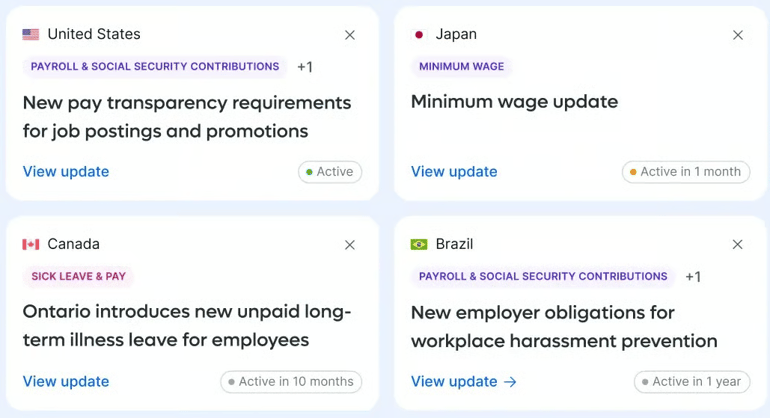
Remote covers the entire employee lifecycle—from onboarding and offboarding to compliant contract generation, paid time off (PTO) tracking, and localized payroll. What truly separates Remote from the pack is its focus on intellectual property protection. Through tools like Remote IP Guard and unlimited indemnity coverage for EOR clients, companies hiring engineers, product designers, and R&D talent can rest easy knowing their proprietary work products are legally secured. Furthermore, its Compliance Watchtower proactively alerts HR teams to shifting local labor regulations.
Pros & Cons
- Pros: 100% owned local entities (no third parties), robust IP protection with unlimited indemnity, clean and intuitive user interface.
- Cons: Higher starting price point compared to niche competitors; refundable deposits may be required based on risk assessments.
2. Papaya Global: Best for Payroll and Payments Control
- Expert Score: 3.52 / 5
- Starter Pricing: $499/employee/month
- Country Coverage: 160+ countries
Papaya Global is engineered for enterprises and growing firms that require absolute transparency and command over global payment flows. While it handles bulk onboarding smoothly, its core differentiator is its proprietary payment architecture.
Why We Chose Papaya Global
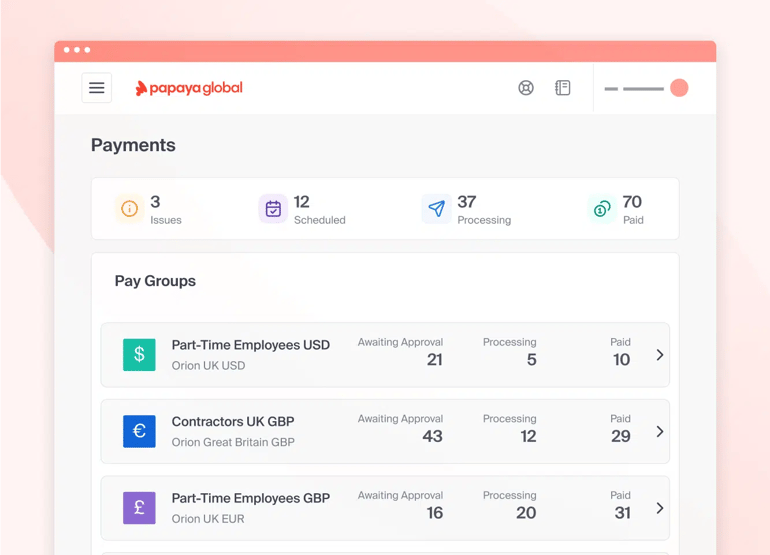
Most EOR services route funds through multiple third-party banking partners, creating blind spots and potential delay risks. Papaya Global owns its payment platform outright. This grants employers immediate, end-to-end visibility over payout tracking, eliminates hidden intermediary fees, and instantly flags anomalies or compliance bottlenecks. With coverage spanning over 160 countries via an extensive partner network, Papaya is a powerhouse for complex, multi-region organizational structures.
Pros & Cons
- Pros: Proprietary payment platform reduces hidden fees, massive country coverage (160+), excellent enterprise-grade analytics.
- Cons: Relies on a partner network in certain regions rather than solely owned entities.
3. Deel: Best for Fast-Scaling Global Teams
- Expert Score: 3.50 / 5
- Starter Pricing: $599/employee/month (Standard Plan)
- Country Coverage: 110+ countries
Deel has become a household name in the HR tech space, renowned for its massive feature stack and rapid deployment times. It is built specifically for high-growth companies that need to spin up international teams at scale without sacrificing compliance.

Why We Chose Deel
Deel balances breadth with depth. Beyond standard EOR capabilities across 110+ countries, Deel provides an integrated talent marketplace equipped with AI tools to help recruiters source candidates globally. It also supports complex mobility needs—such as work visa processing and global background checks—alongside IT management tools for shipping and tracking company-issued hardware.
Pros & Cons
- Pros: Comprehensive feature set (visa support, IT hardware management, background checks), integrated talent marketplace, highly scalable.
- Cons: Premium client onboarding support is restricted to higher-tier enterprise plans.
4. Multiplier: Best for Low-Cost Workforce Expansion
- Expert Score: 3.42 / 5
- Starter Pricing: $400/employee/month
- Country Coverage: 150+ countries
For cost-conscious organizations that want to dip their toes into international waters without breaking the bank, Multiplier provides a streamlined, highly affordable path forward.
Why We Chose Multiplier
Multiplier cuts through the feature bloat to focus on what matters most: rapid, budget-friendly global hiring. Starting at just $400 per employee per month, it allows businesses to generate compliant local employment contracts in as little as five minutes. Supported by coverage in over 150 countries, Multiplier handles multi-currency payroll, localized benefits, and expense management through a straightforward, unpretentious dashboard.
Pros & Cons
- Pros: Highly competitive starting price point ($400/mo), fast contract generation, broad geographic footprint.
- Cons: Lacks the advanced, enterprise-grade customizations and ecosystem depth found in platforms like Deel or Remote.
5. Oyster: Best for Employee Benefits & Total Rewards
- Expert Score: 3.01 / 5
- Starter Pricing: $699/employee/month
- Country Coverage: 120+ countries
While most EOR platforms are engineered strictly from the employer’s perspective (focusing on administrative ease and risk mitigation), Oyster places an equal emphasis on the employee experience.
Why We Chose Oyster
Oyster recognizes that attracting top-tier global talent requires more than just a legally compliant paycheck. Its EOR plans bake in rich, localized benefits packages—including private health insurance, wellness stipends, mental health coverage, and parental leave. Furthermore, Oyster features a Benefits Advisor tool that categorizes local benefit packages into statutory, bronze, silver, and gold tiers, ensuring companies remain competitive in every target market. It also offers unique pre-purchased annual seat structures for teams managing fluctuating headcounts.
Pros & Cons
- Pros: Exceptional localized benefits packages, built-in employee learning tools (Oyster Academy), flexible annual seat pre-purchasing.
- Cons: Lower overall expert score due to a more complex pricing architecture for add-on services.
Supporting Context & Metrics
Choosing an EOR provider requires looking past marketing claims and evaluating quantitative metrics that directly affect operational overhead:

- Entity Ownership Structure: Platforms that own their local entities (e.g., Remote, Deel, Multiplier) generally offer tighter compliance controls. Conversely, those relying on partner networks (e.g., Papaya Global) can often scale faster into niche or emerging markets.
- Hidden Costs: Base monthly fees rarely tell the whole story. Organizations must account for potential setup fees, refundable risk deposits, foreign exchange (FX) conversion markups, and surcharges for custom benefits administration.
- Time-to-Hire: Industry benchmarks show that deploying an EOR can reduce international onboarding timelines from months (associated with direct subsidiary setup) down to 48 hours to one week.
Official Industry Statements
“The modern workforce is borderless by default,” notes workplace strategy analyst Elena Vance. “Companies that restrict their talent acquisition strategies to their domestic zip codes are artificially capping their innovation potential. EOR services have democratized access to global talent, transforming what used to be a legal nightmare into a routine procurement process.”
Industry security compliance experts also stress the importance of data governance: “When evaluating an EOR, you aren’t just buying payroll software; you are trusting a third party with sensitive employee PII (Personally Identifiable Information), banking data, and local tax filings across multiple sovereign jurisdictions. Due diligence on entity infrastructure is non-negotiable.”
Future Outlook
As we look toward the future of global employment, several trends are poised to reshape the EOR industry:
- AI-Driven Compliance: Expect platforms to increasingly integrate predictive artificial intelligence to monitor real-time legislative changes in labor, tax, and immigration laws across hundreds of jurisdictions.
- Blurring Lines Between EOR and PEO: Hybrid models are emerging that allow mid-market firms to seamlessly transition from an EOR model to their own local corporate entities as their foreign employee headcount scales.
- Enhanced Financial Flexibility: With increased competition, we anticipate downward pressure on base EOR per-employee fees, accompanied by more modular, customizable add-on pricing structures for benefits and global mobility.
Frequently Asked Questions (FAQs)
How long does it take to hire an employee through an EOR?
In most standard markets, onboarding an employee through an EOR takes between 48 hours and one week. However, timelines can extend if the target country enforces strict local labor vetting rules, mandatory waiting periods, or complex background checks.
Are employee benefits included in base EOR pricing?
Not uniformly. While all EOR providers include mandatory statutory benefits (such as local social security contributions and mandatory healthcare) in their baseline fees, enhanced or market-competitive fringe benefits (e.g., dental, vision, wellness stipends) often incur additional costs.
What hidden costs should businesses watch out for?
Beyond the advertised monthly per-employee fee, organizations should audit providers for setup fees, refundable risk deposits, FX transfer markups, cross-border payout fees, and extra charges for visa sponsorship or intellectual property protection add-ons.