


Executive Overview
The best IVR systems of 2026 enable businesses to manage high volumes of inbound calls at massive scale, deflect routine queries through self-service modules, and seamlessly route intricate problems to the most qualified human agents. Integrated natively into broader Unified Communications as a Service (UCaaS) and Contact Center as a Service (CCaaS) ecosystems, these platforms eliminate the friction of legacy hardware, offering visual call-flow builders, sentiment analysis, real-time analytics, and hyper-personalized routing.

This report evaluates the top six IVR software providers on the market—RingCentral, Nextiva, Ooma, KrispCall, GoTo Connect, and Aircall—analyzing their core architectures, pricing strategies, strengths, and ideal enterprise use cases. Whether you are an agile startup seeking a frictionless out-of-the-box virtual receptionist or an expansive multinational enterprise requiring multi-level routing and predictive AI, understanding the capabilities of these market leaders is critical to optimizing your customer engagement strategy.
Detailed Chronology: The Evolution of IVR and Platform Integration
To understand where voice technology stands in 2026, one must examine how enterprise communication architectures evolved over the last two decades.

Phase 1: Legacy Hardware and Rigid Trees (Early 2000s–2010s)
Historically, deploying an IVR system required expensive on-premise Private Branch Exchange (PBX) hardware. Changes to call routing structures demanded specialized IT personnel, and callers were routinely subjected to monolithic, linear menus that lacked context-awareness or adaptability. If a caller mistyped a digit, they were often dropped entirely or sent back to the root menu.
Phase 2: Cloud Migration and UCaaS Convergence (2015–2020)
The mass migration to cloud-based VoIP platforms transformed IVR from a capital-intensive hardware investment into a subscription-based software feature. Providers began bundling basic auto-attendant and multi-level routing capabilities into general business phone packages. This era saw the democratization of call routing, allowing small and medium-sized businesses (SMBs) to sound like Fortune 500 companies.
Phase 3: The AI and Omnichannel Era (2021–Present)
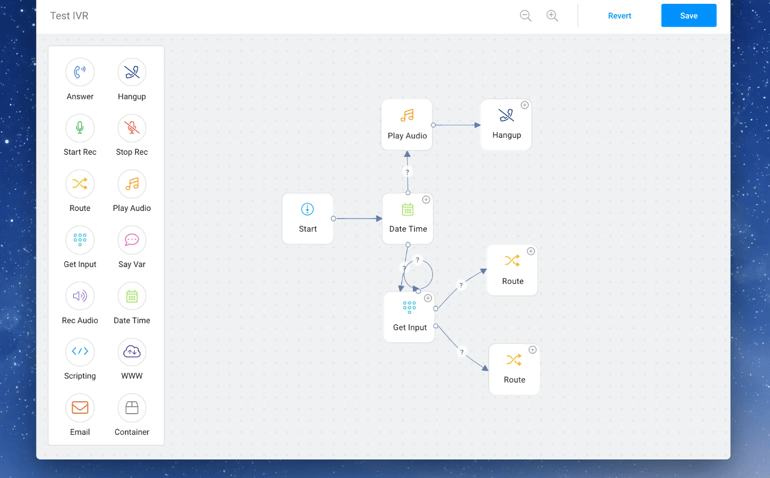
By 2026, the boundaries between phone trees, digital chat, and customer relationship management (CRM) systems have effectively dissolved. Modern IVR platforms leverage Natural Language Processing (NLP) and conversational AI to let callers speak naturally rather than pressing buttons. Call flows are now engineered via drag-and-drop visual designers, linking seamlessly with email, SMS, and ticketing platforms to guarantee context travels with the caller.
Comparative Analysis of the Top IVR Systems
When selecting an IVR platform, organizations must decide whether they require a standalone communication system or a native feature bundled within a broader cloud phone service. Deploying a native IVR drastically reduces deployment friction and eliminates the integration headaches common to third-party bolt-on solutions.

Market Comparison Matrix
| Provider | Free Trial / Guarantee | Key Architecture Focus | Starting Price (Billed Annually) |
|---|---|---|---|
| RingCentral | 14-day free trial | Multi-level IVR, robust AI, extensive API ecosystem | $20 / user / month |
| Nextiva | Not publicly listed | Unified customer engagement & cross-channel routing | $15 / user / month |
| Ooma | 30-day money-back guarantee | Simple DIY setup & virtual receptionist | $19.95 / user / month |
| KrispCall | Demo/guarantee varies | Lightweight cloud phone systems for budget-conscious SMBs | $12 / user / month |
| GoTo Connect | Demo/trial varies | Deep CRM integrations & flexible dial plans | Custom quote-based |
| Aircall | 7-day free trial | Modern UI, high usability, agent-centric workflows | $30 / license / month |
Deep Dive: The Top 6 IVR Software Providers
1. RingCentral: Best IVR System Overall
Architecture and Value Proposition
RingCentral captures the top spot overall by bridging enterprise-grade call routing with consumer-grade ease of deployment. Available out-of-the-box on RingEX plans, its multi-level IVR enables organizations to design sophisticated, tiered call structures without investing in a separate contact center infrastructure.
[Inbound Call]
      │
      ▼
[Multi-Level IVR / AI Greeting]
      ├── Press 1 / Say "Sales" ──────► [Sales Queue (Skills-Based Routing)]
      └── Press 2 / Say "Support" ────► [Self-Service Knowledge Base / Tier-1 Agent]
Beyond core routing, RingCentral acts as a unified hub consolidating voice, video, team messaging, fax, and extensive analytics. Its visual IVR designer allows administrators to map complex call distributions and run test calls before pushing configurations live.
Pricing Structure
- RingEX (Standard Plans): Starts at $20 per user per month (billed annually), with volume discounts unlocking for organizations exceeding 100 users.
- RingCX (Contact Center Solution): Starts at $65 per agent per month, introducing advanced contact center IVR, skills-based routing, and automated queue callbacks.
Key Strengths and Trade-Offs
- Pros: Deep multi-level capabilities, extensive ecosystem of 500+ integrations, elite uptime reliability, and scalable AI features.
- Cons: Configuration depth can introduce a steeper learning curve for non-technical administrators compared to lightweight alternatives.
2. Nextiva: Best for Customer Engagement
Architecture and Value Proposition
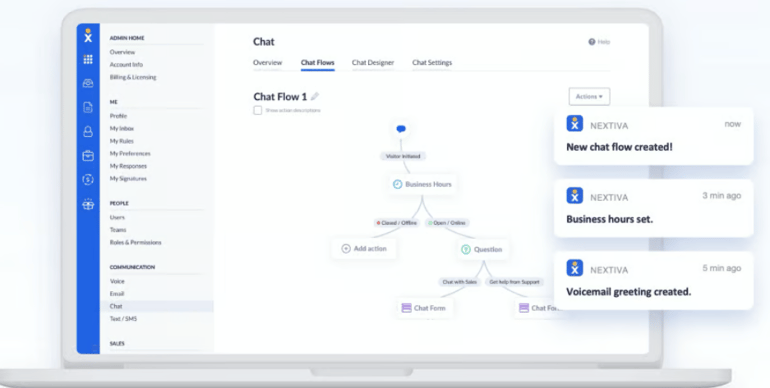
Nextiva is engineered for organizations that view voice communications as merely one component of a holistic customer journey. By fusing intelligent IVR and call routing with digital engagement tools, Nextiva allows support and sales teams to orchestrate conversations across phone lines, SMS, web chat, and customer review platforms from a single pane of glass.
Whether a small boutique business needs a straightforward auto-attendant to handle peak hours or a mid-market enterprise requires automated Call Distribution (ACD) and deep analytics, Nextiva scales fluidly.
Pricing Structure
- Subscription Tiers: Tiered pricing models scale according to feature sets, with entry points starting competitively for growing teams. (Exact promotional rates fluctuate; direct quote recommended).
Key Strengths and Trade-Offs
- Pros: Excellent cross-channel communication merging, reliable uptime, and strong built-in CRM features.
- Cons: Advanced analytics and omnichannel dashboards require migrating to higher-tier enterprise plans.
3. Ooma: Easiest DIY Setup
Architecture and Value Proposition
For organizations lacking dedicated IT departments or specialized telecommunications staff, Ooma provides an oasis of simplicity. Its virtual receptionist is remarkably intuitive, available across all Ooma Office plans.
Ooma is purpose-built for local businesses, professional services, and small offices that require professional call menus, custom audio greetings, and reliable business-hours routing without touching a line of code. While it lacks the sprawling enterprise analytics of RingCentral, its streamlined design philosophy guarantees deployment in minutes.
Pricing Structure
- Ooma Office Plans: Starting at $19.95 per user per month, with a 30-day money-back guarantee. Virtual receptionist functionality is baked directly into the base tier.
Key Strengths and Trade-Offs
- Pros: Exceptionally fast, DIY setup; dependable baseline call routing; zero IT overhead required.
- Cons: Rapidly growing enterprises will eventually outgrow its simple analytics and limited CRM integrations.
4. KrispCall: Best for Small Businesses & Lean Budgets
Architecture and Value Proposition
KrispCall enters the market as a nimble, highly cost-effective cloud telephony platform. It strips away enterprise bloat to deliver essential IVR, call recording, shared team visibility, and international phone number provisioning at an aggressive price point.
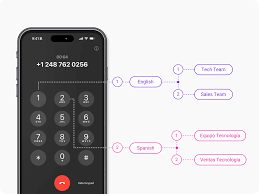
It is tailored for lean startups, remote teams, and small agencies that manage variable or low-to-moderate call volumes. The platform makes it easy to construct language-based or department-specific routing paths without inflating operational overhead.

Pricing Structure
- Base Plans: Starting at $12 per user per month (billed annually). Usage-based fees for specific international telecom corridors and text messaging may apply.
Key Strengths and Trade-Offs
- Pros: Highly affordable starting price, simple global number provisioning, and rapid deployment.
- Cons: Fewer native integrations and lighter reporting frameworks than legacy giants.
5. GoTo Connect: Best for Workflow Integrations
Architecture and Value Proposition
GoTo Connect excels by treating the phone system not as an isolated island, but as an integrated node within your existing software stack. Combining robust cloud PBX features with industry-leading web collaboration tools, GoTo Connect provides custom dial plans and routing matrices designed to sync seamlessly with popular CRM packages and helpdesk platforms.
Its administrative interface allows managers to deploy complex call flows, configure emergency routing, and review historical interaction logs without disrupting ongoing agent workflows.
Pricing Structure
- Enterprise Licensing: Pricing is fully customized and quote-based, scaling relative to user counts, custom integrations, and specialized contact center add-ons.
Key Strengths and Trade-Offs
- Pros: Exceptional ecosystem integrations, reliable audio quality, and flexible custom dial plans.
- Cons: Lack of transparent public pricing makes upfront budgeting difficult without engaging sales representatives.
6. Aircall: Best User Interface and Agent Experience
Architecture and Value Proposition
Aircall approaches IVR design through the lens of user experience (UX). Built specifically for modern sales and support teams, Aircall’s SmartFlow IVR designer features an exceptionally clean, modern visual interface that drastically minimizes administrative friction.
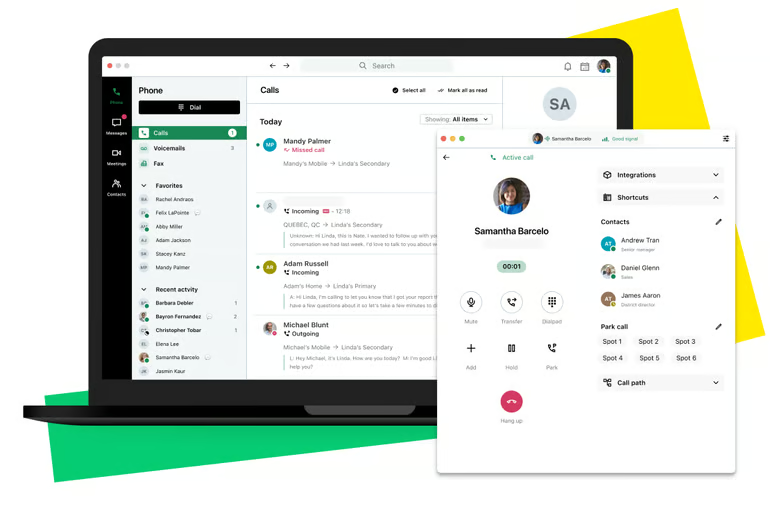
Agents utilizing Aircall are not bogged down by dense, legacy menus; instead, they benefit from a fluid softphone application that surfaces customer context, past interaction logs, and CRM data instantly upon call connection.

Pricing Structure
- Professional Licensing: Starts at $30 per license per month (billed annually). All standard tiers include complete IVR capabilities, unlimited domestic calling (US/Canada), SMS functionality, and parallel outbound dialing capacity.
Key Strengths and Trade-Offs
- Pros: Stunning, modern UI; ultra-smooth agent workflows; and robust out-of-the-box integrations with major CRMs (HubSpot, Salesforce, Zendesk).
- Cons: Carries a higher baseline per-user cost compared to budget competitors like KrispCall or Ooma.
Supporting Context and Evaluation Methodology
To construct this definitive guide, our editorial and technical evaluation team discarded marketing hyperbole in favor of empirical testing, verified user feedback, case study analysis, and hands-on laboratory deployments.
The evaluation framework prioritized four core criteria:
- Ease of Configuration: How quickly can a non-technical administrator build, test, and deploy a multi-level call flow?
- Scalability: Can the system evolve from a basic auto-attendant into a full-scale contact center solution as call volumes spike?
- Integration Depth: Does the IVR pass actionable metadata and customer context directly into CRM and helpdesk environments?
- Reliability and Support: What is the provider’s historical uptime record, and what tier of customer support backs the subscription?
Strategic Guidance: How to Choose the Right IVR System
Selecting the correct IVR system requires an honest internal audit of your organization’s communication maturity and operational requirements. Follow this three-step framework:
- Assess Complexity: If your operation requires simple call distribution, business-hours routing, and basic greetings, lean toward lightweight options like Ooma or KrispCall. If you manage complex, multi-tiered departments requiring skills-based distribution and AI analytics, invest in RingCentral or Nextiva.
- Evaluate Administrative Resources: If your IT department consists of zero dedicated engineers, prioritize platforms with visual drag-and-drop builders and guided setup wizards (e.g., Aircall or Ooma).
- Plan for Future Growth: Ensure the platform you choose possesses an accessible upgrade path. Migrating voice infrastructure is disruptive; selecting a scalable ecosystem like RingCentral or GoTo Connect from day one prevents costly platform migrations later.
Future Outlook: The Horizon of Interactive Voice Technology
As we look deeper into the back half of the decade, the evolution of IVR systems will be defined by hyper-personalization and generative artificial intelligence. The rudimentary "press 1" paradigm is rapidly giving way to conversational voice bots capable of understanding nuance, detecting customer frustration via vocal tone, and resolving complex tier-1 transactional inquiries entirely unassisted.

Furthermore, predictive routing algorithms will increasingly analyze a caller’s historical behavior, purchase history, and real-time sentiment before the call even reaches a queue, dynamically matching them with the agent best equipped to handle their specific needs. For businesses ready to invest in intelligent infrastructure today, modern IVR systems are no longer mere call-routing costs—they are dynamic engines of customer retention and revenue growth.