
Executive Overview
It was a methodology built strictly for rapid prototyping, entirely unfit for the rigorous demands of enterprise production.
Today, the role of the AI Engineer has matured from an experimental hacker wiring disparate endpoints together into a disciplined systems architect. Modern practitioners are no longer frantically stitching APIs together to see if a language model can summarize a PDF; they are engineering deterministic software systems around non-deterministic engines. Because modern foundation models now feature integrated native reasoning and advanced state management, the tooling required to build around them has dramatically shrunk.
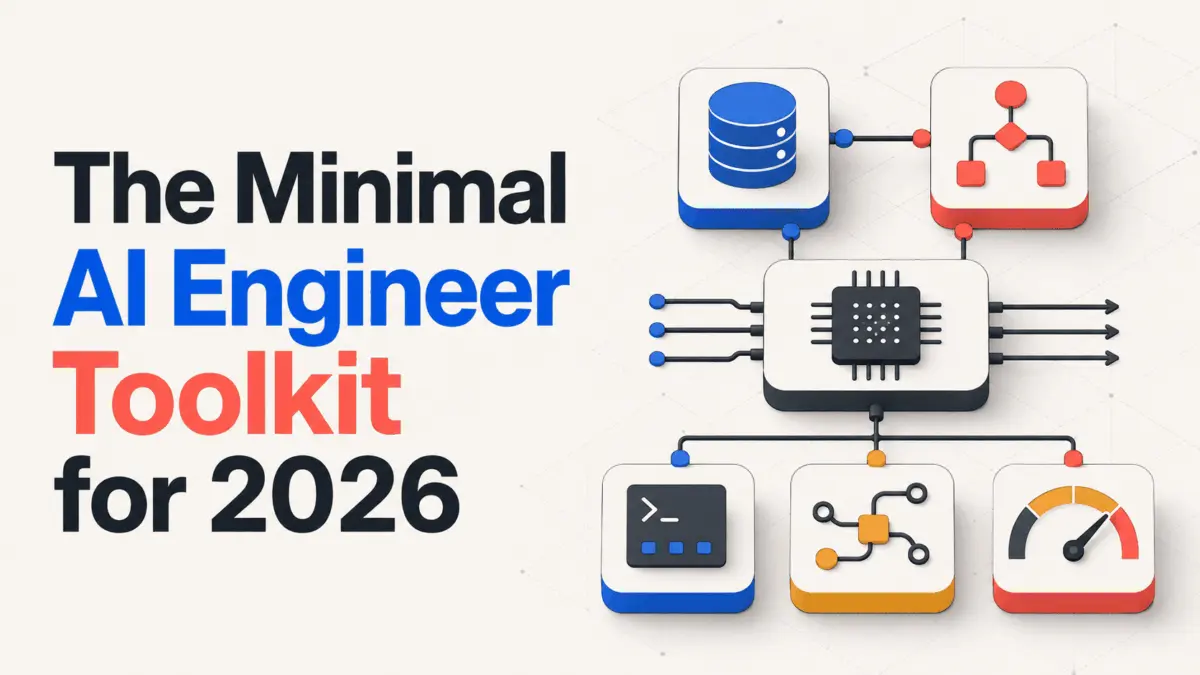
The bloated "kitchen sink" approach has been permanently replaced by a lean, standardized set of primitives. This article details the minimal, production-grade toolkit required by mid-2026 for building, evaluating, and deploying autonomous systems. Each layer addresses a distinct technical hurdle, and together, they form a cohesive, resilient engineering stack.
Detailed Chronology: From Brittle Prototypes to Resilient Systems
To understand where AI engineering stands today, it is essential to retrace how the ecosystem evolved from a chaotic collection of workarounds into a structured software engineering discipline.
Phase 1: The Wild West of Prompt Engineering (2023–2024)
In the early days of the generative AI boom, development was largely ad-hoc. Developers treated LLMs as magical oracles rather than components of a broader software architecture. Applications were characterized by fragile while loops, hardcoded strings, and manual prompt parsing. If a model failed to return valid JSON, the application crashed, leading to the widespread adoption of messy, recursive regex patterns and desperate strings of instructions like: "Please return ONLY valid JSON. Do not include markdown formatting."
Phase 2: The Bloated Framework Era (2024–2025)
As use cases scaled, the industry rushed to build abstractions. A cottage industry of heavy orchestration frameworks emerged, hiding the underlying prompts and tool calls behind black-box wrappers. While these tools lowered the barrier to entry, they introduced severe debugging nightmares. When an agent failed, engineers could not easily inspect the execution graph, leading to unexpected infinite loops, runaway token consumption, and unpredictable outputs that could not be caught by traditional continuous integration pipelines.
Phase 3: The Lean, Deterministic Paradigm (2026 and Beyond)
By mid-2026, the pendulum swung back toward simplicity, predictability, and control. The industry recognized that non-deterministic foundation models must be anchored by deterministic software structures. Engineers began stripping away unnecessary abstractions, demanding transparent code-first orchestration, token-level output constraints, standardized connector protocols, and robust automated evaluations. AI engineering had finally grown up, transforming from an art form into a measurable, version-controlled science.
The Minimal Production Toolkit: Core Architectural Layers
The modern AI engineer’s toolkit is defined by six essential layers. Each tackles a specific operational bottleneck, removing bespoke friction in favor of clean, standardized primitives.
1. Orchestration: Graphs and Event Loops
Everything in an autonomous system begins with orchestration. Without reliable control over how an agent reasons and routes tasks, nothing else in the stack matters. For production-grade agentic systems, visibility into execution graphs, state transitions, and error-handling mechanisms is non-negotiable. Frameworks that obscure underlying prompts or block developers from intercepting tool calls belong in obsolete prototypes, not deployed enterprise software.
The industry has converged on two primary paradigms for orchestration:
- Code-First Graph Frameworks: For complex, stateful applications, cyclical graphs have become the undisputed standard. Instead of writing brittle
whileloops to manage agent reasoning, developers define explicit nodes (representing agents or tools) and edges (representing conditional routing logic). State is maintained automatically across the graph, allowing systems to pause execution, request human-in-the-loop approval, and resume computation seamlessly without dropping context. Tools like LangGraph and Burr exemplify this paradigm, offering low-level, code-first control over state transitions. - Visual Event-Driven Orchestration: For asynchronous workflow automation and data pipelining, visual orchestration platforms have proven exponentially more maintainable than thousands of lines of boilerplate Python. Modern visual builders treat AI models as first-class citizens, enabling engineers to map webhooks to classifier agents, route outputs to Python execution nodes, and write directly to databases—all embedded with native retry logic and telemetry.
The Golden Rule of 2026: If a task requires complex conversational memory and multi-turn planning, build an explicit graph in code. If it involves an asynchronous, event-triggered workflow, leverage a visual orchestrator.
2. The Universal Connector: Model Context Protocol (MCP)
Historically, granting an AI agent access to a new tool required writing a custom Python wrapper, defining a cumbersome JSON schema, handling API authentication protocols, and hoping the model parsed the argument parameters correctly. Every single integration was a mini-project unto itself.
The widespread adoption of the Model Context Protocol (MCP) has radically slashed this engineering overhead. MCP serves the AI model ecosystem much like USB-C serves hardware: it is an open standard that allows any AI agent to connect to any external data source or software tool through a consistent, unified interface.
Rather than writing bespoke integrations, developers deploy an MCP server for their database, Slack workspace, or GitHub repository. The agent connects via an MCP client, immediately comprehending the available tools and contextual boundaries. This paradigm shift relocates engineering effort away from integration plumbing and toward security governance. Credential management moves server-side, separating execution environments from reasoning engines.
3. Local Inference and Small Language Models (SLMs)
The days of burning expensive cloud provider tokens simply to write and test unit tests are over. A modern AI engineering workflow starts entirely offline.
Small Language Models (SLMs) have crossed a critical quality threshold where models with fewer than 10 billion parameters routinely outperform the massive frontier models of 2024 on targeted, domain-specific tasks. This evolution makes local development not merely cost-effective, but vastly superior in terms of iteration speed. Portability between local development and cloud inference environments means engineers can prototype rapidly on local hardware before graduating to heavy production models without altering a single line of orchestration code.
4. The Evaluation Engine: CI/CD for Prompts
Probabilistic outputs demand rigorous statistical testing; you cannot verify an enterprise AI application by running a handful of manual queries and checking if the response "looks right."
Modern AI engineering mandates an evaluation framework—such as Promptfoo, LangSmith, or Braintrust—integrated directly into the continuous integration and continuous deployment (CI/CD) pipeline. Whenever a system prompt is tweaked or an underlying model is updated, the evaluation engine automatically executes a comprehensive test suite covering hundreds of edge cases.
This infrastructure relies heavily on "LLM-as-a-Judge" grading, where a secondary, highly capable model scores the agent’s output against a strict, deterministic rubric (e.g., "Did the agent correctly invoke the refund_api tool without hallucinating a transaction ID?"). Setting strict build gates, such as a mandatory 95% pass rate, transforms prompt engineering from a subjective art into a version-controlled engineering science.
5. Structured Output Enforcement
The headache of instructing models with phrases like "Please return ONLY valid JSON" has vanished. The modern toolkit solves structured outputs through two complementary techniques:
- Constrained Decoding: Libraries like Outlines and vLLM Guided Decoding intercept the model’s generation process at the raw token level. By providing a Pydantic model schema, the generation engine restricts the model to emitting strictly validated tokens, physically preventing invalid outputs at the sampling stage.
- Validation-and-Retry: Tools like Instructor wrap the model’s function-calling interface, validating outputs against a Pydantic schema post-generation. If validation fails, the system automatically retries with error context appended. This approach works seamlessly across any OpenAI-compatible API without demanding a specialized local inference backend.
6. Advanced Development Workflows: Git Worktrees
Experimentation in AI development is inherently messy. Engineers frequently need to test a new prompt technique against a different model version while simultaneously debugging a broken tool call on the main branch.
Relying on standard branch-switching creates friction when managing local models or heavy context files. Git Worktrees solve this by allowing developers to check out multiple branches of a repository into separate directories simultaneously. An engineer can run an evaluation suite on an experimental agent branch in one terminal while hot-fixing a bug in the main branch in another, without corrupting local model states or environment variables.
Supporting Context & Metrics: The Shift in Efficiency
The transition from bloated architectures to minimalist production stacks has yielded measurable improvements across enterprise deployments:
- Token Cost Reduction: By shifting routine tasks and unit testing to localized Small Language Models, teams have reported cloud inference cost reductions of up to 70%.
- Latency Improvements: Removing heavy, abstracted intermediary frameworks has slashed end-to-end execution latency for agentic workflows by nearly half.
- Reliability Metrics: Implementing token-level constrained decoding and CI/CD evaluation gates has driven downstream parsing error rates down to near zero in production environments.
Expert Perspectives
Industry leaders and educators emphasize that mastery in modern AI engineering is defined less by knowing every new framework that hits GitHub, and more by knowing which layers of abstraction to strip away.
"The defining characteristic of senior AI talent isn’t knowing the most frameworks. It’s knowing exactly which layers of abstraction to strip away," notes Vinod Chugani, an AI and data science educator specializing in agentic workflows and quantitative frameworks. "The minimal toolkit—a graph orchestrator, MCP for integrations, local SLMs for testing, structured output for reliability, and automated evaluation for CI/CD—covers everything required to build rock-solid systems."
According to enterprise architecture consultants, teams that fail to adopt rigorous evaluation pipelines and standardized connectors find themselves paralyzed by technical debt within months of initial prototyping.
Future Outlook: What Lies Ahead for AI Engineers
As the ecosystem stabilizes, the trajectory of AI engineering points toward even greater modularity and security governance.
- Autonomous Agent Fleets: The focus will shift from building single monolithic agents to orchestrating collaborative fleets of specialized SLMs communicating via standardized protocols like MCP.
- Zero-Config Governance: Security, credential management, and compliance auditing will become deeply embedded into infrastructure layers rather than handled via prompt engineering.
- Standardized Benchmarks: Automated evaluation suites will become universal industry standards, moving AI deployment closer to traditional DevOps maturity levels.
For professionals entering the field or scaling existing architectures, the recommended strategy is simple: identify the current operational bottleneck and start there. If the local development loop is sluggish, implement local SLM inference. If deployments are unpredictable, build out an evaluation pipeline. The tools fit together seamlessly, making incremental adoption a reliable path to enterprise-grade AI maturity. Everything else is just noise.