


Executive Overview
Enter Session Initiation Protocol (SIP) trunking—the vital bridge connecting traditional Public Switched Telephone Networks (PSTN) and modern digital communications over the internet. SIP trunking allows businesses to preserve their existing hardware infrastructure while progressively shifting their communication architecture to the cloud. By routing voice, video, and data over internet lines rather than traditional copper circuits, businesses achieve significant cost efficiencies, elastic scalability, and streamlined maintenance.

To help organizations navigate this technological crossroads, we have evaluated the leading SIP trunking providers on the market in 2026. Through rigorous research spanning pricing models, setup complexity, customer support quality, native features, and third-party integrations, this guide identifies the industry standards across multiple operational categories.
At a Glance: Best SIP Trunk Providers of 2026
| SIP Trunk Provider | Best For | Starting Price | Primary Coverage |
|---|---|---|---|
| RingCentral | Overall SIP Trunking & Hybrid Migration | Custom Quote | Global (50+ countries) |
| Nextiva | Fast, Guided SIP Deployment | Starts at $14.95/mo | U.S., Canada, Puerto Rico |
| Ooma | Hybrid SIP and IP Trunking | Custom Quote (Core from $19.99/user) | 25+ countries |
| GoTo Connect | Deep CRM and Software Integrations | Custom Quote | U.S. only |
| Intermedia Unite | Predictable, Transparent Pricing | Starts at $16.95/mo | U.S. only |
| 8×8 | Multinational & Global Coverage | Custom Quote | 100+ countries (PSTN in 55+) |
Detailed Chronology: The Evolution of PBX and the Rise of SIP Trunking
To understand why SIP trunking has become the definitive choice for modern enterprise modernization, one must examine the evolution of business telephony over the past three decades.

Phase 1: The Analog and ISDN Era (Late 20th Century)
For decades, business communication was tethered to physical copper wiring. On-premises PBX hardware sat in IT closets, managing internal routing while connecting outward through Primary Rate Interface (PRI) or Basic Rate Interface (BRI) lines. These systems were notoriously rigid. Scaling capacity meant physically installing new circuit cards and paying telecommunications utilities for additional lines—regardless of whether those lines were utilized to capacity.
Phase 2: The VoIP Disruption (Early 2000s)
The advent of Voice over Internet Protocol (VoIP) promised a revolution. By digitizing voice signals into data packets transmitted over broadband networks, businesses could bypass traditional toll charges, particularly for long-distance and international calls. However, early VoIP implementations often demanded complete hardware overhauls, forcing businesses to abandon functional analog equipment in favor of proprietary IP-phones.
Phase 3: The Hybrid Compromise and SIP Trunking Standardization (2010s–2020)
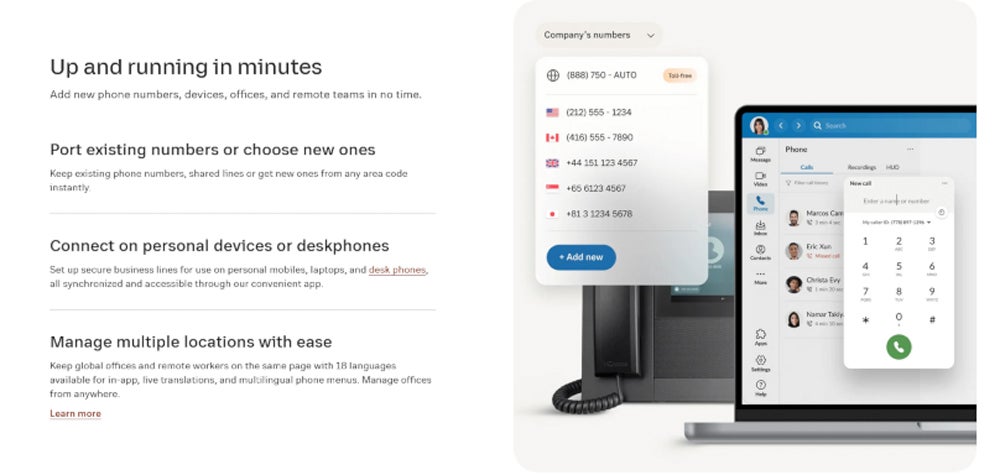
As cloud computing matured, the industry realized that a binary choice—all analog or all cloud—failed to serve large enterprises with complex, distributed footprints. SIP trunking emerged as the ideal compromise. Instead of replacing an entire on-premises PBX, IT teams could establish a virtual "trunk" over an internet connection, mapping digital telephone numbers directly to legacy hardware.
Phase 4: Cloud-Native Agility and Hybrid Coexistence (2026)
Today, SIP trunking is no longer just a cost-cutting mechanism; it is a foundational component of digital transformation strategies. Modern providers offer sophisticated cloud connectors, allowing organizations to maintain internal dialing parity between employees utilizing physical office desk phones and remote workers logged into cloud Unified Communications as a Service (UCaaS) platforms. The focus has shifted toward low-latency global routing, robust disaster recovery, and deep software integrations.

Supporting Context & Metrics: Evaluating the Top Providers
Evaluating a SIP trunking provider requires looking beyond raw cost to analyze interoperability, geo-redundancy, and long-term scalability. Below is a detailed breakdown of the leading solutions driving the market in 2026.
1. RingCentral: Best SIP Trunk Provider Overall
While globally recognized for its market-leading cloud phone systems, RingCentral delivers an exceptionally versatile SIP trunking solution via its Cloud Connector framework. Designed for enterprises looking to phase their cloud transition, RingCentral supports hybrid-PBX deployments.
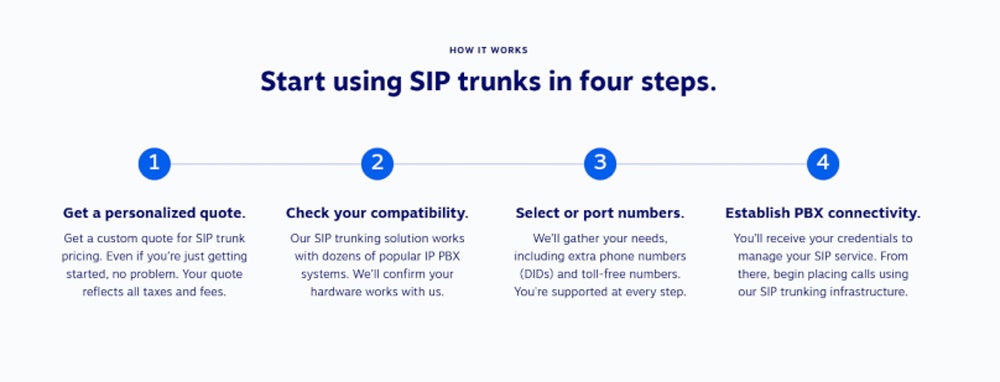
- Why It Stands Out: RingCentral allows internal dialing between employees using legacy on-premises equipment and those operating on RingCentral’s cloud PBX solution, RingEx. This eliminates communication silos during multi-year migration projects. Furthermore, enterprises can choose data residency options across the U.S., Canada, the U.K., or Germany.
- Ecosystem & Integrations: Boasting a library of over 300 pre-built integrations, RingCentral ensures that modernized communication lines sync effortlessly with existing enterprise software tools, customer relationship management (CRM) suites, and helpdesk systems.
- Pricing Structure: Available via custom enterprise quotes tailored to specific geographic footprints and call volume requirements.
2. Nextiva: Best for Quick Deployment
For businesses seeking an efficient, frictionless path to cloud integration, Nextiva stands out by eliminating the typical administrative overhead associated with SIP trunking deployment.
- Why It Stands Out: Nextiva’s architecture is engineered to integrate cleanly with most major legacy PBX systems with minimal configuration. It offers both metered and unmetered billing plans, catering efficiently to both low-volume office branches and high-volume contact center teams.
- Support & Usability: Nextiva pairs its streamlined onboarding process with accessible customer service, making it an ideal fit for mid-market businesses that lack dedicated, enterprise-level telecommunications engineering teams.
- Pricing Structure: Entry-level plans begin at a highly competitive $14.95 per month, offering transparent pricing with zero hidden fees.
3. Ooma: Best for SIP and IP Trunking
Ooma has long built a reputation for accessible, reliable communication systems, but its enterprise-grade offerings bring sophisticated capabilities to businesses requiring both traditional SIP and broader IP trunking.

- Why It Stands Out: Unlike many competitors focused exclusively on voice traffic, Ooma supports analog PBX systems alongside IP-enabled devices. Its IP trunking framework handles video conferencing, secure messaging, and data transmission alongside voice channels.
- Features: Ooma packages essential VoIP analytics, customizable call-routing flows, and centralized device management into its enterprise tier, providing granular control that is often absent in stripped-down trunking services.
- Pricing Structure: SIP and IP trunking services require a custom enterprise quote, though Ooma’s core business telephony packages start at $19.99 per user per month.
4. GoTo Connect: Best Integrations
GoTo Connect embeds robust SIP trunking capabilities directly into its feature-rich VoIP and contact center ecosystem, distinguishing itself primarily through its deep software integrations.
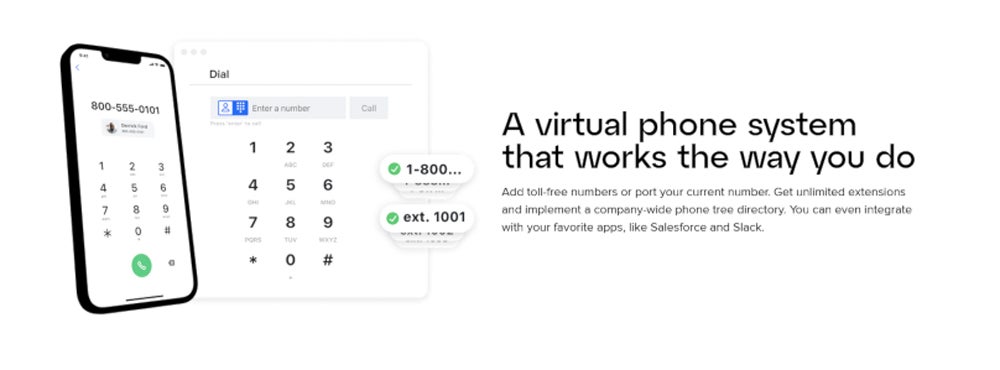
- Why It Stands Out: GoTo Connect shines for organizations that rely heavily on third-party productivity tools, CRM platforms, and marketing automation software. The platform supports automatic call logging, click-to-dial functionality, interaction tracking, and dynamic ticket creation.
- Bandwidth Control: Administrators can dynamically adjust bandwidth allocation for individual trunks based on real-time demand, ensuring the organization never overpays for idle capacity.
- Pricing Structure: Tailored custom quotes based on required capabilities, user counts, and contract duration.
5. Intermedia Unite: Best for Predictable, Transparent Pricing
Intermedia Unite removes the ambiguity often found in telecommunications billing by offering reliable SIP trunking paired with straightforward, predictable cost structures.
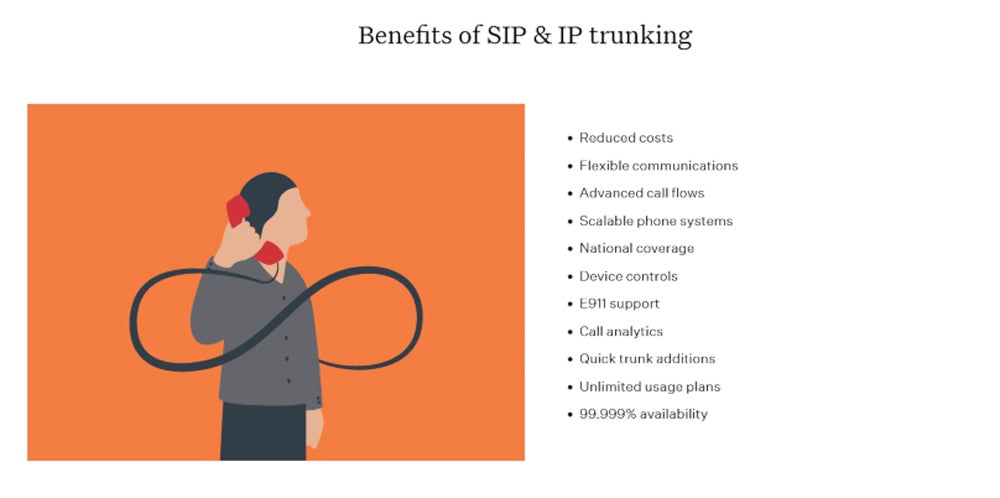
- Why It Stands Out: By cutting out legacy phone company overhead, Intermedia Unite allows businesses to modernize their infrastructure while retaining absolute clarity on monthly expenses. It offers flexible metered and unlimited calling packages tailored to specific enterprise workflows.
- Pricing Structure: Transparent plans start at $16.95 per month, appealing directly to budget-conscious IT leaders who prioritize financial predictability.
6. 8×8: Best Global Coverage
For multinational organizations and geographically distributed enterprises, 8×8 represents the gold standard in global SIP infrastructure.
- Why It Stands Out: 8×8 boasts 35 points of presence spanning five continents. It provides full PSTN replacement capabilities in over 55 countries and virtual number support in more than 100 countries.
- Performance & Reliability: Designed with an architecture ensuring zero single points of failure, 8×8 guarantees low packet loss and minimal latency through intelligent local routing. This makes it an essential choice for enterprises where call quality and global uptime are non-negotiable.
- Pricing Structure: Customized enterprise pricing based on geographic scope, user seats, and international regulatory requirements.
Official Statements and Industry Perspectives
As digital transformation initiatives mature across the global economy, telecommunications analysts emphasize that SIP trunking is no longer merely a temporary stepping stone, but a permanent architectural layer for hybrid enterprises.

Industry analysts point out that while cloud-native phone systems continue to gain market share, the sheer volume of institutional capital tied up in legacy hardware ensures that SIP trunking will remain a foundational technology well into the 2030s. Enterprises are increasingly prioritizing providers that can guarantee zero-downtime migration paths and stringent compliance standards across multi-region jurisdictions.
Furthermore, compliance and data sovereignty regulations—such as GDPR in Europe and evolving state-level privacy laws in the United States—have made regional data hosting capabilities a primary vetting criterion for enterprise buyers. Providers offering localized point-of-presence routing and flexible data residency options hold a distinct competitive advantage.
Future Outlook: What Lies Ahead for Enterprise Communications?
Looking past 2026, the trajectory of SIP trunking is closely intertwined with advancements in artificial intelligence, edge computing, and 5G network integration.
- AI-Driven Quality of Service (QoS): Future SIP trunking deployments will increasingly leverage machine learning algorithms to monitor network congestion in real-time, dynamically shifting voice packets across redundant paths to prevent jitter and packet loss before call quality degrades.
- The Convergence of UCaaS and CCaaS: The rigid lines separating internal business telephony (UCaaS) and customer-facing contact centers (CCaaS) will continue to blur. SIP trunks will increasingly act as the foundational pipeline feeding real-time speech analytics, automated transcription, and sentiment analysis tools directly into customer service workflows.
- The Long-Term Decline of On-Premises PBX: While hybrid deployments remain vital today, the natural hardware lifecycle of physical PBX systems means that more organizations will eventually phase out on-premises closets entirely, transitioning their SIP integrations directly into software-defined wide-area networks (SD-WAN).
Decision Framework: How to Choose Your Provider
When selecting a SIP trunking provider for your organization, follow this sequential evaluation checklist:
- Verify System Compatibility: Audit your existing PBX hardware, VoIP codecs, and network routers. Ensure your chosen provider explicitly supports your specific firmware and signaling protocols to avoid costly deployment delays.
- Assess Geographic Footprint: If your organization operates internationally, prioritize global providers like 8×8 or RingCentral that offer local routing and compliance adherence across your operating regions.
- Evaluate Migration Flexibility: Determine whether you require a sudden cutover or a phased hybrid rollout. Providers supporting dual-environment internal dialing protect business continuity during lengthy transitions.
- Calculate True Total Cost of Ownership (TCO): Compare the long-term maintenance costs of retaining your legacy PBX against the potential productivity gains and cost reductions of migrating to a fully cloud-native telephony stack.