Nana is a reporter for Tech Ledgers covering Blockchain & Cryptocurrency. She/He is based in Indonesia.
6 August 2026 • 9 min read
In the rapidly escalating arms race for artificial intelligence supremacy, the battleground has decisively shifted from conversational chatbots to fully autonomous software engineering agents. Meta has officially entered this competitive space with the public beta release of Muse Code, a command-line terminal agent driven by the company’s latest foundation model, Muse Spark 1.2.
Executive Overview
Designed to operate directly within large, complex code repositories, Muse Code represents Meta’s direct bid to challenge incumbents such as Anthropic, OpenAI, and DeepSeek. Rather than merely offering code completion or localized inline suggestions, Muse Code acts as an agentic engineer: planning multi-step architectural changes, executing file modifications, managing persistent subagents, and validating its own work over extended runtimes.
While rival platforms have largely prioritized raw synthetic benchmark scores, Meta’s strategic differentiation lies in system-level architecture and execution safety. Muse Code introduces a local event-logging mechanism that creates a deterministic, "replay-exact" runtime state. This design guarantees crash safety during long-running, multi-hour operations—a persistent structural bottleneck in autonomous agent workflows. Coupled with native multimodal capabilities capable of translating raw video files into complete web applications, Meta is betting that developer workflows require deep environment control and high-horizon reliability rather than ephemeral speed.
Detailed Chronology of the Release & Architecture
The announcement of Muse Code marks a deliberate pivot in Meta’s AI development strategy, moving away from standalone model releases toward integrated, task-specific agentic platforms.
The Architectural Genesis: Co-Training Muse Spark 1.2 and Muse Code
At the core of Meta’s new development framework is Muse Spark 1.2, an iterative evolution of the Muse Spark 1.1 foundation architecture. According to Meta’s engineering documentation, the underlying model was co-trained alongside the Muse Code runtime environment. By exposing the foundation model to simulated terminal environments, tool-use calls, and multi-agent coordination scenarios during pre-training and fine-tuning phases, Meta achieved tight integration between the model’s reasoning capabilities and the agent’s execution harness.
Training compute was scaled up specifically across software engineering domain datasets, introducing synthetic and open-source execution environments designed to simulate messy, real-world codebases. This co-training process allows Muse Spark 1.2 to anticipate tool outputs, construct syntax-valid terminal commands, and maintain structural intent across deep context histories.
Muse Code operates directly inside the developer’s terminal, exposing an agentic interface designed to structure long-horizon tasks into manageable execution phases. The framework ships with native command abstractions:
/plan: Converts high-level natural language requests into structured, step-by-step execution trees. These plans are approval-gated, requiring explicit developer confirmation before structural modifications occur across the workspace.
/grill: Acts as an automated red-teaming directive. When executed, the agent stress-tests its proposed plan against edge cases, dependency conflicts, potential breaking changes, and security vulnerabilities until the plan proves structurally sound.
/goal: Directs the agent to work autonomously toward objective completion, coordinating context retrieval, code generation, and test suite execution with minimal human intervention.
Crucially, Muse Code manages persistent subagents. For massive refactoring tasks across vast repositories, the primary terminal agent can spawn and delegate localized sub-tasks—such as updating unit tests, refactoring API interfaces, or indexing documentation—to specialized background workers, consolidating results upon execution.
Multimodal Visual Coding: Ingesting Raw Video
Beyond raw text-to-code generation, Meta integrated native multimodal parsing directly into the terminal workflow. In a primary demonstration, Meta illustrated the system’s vision capabilities by feeding an uncompressed MP4 fly-through video of a real estate property directly into the terminal tool.
Rather than relying on static screenshot parsing, Muse Code processed the spatial temporal frames of the video, extracted the visual layout and aesthetic theme, and generated a web application featuring an interactive visual interface and integrated booking functionality. This capability positions Muse Code not merely as a terminal tool, but as an end-to-end multi-modal synthesis engine.
Supporting Context & Metrics
To evaluate Muse Code’s operational capabilities against industry benchmarks, Meta subjected Muse Spark 1.2 to rigorous standardized testing across terminal environments, agentic task completion suites, and long-horizon tool execution benchmarks.
Comparative Benchmark Performance
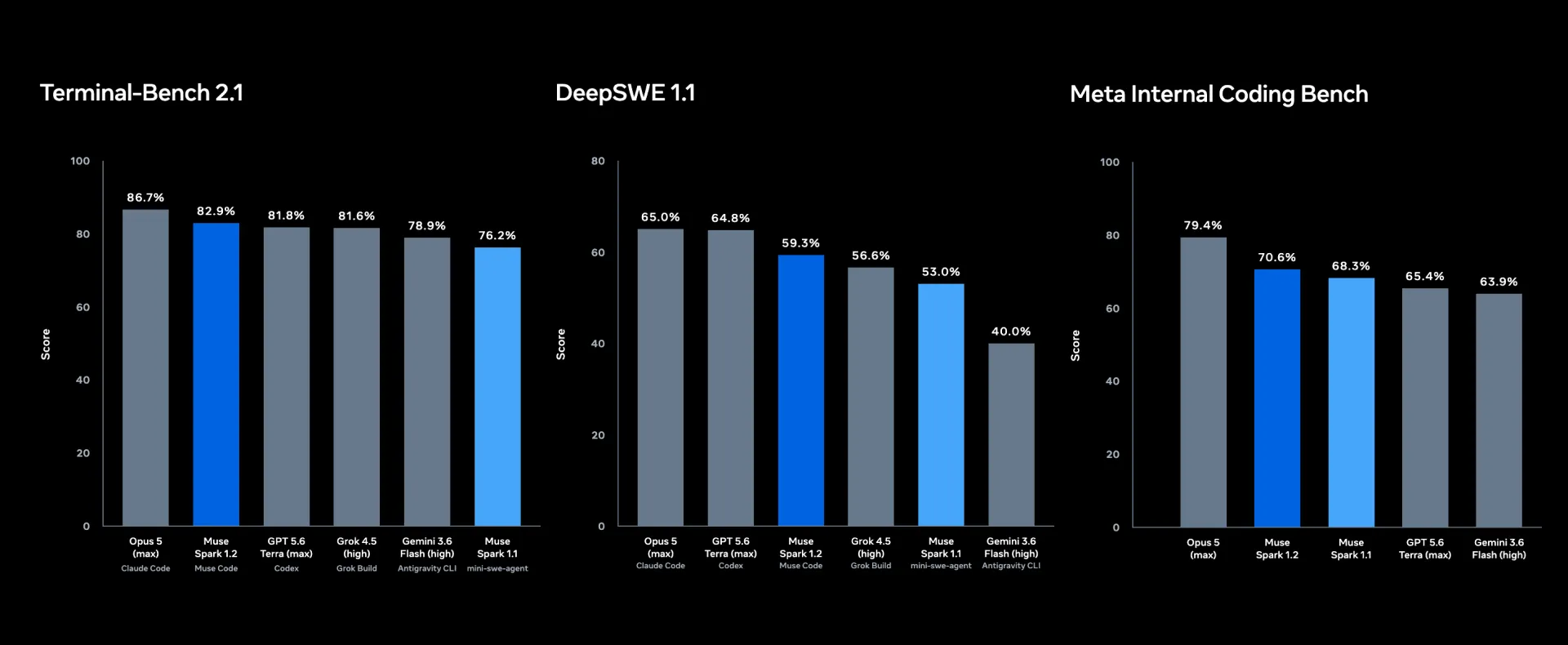
On Terminal-Bench 2.1, which evaluates terminal-native execution, command construction, and interactive tool usage, Muse Spark 1.2 paired with Muse Code registered an impressive 82.9% success rate. While this places Meta ahead of competing modern stack setups—including GPT-5.6 Terra on Codex (81.8%) and Grok Build (81.6%)—it still trails Anthropic’s flagship Claude Code on Opus 5, which leads the benchmark at 86.7%.
System / Model Combination
Terminal-Bench 2.1
DeepSWE 1.1 (Agentic Coding)
Meta Internal Code Bench
Claude Code (Opus 5)
86.7%
65.0%
79.4%
Muse Code (Muse Spark 1.2)
82.9%
59.3%
70.6%
Codex (GPT-5.6 Terra)
81.8%
64.8%
Unspecified
Grok Build
81.6%
Unspecified
Unspecified
On the DeepSWE 1.1 benchmark—which measures an agent’s ability to navigate complex repositories, resolve real-world software engineering issues, and run integration tests—Muse Spark 1.2 achieved 59.3%. It trails both OpenAI’s Codex (64.8%) and Anthropic’s Opus 5 (65.0%), highlighting a slight performance gap when handling non-deterministic, long-chain codebase modifications. Similarly, on Meta’s internal proprietary coding benchmark, Muse reached 70.6%, compared to Opus 5’s top mark of 79.4%.
The Engine Room: Replay-Exact Resiliency and Long-Horizon Execution
Where Meta departs from market norms is in the operational mechanics of the runtime environment. Traditional agentic coding frameworks store interaction state in ephemeral memory or volatile chat context buffers. If an process crashes, encounters a rate limit, or suffers an unhandled local exception 12 hours into an enterprise refactoring job, the entire agent state is lost, forcing developers to clean up half-written files and restart from scratch.
Muse Code solves this by writing every model invocation, tool output, user approval, and file edit to a local, append-only event log. This event log acts as the single source of truth for the local environment.
Because the runtime is replay-exact and restart-safe, an agent that experiences a fatal error or hardware interrupt can inspect the local log, reconstruct its state machine, and resume execution precisely at the point of failure.
This architectural resilience is vital for high-horizon optimization tasks. In internal stress-testing, Meta demonstrated Muse Code operating continuously on Nvidia Hopper GPUs for up to 24 hours, executing over 1,000 sequential tool calls. During this trial, the agent iteratively benchmarked, profile-guided, and optimized low-level CUDA software kernels without human intervention.
While Opus 5 demonstrates higher raw peak execution improvements over extended tool call chains (74–75% efficiency gain over baseline vs. Muse’s 61–69%), Muse Code’s unique advantage remains its ability to reliably survive multi-hour operational lifetimes.
Official Statements & Industry Positioning
In its launch announcement, Meta framed the release as a pivotal step in democratizing access to frontier-tier software engineering agents:
"We’re excited to release Muse Code (beta), a terminal coding agent powered by Muse Spark 1.2, our newest model," Meta’s AI research group stated. "This marks our next step toward the frontier, with larger and much more capable models on the way. Muse Code takes on complex software engineering tasks across large repositories: planning changes, writing code, and validating the results. It can coordinate multiple persistent subagents for each task, solving difficult problems faster, more accurately, and with less intervention."
Addressing the core architectural philosophy behind the tool’s runtime state logging, the engineering team added:
"This single source of truth makes the runtime replay-exact and restart-safe: after a crash, the agent can resume precisely where it stopped."
Market Context: Navigating a Crowded Field
Despite the technical strengths of Muse Code, Meta enters an exceptionally crowded market segment:
OpenAI’s Codex platform already commands widespread enterprise adoption through parallel cloud infrastructure and deep integration with developer toolchains.
Anthropic’s Claude Code continues to hold performance benchmarks across terminal automation and software engineering benchmarks.
Open-source frameworks such as Hermes and OpenClaw offer extensible, community-maintained tools that allow custom agent design without proprietary ecosystem lock-in.
Meta’s advantage relies on the interplay between its open release philosophy, its unified multi-modal models, and its resilient local runtimes. By focusing on workspace safety and command-line execution, Meta aims to capture enterprise developers who manage massive code bases where execution stability is paramount.
Future Outlook & Strategic Implications
The debut of Muse Code signals a broader transition in AI-assisted software engineering: the evolution from passive text completion tools to fully autonomous, state-aware agentic systems.
Risk Profiles, Governance, and Developer Adoption
The emergence of high-horizon agents capable of executing hundreds of tool calls across 24-hour cycles introduces novel engineering risks. An autonomous process operating with elevated local directory access could introduce subtle architectural flaws, relicense dependencies, or write insecure code if left unmonitored.
Meta addresses these security concerns through approval gates—such as those enforced by /plan—and localized environment sandboxing. However, as subagent structures become more complex, verifying non-deterministic agent workflows will remain a major operational challenge for enterprise safety teams.
Furthermore, token economics and local compute burdens will heavily dictate enterprise adoption. Running high-horizon models that generate thousands of context-heavy tool calls over a 24-hour window incurs non-trivial operational costs, placing a premium on model distillation and context caching mechanisms.
What Lies Ahead on Meta’s Roadmap
The release of Muse Spark 1.2 and Muse Code (beta) represents an initial step in a larger product trajectory. Meta has signaled that larger foundation models designed to scale agentic planning capabilities are currently in training.
As frontier models approach parity on standard code evaluation metrics, competitive advantage will depend on execution safety, system integrations, subagent orchestration, and developer UX. Meta’s focus on crash-safe, replay-exact local runtimes offers a compelling framework for how human developers and AI agents will co-exist within the modern command-line environment.
Developers interested in testing the beta release can install the terminal agent directly via Meta’s official dev channel:
curl -fsSL https://dev.meta.ai/install.sh | bash
As Meta continues to refine its underlying architectures, Muse Code establishes a strong foundation in the ongoing battle to define the future of software development.