


Executive Overview
That core paradigm has now been directly challenged.
Researchers at Multiverse Computing have unveiled a breakthrough methodology known as "Quantization-Aware Healing." Applying this technique to an enterprise-grade 120-billion-parameter open-weights model—GPT-OSS 120B—the team compressed the architecture by half, down to 60 billion parameters, while simultaneously squeezing its numerical representation into ultra-dense 4-bit integers.
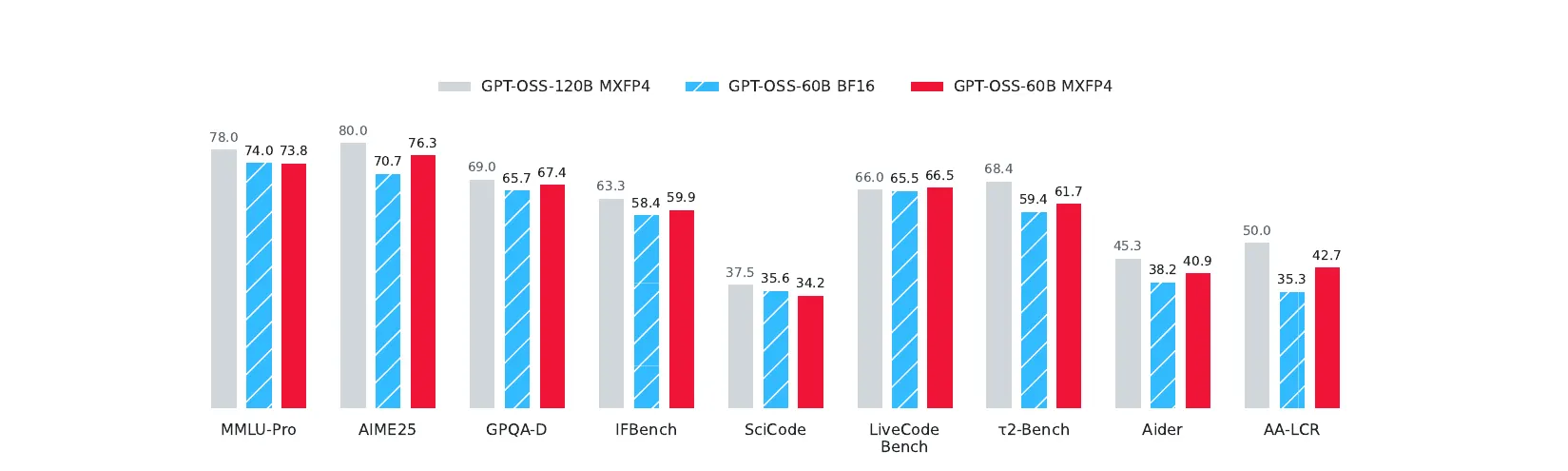
Under conventional machine learning theory, this double compression—pruning half the model’s parameters and slashing weight precision by 75%—should have severely crippled its performance. Instead, the resulting model, named Hypernova-60B, defied standard expectations: on 7 out of 9 standard standardized AI benchmarks, the 4-bit, 60-billion-parameter model outperformed the full-precision 60-billion-parameter baseline.
This counterintuitive triumph— akin to a sprinter dropping body weight while simultaneously lifting heavier max loads—suggests that the industry has been approaching model compression incorrectly. By transforming quantization from a lossy post-processing step into an active phase of supervised teacher distillation, Multiverse Computing has shown that ultra-compressed models can match or exceed the reasoning capabilities of far larger, uncompressed systems at a fraction of the computational operational cost.
Detailed Chronology: Unpacking the Breakthrough
                  TRADITIONAL COMPRESSION PIPELINE (Cascading Degradation)
  ┌──────────────────────┐        ┌───────────────────────┐        ┌───────────────────────┐
  │ Original 120B Model  │ ───►   │ Pruned 60B Model      │ ───►   │ Quantized 4-Bit Model │
  │ (Full Precision)     │        │ (Degraded Intermediate│        │ (Muddy "Photocopy of  │
  └──────────────────────┘        └───────────────────────┘        │  a Photocopy")        │
                                                                   └───────────────────────┘

                 QUANTIZATION-AWARE HEALING PIPELINE (Multiverse Approach)
  ┌──────────────────────┐                                         ┌───────────────────────┐
  │ Original 120B Model  │ ──────────────────────────────────────► │ Hypernova-60B         │
  │ (Teacher Supervision)│  Direct Logit Distillation + 4-Bit QAH    │ (4-Bit INT4 Model)    │
  └──────────────────────┘                                         │ Outperforms FP16 60B  │
                                                                   └───────────────────────┘
The Standard Compression Workflow and the "Photocopy Mistake"
To understand how Multiverse Computing achieved this result, one must examine how LLMs are traditionally optimized for deployment.

Modern top-tier neural networks operate using billions of parameters—the numerical "knobs" that store knowledge, contextual associations, and logic patterns. In high-precision models, these parameters are represented using 16-bit floating-point numbers (FP16 or BF16). To run a 120-billion-parameter model in FP16, an enterprise requires massive clusters of specialized graphical processing units (GPUs) with hundreds of gigabytes of high-bandwidth memory (HBM).
To deploy these models outside data centers, engineers traditionally follow a multi-stage compression pipeline:
- Pruning/Distillation: The architecture is structurally trimmed (e.g., cutting 120 billion parameters down to 60 billion). The smaller "student" model is trained to mimic the outputs of an intermediate 60B reference model.
- Post-Training Quantization (PTQ): The remaining parameters are squished from 16-bit values to 8-bit or 4-bit integers (INT4).
The fundamental flaw in this traditional pipeline is what researchers call "The Photocopy Mistake." During conventional post-pruning refinement, the shrunken student model is forced to emulate a half-shrunk, intermediate teacher model that has already lost fidelity. The student is essentially trying to create a clear copy of an already blurry document. When aggressive 4-bit quantization is subsequently applied to this degraded student, errors compound rapidly.
The Innovation: Quantization-Aware Healing (QAH)
Multiverse Computing inverted this workflow through a process detailed in their recent paper on the arXiv preprint repository.
Instead of allowing the student model to learn from a compromised, half-sized intermediate model, Quantization-Aware Healing maintains a direct supervision link back to the uncompressed, full-precision 120-billion-parameter master model.
During the QAH process:
- The original 120B teacher model guides the optimization of the 60B student network while the student is actively being constrained into a 4-bit quantized structure.
- The quantization step is no longer treated as a passive degradation phase at the end of the line. Instead, it is integrated into the fine-tuning loop.
- The 4-bit student model adjusts its coarse weight allocations under real-time supervision from the original 120B FP16 master teacher, finding mathematical representations within 4-bit space that compensate for the lower bit precision.
       Step 1: Raw 120B Master Model (16-bit Precision)
                         │
                         ▼
  [ Direct Supervised Distillation Loop + Int4 Quantization ]
                         │
                         ▼
       Step 2: Hypernova-60B (4-bit Precision)
   Result: Outperforms 60B FP16 baseline on 7/9 benchmarks
Supporting Context & Metrics
Quantitative Performance and Hardware Impact
The practical outcomes of Quantization-Aware Healing carry major operational consequences for the compute infrastructure of enterprise AI.
| Metric / Dimension | Standard 120B Model (FP16) | Standard 60B Model (FP16) | Hypernova-60B (4-Bit QAH) | Operational Advantage |
|---|---|---|---|---|
| Parameter Count | 120 Billion | 60 Billion | 60 Billion | 50% Reduction vs. 120B |
| Numerical Precision | 16-Bit Floating Point | 16-Bit Floating Point | 4-Bit Integer (INT4) | 75% Compression per Parameter |
| VRAM Requirement | ~240 GB+ | ~120 GB+ | ~30 GB – 35 GB | ~75-85% Footprint Reduction |
| Benchmark Win Rate | Baseline Master | Baseline Intermediate | Wins 7 of 9 Benchmarks | Beats FP16 60B Equivalent |
| Target Deployment | Enterprise Multi-GPU Nodes | Enterprise Dual-GPU Nodes | Single Workstation / Desktop | Localized Edge Execution |
Key Architectural Benchmarks
Across nine standard natural language processing, coding, and mathematical logic benchmarks, the 4-bit Hypernova-60B repeatedly cleared benchmarks that previously required unquantized FP16 parameters:
- Logic & Reasoning (7 of 9 Benchmarks): Hypernova-60B surpassed the baseline 60B FP16 model, demonstrating that direct supervision from a 120B teacher allows a 4-bit network to select highly optimal activation paths.
- Memory Footprint: By reducing memory requirements from over 240 gigabytes down to approximately 30–35 gigabytes, Hypernova-60B eliminates the need for expensive multi-node GPU interconnects (such as NVLink clusters).
- Power Efficiency: Moving data from memory to processing cores consumes significantly more energy than computing operations themselves. Reducing memory bandwidth pressure by nearly 75% results in immediate, drastically lowered power usage during inference.
Official Statements and Research Findings
In their published paper detailing the breakthrough, the research team from Multiverse Computing highlighted the fundamental shift in perspective their findings demand from AI engineers:
"For practitioners, the practical message is that in a distillation-based healing pipeline the quantization step is not a cost to be minimized but an additional opportunity for teacher supervision, yielding a model that is simultaneously cheaper to serve, lighter in memory, and at least as accurate as its full-precision counterpart."
The research directly refutes the long-held assumption that low-bit quantization must always be compensated for with higher parameter counts. By showing that quantization can serve as an optimization regularizer when coupled with strong teacher supervision, Multiverse Computing’s findings offer a scalable methodology for squeezing enterprise-tier performance into edge-compatible hardware footprints.
Open-Weights Availability and Caveats
To validate their claims and encourage community verification, Multiverse Computing released the open weights for Hypernova-60B directly on Hugging Face, allowing researchers worldwide to run, test, and fine-tune the model locally.
However, industry analysts note key caveats regarding the current state of the research:
- Proprietary Pipeline Tools: While the resulting Hypernova-60B model weights are open, the proprietary software platform used by Multiverse Computing to execute the Quantization-Aware Healing process remains closed-source.
- Architecture Validation Scope: The published experiments were conducted primarily on OpenAI’s open-weights architecture family (GPT-OSS). Broad testing across competing open-source architectures—such as Meta’s Llama 3 family, Alibaba’s Qwen series, or Mistral AI’s sparse Mixture-of-Experts (MoE) models—has yet to be fully documented.
Future Outlook: The Democratization of Edge AI
The discovery that a shrunken, 4-bit quantized model can outthink its uncompressed counterpart comes at a critical juncture in the artificial intelligence industry. As data center power consumption surges and high-end AI accelerators remain constrained by supply chains, the ability to run high-reasoning models locally offers a crucial path forward.
                   THE COMPRESSION EFFICIENCY CURVE
  Memory Footprint
     (GB VRAM)
       │
  240GB│  ■ 120B FP16 (Massive Data Center Requirement)
       │
  120GB│        ■ 60B FP16 (Enterprise Server)
       │
   35GB│              ★ Hypernova-60B (4-Bit QAH)
       │                [Higher accuracy than 60B FP16, fits on desktop GPU]
       └──────────────────────────────────────────────────────── Intelligence
                                                                (Benchmark Score)
1. The Shift to On-Premise and Local Inference
Historically, running a model capable of complex, multi-step logic required API calls to centralized cloud infrastructure. With Hypernova-60B demonstrating that 4-bit models can retain top-tier intelligence, consumer-grade hardware—such as workstation GPUs, high-end Apple Silicon chips, and next-generation system-on-chips (SoCs)—can now run enterprise-grade models locally. This transition resolves key corporate concerns regarding data privacy, latency, and cloud API overhead costs.
2. Alignment with the Open-Source Renaissance
Hypernova-60B joins a growing list of community-driven and open-weights achievements breaking proprietary ceilings. Recent discoveries—such as the anonymous Ox Alpha benchmark contender, Alibaba’s hyper-efficient Qwen 3.8 Flash Next, and fine-tuning techniques utilizing synthetic reasoning traces from models like Claude Opus—demonstrate that small, hyper-optimized models are rapidly narrowing the gap with massive proprietary models.
3. Redefining the Next Era of AI Training Pipelines
Moving forward, model distillation and quantization will likely no longer be isolated, post-hoc optimization steps. As Multiverse Computing’s work demonstrates, the next generation of model development will integrate quantization natively into the training lifecycle.
As researchers extend Quantization-Aware Healing to sub-4-bit domains (such as 2-bit or ternary weight configurations) and apply it to multi-modal networks, the industry moves closer to an ideal equilibrium: high-level artificial intelligence decoupled from data-center hardware constraints.