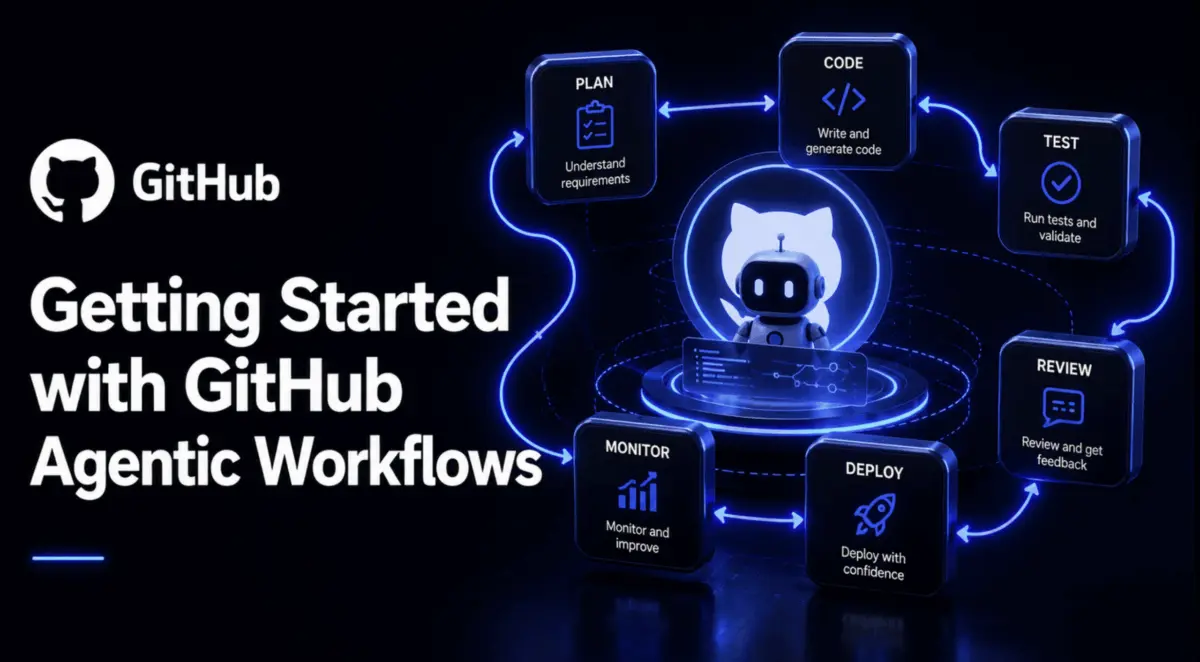
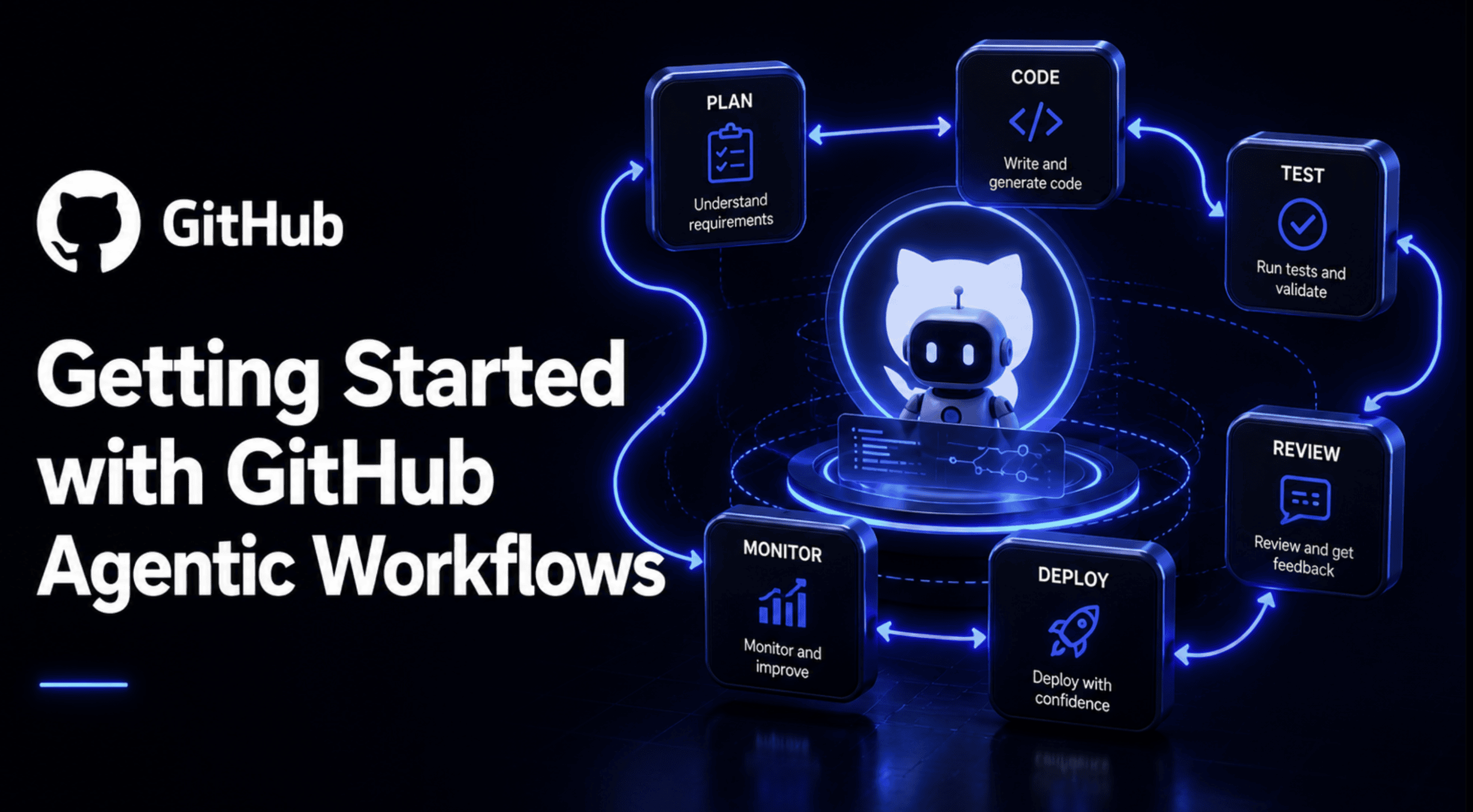
This type of tedious, reasoning-heavy administrative overhead has long been an accepted tax of software development. But on June 11, 2026, GitHub fundamentally altered that paradigm by moving Agentic Workflows into public preview. By allowing developers to run coding agents directly inside GitHub Actions, this feature aims to lift repetitive, cognitive labor straight off human plates. Rather than functioning as a mere chat sidebar or code completion plugin, Agentic Workflows introduces scheduled or event-triggered agents capable of reading an issue, parsing a pull request, or analyzing a week’s worth of commits to execute complex, contextual decisions.
Executive Overview: Bridging the Gap Between Code and Continuous AI
Strip away the marketing jargon, and the underlying mechanics of GitHub’s latest initiative are remarkably straightforward. Developers write a Markdown file stored within .github/workflows/. The top of this file incorporates a YAML frontmatter block detailing when the workflow runs, which permissions it holds, and the specific artificial intelligence engine driving it. Beneath the frontmatter lies plain-English instructions dictating the precise tasks the agent should perform.
A command-line interface (CLI) tool designated as gh-aw reads this Markdown source file and compiles it into a .lock.yml file—a standard, ordinary GitHub Actions workflow. This foundational architecture is worth pausing to consider: GitHub has not bolted a fragile, separate agent runtime onto your repository. Instead, Agentic Workflows reuses existing runners, branch protection rules, and policy constraints because, beneath the natural language layer, it is simply Actions.
Jointly developed by GitHub Next and Microsoft Research, the project launches with robust out-of-the-box support for four major AI engines: GitHub Copilot, Anthropic’s Claude, OpenAI Codex, and Google Gemini. Developers can also plug in custom processors if enterprise requirements dictate a specialized backend. Copilot serves as the default engine, and if an organization already maintains an enterprise Copilot plan, workflow runs bill directly to that organization without requiring separate API key management.
This feature sits squarely within a broader strategic initiative GitHub terms Continuous AI—the systematic application of artificial intelligence across the entire software lifecycle, rather than invoking LLMs purely through reactive, single-turn prompts. Agentic Workflows operationalizes this vision, executing tasks on a strict schedule or in response to repository events long after the developer has logged off for the day.
Detailed Chronology: From Experimental Preview to Public Rollout
The path to Agentic Workflows did not happen overnight. Its trajectory reflects a deliberate engineering effort to balance autonomous execution with rigorous enterprise security controls.
- Late 2025 / Early 2026 (Technical Preview): Early iterations of the tool required developers to generate fine-grained Personal Access Tokens (PATs) with specialized permissions, manually embedding them as repository secrets to handle Copilot requests. Early hands-on accounts noted immense promise marred by cumbersome authentication setups.
- February 2026: Developers experimenting with early private builds began drafting multi-repository automation patterns, discovering that getting an agent to open a pull request was trivial, but trusting the output enough to merge it was the true engineering bottleneck.
- June 11, 2026 (Public Preview Launch): GitHub officially announced the public preview of Agentic Workflows, introducing groundbreaking improvements. Most notably, the update eliminated the need for a Personal Access Token (PAT) when utilizing Copilot within organization-owned repositories, routing billing and authentication through native
GITHUB_TOKENpermissions andcopilot-requests: writescopes. Simultaneously, enterprise adopters like Carvana, Marks & Spencer, and Hud.io stepped forward with early validation metrics.
Supporting Context & Metrics: Adoption, Architecture, and Security
GitHub does not typically publish aggressive adoption metrics this early in a feature’s lifecycle. However, the inclusion of named enterprise customer testimonials at launch highlights how deeply the platform was battle-tested prior to the public preview.
Key Platform Metrics at Launch
| Metric Category | Specification & Value |
|---|---|
| Supported AI Engines | 4 built-in (Copilot, Claude, Codex, Gemini) + Custom Engine Support |
| Security Layers | 5 distinct boundaries (Read-only token, zero secrets, network firewall, safe outputs, threat detection) |
| Documented Design Patterns | 18+ established patterns (IssueOps, ChatOps, DailyOps, BatchOps) |
| Supported Event Triggers | 10+ GitHub event triggers (issues, pull_request, push, schedule, discussion, label) |
| Safe Output Types | 8+ controlled actions (create-issue, create-pull-request, add-comment, add-label) |
| Installation Command | One-line CLI integration: gh extension install github/gh-aw |
The Security Model: Why Trust is Built-In
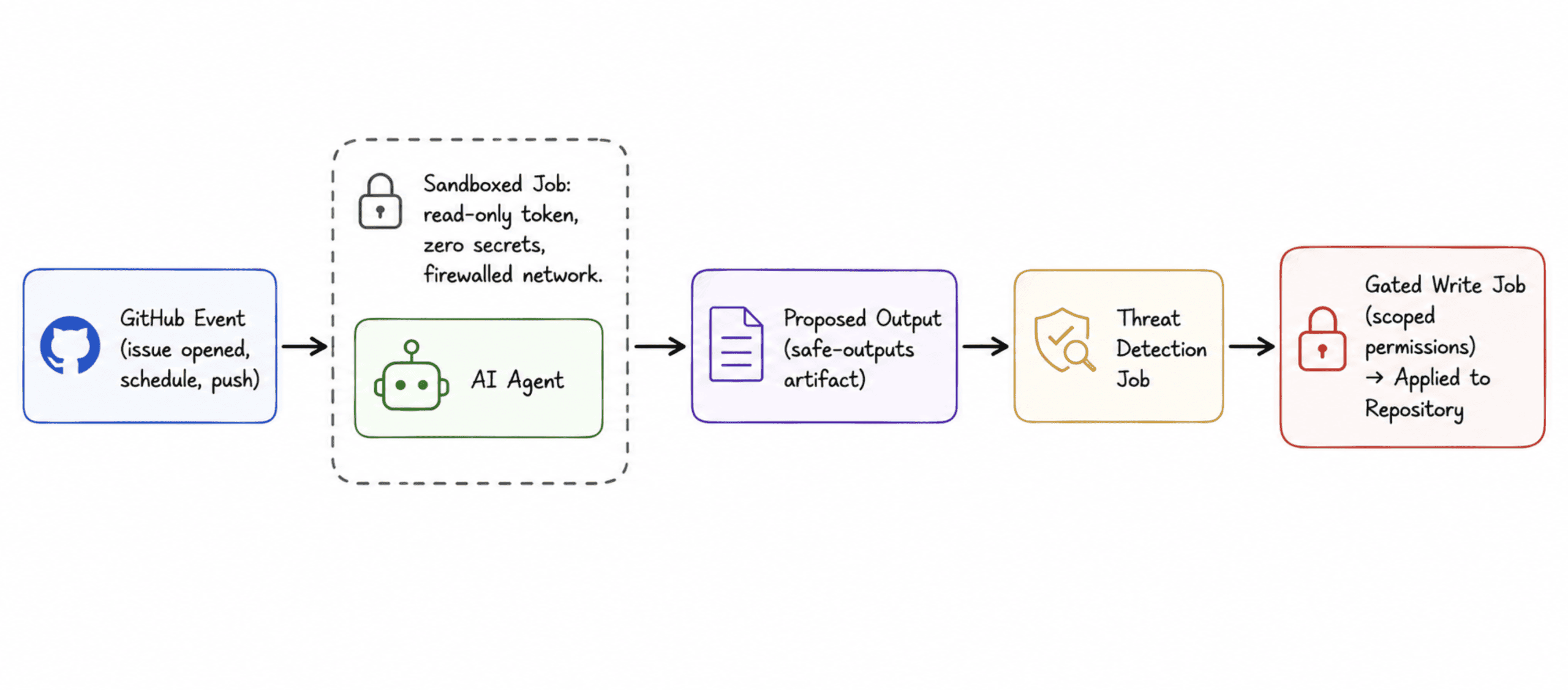
Most autonomous DevOps pitches gloss over an uncomfortable reality: prompt injection via malicious repository content is an acute threat when dealing with untrusted text inputs (such as an issue comment or a malicious pull request file). Rather than pretending this vulnerability does not exist, GitHub engineered a five-layered security model to contain potential breaches:
- Read-Only Default Tokens: Execution runs on narrowly scoped permissions, preventing unauthorized data modification.
- Zero-Secret Architecture: Workflows do not require exposing persistent API keys inside environment variables unless explicitly mandated by third-party engines.
- Network Firewalls: Outbound container traffic is strictly restricted to secure default allowlists.
- Safe Outputs Contracts: Agents cannot perform arbitrary modifications; they are constrained to pre-approved output types (e.g., maximum of three labels, exactly one comment).
- Threat Detection Scanning: Built-in heuristics monitor for anomalous instruction drift or malicious prompt overrides buried within user-submitted text.
Official Statements and Enterprise Perspectives
Enterprise feedback during the preview phase illuminated both the utility and the limitations of autonomous repository management.
According to Carvana’s engineering leadership, the flexibility and granular built-in controls provided their teams with sufficient confidence to deploy agentic workflows across complex, multi-repository systems—handling interdependent changes that previously demanded tedious manual coordination.
Meanwhile, Marks & Spencer noted that their developers were bleeding valuable sprint hours on operational friction: routine issue triage, dependency maintenance, vulnerability remediation, and baseline code reviews. Establishing a shared catalog of reusable agentic workflows allowed individual squads to consume automated solutions without reinventing the wheel for every repository.
Hud.io highlighted the psychological barrier inherent to AI automation: getting an agent to generate a pull request was never the hard part; trusting its output enough to click "Merge" was. This exact philosophical tension informed GitHub’s decision to prioritize deterministic safety limits over wide-open autonomous capabilities.
Crafting Your First Workflow: A Practical Walkthrough
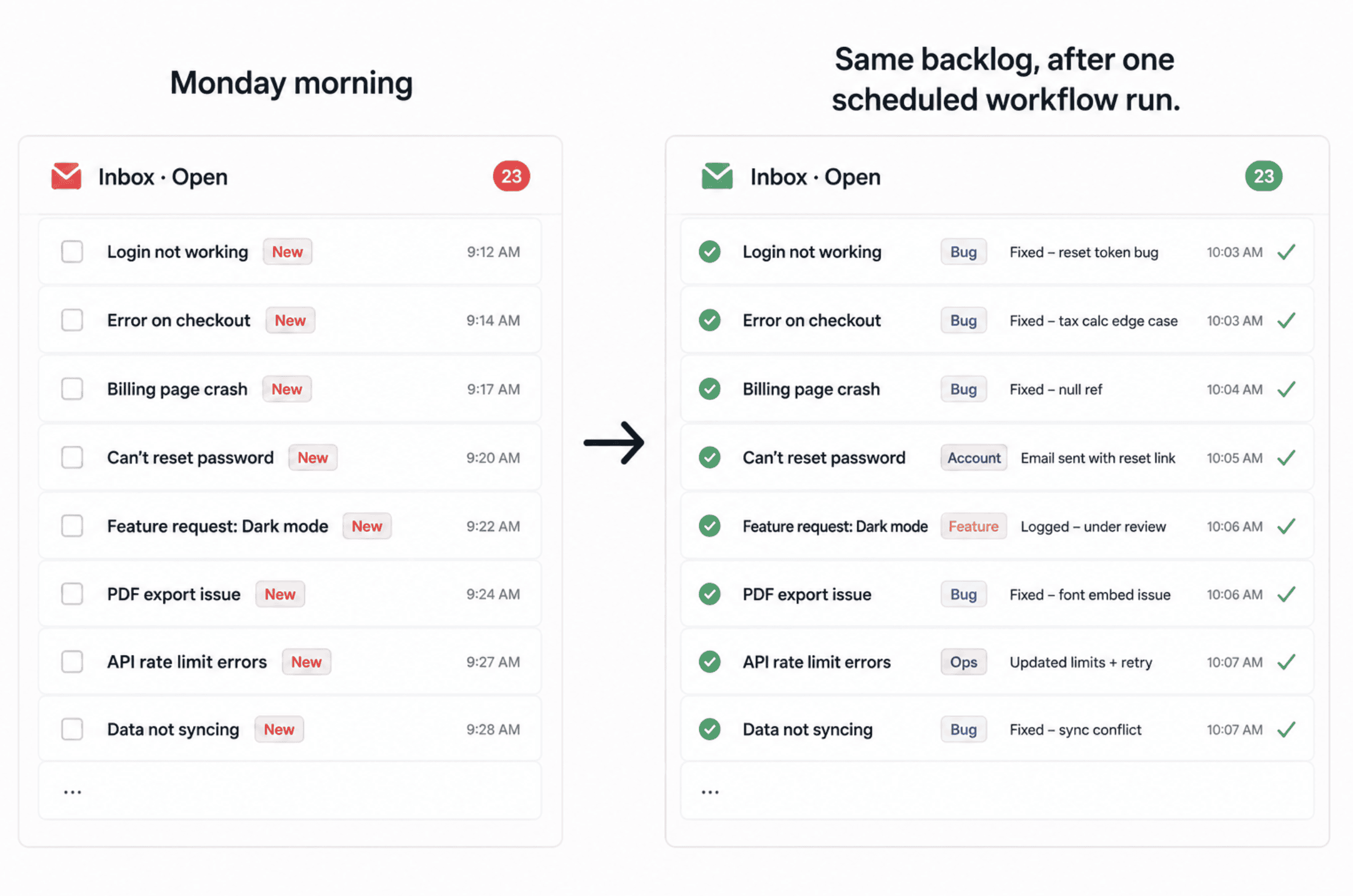
To appreciate how Agentic Workflows operate in practice, consider a standard issue-triage agent designed to ingest newly opened issues, classify them, apply appropriate metadata, and respond politely.
1. Environment Preparation & Installation
Ensure you are running GitHub CLI version 2.0.0 or later, then authenticate with the required scopes:
gh auth login --scopes repo,workflowInstall the compilation extension:
gh extension install github/gh-aw2. The Markdown Source File (.github/workflows/issue-triage.md)
---
description: Classify new issues, apply labels, and post a short response
on:
  issues:
    types: [opened]

permissions:
  contents: read
  issues: read

network: defaults

tools:
  github:
    toolsets: [issues]

safe-outputs:
  add-label:
    max: 3
  add-comment:
    max: 1
---

# Issue Triage Agent

When a new issue is opened, read its title, body, and any code snippets included in it.

Classify the issue as one of: bug, feature request, question, or documentation gap.

Assess priority as critical, high, medium, or low based on system impact.

Apply labels reflecting both type and priority.

Post one short comment thanking the reporter, restating the classification in plain language, and informing them that a maintainer will follow up if prioritized. Keep the comment under four sentences. Do not speculate on fixes.
3. Compilation and Execution
Compile the Markdown source into a native GitHub Actions lock file:
gh aw compileBoth the .md source file and the generated .lock.yml file must be committed to version control. To test the workflow locally without waiting for a real user issue, trigger it manually via the CLI:
gh aw run issue-triageFuture Outlook: Where Agentic Workflows Go From Here
As a public preview, Agentic Workflows is a fast-moving, imperfect technology. Early adopters have noted that debugging can occasionally feel opaque—when an agent makes an unexpected classification, your primary window into its decision-making process remains standard GitHub Actions text logs rather than a structured reasoning trace. Furthermore, granular per-workflow cost tracking remains underdeveloped, making it challenging for engineering managers to accurately forecast AI token budgets across hundreds of repositories.
However, these growing pains do not diminish the long-term significance of the platform. The core innovations—the safe-outputs contract, the decoupling of authentication via native organization-level billing, and the translation of plain-language intent into deterministic CI/CD actions—represent a fundamental leap forward.
We are moving past an era where automation is strictly rule-bound ("if X happens, execute script Y"). We are entering a phase where developers can encode judgment into their repositories. As the ecosystem matures, the boundary between writing code and managing the systems that run it will continue to blur, transforming repositories from passive storage bins into active, self-maintaining software organisms.